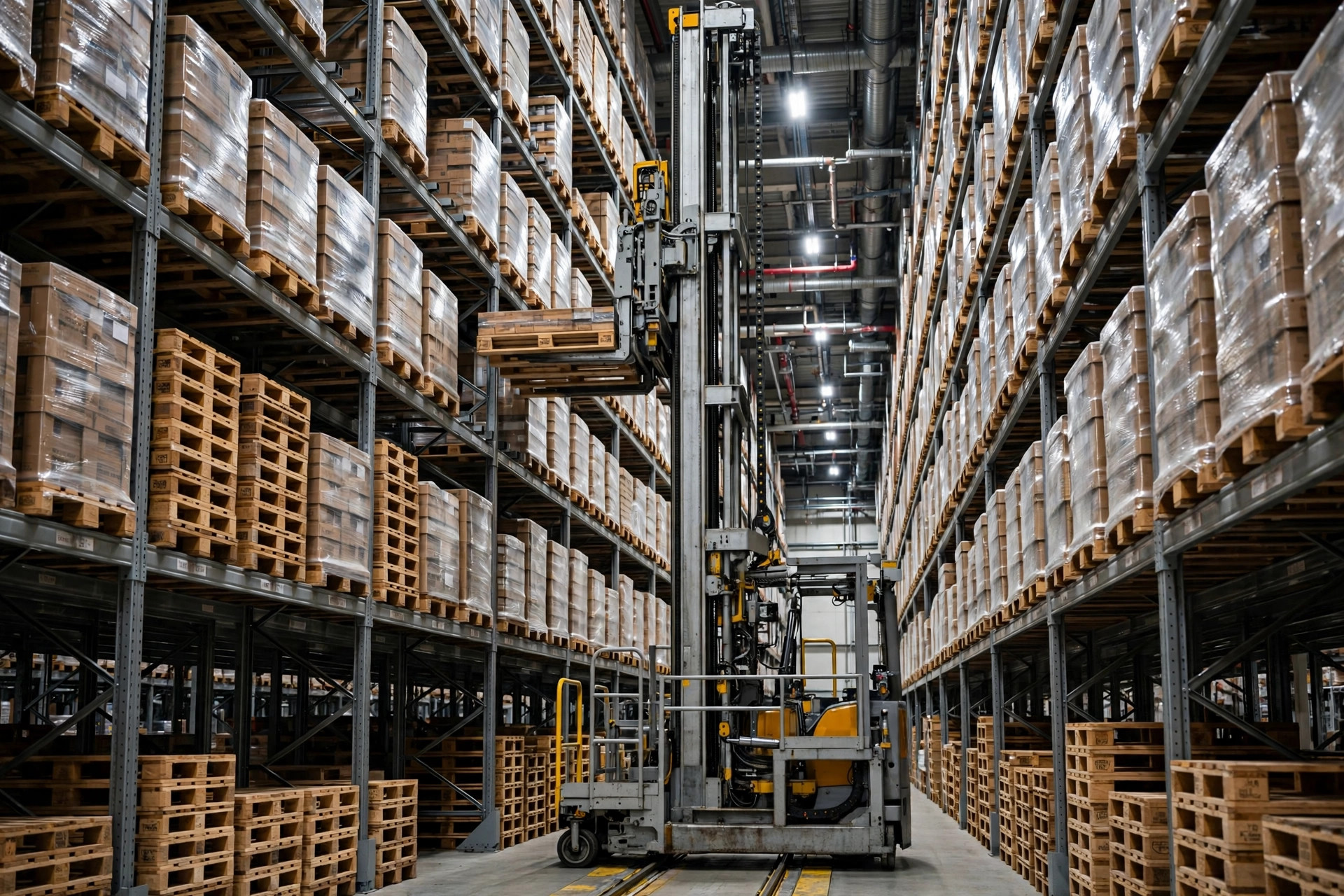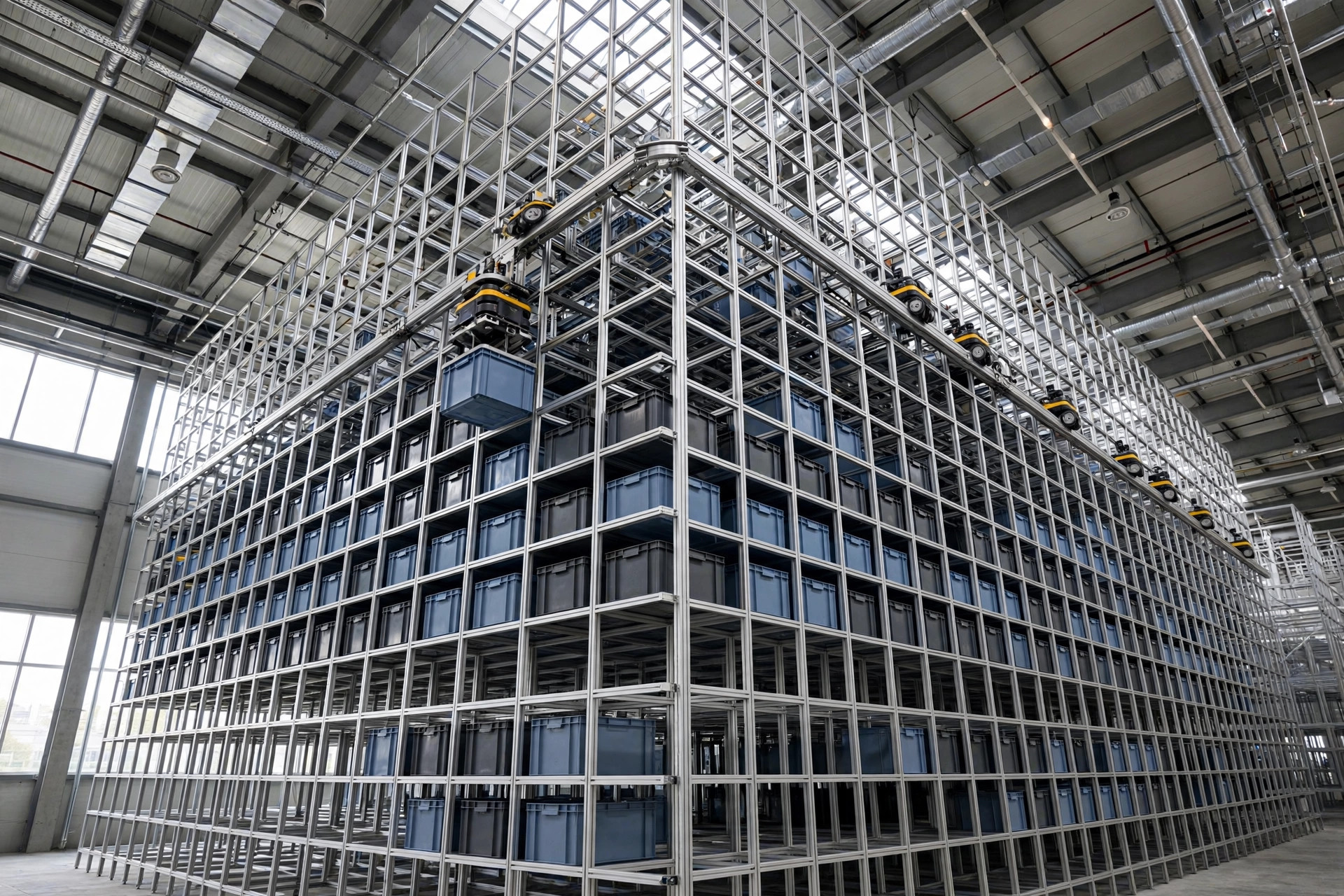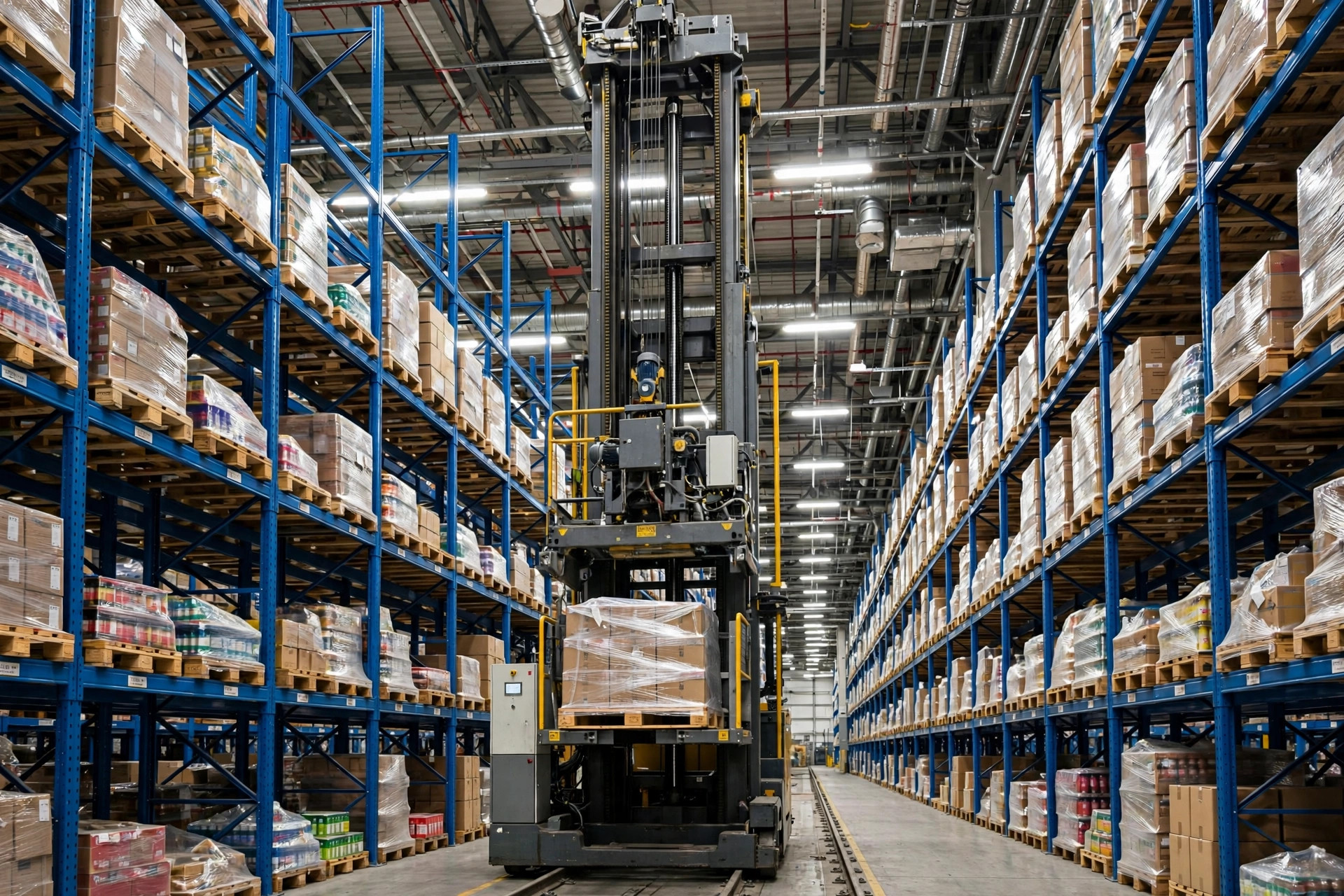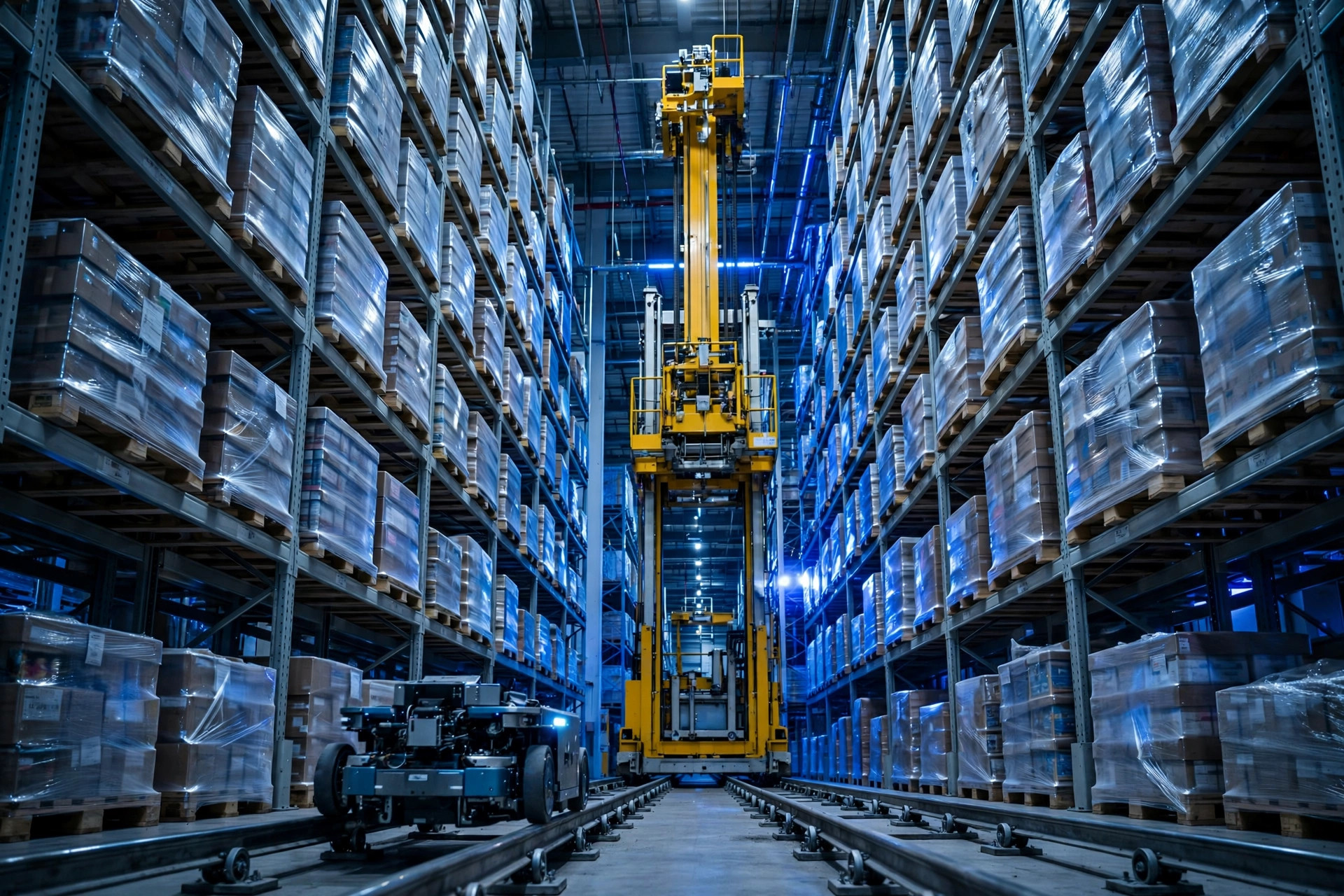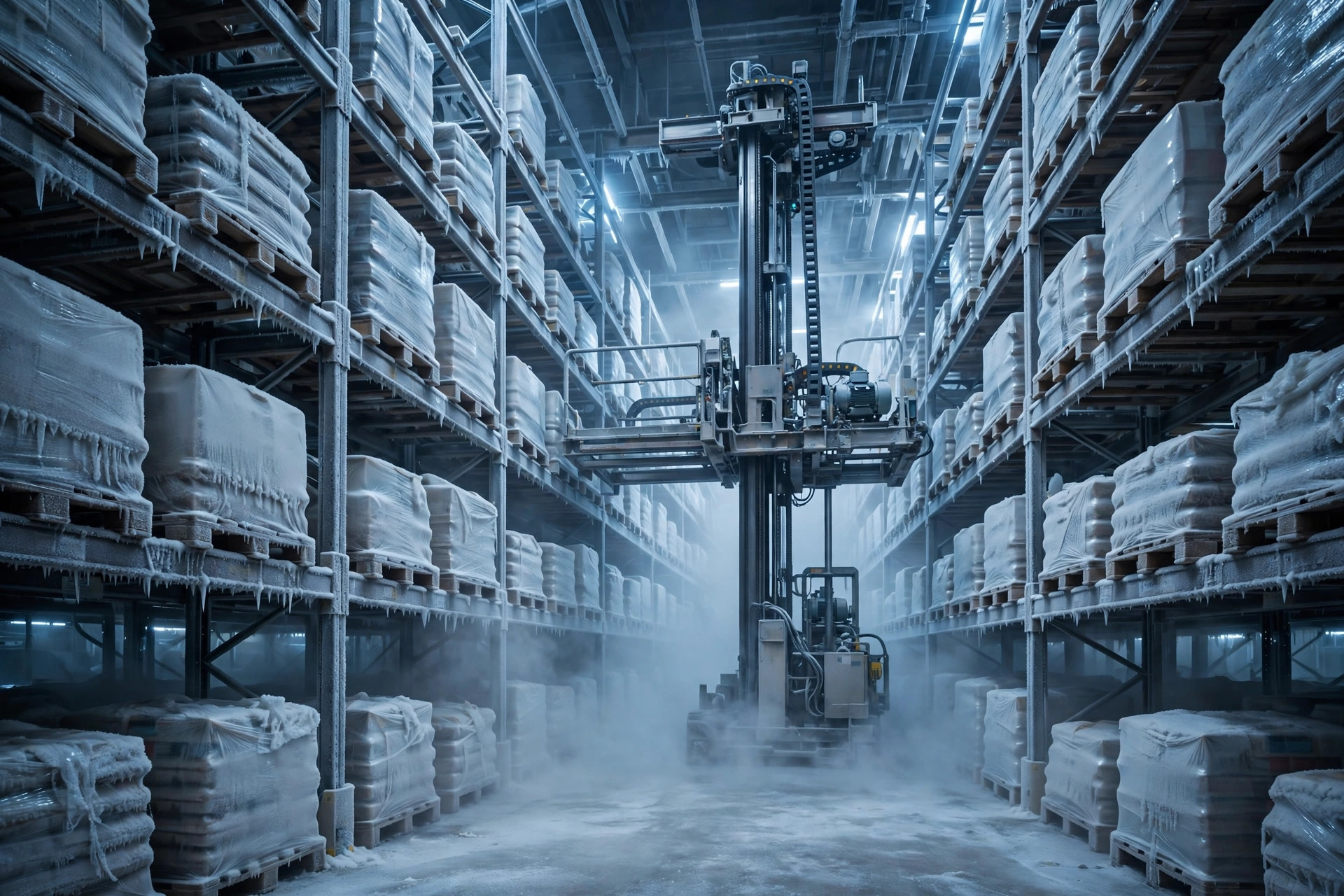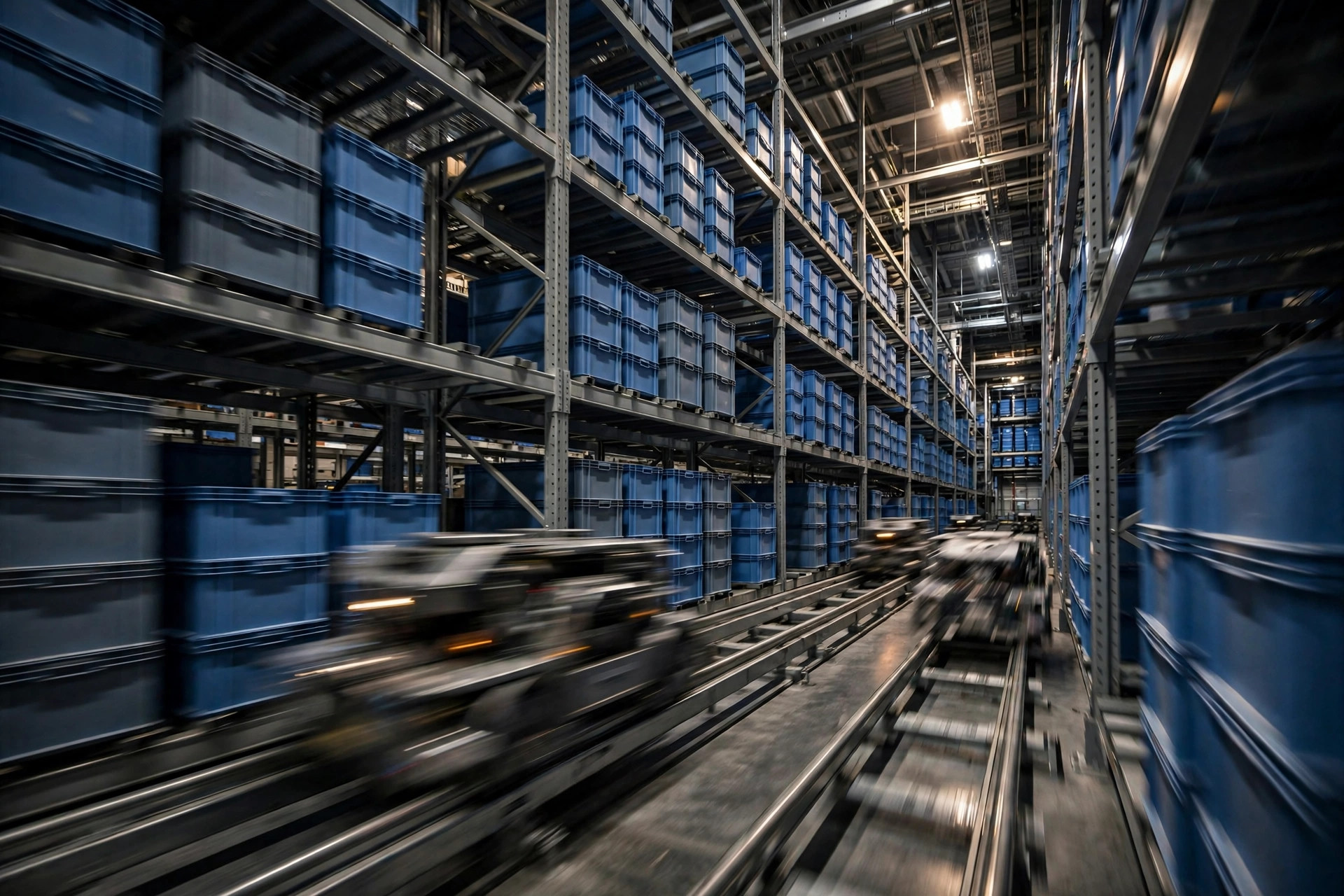
Start with the principle. In a shuttle ASRS, the shuttle only runs horizontally. Every level change is done by the lift. Always.
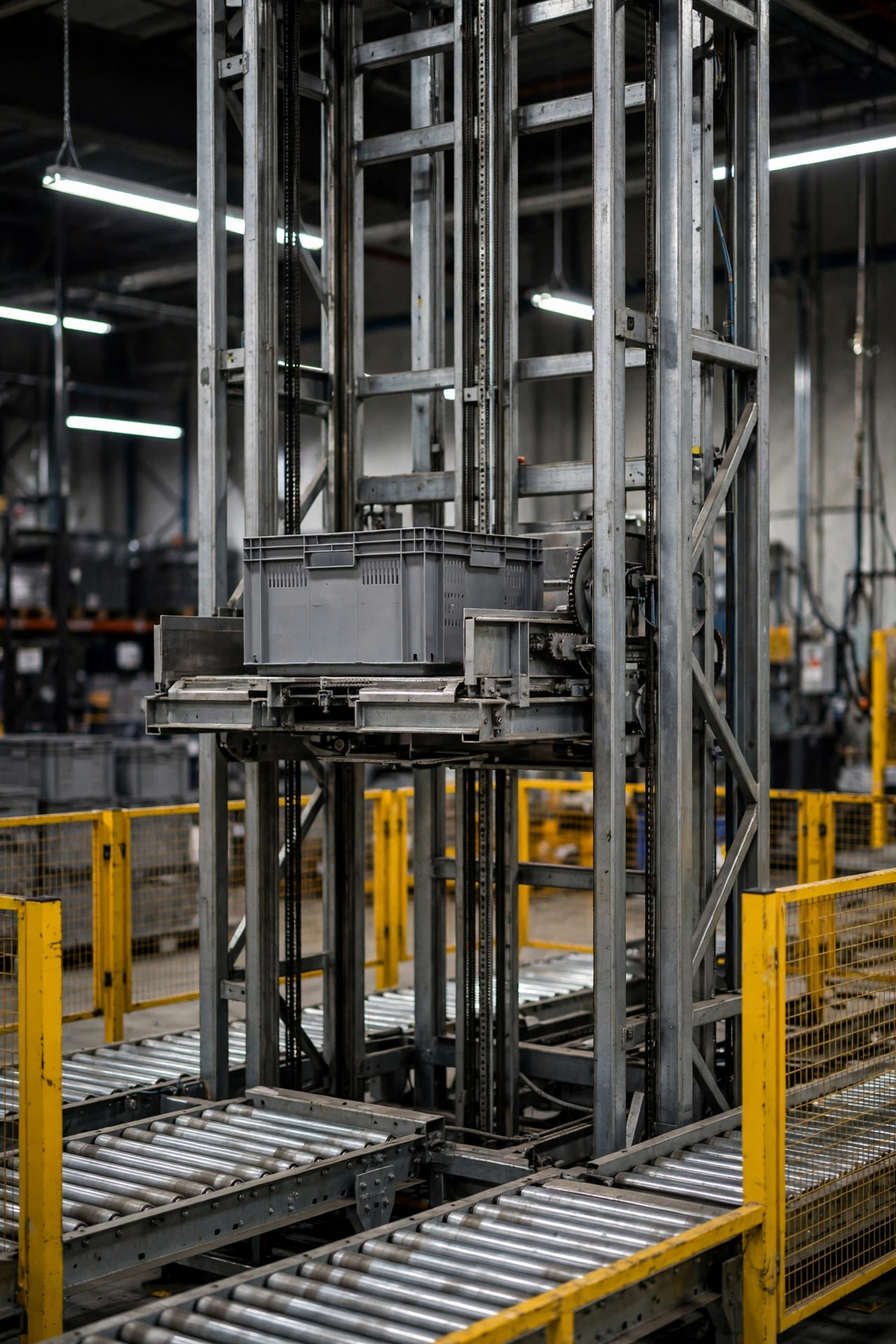
Think of it this way: the shuttle is the courier running around one floor of an office building, and the lift is the elevator. The fastest courier in the world still queues in the lobby if the elevator can't keep up. That analogy explains more than half of all shuttle-project performance disasters I've seen.
Two architectures, two level-change logics
The first is captive: every level has its own shuttle parked on it, and the lift only moves shuttles — or totes — between levels. Vehicle utilization is high, but vehicle count equals levels times aisles, and hardware cost takes off.
The second is roaming: one or two shuttles per aisle. When a shuttle needs to change levels, it drives itself into the end-of-aisle lift and rides the "elevator" up or down. Fewer vehicles, lower cost — but the lift becomes the throat of the entire aisle.
Which one to pick depends on your flow profile, not on which sounds more "advanced." Even flow with picks needed on every level — captive. Flow concentrated on a few hot levels — roaming with one good lift is the better deal. Anyone talking architecture before measuring their per-level flow distribution is ordering blind.
So how many shuttles can one lift actually serve?
Let's do the cycle math. One complete lift cycle — receive the shuttle (or tote), travel to the target level, discharge — measures 25-35 seconds in the field. Call it 30 seconds: a theoretical ceiling of 120 cycles per hour. That's theoretical; with scheduling waits and contention, 90-100 is a good real-world number.
And the shuttle? Take a mainstream multi-shuttle system: horizontal speed up to 4 m/s, acceleration up to 2 m/s² (verify against your equipment vendor's datasheet). On a 100-meter aisle, one leg takes 25 seconds, plus 8-10 seconds to pick and deposit a tote. One round trip runs just over a minute — so one shuttle manages 50-60 cycles an hour.
The conclusion writes itself:
| Aisle throughput needed | Lift configuration | Verdict |
|---|---|---|
| ≤80 totes/hour | 1 lift | Enough, with headroom |
| 100-200 totes/hour | 1 lift + dual-load handling | Marginal — queues at peak |
| 200-400 totes/hour | 2 lifts (one at each aisle end) | Solid |
| >400 totes/hour | Dual lifts + dual-cycle mode | Or add aisles |
That brochure line — "up to 1,200 in-and-out loads per hour for the complete system" — is lab data with multiple aisles, multiple lifts, and dual-cycle mode all running at once. Whether your project gets there starts with the lift table above, and only then with the brochure.
A real case: the 40-second queue
In 2023 I worked on an e-commerce warehouse project in East China: 12 levels of racking, one aisle, captive architecture with 24 shuttles, one lift. On a normal day it hummed along at 150 totes an hour per aisle, passed acceptance on the first try, and the client was happy.
Then the big sale hit. Pick stations doubled their wave density, and level-change requests started queuing. The monitoring dashboard told the story: lift utilization at 96%, average wait 40 seconds. Shuttles sat idle on their floors waiting for the "elevator" while pick stations starved — three stock-outs in one shift, and at one point the site sent people up to pick from high bays by hand.
The fix wasn't more shuttles — more shuttles would only have made the queue longer. We added a second lift at the other end of the aisle for two-sided infeed and outfeed. It cost one lift's worth of money, and throughput doubled to 280 totes an hour.
The counterintuitive lesson: in a shuttle system, the bottleneck is never the number of shuttles. Shuttles are parallel; the lift is serial. Adding quantity to the parallel part while the serial part is saturated is queuing-theory 101 — and people still get it wrong.
The maintenance trap: single point of failure
Captive architecture: one shuttle dies, only its level is affected, everything else keeps running. Roaming architecture: one lift dies, the whole aisle stops.
So a roaming proposal must answer three questions: what's the lift's MTBF? Are spares (chains, motors, encoders) on the shelf? Can you accept a 4-hour whole-aisle outage for a maintenance window?
If the vendor can't answer, don't sign roaming no matter how cheap it looks. The money saved on vehicles gets wiped out by a single outage — plus penalty clauses. Worse, lifts are usually custom-built with 8-12 week lead times. One failure during peak season, and the season is over.
Time to shoot down some fake requirements
"I want two shuttles on every level — the faster the better." That's the most common fake requirement I hear.
More shuttles don't mean faster. Twelve levels times two shuttles is 24 vehicles sharing one 120-cycle-per-hour lift — twenty-four people squeezing into one elevator at rush hour, everybody late. The correct order is reversed: set the throughput target first, derive the lift count, and only then size the shuttle fleet. Get the order wrong and the money is wasted.
Another fake requirement: "the faster the lift, the better." Speeding up a lift 20% might only cut cycle time 10% — acceleration, deceleration, and positioning eat the rest — while motor and structural costs jump 30%. That money buys more happiness in the scheduling software: good scheduling can cut empty travel by a third, which beats brute-force speed every time.
Whether the money was worth it: watch this one number
Lift utilization.
Consistently under 50%: you overbought; derate the next phase. 50-70%: healthy. Over 70%: don't hesitate — add a second lift, or upgrade to dual-load/dual-cycle handling.
Remember: in a shuttle project, the most expensive thing was never the little vehicles. It's the lift and the scheduling software behind it. The shuttles are the limbs; the lift is the heart. A weak heart makes strong limbs useless.
By Da Liu, Automation Engineer