Saturday delivery surcharges are the most underestimated line on a parcel invoice. Your order volume hasn't changed, but somehow weekend shipments quietly cost more. This piece walks through how UPS and FedEx actually charge for Saturday delivery — which services include it, which ones bill extra, how Friday cutoff times decide weekend transit — and gives e-commerce sellers a practical playbook for settings and contract negotiation to stop the bleed.
We have a client, a pet-supply independent store shipping out of Ontario, California. In March 2026, their finance team spotted a new line on the carrier invoice: Saturday delivery. Three months of it added up to nearly two thousand dollars. Their first instinct was that the carrier was padding the bill, and they asked us to go fight it. After digging in, the truth was a little embarrassing: nobody was padding anything. Their shipping template had the Saturday delivery option switched on since last peak season, and nobody ever turned it off. Every weekend order shipped with Saturday delivery by default, billed per package. A few thousand packages over three months. It adds up fast.
This is a classic with shippers: every switch flipped for peak-season speed stays flipped long after peak is over. The invoice, though, never forgets.
How the Saturday Delivery Surcharge Actually Works
The mechanics first. One: it's billed per package — not by weight, not weighted by zone. One package, one surcharge, whether it weighs 1 pound or 20. Lightweight sellers get hurt the most, because the surcharge is a bigger percentage of an already-small shipping cost. Heavy packages dilute it.
Two: the trigger is a checkbox, not your intention. Every shipping system — the carrier's own portal, your multi-carrier software, your 3PL's order entry — has a Saturday Delivery toggle. If it's on, you pay. The trap is that templates switched on during peak never get switched off, or the setting silently carries over when someone changes service levels. If you never read the invoice detail, you'll never notice.
Three: rates change every year. Most of the specific dollar figures floating around in online guides come from expired rate sheets. Before you compare or sign anything, pull the current numbers from the carrier's official rate table. Trust the carrier's site over a blog post from two years ago.
UPS vs. FedEx: Who Includes Saturday, Who Charges Extra
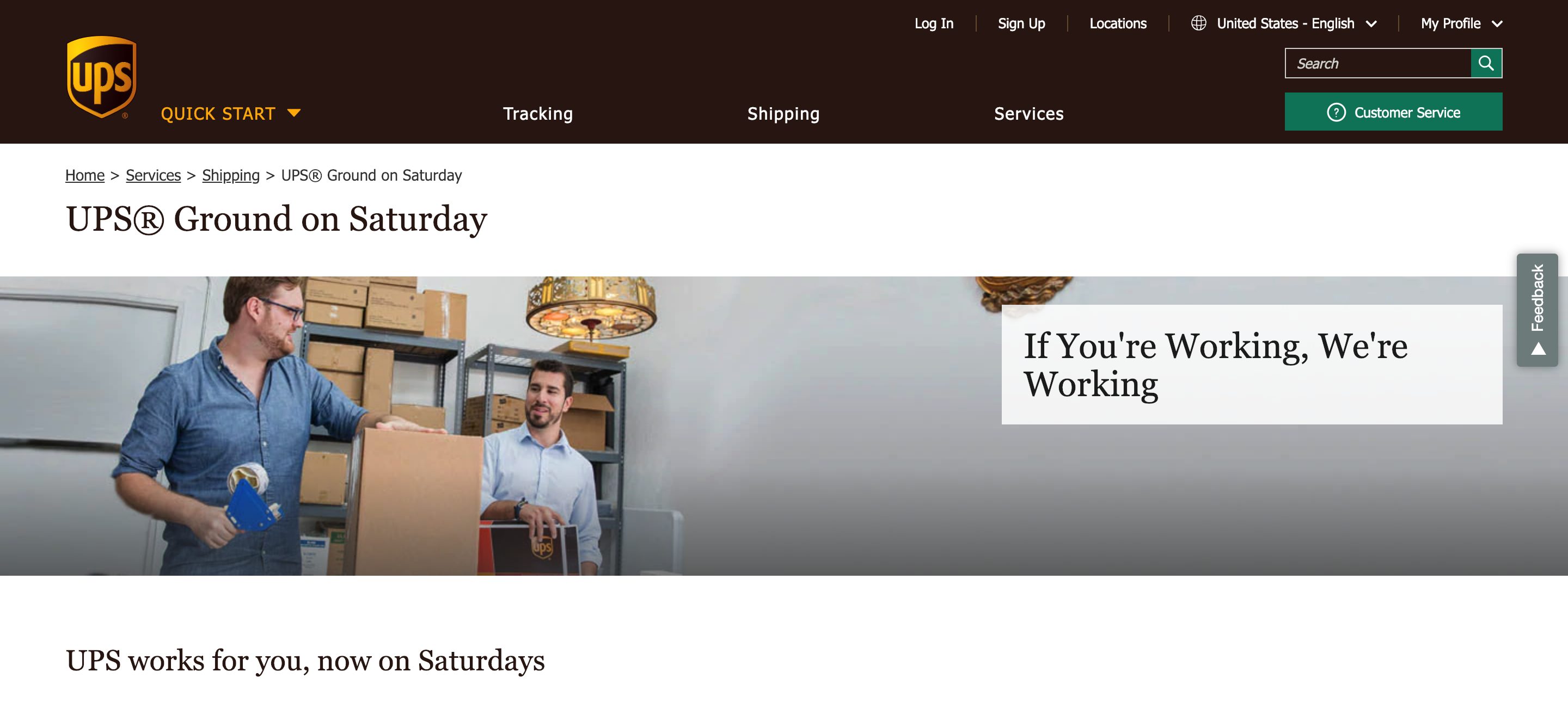
Below is a screenshot from UPS's official page explaining its Saturday delivery options. The two carriers play the game completely differently — look at the screenshot, then the table:
| Service | Saturday delivery | Surcharge logic |
|---|---|---|
| FedEx Home Delivery (residential) | Included by default, Saturday and Sunday | No surcharge, baked into standard pricing |
| FedEx Express (overnight, 2Day) | Optional | Per-package surcharge. Third-party compilations of the 2026 rate tables put it in the mid-teens per package — verify against the current official rates |
| UPS Ground | Optional, requires adding the Saturday delivery option | Per 2026 rate tables: no separate Saturday surcharge for residential, a few dollars per package for commercial addresses — check the latest official rates |
| UPS Express (Next Day Air, 2nd Day Air) | Optional | Per-package surcharge, varies by service and destination — check the latest official rates |
The takeaway: FedEx residential is the easy one — Saturday is already included. Both carriers' express services charge extra for Saturday. UPS Ground needs the option actively added, and Saturday transit on Ground without the option is luck, not a commitment. Don't bank on it.
Cutoff Times: Friday Afternoon Is the Real Deadline
Whether a package arrives Saturday has nothing to do with when the order was placed. It depends on when the package physically reaches the carrier, and whether it makes Friday's sort.
Another client of ours, an apparel store shipping from Dallas, learned this the expensive way in early February 2026. A batch of orders printed at 9 p.m. on a Friday had Saturday delivery checked by the 3PL's operator — out of habit. The freight missed the Friday night sort entirely, sat at the hub all Saturday, and reached customers on Monday. The surcharge was billed in full. And a customer left a one-star review because the order "promised Saturday." Lesson: checking Saturday delivery after the cutoff is paying for nothing but peace of mind.
The typical scenarios: a 2nd Day Air package tendered Thursday afternoon arrives Friday anyway — Saturday delivery is pure waste. An overnight package tendered before Friday's cutoff needs the Saturday option to arrive Saturday, or it sits until Monday. Orders printed after Friday's cutoff? Stop trying. Ship them on Monday's rhythm. Checking the box only adds cost.
Here's something only the carrier side will tell you: cutoff times vary by facility and move earlier during peak. What the sales rep promises verbally in October may not hold in December. Don't take the verbal promise — look up the published cutoff for the facility serving your warehouse, and screenshot it.
The Counterintuitive Part: Your Cheapest Saturday Option Might Be the One You Overlooked
When Friday panic hits and a customer needs it Saturday, most sellers instinctively upgrade to 2nd Day Air or overnight. Run the math instead: the same few-pound residential package on UPS Ground with the Saturday delivery option costs far less than jumping straight to 2nd Day Air. And FedEx Home Delivery is the quiet winner — Saturday is already in the standard price, no surcharge at all, and it delivers Sunday too.
Second counterintuitive point: not every customer is worth a Saturday. Saturday delivery is, at its core, paying extra to buy one day of speed. For most product categories — anything not urgent, not perishable — customers genuinely don't care whether it arrives Saturday or Monday. Paying the surcharge on every weekend order means spending money on an experience nobody notices. Look at your category before flipping that switch.
Let's put numbers on it. Say you run 200 weekend packages with Saturday delivery. Per third-party compilations of the 2026 rate tables (express services, roughly mid-teens per package), that's several thousand dollars a week — tens of thousands a month. Over a year, that's half an operations hire. And for at least half those customers, Saturday versus Monday changes nothing about repurchase behavior. That's money burned on autopilot.
Three Moves That Save Real Money: Settings, Service Choice, Contract Terms
First, kill the default. Audit your shipping setup: templates, your 3PL's default order settings, leftover peak-season rules. Saturday delivery should only be on for orders that genuinely need to arrive Saturday. Read your invoice detail every month, and for every Saturday Delivery line, ask one question: did this package really need to arrive Saturday?
Second, look at FedEx Home Delivery for residential orders. Saturday and Sunday delivery are both in the standard rate. If weekends are a big share of your volume, this one move saves serious money over a year. Don't let brand loyalty cost you.
Third, negotiate the surcharge into your contract discount. Here's the insider part: the discounts sales reps offer usually cover base transportation only. Surcharges — Saturday delivery, residential, fuel — are billed separately at list rates. If you don't negotiate that line item, the prettiest base-rate discount still leaves you with an ugly invoice. At the table, treat the surcharge discount and the base-rate discount as two separate negotiations. Because they are.
Next Time You Negotiate a Contract, Ask These Three Questions
One: is the Saturday delivery surcharge covered by my discount, or billed at full published rates?
Two: which of my services currently have Saturday delivery switched on by default — can you give me the list?
Three: can Friday cutoff times go into the contract appendix, and how many days' notice do I get when they move earlier for peak?
Answer those three, and you'll stop paying at least one kind of dumb money. A shipper's money is still money.
By Susan, 3PL Sales Director