Two numbers, then we talk. On ups fedex residential surcharge cost 2026, the only figures that matter: the UPS Ground residential surcharge is $6.50 per package in 2026, and FedEx Ground/Home Delivery is $6.45 (per the carriers' 2026 rate schedules, cross-checked against industry analyses; always confirm against the current published rates on ups.com and fedex.com). Six and a half dollars sounds trivial until you annualize it. A mid-size DTC brand easily pays more than $200,000 a year on this one line item, and most sellers have never calculated it once.
I have spent over a decade auditing logistics bills, and the pattern never changes: a seller negotiates a 3% discount on base rates, then pays the residential surcharge at full list, on every single package, without a fight. That money is wasted. Let us do the math.
Run the numbers: what the residential surcharge costs you per year
Take a DTC apparel brand in Ohio shipping 4,200 parcels a month. B2C sellers typically see 70% or more of orders going to home addresses; at 74%, that is 3,108 residential parcels a month. At $6.50 each: $20,202 a month, $242,424 a year.
Now look at the weight of that fee. FedEx Ground's 2026 list rate for a 1-lb parcel in a short zone is $11.99. Add the $6.45 residential surcharge and the delivered cost is $18.44 — the surcharge alone equals 54% of the base rate. Whatever discount you negotiated on the base rate probably does not cover it. Lightweight shippers get hit hardest: this is a flat per-package fee, not weight-based, so the lighter the parcel, the larger the share of total shipping cost it consumes.
Second example: a beauty DTC in Austin shipping 6,800 parcels a month. During a bill audit we found 8% of orders flagged as residential, and about half of those were misclassified — commercial addresses, or bad entries in the carrier's address database. After disputing them, the brand stopped paying $6.50 on roughly 272 parcels a month: $1,768 a month, about $21,000 a year. That money was not saved. It was recovered.
So the first step is always arithmetic, never negotiation. Annual residential surcharge = annual parcel volume × residential share × per-package rate ($6.50 UPS / $6.45 FedEx). Plug in your numbers. If the answer is above $50,000 a year, the rest of this article is worth your time.
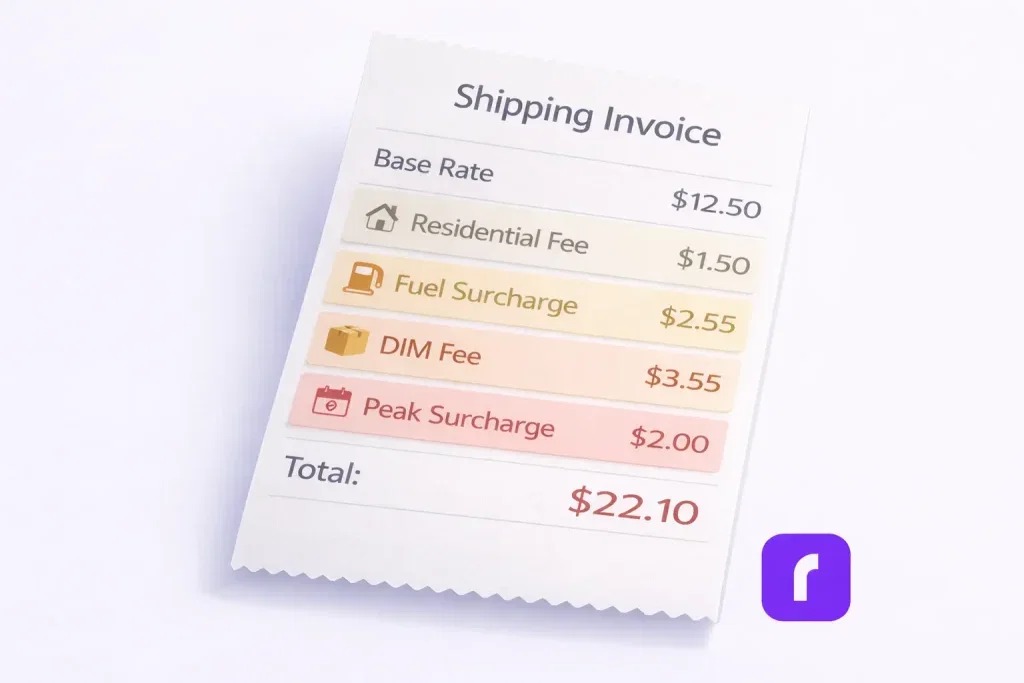
Breaking down the 2026 residential surcharge: how UPS and FedEx price it
Both carriers define it nearly identically: delivery to a home address counts, including a business operating out of a home. If the carrier's address database calls it residential — even when you entered a company name — you pay. The 2026 comparison (USD per package; confirm against the carriers' current rate tables):
| Service | UPS | FedEx | | Ground / Home Delivery | $6.50 | $6.45 | | Air / Express | $7.00 | $6.95 |
The increases are outpacing the headline rate hike. UPS Ground went $5.65 (2024) → $6.10 (2025) → $6.50 (2026), up 15% in three years. FedEx went $5.95 (2025) → $6.45 (2026), an 8.4% single-year jump. Both carriers announced an average 5.9% general rate increase for 2026 — but the residential surcharge is rising faster than the average. Budgeting off the GRI headline alone means underestimating. That is why I rebuild my ups fedex residential surcharge cost 2026 ledger every January instead of glancing at the rate announcement and moving on.
Here is the counterintuitive part: the residential surcharge is the most small-seller-hostile accessorial in the book. Heavy freight can be negotiated, fuel floats with the market — but the residential surcharge is a flat tax. It ignores weight, ignores distance, and (for small and mid-size shippers) ignores your volume. And it stacks: a remote residential address adds a Delivery Area Surcharge on top (UPS residential DAS is $6.55 per package in 2026), and during peak season (late October 2026 through mid-January 2027) a demand surcharge piles on — $0.50 to $0.75 per package at UPS, $0.50 to $0.80 at FedEx. A single remote residential parcel can carry more than $13 in surcharges, exceeding the base rate itself.
Two exceptions worth knowing: UPS SurePost and UPS Simple Rate carry no residential surcharge (with downgraded transit commitments and no money-back guarantee to match), and USPS Ground Advantage charges nothing extra for home delivery — its real weapon in the lightweight game.
Invoice auditing: the two ways this fee gets overcharged
In all my years of audits, residential overcharges come in exactly two flavors: misclassification, and double standards.
Misclassification is the common one. Carrier address databases are not perfect: commercial addresses flagged residential, and vice versa. The Austin case above is textbook. The audit method is unglamorous: export the invoice weekly, filter by the residential indicator, spot-check 50 parcels against the actual addresses, compute your misclassification rate, then dispute individually or in bulk. Disputes have time limits — do not wait until quarter-end.
The double standard is sneakier. Sellers using both UPS and FedEx, or switching carriers midstream, often find the same address classified commercial at one carrier and residential at the other. Or an integration drops the address-type field and the carrier defaults to residential. Nobody finds this without reconciling. Do not expect the carrier to volunteer a refund — that is not how GRIs work.
Third example: a home-goods DTC in Dallas shipped 90,000 residential parcels across November and December, never noticing the peak demand surcharge — an extra $0.75 per UPS parcel and $0.80 per FedEx parcel, roughly $60,000 over two months. The 2026 peak window is already published. Budget it as its own line item.
Four levers: few places this fee can move, but each one is calculable
| Lever | Action | Who it fits | What it saves | | Address verification | Audit address classifications regularly, dispute errors | Everyone | Each 1-point drop in misclassification rate saves ~$650/month per 10k parcels | | Service switch | Move lightweight parcels to USPS Ground Advantage or UPS SurePost | Parcels under ~5 lbs | Roughly $3–$6 per parcel, varies by weight and zone | | Forward stocking | Place inventory near customer clusters to shorten zones | 10k+ parcels/month, concentrated customers | Cuts base rates mainly; surcharge unchanged, total cost down | | Invoice auditing | Weekly reconciliation plus a pre-peak special audit | Everyone | Recovers mischarges; upside depends on how sloppy the bills are |
Run the ROI on address verification: a seller shipping 10,000 parcels a month at 70% residential with a 5% misclassification rate overpays 10,000 × 0.70 × 0.05 × $6.50 = $2,275 a month. A part-timer spending half a day a week on this recovers $27,000 a year. That trade clears easily.
The trade-off, stated plainly: switching to USPS or SurePost saves the surcharge but costs you transit certainty and claims — SurePost carries no service guarantee, so a late parcel buys you nothing. During peak-season meltdowns that clause can hurt. My recommendation is tiered: keep high-value, time-sensitive orders on UPS/FedEx Ground; push low-value, flexible orders to economy products. Never one-size-fits-all.
A calculable conclusion to end on. Pull last month's invoice and do three steps: ① compute your residential share; ② multiply by $6.50 (UPS) or $6.45 (FedEx) for the monthly spend; ③ annualize it. Above $50,000 a year: start weekly invoice audits plus address verification immediately. Above $200,000: add a third-party audit firm on contingency (typically 30–50% of recovered amounts; nothing recovered, nothing paid). Rebuild your own ups fedex residential surcharge cost 2026 ledger every January when the new GRI lands, because the carriers will keep repricing this fee faster than the headline rate. Money you have not calculated is money you have already wasted.
By Lao Zhou, Logistics Cost Analyst