Start with robotic picking gripper selection warehouse logic, not with a vendor demo. Asking whether vacuum or a jaw gripper is "better" is like asking whether a truck beats a forklift. Better for what? The gripper is not really the decision. Your SKU mix is the decision, and the gripper just follows from it.
Four kinds of robotic picking gripper, four kinds of hand
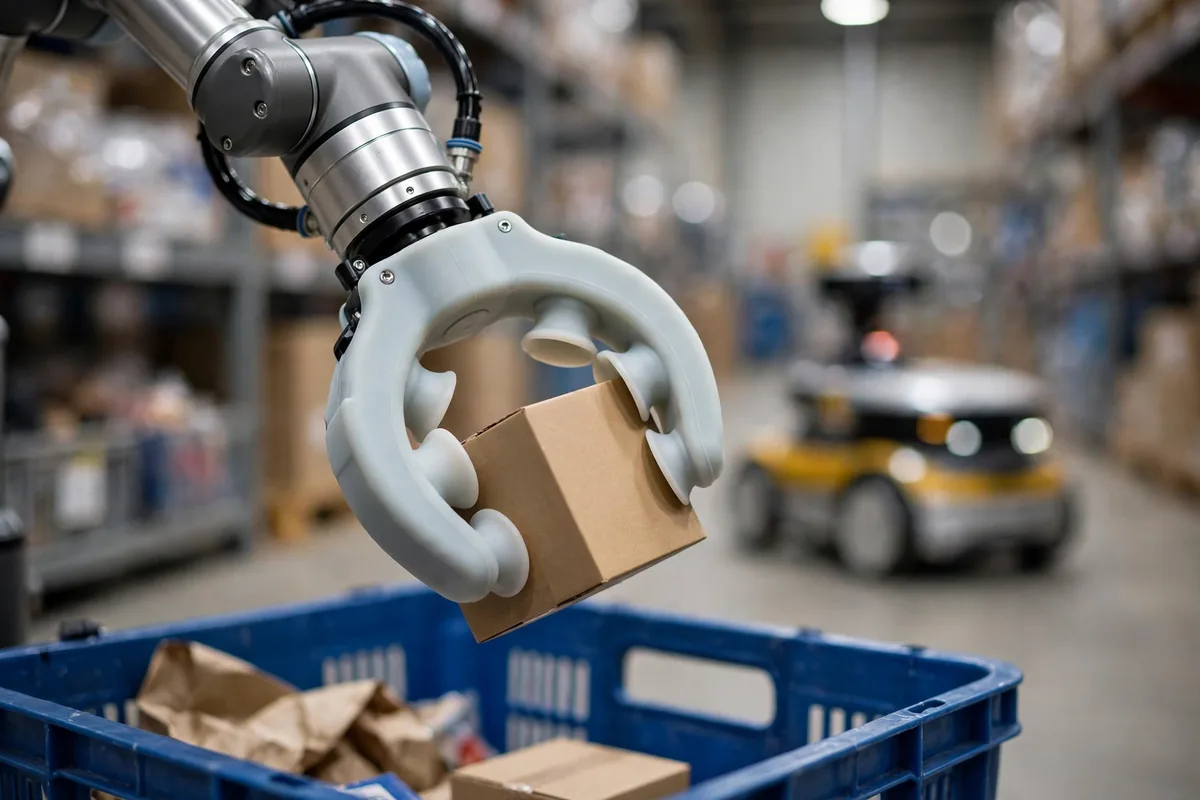
Think of each gripper as a different hand. A vacuum gripper is a palm that sticks. With enough flat, sealed surface it is fast and simple, which is why it loves cartons, shrink-wrapped cases, and flat multipacks. Its weakness is air. A torn corner, a tape seam, or a wrinkled film breaks the seal and the part drops.
A parallel jaw gripper is two stiff fingers. It is precise on rigid boxes, cans, and bottles, and its repeatability is easy to engineer. The trade-off is speed and force control: too little force and the item slips, too much and you dent the packaging your customer will photograph.
A soft or flexible finger gripper is a hand that gives. The fingers conform around produce, bakery packs, pouches, and odd shapes instead of forcing them into a fixed geometry. That gentleness costs you cycle consistency and wear life, so you have to watch the contact surfaces like consumables, because they are.
A hybrid gripper combines vacuum and fingers on one tool. It covers the widest SKU range and reduces tool changes, but it is heavier, pricier, and harder to tune. Every added mode is another failure mode you now own.
Three numbers draw the selection line: usable gripping surface, item weight range, and required cycle rate. Put those on one page and most arguments in a selection meeting disappear.
A gripper selection matrix for the warehouse
Use SKU shape first, brand second. This simplified matrix reflects how I split test work on integration projects; treat it as an experience framework, not a vendor guarantee, and always validate with production packaging.
| SKU shape | First choice | Backup | Typical failure |
|---|---|---|---|
| Flat cartons, sealed cases | Vacuum | Hybrid | Leaks at seams or damage |
| Rigid boxes, cans, bottles | Parallel jaw | Flexible fingers | Denting or slipping |
| Pouches, bags, soft bakery packs | Flexible fingers | Large low-vacuum cup | Shape shift after lift |
| Mixed, irregular items | Hybrid | Flexible fingers | Slow mode switching |
| Reflective film, clear bags | Flexible fingers | Parallel jaw | Bad depth reads, poor seal |
Case one: a cosmetics warehouse I supported in 2023 looked perfect for vacuum. The sample boxes were flat and sealed beautifully. Production cartons were different. The shrink film wrinkled at the corners, the cups leaked, and drops kept appearing in longer runs. Switching to conforming fingers slowed the cycle slightly but nearly eliminated the drops. The lesson was blunt: sample packaging lies, production tolerance tells the truth.
Case two: a snack warehouse in 2024 used parallel jaws on inflated pouches. No two bags held the same shape, so the jaws missed or squeezed air from one end to the other. Soft fingers fixed the grip, then created a placement problem because the swinging bag shifted its center of gravity. A simple guide at the drop point solved it. Picking is not finished when the item leaves the shelf. It is finished when it lands where it should.
Failure modes in warehouse picking: soft packs and shiny film
In any robotic picking gripper selection warehouse project, two families scare me most. The first is deformable packaging. Soft pouches, thin cartons, and padded mailers change shape the moment you touch them, so the grasp point vision calculated is already stale. Cranking up force is the wrong answer; it damages goods. Lower approach speed, spread the contact area, and let the tool comply with the object.
The second is reflective and transparent film. Glossy surfaces make depth readings jump, a few millimeters of error breaks a vacuum seal, and a jaw closes off-center. Test this family with real outbound packaging, never with a clean sample box.
Here is the counter-intuitive call: a better camera cannot rescue the wrong gripper. Teams love to spend on algorithm upgrades because software feels modern. Often the honest fix is mechanical. Change the hand first, then tune the vision. Reversing that order burns budget.
Maintenance belongs in the selection meeting too. Vacuum cups age faster in dusty buildings and need scheduled replacement. Soft finger surfaces lose friction gradually, so slippage creeps in before anyone declares a failure. Jaw grippers drift after collisions and need recalibration checks. If those costs are not in your model, your model is fiction.
The one number that decides whether it pays
Run a labelled hypothetical before you sign anything. Suppose a hybrid tool costs noticeably more than a vacuum-only tool, but raises the share of SKUs the robot can handle from roughly six in ten to roughly nine in ten in your test sample. The expensive tool may still win, because every SKU the robot cannot handle falls back to labor, exception handling, and delay. This is an illustration of method, not a price quote; current pricing comes from your vendors.
My ROI test uses one number: fully loaded cost per successful pick. Divide equipment amortization, consumables, drop rework, and fallback labor by successful picks, not attempted picks. If that number beats your manual cost with room to absorb maintenance swings, the investment works. If it only wins on headline cycle rate, it does not.
So my sequence never changes: profile the SKU shapes, pick the primary gripper from the matrix, test the hardest fifth of the range first, and only then negotiate rate and price. If the hard items fail, there is no system to buy, no matter how smooth the demo video looked.
One more step teams skip: how you build the test list. Rank SKUs by pick frequency, take the items that drive most of your orders, then add a separate list of your most damage-prone, hardest-to-handle products. Test both lists and score four outcomes separately — success, drop, crush, and misplacement. A single blended success rate hides exactly the failures that will dominate your exception labor after go-live.
Cycle rate needs the same honesty. Judge a cell by successful picks per hour, including vision wait time, retries, placement confirmation, and exception stops. A hybrid tool that attempts more slowly but retries less often can out-produce a faster tool by the only measure that matters. That is why robotic picking gripper selection warehouse acceptance criteria should be written in successful picks, with consumable replacement and recalibration intervals logged against the same measure, so when performance drifts you can tell whether the hand or the goods changed.
By Da Liu, Automation Engineer