Start with the physics. A barcode is roll call — one name at a time. RFID is shouting into a room — the reader broadcasts, and every tag within a few meters answers at once, dozens or hundreds per read. Think of it this way: barcodes are a teacher checking names off a list one by one; RFID is the whole class yelling "here" simultaneously.
The physics sounds beautiful. Now the ugly truth up front: RFID in the picking operation is the easiest technology in the whole warehouse to buy wrong. Not because the tech is bad — because nine out of ten buyers deploy it in the wrong scenario.
The selection line: where it pays, where it burns
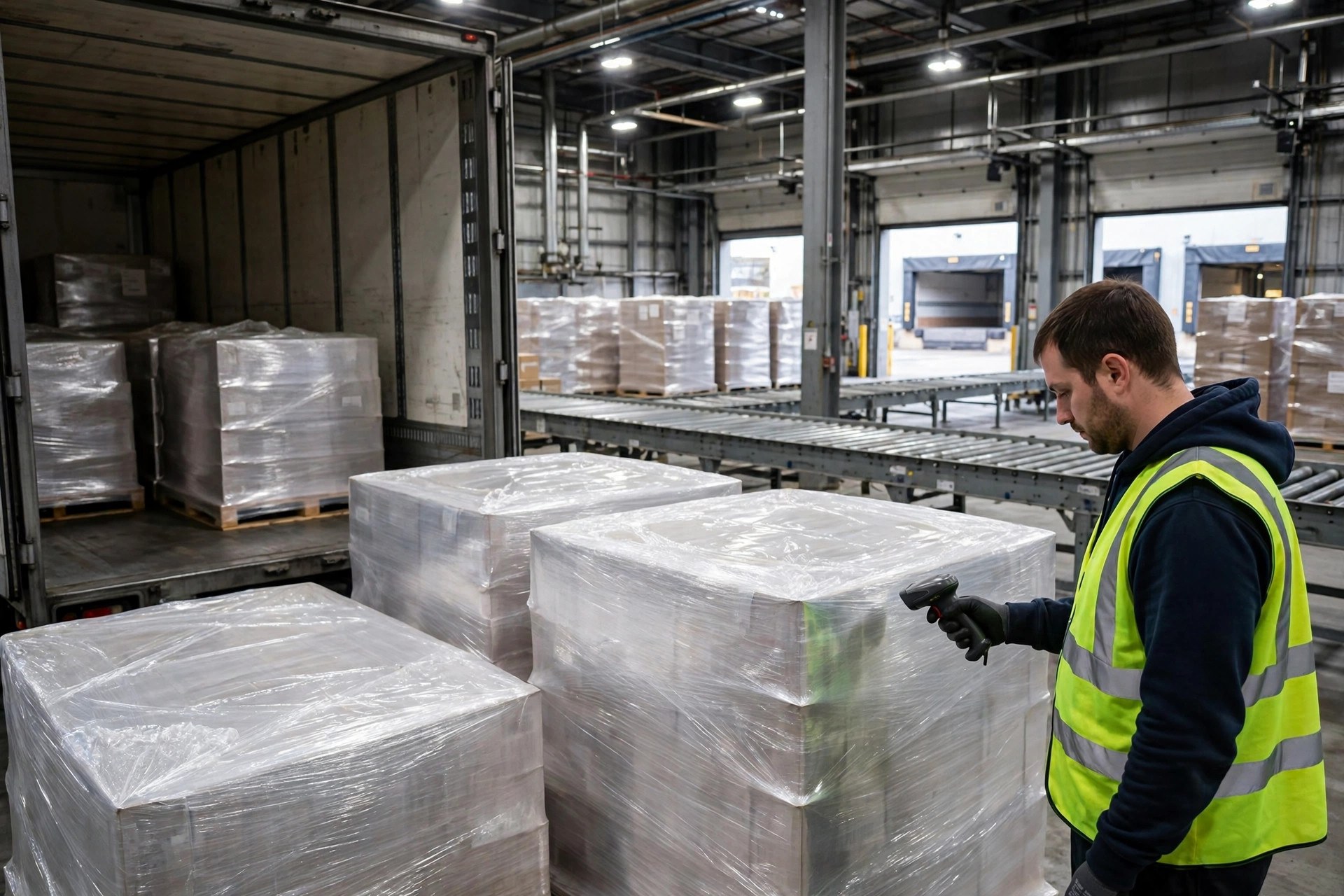
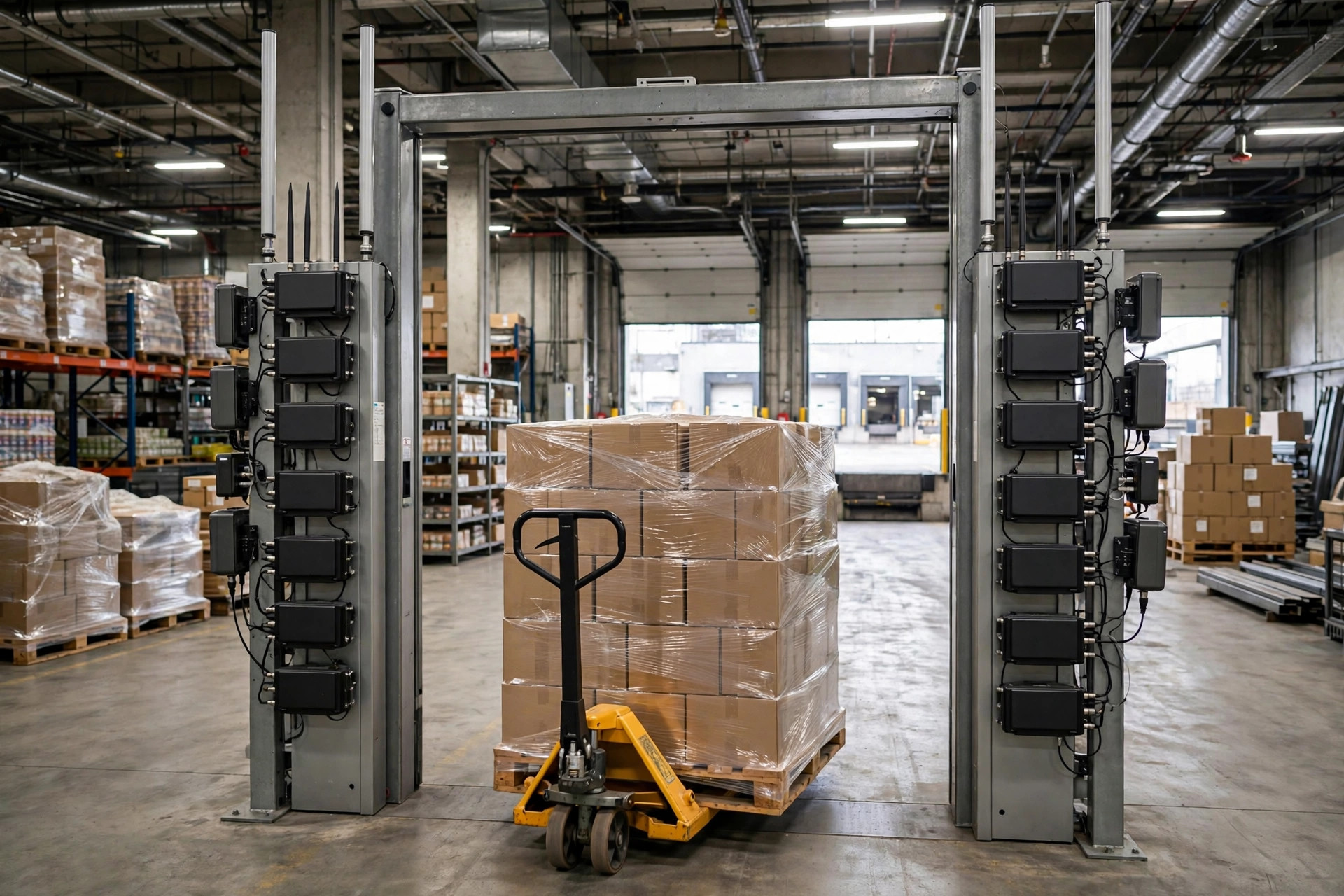
RFID's physics defines its comfort zone: full pallets, full cases, bulk reads at a gate. Tags on the pallet or the outer carton, goods roll through a portal, and in about 3 seconds dozens of tags are captured in one pass. Manual per-pallet barcode scanning takes around 40 seconds. Here, RFID crushes it.
But move to each-picking and the math flips. Here's the line:
| Scenario | Barcode | RFID | Verdict |
|---|---|---|---|
| Full-pallet/case in-out through a portal | Scan pallet by pallet, slow | Portal reads everything in ~3 sec | RFID wins outright |
| Full-case replenishment to forward pick | Scan case by case | Bulk read | RFID pays off |
| Each picking | One scan, 1–2 sec | Tag on every unit — cost kills it | Barcode wins outright |
| High-value unit tracking | Good enough | Tag cost negligible vs. unit value | RFID worth considering |
In 2024 I visited a food distribution warehouse in California with two RFID portals at the receiving dock. Full pallets of frozen product rolled through — one beep, 48 cases confirmed in 3 seconds. The receiving crew went from 6 people to 4, and peak season stopped queueing at the dock. Money well spent — because the scenario was right.
The counter-example, same year: an e-commerce small-parcel warehouse. The owner watched a vendor demo, got excited, and tagged all 30,000 SKUs at the unit level with passive tags. The result: tag cost ate 2–3 points of per-unit margin; tags on adjacent SKUs cross-read on the shelf — the picker grabbed item A while the system registered item B, and mispicks went up; six months later every tag was peeled off and they went back to barcodes. Tagging every SKU with RFID is a disease. Get it treated.
The three-way math: tags vs. hardware vs. labor
Disclaimer first: tag and hardware prices move a lot — everything below is order-of-magnitude, and you should work from your suppliers' latest quotes.
Passive UHF tags, at volume, run in the single-digit cents to low-teens-of-cents range per tag. Sounds cheap? Multiply: a warehouse shipping 5,000 cases a day burns through 1.8 million tags a year — at 10 cents that's $180,000 a year in consumables. Barcode labels cost fractions of a cent, need no power, no antennas.
A fixed reader plus portal gate runs in the thousands to low tens of thousands of dollars per set; a handheld RFID reader is also in the thousands per unit. An industrial barcode scanner costs a few hundred dollars and lasts three to five years.
Labor's side of the ledger: 40 seconds per pallet for manual scanning versus 3 seconds at a portal. At 200 pallets a day that's roughly 2 labor-hours saved — $40 a day at $20 an hour, about $10,000 a year. Divide your portal investment by that and you have your payback period.
So RFID's business case has exactly one valid shape: bulk, unit-load, high-frequency. Miss any one of the three and the ROI doesn't pencil out. If you run an each-pick operation and want RFID, answer me one question first: how much will you pay per unit to skip that one scan? A 10-cent tag times your annual unit volume — if that number tops 30% of your scanning labor cost, you're looking at a pseudo-requirement.
The accuracy trap: missed reads are sneakier than bad scans
Every vendor deck claims 99%+ read rates. That's not a lie — it's missing a qualifier: "under ideal conditions."
Real-world warehouse read rates are a range, roughly 97–99.5%, versus 99.9%+ for barcodes under disciplined operation. And RFID's failure mode isn't "wrong read" — it's missed reads and cross-reads. A missed read is a tag that never answered, so the system thinks that case never passed. A cross-read is the neighboring pallet's tags getting picked up, so the system thinks there's extra freight. When a barcode mis-scans, the gun beeps an error and you know instantly. An RFID miss is silent — you don't know until cycle count doesn't reconcile.
The maintenance traps: metal, liquid, antenna angles
RFID is radio, and radio obeys physics. Three traps, each more expensive than the last:
Metal is RFID's nemesis. Metal racking, metal pallets, metal packaging reflect and block RF. I saw an auto-parts warehouse with tags on metal parts bins — read rate dropped into the low 80s. The fix is on-metal tags, which cost 3–5× standard tags, and the whole business case has to be recomputed.
Liquid absorbs RF energy. Beverage, cosmetics, and chemical warehouses take a real hit — liquid packaging can halve your read distance. Tag placement has to face away from the liquid surface; a tag in the wrong spot is a tag wasted.
Antenna angles turn voodoo into engineering. A portal's antenna polarization, height, and spacing — 10 centimeters off can swing read rate by 5 points. After installation you push test pallets through dozens of times and map the read hot zones. The vendor's salesperson won't tell you this; it's baked into the integrator's implementation fee.
Then there's the uptime and MTBF math: a portal gate is fixed infrastructure running around the clock, and antennas, cabling, and readers are consumables. Budget 10–15% of the hardware investment per year for spares — don't wait until the gate dies in peak season to think about it.
Worth it or not? Look at this one number
No hedging at the end. One number: your total tag cost per pallet, divided by your manual scanning cost per pallet.
Total tag cost per pallet = tags per pallet × unit tag price + portal depreciation allocated per pallet. Manual scanning cost per pallet = scan time × hourly wage.
Below 0.5, buy it with confidence. Between 0.5 and 1, run the detailed numbers first. Above 1, close the vendor's slide deck and go fix your barcode process — because odds are the problem isn't "scanning is too slow," it's messy slotting, long travel paths, and missing verification steps. RFID can't cure those, and neither can a scanner. That knife has to cut into the process first.
By Da Liu, Automation Engineer