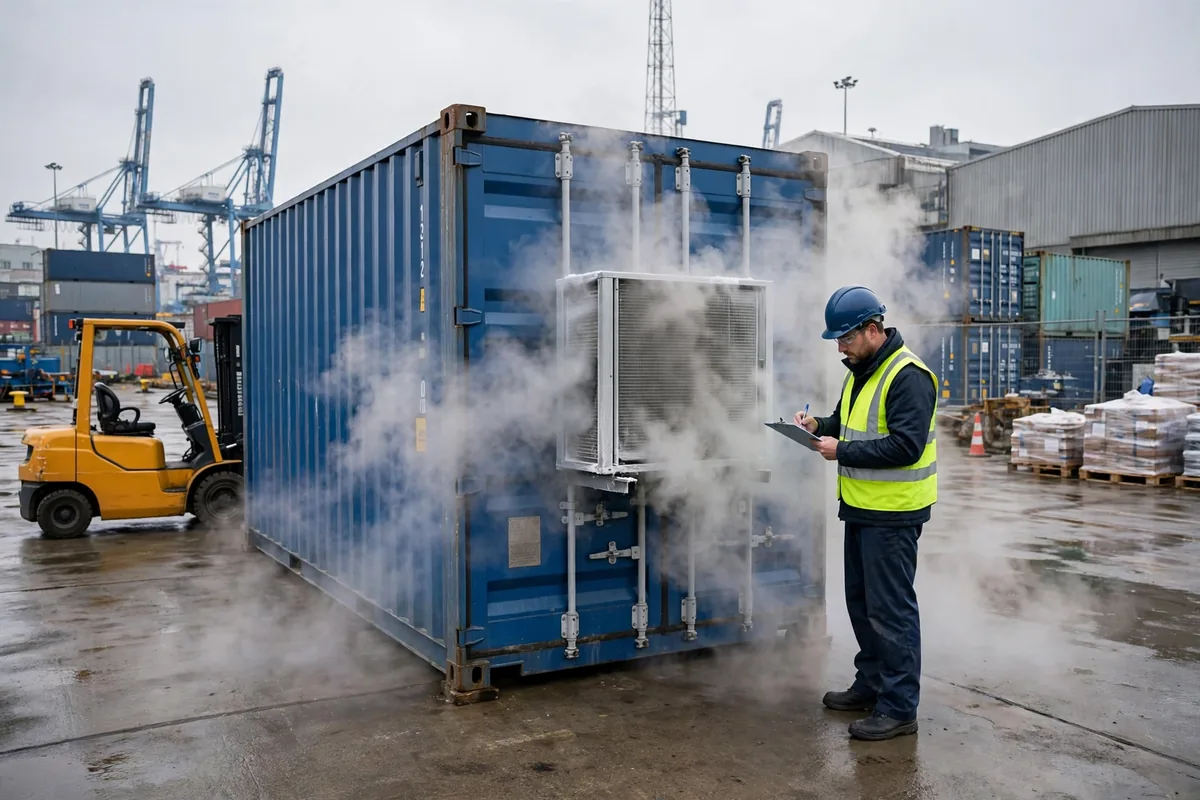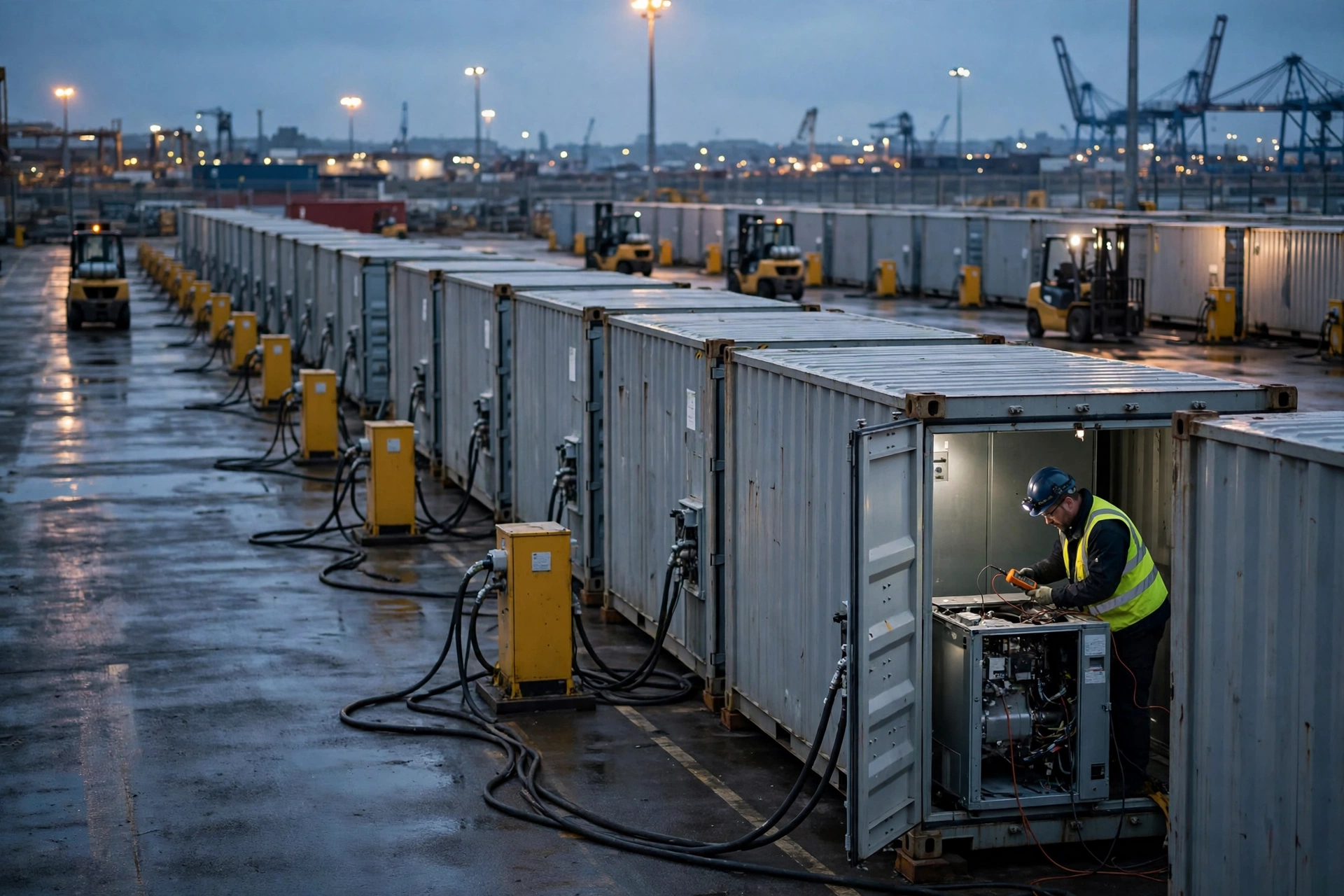
The call came at half past four in the morning. Our night shift lead was on the phone, truck engines behind him. Six more reefers had just arrived, every plug was taken, and drivers were asking how long they would wait. To be honest, that is the call I dread most in peak season. A reefer that cannot be plugged in is not just a parking problem. Its logger keeps running and the customer keeps asking. The reefer plug points warehouse yard problem never shows up on a quiet Tuesday. It shows up all at once, on the busiest night of the month.
I manage operations at a port-side warehouse in Europe. Boxes arrive from the terminal, wait for customs or a cold store slot, and leave by road. On the ground that flow comes in waves, and plug planning has to survive the waves, not the average day.
Reefer plug points are not an average problem
The first mistake I see, and made myself, is sizing points from an average. Count last month's reefers per day, order that many points plus a spare, and it feels tidy. It fails in the first real peak, because an average hides the days that matter.
We now size from three questions. First, how many reefers are in the yard at the same time at the peak, not how many arrive in a day? Twenty arrivals mean little if ten leave in the morning. They mean a great deal if a vessel delay and a slow customs release stack them into one evening. Second, how long does each box hold a point? A reefer waiting four hours is a different load from one sitting over a weekend. Dwell time, not arrival count, eats capacity. Third, how sensitive is the load? Boxes needing continuous power cannot compete with routine turnover boxes. They need a protected pool reserved for them.
Here is the counterintuitive part. A shortage is often not a shortage of points. It is a shortage of spread. When every booking lands in the same two hours, the peak is man-made. Stagger arrival windows and the peak falls, sometimes enough that no building work is needed. Fix the rhythm first, spend money second.
Illustrative scenario one. In one peak week, our daily average still looked comfortable. Then two heavy days landed together. Inbound boxes arrived in a bunch, outbound boxes had not left because loading inside was slow, and reefers stacked up. The night team spent the shift walking unplugged boxes, checking temperatures by hand, and explaining the queue to drivers. Nothing had broken. The plan had been built on the wrong number: the daily total instead of the simultaneous peak.
How the warehouse yard queue should work
When points run out, the worst system is loudest voice first. If the driver who complains most gets the next plug, the box at real risk waits until it becomes an emergency. We tried a whiteboard queue. It worked until handover, then it did not.
Our fixed rule is written on the duty room wall. First priority goes to the box closest to its temperature limit, or unplugged the longest. Second goes to boxes with a hard deadline, a booked pickup or a sailing that cannot slip. Third come fresh arrivals whose temperature is stable and whose stay should be short. One hard rule sits alongside: every unplugged reefer goes on a patrol list, with box number, time, recorded temperature, and the name of the person who checked it. Memory is not a monitoring system, especially at three in the morning.
Responsibility must be settled before the box arrives, not after an alarm. While a container sits in our yard, the first monitoring duty sits with us. But special instructions must come from the owner or carrier in advance: what temperature band matters, whether a short unplugged move is acceptable, and who gets the first call on an alarm. We added a field for that on the arrival paperwork. Before it existed, one incident became an evening of scrolling chat threads to prove who had agreed to what.
Illustrative scenario two. On a weekend with every point taken, a late arrival came in with a strict temperature requirement. By arrival order it was last. By risk it belonged near the front. The shift lead swapped it with a stable box about to be collected, logged the reason, and kept both patrol records clean. When the customer asked next day, we could show times and readings line by line. A clear rule protects the cargo, and the team that must explain the decision.
Temporary power, and the separate maths of building more
Two short-term answers exist: temporary generation for waiting boxes, or moving boxes to a nearby yard with spare points. Expansion is a third answer, but it belongs in a different budget conversation. It cannot rescue this weekend.
Temporary power is fast, and that is its value. It is also labour hungry. Someone must watch it, patrol it, manage cables safely, and stay responsible all night. Expansion is the opposite: it solves the problem properly, but runs through site work, electrical capacity, construction, and sign-off, none of which moves at peak-season speed. Our rule is simple. Cover the current peak temporarily, and keep the peak data. That data makes a later expansion request credible.
The example below is an illustrative calculation only. Every figure is an assumption showing the method. Electricity prices, rental rates, and equipment prices must come from current local quotations, never from a table like this.
| Illustrative item | Assumption used | What it tells you |
|---|---|---|
| Peak reefers on site at once | A busy weekend well above a normal day | Size from the simultaneous peak |
| Fixed points available | All points occupied on the peak day | Quiet-day spare capacity proves nothing |
| Shortfall | Peak boxes minus fixed points | The gap the queue or temporary power must cover |
| Temporary power cost | Fill in from a current local quotation | Include kit, cabling, supervision, patrol labour |
| Cost per added point | Fill in from a current local quotation | Include groundworks, distribution, sign-off |
Read honestly, that maths points one way. If the shortfall appears on only a few peak days a year, temporary cover plus staggered bookings is normally cheaper. If it shows up every month, with patrol labour, complaints, and cargo risk stacking up, expansion stops being a luxury. The question is whether your shortfall is occasional or structural.
One cost is easy to miss. Adding points is not just adding sockets. You need electrical capacity, safe cable routes, clear fire access, and a patrol route that works at night. Our first expansion proposal was sent back for that reason: it counted points and said nothing about capacity or routing. That is why I treat the reefer plug points warehouse yard question as a yard, power, and people question together, never a socket count.
The routine we now keep
Our routine has four steps, none of them clever. First, once a week we look ahead at vessel timing, bookings, and boxes on site, and flag stacking days so arrival windows can move early. Second, we split points into two pools: a protected pool for high-risk boxes, and a turnover pool for the rest. The protected pool may sit empty. That is the point of it. Third, every unplugged box sits on a written queue with number, arrival time, temperature requirement, and next check time, handed over face to face. Fourth, after each peak we review the numbers and decide whether temporary cover continues or the expansion case gets pushed.
On heavy nights the night shift also carries one extra person who can deal with an alarm and make the call. Monitoring kit raises the alarm. A person owns what happens next.
My reminder to other managers is plain. Do not wait until boxes block the gate to think about plugs. Record peaks, dwell times, and your queue rule while things are calm. The expensive part was never the sockets. It is the cargo claim and lost trust when a box sits unplugged with no plan and no record. Do the maths early, and that half past four call gets rarer.
By Chen Feng, Warehouse Operations Manager