To understand what electronic shelf labels are really worth, picture what I saw in October 2024 at a retail distribution center in Qingpu, Shanghai: three handlers pushing a cart of freshly printed location labels down every aisle — a packaging spec change meant 2,000+ locations needed new labels. Two full days, and 30+ still ended up wrong. That is exactly the kind of dumb, repetitive rework electronic shelf labels (ESL) were built to kill. In warehouse picking, the most expensive label is the one showing yesterday's information.
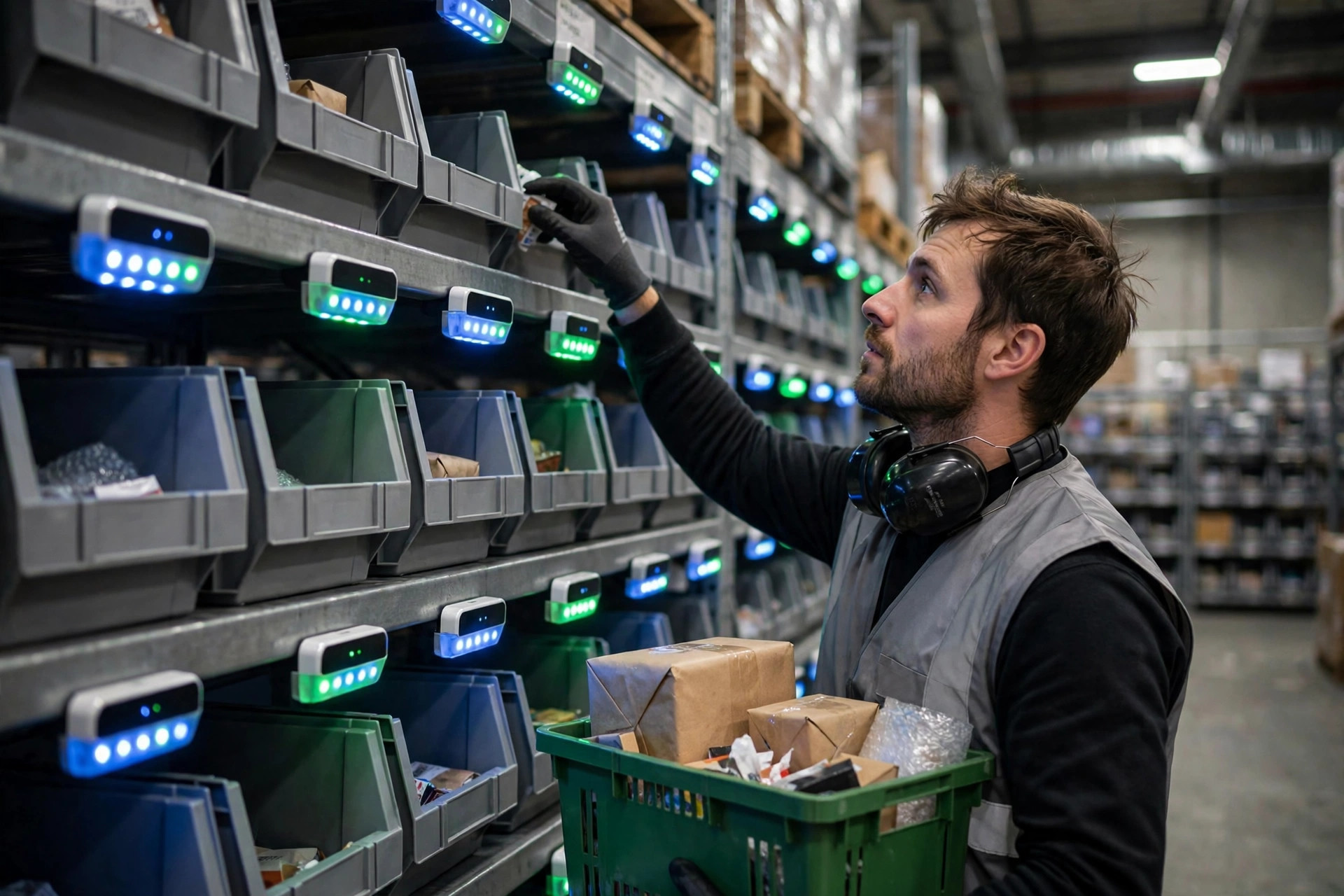
Think of it this way: an ESL turns every paper location label on the rack into a tiny screen that talks to your WMS in real time.
How Electronic Shelf Labels Actually Work: An Electronic Chalkboard on the Rack
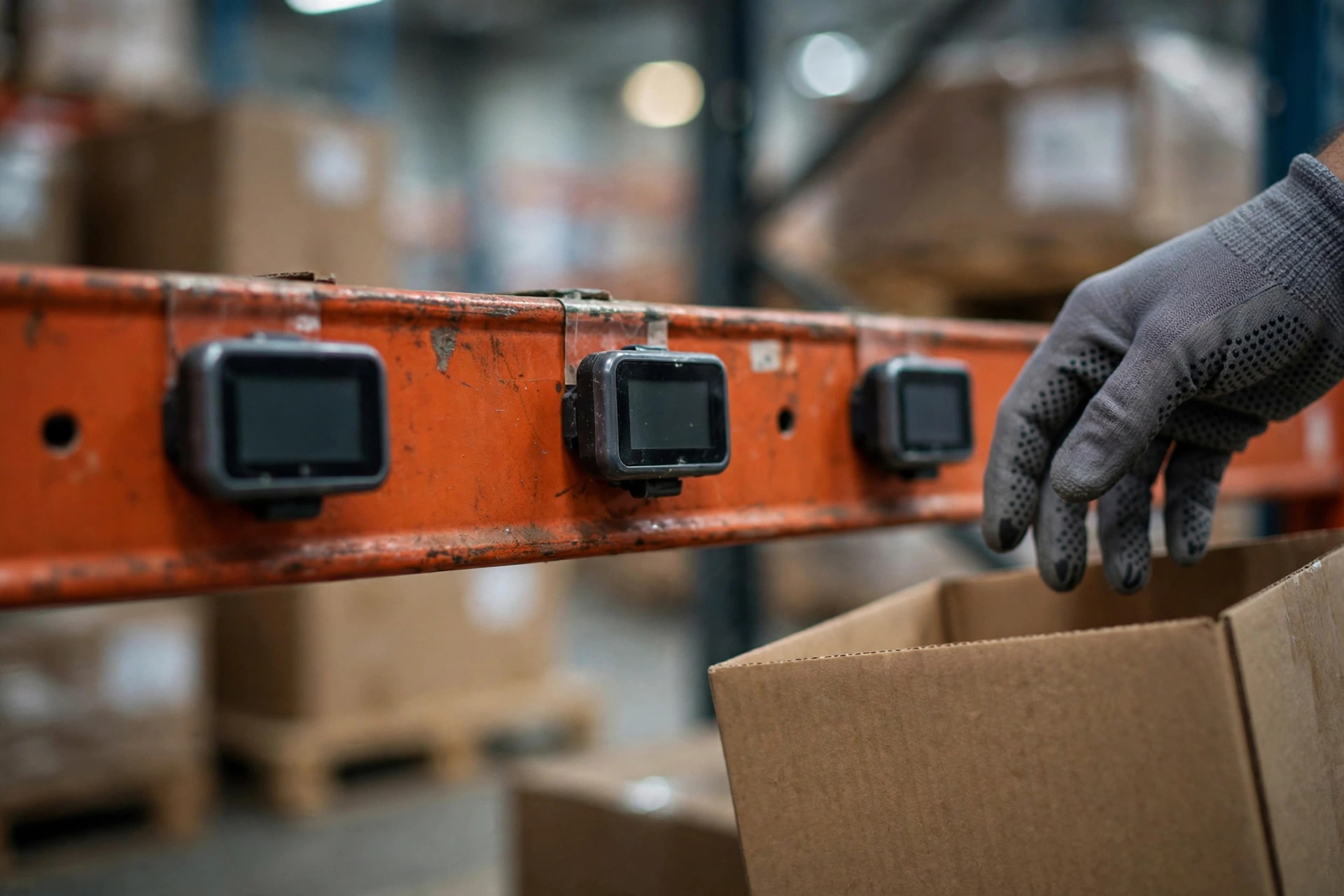
You can think of each ESL as an e-reader screen — e-ink, sipping power only when it refreshes, the image surviving even a dead battery. A WMS change goes to a gateway (the warehouse's Wi-Fi router; one drives hundreds to over a thousand labels), which broadcasts the update over 2.4 GHz or sub-1 GHz radio. Refresh takes seconds to minutes. That's the whole trick.
Three links in the chain — get sloppy about none:
- The label itself. Sizes run 1.5" to 7.5"; pick faces usually take 2.9" or 4.2" — smaller is unreadable at arm's length, bigger is burning money. Small labels sit in the tens-of-RMB range; large ones cross a hundred. Get your own quote.
- The gateway. It translates and relays between WMS and labels. Steel racking eats radio for breakfast — skimp on gateways and you get "ghost labels": updated in the system, stale on the screen.
- The integration layer. Most vendors expose an API for WMS/ERP integration. The trap: does your WMS push location changes as real-time events? If it only does a nightly batch export, the refresh speed you paid for is dead on arrival — you've bought a very expensive paper label.
Most ESLs carry NFC, so binding a label to a location is a phone tap, not a ladder climb — across thousands of labels, that saves a full week of implementation labor.
The Selection Line: Four Warehouses That Should Deploy ESL, Three That Shouldn't
ESL only pays when one condition holds: location info changes often enough that manual relabeling can't keep up — or keeps up but keeps making mistakes.
Good fits:
- High-frequency price and info changes. E-commerce peak seasons, retail promo cycles — prices, promo copy, display rules changing weekly. Before the 2025 618 festival, a 3PL e-commerce warehouse in East China (50,000 locations): four people, three days of label swapping, and missed labels still caused mispicks. Textbook ESL case, no debate.
- Strict expiry and batch control. Pharma, food, fresh — labels must show expiry date plus batch. Handwriting expiry dates on paper labels: one transposed digit is a store rejection, and in the worst case a recall. With ESL, expiry data flows straight from the WMS. No human handwriting touches it, so no human can miscopy it.
- Frequent dynamic re-slotting. Aggressive re-slotting changes locations constantly. Peel-and-stick labels leave ghosts behind; a picker staring at two labels on one location guesses — and guesses wrong. I see these "double-label" mispicks several times a year.
- High cost of picking errors. Consumer electronics, cosmetics, high-value smalls — one mispick's return-and-reship covers dozens of labels. ESL gives scan-plus-screen double confirmation, and that's where error rates drop hardest.
And the don'ts:
- Stable SKUs, info that changes a few times a year. A paper label costs cents; an ESL costs dozens of times more. That's a sledgehammer for a walnut — spend the money on your slotting plan instead.
- Extreme environments you haven't planned for. In a -25°C freezer, a standard ESL's coin cell fades fast and the screen gets sluggish or quits. You need wide-temperature models at a steep premium — no budget line for that, don't start.
- Using ESL as a poor man's PTL. That one gets its own section below, because it deserves a proper scolding.
Four Maintenance Pitfalls the Brochure Won't Tell You
Pitfall 1: Battery life is a lab number. The advertised 5–7 years assumes 2–3 refreshes a day at room temperature. Peak season brings dozens of refreshes a day, and your first battery-swap wave lands in year three. Amortize over 3–4 years, not seven — in year four the swap labor costs more than the labels did.
Pitfall 2: Radio dead zones. Steel racking plus dense product is basically a Faraday cage. Survey on site before placing gateways, aisle by aisle, level by level. Everyone who trusted the slide deck's coverage radius ended up buying more gateways — that 3PL warehouse had 200+ labels go dark in the mezzanine zone and needed six extra. Gateway count is measured, not calculated.
Pitfall 3: Labels falling off and getting smashed. A forklift nudge, a pallet scrape — plastic clips snap. Keep 3–5% spares, choose metal clips. A label on the floor means a blind location.
Pitfall 4: Firmware upgrades. Push an OTA update to thousands of labels and a handful brick every time, each needing a ladder climb and an NFC tap. Schedule upgrades after a count day with buffer before peak — upgrading the week before Black Friday is a self-inflicted wound.
The Math: Whether ESL Is Worth It Comes Down to One Number
Formula first, verdict second:
Total investment = unit label price × quantity + gateway price × count + software licenses & WMS integration + installation Annual return = relabeling labor saved + picking errors avoided × cost per error + cycle-count time savings converted to labor
| Paper labels | ESL | |
|---|---|---|
| Cost per location | Cents | Tens to hundreds (by size) |
| One info change | Manual swap across the building, with misses | WMS push, seconds, everywhere |
| Pick verification | Eyeballing SKU and quantity | Scan + screen double-check |
| Cycle counting | Verify each paper label | Screen shows book quantity — just reconcile |
| Hidden cost | Mislabels and misses → mispicks | Battery swaps, gateway upkeep |
Here's the formula with a worked illustration — every number below is hypothetical; plug in your own quotes: 20,000 labels at 45 per unit installed = 900,000; 20 gateways at 3,000 = 60,000; software + integration 150,000; total ~1.11 million. Annual return: relabeling labor previously ~300,000 a year (fully loaded cost of two dedicated staff); error rate from 0.3% down to 0.1% on 5 million picks a year = 10,000 fewer errors at 15 per error = 150,000. Total annual savings 450,000 → payback ~2.5 years.
The counterintuitive part: the biggest money in ESL isn't the relabeling labor you save — it's the picking errors you stop making because location info can never drift from the WMS again. Labor savings are easy to calculate but they're the smaller half; error costs hide inside returns, reships, and chargebacks. Count only labor and you'll undervalue ESL by half.
Payback under 2 years — just do it. Two to 3 years — go ahead if error costs are high. Over 3 years — stick with paper and fix your slotting.
A Rant: ESL Is Not a Budget PTL
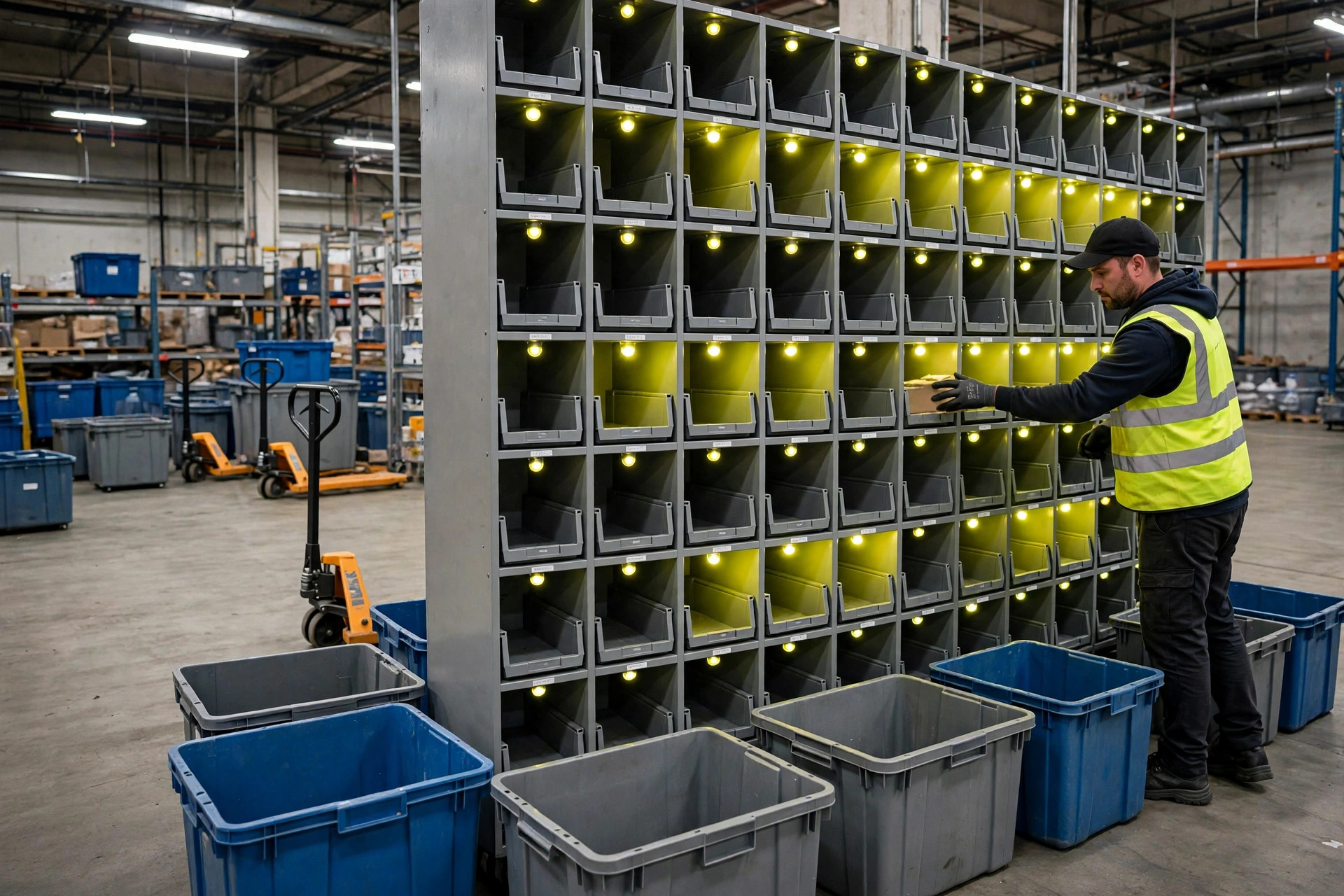
More than once I've heard "PTL is too expensive, let's do ESL — the LED blink can guide picking too." That's wrong from the foundation up:
| ESL | PTL (pick-to-light) | |
|---|---|---|
| Essence | Location information display | Pick task director |
| Trigger | WMS info-change push | Pick task drops, light turns on |
| Pick action | Human finds goods, scans, verifies on screen | Light on, human goes, presses to confirm |
| Problem solved | Is the information right? | How fast can we move? |
| Cost order | Per label, relatively friendly | Per location + controllers, an order pricier |
The LED blink only helps you spot which location — it isn't task-driven. Using ESL as a poor man's PTL is like buying a monitor as a desk lamp: it's not that it can't glow, it's that you bought the wrong thing. ESL's territory is location-label digitalization, inventory visibility, and pick assistance. Need "light on, go there, grab that many" takt time? That's PTL's job, at several times the budget. Own it.
The One Number
The decision comes down to one number: how many times per year does a single location's information change?
More than 12 — roughly monthly — and ESL very likely pays; the more frequent, the better. Fewer than 4 a year — paper plus a solid slotting plan spends the money better. In between, do the error-cost math — plenty of warehouses discover ESL wasn't expensive; they'd just never priced a single mistake.
By Da Liu, Automation Engineer