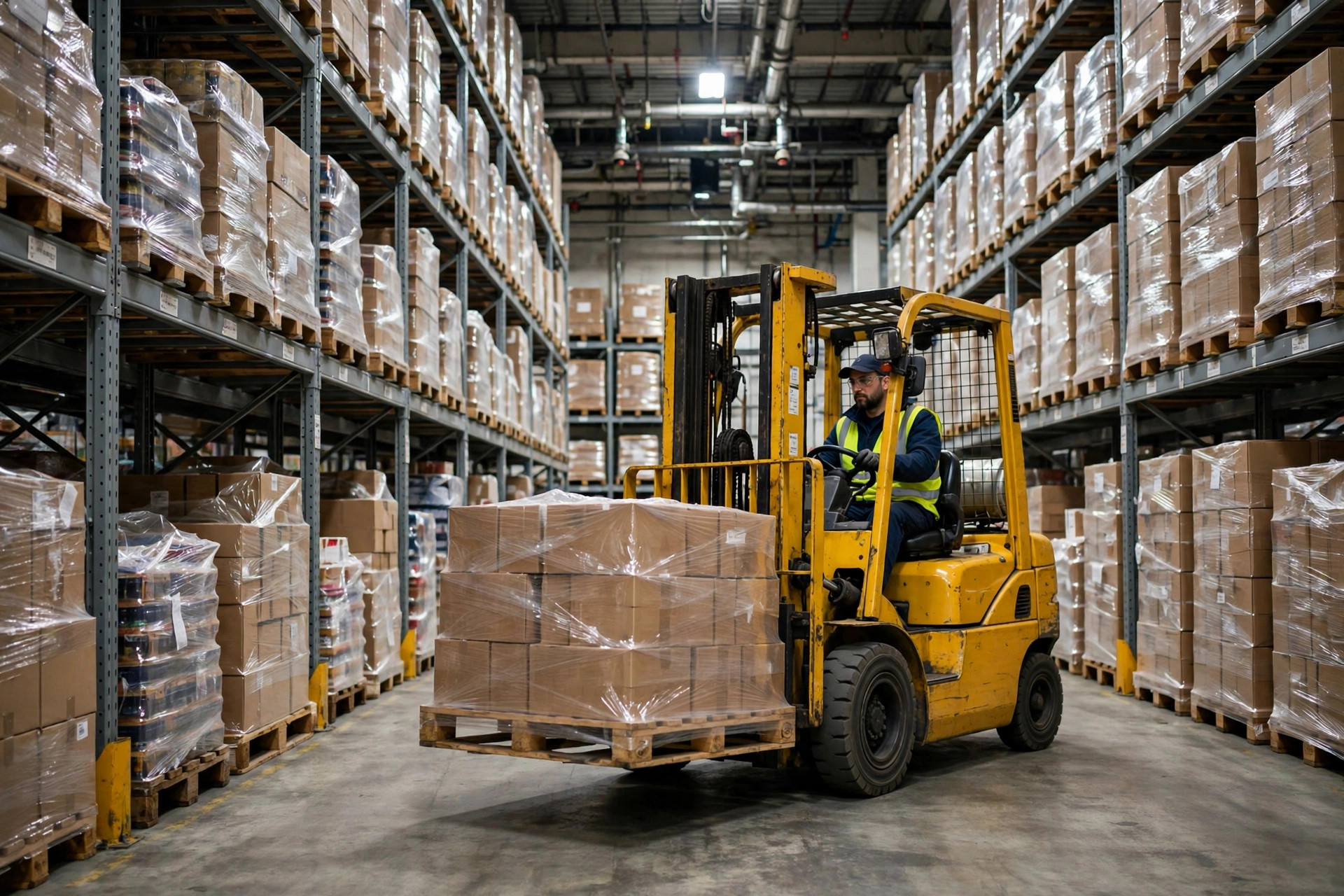
Let's open with the math. A 5,000 lb propane forklift, working a normal shift, burns about $4.20–$5.60 in fuel per hour. How much does it cost to run a propane forklift per hour once you count everything — fuel, maintenance, tank swaps, downtime? The real number is $5.50–$7.60 per hour. Run one truck 2,000 hours a year, and five years of operating cost totals $55,000–$77,000 — enough to buy two new trucks outright.
So stop asking "how much does a propane forklift cost." The purchase price is just the down payment; the hourly cost is the mortgage. This article breaks the total into four line items, puts propane and electric side by side in one table, and ends with a breakeven formula you can plug your own numbers into.
Sources: propane at a 2026 U.S. Midwest average of ~$2.80/gallon (per EIA weekly prices), industrial power at $0.14/kWh. Regional spreads are wide — rerun the math with your supplier's latest quote and your utility bill. Equipment prices reflect 2026 dealer quote ranges, brands neutralized.
How Much Does It Cost to Run a Propane Forklift Per Hour? Start With Fuel
Fuel is the biggest line item — over 70% of a propane truck's hourly cost. The formula is simple: consumption × price.
Consumption: a 5,000 lb propane forklift typically burns 1.5–2.0 gallons per hour. That range comes from manufacturer duty-cycle tests and fleet measurements — light shuttle work dips to 1.2, heavy continuous loading pushes 2.2. For most indoor warehouses, 1.75 gal/hr is the honest middle.
Price: 2026 Midwest propane averages about $2.80/gallon. Large accounts on annual contracts negotiate $2.40–$2.60; spot buyers on the coasts pay $3.20 and up.
Fuel cost = 1.5–2.0 × $2.80 = $4.20–$5.60/hour. Anchor on this range — every comparison below builds on it.
The Three Costs Everyone Forgets: Maintenance, Tank Swaps, and Downtime
People who count only fuel have done half the accounting. A propane forklift has an internal combustion engine, and engines demand attention.
First, amortized maintenance. Oil and filters every 500 hours, $120–$180 a service — that's $0.24–$0.36/hour. Spark plugs and ignition components every 2,000 hours, $400–$600 a set — $0.20–$0.30/hour. Tires, brake pads, belts add another $0.30–$0.50/hour. Total maintenance amortization: roughly $0.80–$1.20/hour. Invisible per hour, but over five years and 10,000 hours it's $8,000–$12,000.
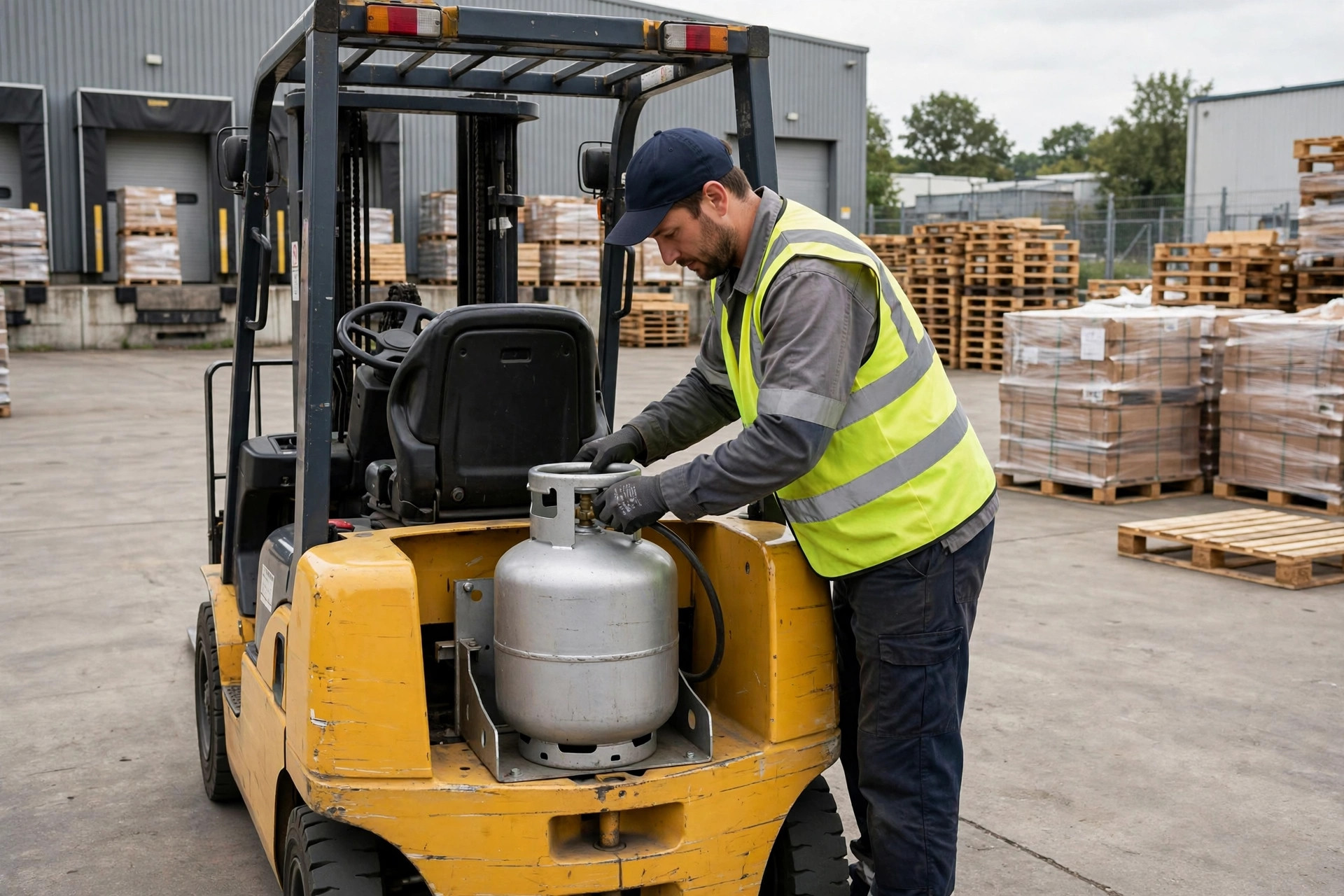
Second, tank-swap downtime. A standard propane cylinder (33.5 lb, about 8 gallons) lasts 4–5 hours. Each swap takes 8–10 minutes. At a fully loaded operator wage of $22/hour, that's $0.50–$0.80/hour in lost time and labor. Of the warehouses I've audited, nine out of ten book zero here — not because the cost doesn't exist, but because nobody measured it.
Third, residual value. A five-year-old propane truck typically retains 20–25% of its value at resale, versus 30–35% for an electric of the same age — buyers know engine wear when they see it. It doesn't enter the hourly cost, but it enters TCO, and the closing formula folds it in.
True hourly cost of propane: $4.20–$5.60 (fuel) + $0.80–$1.20 (maintenance) + $0.50–$0.80 (tank swaps) = $5.50–$7.60/hour.
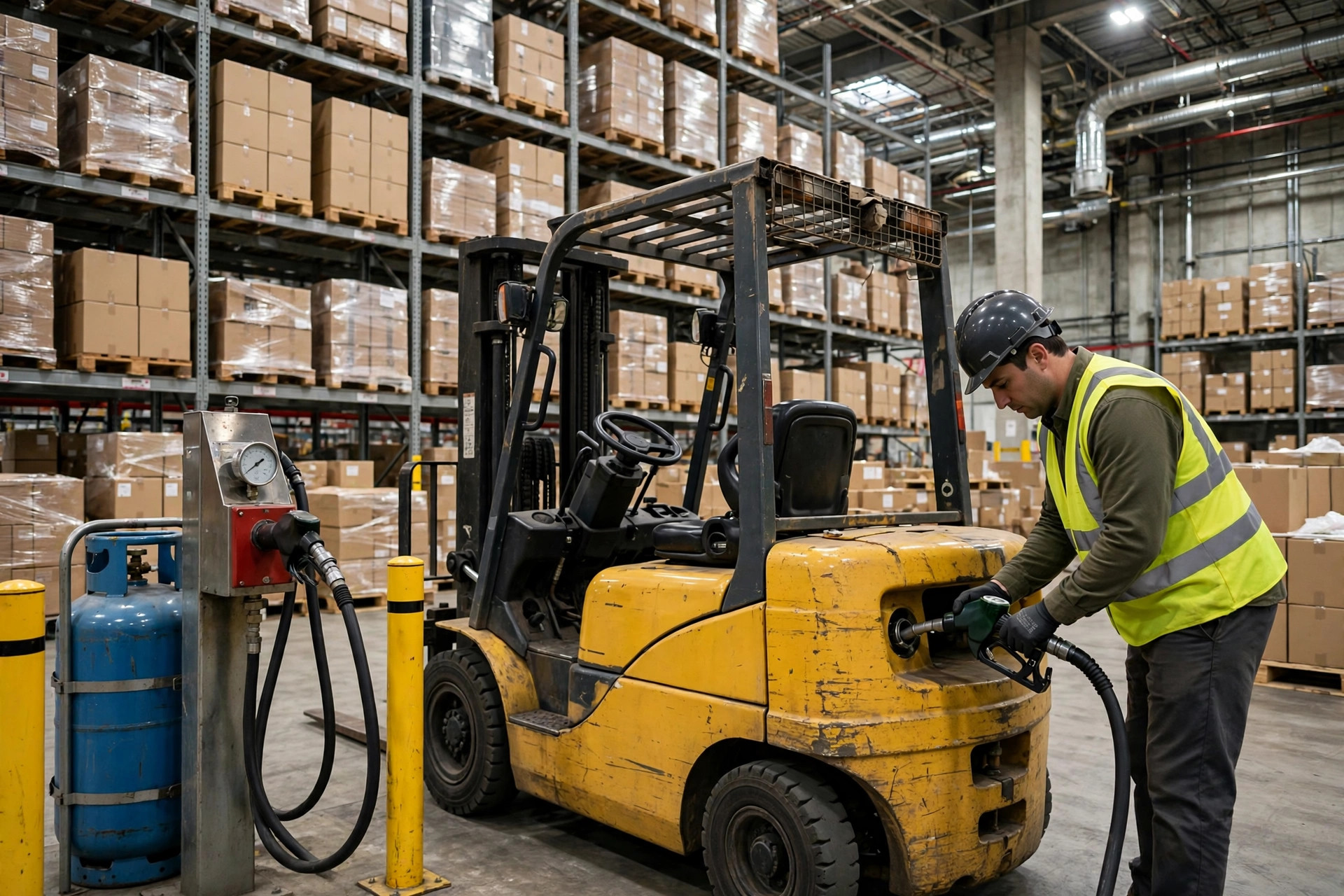
The Electric Ledger: Cheap Charging, Expensive Battery and Charging Room
Many analyses stop at "electric charging costs pennies" and miss the three big items behind it.
Charging electricity: a 36V 800Ah lead-acid pack takes about 28–30 kWh for a full charge. At $0.14/kWh industrial rate, that's roughly $4 per charge, good for 6–8 hours of work. Electricity cost: $0.50–$0.70/hour — genuinely one-tenth of propane fuel.
Battery amortization: this is the big one. A battery pack runs $6,000–$8,000 with a life of about 1,500 cycles. At one charge per day and 250 working days a year, that's 250 cycles a year and a 5–6 year life. Per hour: $7,000 ÷ (250 × 6 × 7) ≈ $1.00–$1.30/hour. Note that batteries age on cycle count, not calendar alone — a truck that mostly sits still ages its battery on the calendar while earning nothing.
The charging room: racks, ventilation, fire-safety upgrades — an $8,000–$15,000 one-time investment, amortizing to roughly $0.20–$0.40/hour per truck. Small warehouses underestimate this line most often.
Electric hourly operating cost: $0.50–$0.70 (electricity) + $1.00–$1.30 (battery) + $0.20–$0.40 (charging infrastructure) = $1.70–$2.40/hour. But remember: the electric truck costs $8,000–$12,000 more to buy than the propane equivalent, and that premium has to be earned back dollar by dollar from the hourly savings.
Hourly Total Cost: Propane vs Electric in One Table
| Cost item ($/hour) | Propane forklift | Electric forklift |
|---|---|---|
| Fuel / energy | $4.20–$5.60 | $0.50–$0.70 |
| Maintenance amortization | $0.80–$1.20 | $0.40–$0.60 |
| Battery amortization | — | $1.00–$1.30 |
| Tank swaps / charge management | $0.50–$0.80 | $0.20–$0.30 |
| Total | $5.50–$7.60 | $2.10–$2.90 |
The gap: propane costs $3.00–$4.50 more per hour. At 2,000 hours a year, one truck costs $6,000–$9,000 extra annually. That gap is the repayment stream for the electric purchase premium.
The Breakeven: How Many Hours a Day Before Electric Pays Off
The core formula: payback years = purchase premium ÷ hourly savings ÷ annual operating hours.
Plug in midpoints: $10,000 premium, $3.75/hour savings.
- 2,000 hours/year (two shifts, full utilization): $10,000 ÷ $3.75 ÷ 2,000 ≈ 1.3 years to break even. Everything after is pure gain. Switch without hesitation.
- 1,200 hours/year (about 5 hours a day): ≈ 2.2 years. Justifiable, but watch the trajectory of your local gas vs. electricity prices.
- 800 hours/year (3–4 hours a day): ≈ 3.3 years — while the battery dies at year 5–6. You'd replace the battery before the premium is repaid. That money was wasted.
Two bright lines to remember: below 1,200 annual hours, propane probably wins; above 1,800, electric probably wins. In between, it comes down to which way your local propane and power prices are moving.
Two Real Cases: Same Question, Opposite Answers
Case one: 2024, a 60,000 sq ft 3PL warehouse in Indianapolis, eight propane forklifts on two shifts. A year of propane invoices: $11,000 a month, $132,000 a year — fuel alone. In early 2025 they swapped six trucks for electrics indoors and kept two propane units for the outdoor dock. Year one saved ~$70,000 in fuel and maintenance; the $60,000 premium paid back in 14 months.
Case two: 2025, a 12,000 sq ft food warehouse in Ontario, California, forklifts actually working 3–4 hours a day — about 900 hours a year. The owner heard "electric saves money" and bought two. The ledger: $20,000 extra on purchase, $9,000 on charging-room upgrades; five years of operating savings ≈ $3.75 × 900 × 5 ≈ $17,000. Net: $12,000 worse off — before the $14,000 battery replacement due in year six. Following the "electric is cheaper" narrative at low utilization: that money was wasted.
The Counterintuitive Take: Two Ways to Count Only Half
This industry has two mirror-image traps. Trap one: buying propane on purchase price alone. The propane truck saves you $10,000 at the door and burns an extra $30,000–$40,000 in fuel over five years. The "savings" get handed back with interest. Most small and mid-size warehouses are paying this tax right now.
Trap two: switching to electric because you heard it saves money. Electric's savings are bought with utilization; without enough hours, battery amortization and the charging room can't be spread thin, and electric costs more than propane. The savings narrative isn't wrong — copying it without checking your own hour meter is.
One line: there is no cheaper forklift, only the forklift that matches your duty cycle.
Three Money Levers
Lever one: measure your real hours first. A $50 hour meter and two weeks of data, then plug H into the closing formula. Highest-value action in this article — without H, the rest is talk.
Lever two: propane price is negotiable. High-volume warehouses signing annual contracts can shave $0.30–$0.50/gallon. One truck at 2,000 hours and 1.75 gal/hr saves $1,050–$1,750 a year; eight trucks is nearly ten grand. One phone call.
Lever three: run a mixed fleet. Electrics for high-utilization indoor work, propane for outdoor, low-utilization, and backup trucks. The Indianapolis 3PL did exactly this — no brand loyalty, just arithmetic.
The Closing Calculation: Three Numbers, and the Answer Writes Itself
Take a piece of paper and write three numbers: P, your electric purchase premium; S, your hourly savings ($3.00–$4.50, or recomputed from your gas and power prices); H, your annual operating hours.
Payback years = P ÷ S ÷ H. Under 2 years: switch. Over 4 years: stay with propane. Between 2 and 4: judge the five-year price outlook, with one adjustment — add half a year of confidence for indoor duty, subtract half a year for outdoor.
Stop deciding on gut feel, and stop deciding on sticker price. Run the numbers, and the answer speaks for itself.
By Lao Zhou, Logistics Cost Analyst