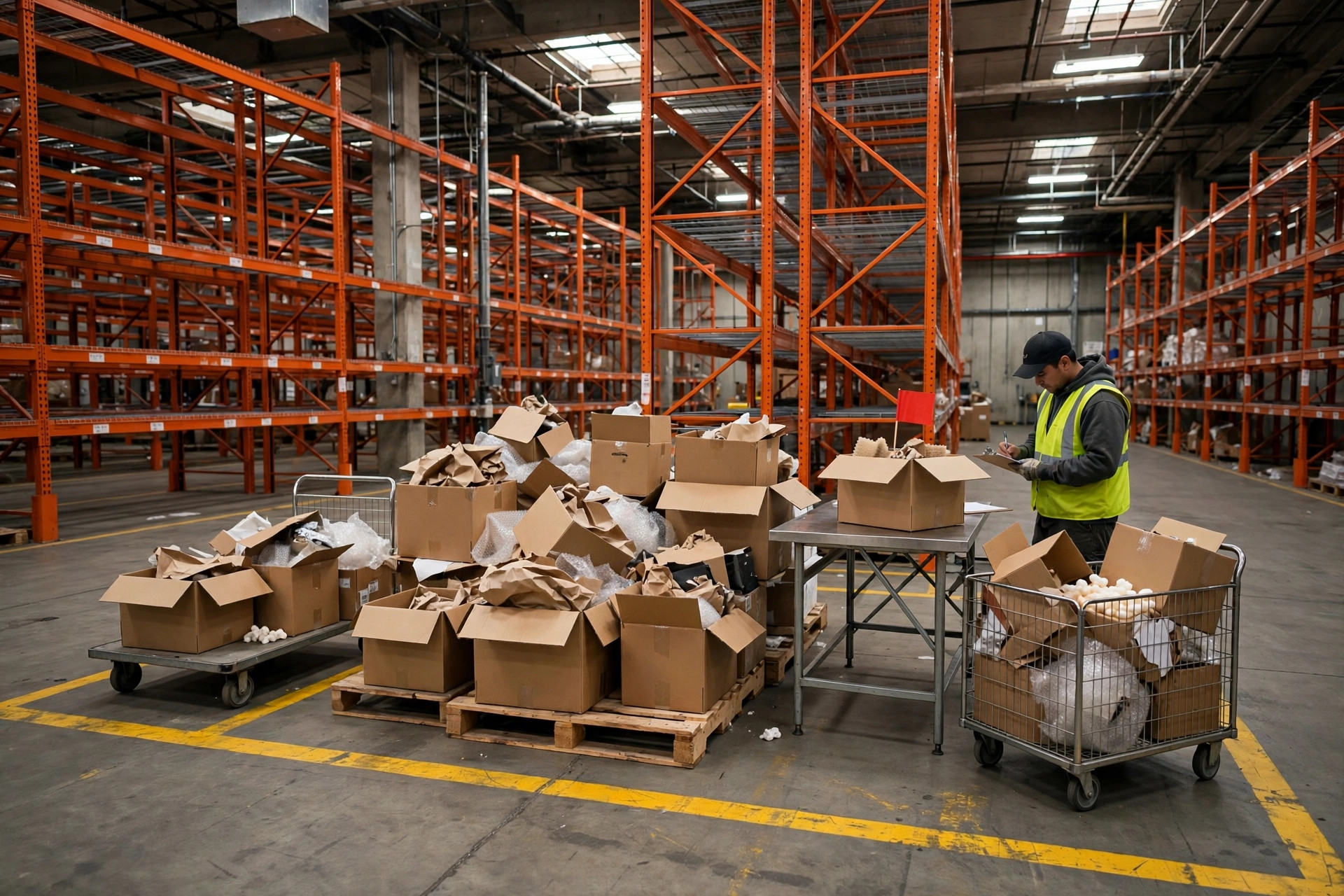
It was almost 2 a.m. on a night shift when I walked past the picking exception staging area at the end of our pick zone. Twenty or so items sat on the floor: boxes with flaps open, labels fallen off, location tags that didn't match the product underneath. One of my pickers, Li, stood there scratching his head. "Boss, I've walked that aisle three times. The order's still waiting to ship."
Anyone who's run a warehouse floor knows: picking exceptions look like a small problem until peak season turns them into a wrecking ball for your whole pick rhythm. When a picker can't find the goods, the fault usually isn't with the picker — it's with something that went wrong upstream. Today I'll walk you through exactly how my building handles it: where the unpickable items go, how they flow back onto the shelves, and how we review them every week. Steal anything that helps.
Before You Touch Anything: Sort Your Picking Exceptions Into Four Buckets
We used to make a dumb mistake: every exception item got tossed into the staging area in one big pile, "to deal with later." The pile grew, and soon nobody could tell which item belonged to which order.
So we made one hard rule: sort first, solve later. When a picker drops an item at staging, they decide which of four categories it falls into and stick on the matching colored tag before walking away. It looks like extra work. It saves hours down the line.
The four types we see on the floor:
- Phantom inventory — the system says the slot has stock, the picker arrives, the slot is empty. The nastiest one. Nine times out of ten, somebody mis-slotted the product during putaway, or an outbound transaction never posted.
- Wrong product — product in the slot, but not what the order calls for. Barcode doesn't match, or it just looks wrong.
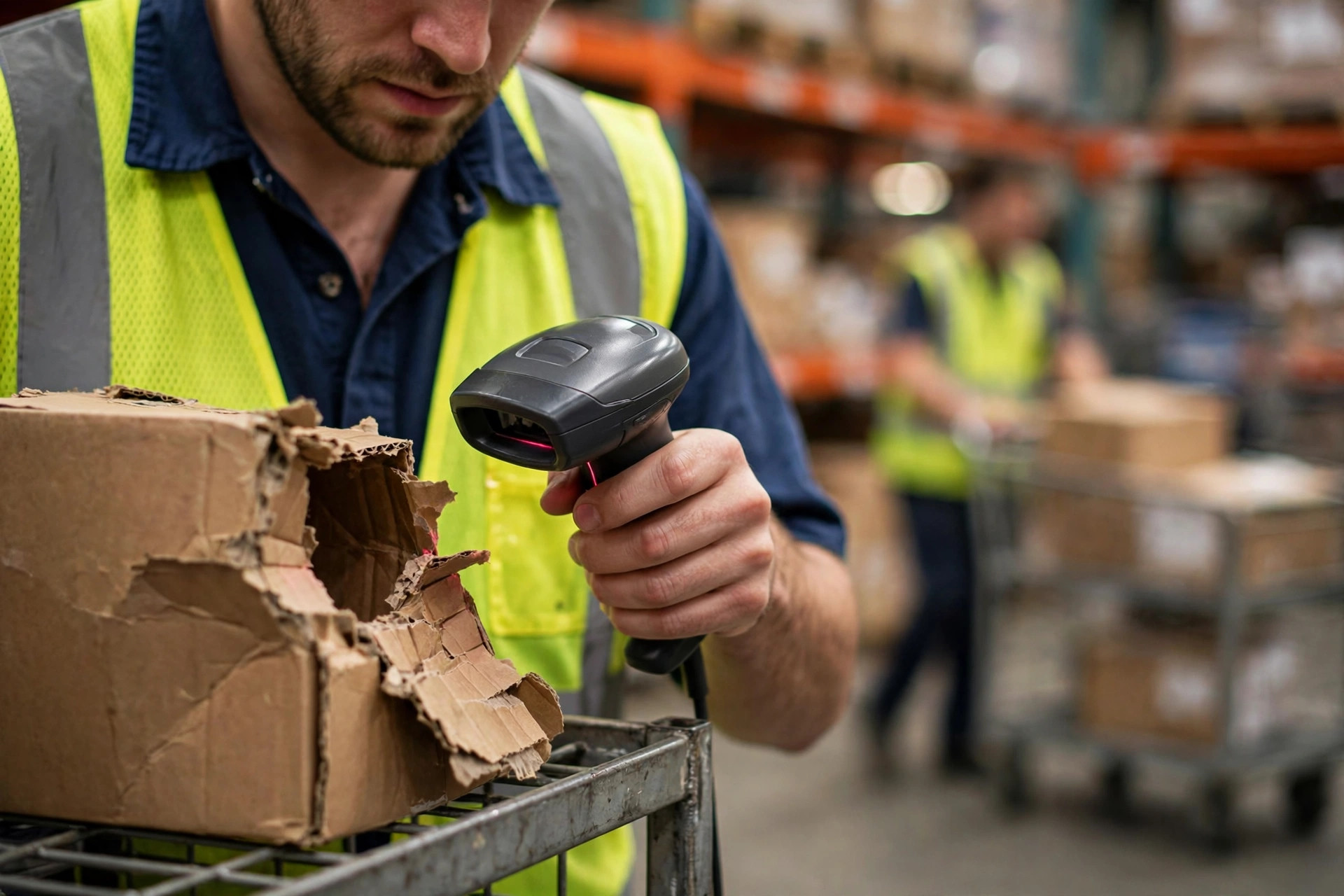
- Damaged or soiled — the product is there, but the carton is crushed, water-damaged, or the label is gone. Can't ship. Quarantine it.
- Unreadable barcode — right product, dead label. Wrinkled, faded print, sticker on upside down. The gun beeps at nothing.
Phantom inventory bit us hard last Black Friday. That Saturday after Thanksgiving, night-shift volume ran at more than double normal. A big order ground to a halt mid-pick: the system showed dozens of units of a small appliance on level three of Zone B. The picker walked over. Empty slot. He waited a dozen minutes, walked the neighboring slots twice. Nothing. The order shipped almost an hour late, and QA, packing, and loading all backed up behind it.
Next morning we pulled the footage. A new hire on day shift had taken a shortcut during putaway and dropped a full pallet into the same-numbered slot in the next aisle — A-12-3 versus B-12-3. He misread it. The goods were always there; they just weren't where the system said they were. The system count was right; the location was wrong. One misplaced pallet cost a night picker three round trips and held up a whole order.
After that we learned: when phantom inventory shows up, don't blame the picker. Check the putaway log and the location-move history first. The root cause lives upstream. The picker just takes the hit.
Exception Disposition: Four Bins, Four Destinations
Once the categories are set, each type gets a destination. Our method is low-tech but it works: four colored totes in the staging area — red, yellow, blue, green — one per type, with the handling flow posted on the wall. New hires memorize it on day one.
| Exception type | How we confirm it | Where it goes | Owner | Deadline |
|---|---|---|---|---|
| Phantom inventory | Slot empty, system shows stock | Check putaway log for mis-slots; put back once found; cycle-count if not found | Exception handler | Same shift |
| Wrong product | Barcode/appearance doesn't match | Quarantine, photo for the record, re-slot under the correct SKU or move to returns | Exception handler | Same shift |
| Damaged/soiled | Crushed carton, moisture, missing label | Repack or relabel and put back if salvageable; scrap or claim if not | QA inspector | Within 24 hours |
| Unreadable barcode | Right product, won't scan | Reprint label on the spot, verify with a scan, put back directly | Pick lead | As it arrives |
Look at the owner column. The person who resolves the exception is never the picker who found it. We learned that the painful way.
Two years ago we tried "you find it, you fix it": the picker who hit an exception went hunting for the product, found a lead, reprinted a label. One exception ate twenty to thirty minutes of pick time, and every normal order in their queue sat frozen. A peak-season shift with thirty or forty exceptions burned most of a person's day on a handful of problem items while good orders piled up.
Now the rule is: the picker finds an exception, tags it, drops it in the matching tote, and moves to the next order. Not one minute of delay. Staging gets cleared by a dedicated exception handler — we call him the "sweeper" — who works it in batches, twice in the morning and twice in the afternoon. Bulk resolution, bulk put-back.
Here's the counterintuitive part: the goal isn't to resolve exceptions as fast as possible — it's to resolve them with minimum disruption to the main flow. Instinct says "fix it the moment you see it." But in picking, a picker's time is some of the most expensive labor in the building. Trading it to clear a few exceptions is a losing deal. The right move is to lift exceptions out of the main process and digest them in a small side process while the main line never stops.
One condition: staging must hit zero every day. No overnight carryover. An exception that sleeps overnight is one nobody can explain the next morning — which order, what happened, all gone. Our iron rule is same-day clearance. If the sweeper can't clear it before clocking out, it escalates to me.
Put-Back: The Way We Do It Now
Resolved exceptions that are still sellable go back on the shelf. Put-back is where second accidents happen — you finally recovered the item, then slot it in the wrong location, and the cycle starts over.
Our put-back rules, three of them:
First, every put-back gets a scan confirmation. The handler scans the location code, then the product code, and the system has to agree before it counts as slotted. No going by memory. Memory is the least reliable thing in the building during peak season.
Second, recovered mis-slots get a two-person check. Like that A-12-3 versus B-12-3 case: once the product is found, the handler and the pick lead confirm location and quantity together, both tapping confirm in the system. It's a hassle. But phantom inventory is almost always a putaway mistake, and without the double check you're doing the work twice.
Third, put back to the original slot whenever possible. Unless the original slot is genuinely full, don't take the lazy route and stuff it into the nearest open space. A product that wanders from slot to slot will eventually break the match between system count and physical count — and then you're staring at a fresh round of phantom inventory.
The Weekly Review: Picking Exception Review Is Really Just Five Questions
Daily clearance treats the symptom. The weekly review treats the disease. Every Monday meeting, we spend twenty minutes on last week's exception log: date, type, SKU, location, root cause, handler. Exactly five questions:
- Which exception type showed up most last week?
- Did the same SKU keep appearing? If yes, something is broken in that SKU's putaway process.
- Did the same location keep appearing? If yes, go look at it — missing location tag, dim lighting, numbering that's easy to misread?
- Did the same new hire keep making the same mistake? If yes, that's a training problem, not a discipline problem — and the veteran mentoring them needs to change approach.
- What's the one thing we change this week? Just one. Change five things and you've changed nothing.
Question four matters most to me. We have a veteran on my floor, seven or eight years in, a human map — he knows every corner slot by heart. Last year a new kid mis-slotted for two straight weeks, three phantom-inventory incidents. I didn't chew him out. I had the veteran walk putaway shifts with him for a week, teaching him to read location codes and scan-confirm, step by step. The kid hasn't mis-slotted since.
Trace a picking exception to its root and seven times out of ten it's a people issue, three out of ten a process issue, almost never a system issue. But people issues don't get fixed by yelling. They get fixed by mentoring and by process guardrails. One new hire mis-slotting might be carelessness. Three new hires mis-slotting in the same spot means your numbering scheme or your training is broken.
One last reminder for my fellow managers: don't underestimate those few dozen items in staging. Every exception is one upstream process failure with a barcode on it. Resolve it and you've saved an order. Review it and you've saved the next hundred. Our exception volume is a fraction of what it was two years ago — not because our pickers got sharper, but because the weekly review plugged the upstream holes one by one.
Tomorrow morning, go stand in your exception staging area for five minutes. Look at what's sitting there and ask how each piece got there. The answers will probably surprise you.
By Chen Feng, Warehouse Operations Manager