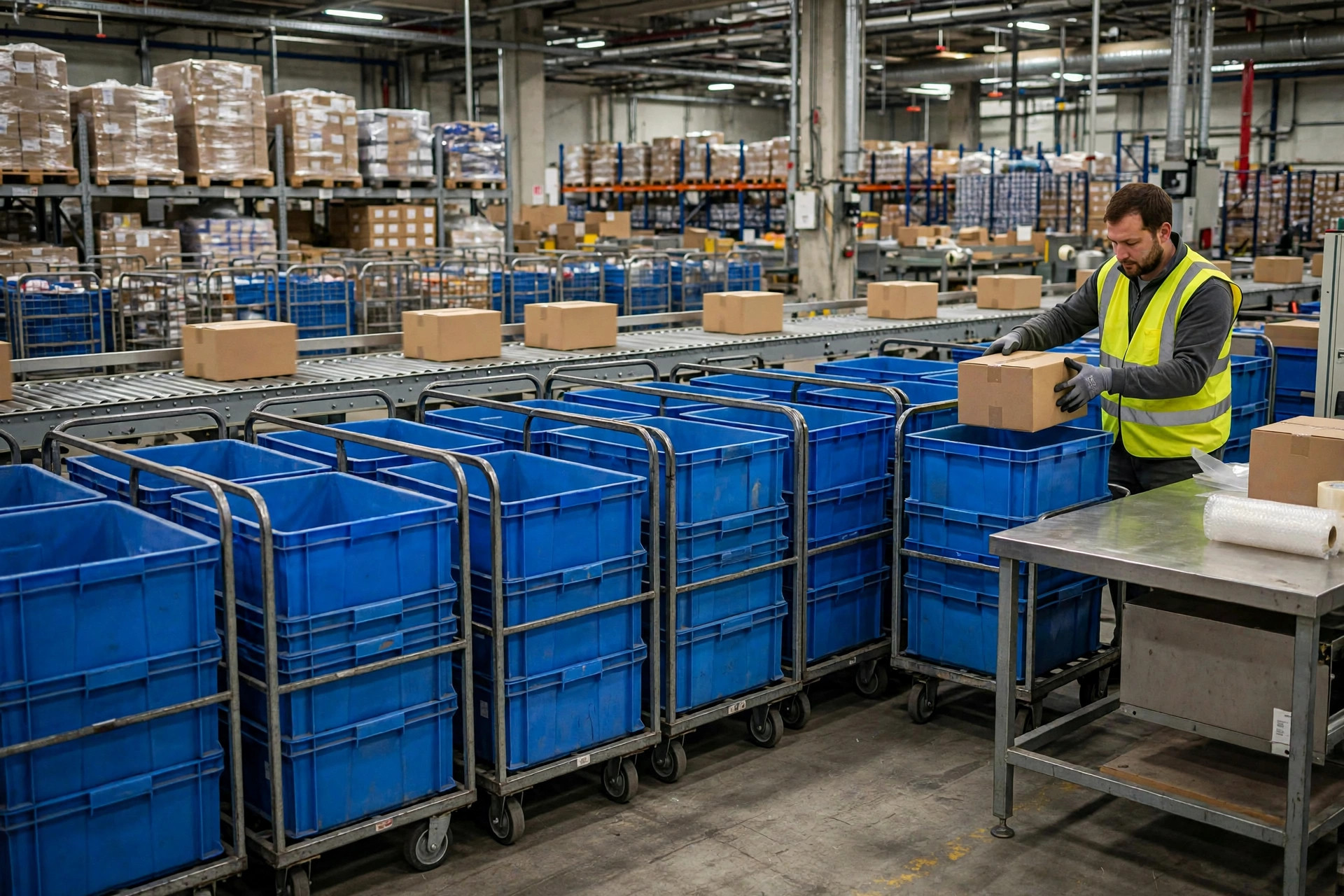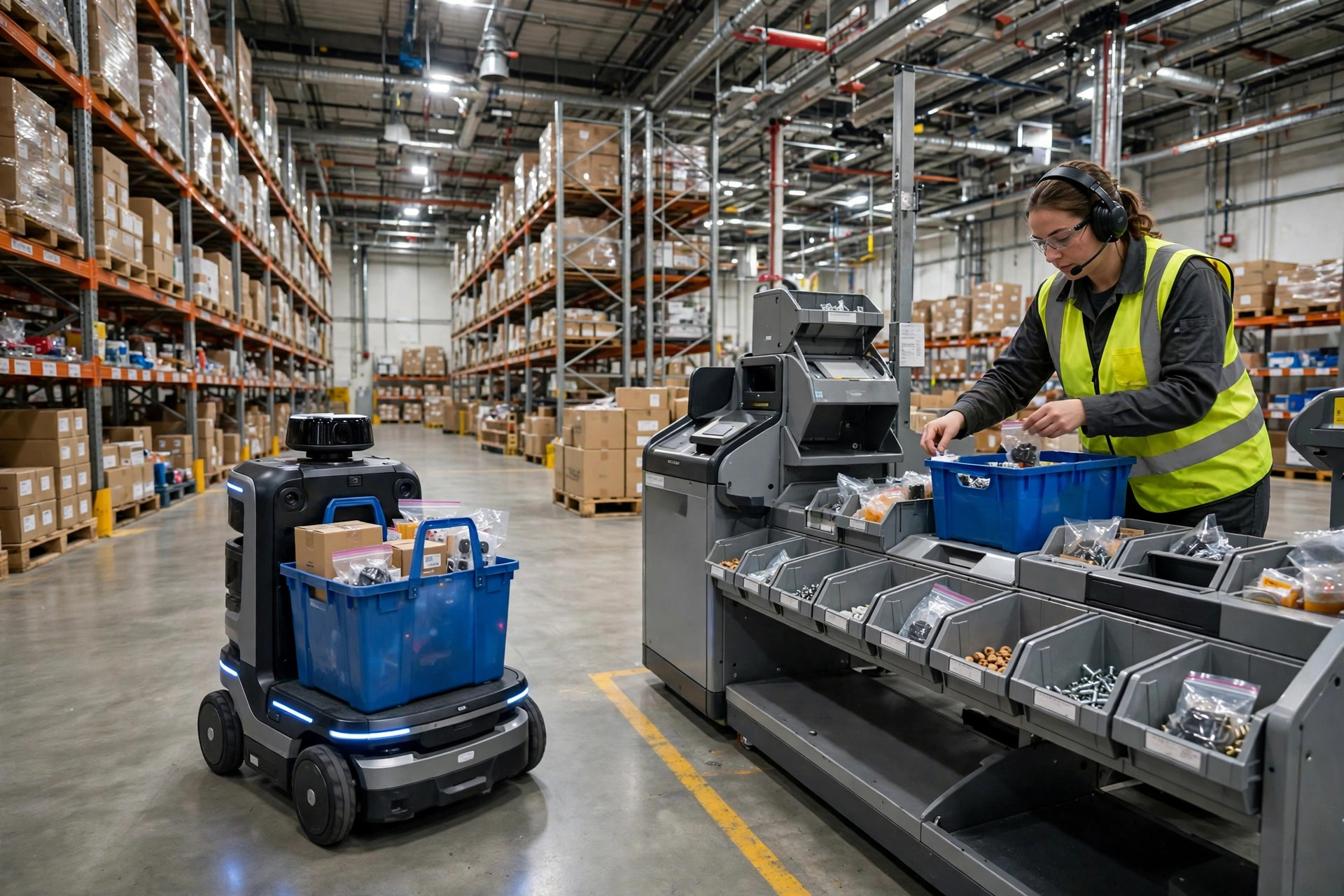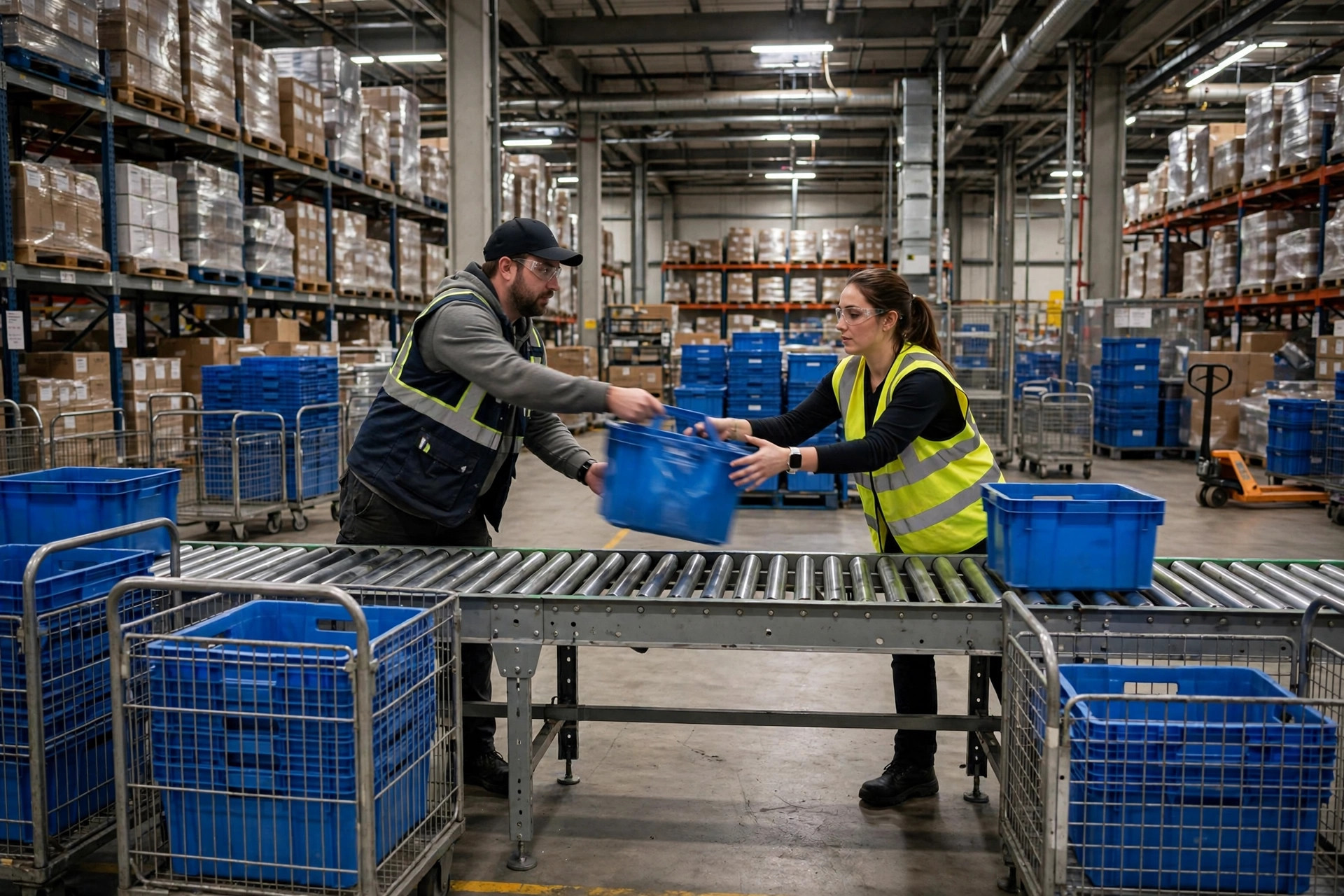
Think of pick and pass order picking like a 4x100m relay race. The order is the baton. It travels from Zone 1 to Zone 2 to Zone 3, and each picker only runs their own leg — pick the SKUs for their zone, then hand the tote to the next runner. Sounds elegant. But what kills relay teams? Dropped baton exchanges. Same in the warehouse: if one zone's takt time falls behind, the whole order stalls mid-route and everything behind it queues up.
How Pick and Pass Works
The principle is simple: divide the warehouse into pick zones by SKU velocity or product category. Orders travel in totes along the pick path, passing through each zone in sequence. Pickers stay in their zone, pick only their SKUs, then release the tote downstream. Once the tote clears every zone, the order is complete and goes straight to pack-out.
You can understand it as an automotive assembly line. A car moves from station 1 to station 10; each station installs only its parts. The car never stops, the workers never move — the work flows.
The difference from the other two models, in one sentence each: classic zone picking splits the order across zones, picks in parallel, then consolidates — and the consolidation area is the bottleneck. Batch picking has one picker grab goods for dozens of orders in a single trip, which works when lines per order are tiny. Pick and pass is "one order walks through many zones" — the order itself moves, so there is no consolidation step. Eliminating consolidation is its biggest temptation, and also its biggest risk: that buffer you removed was exactly what used to hide unbalanced takt times.
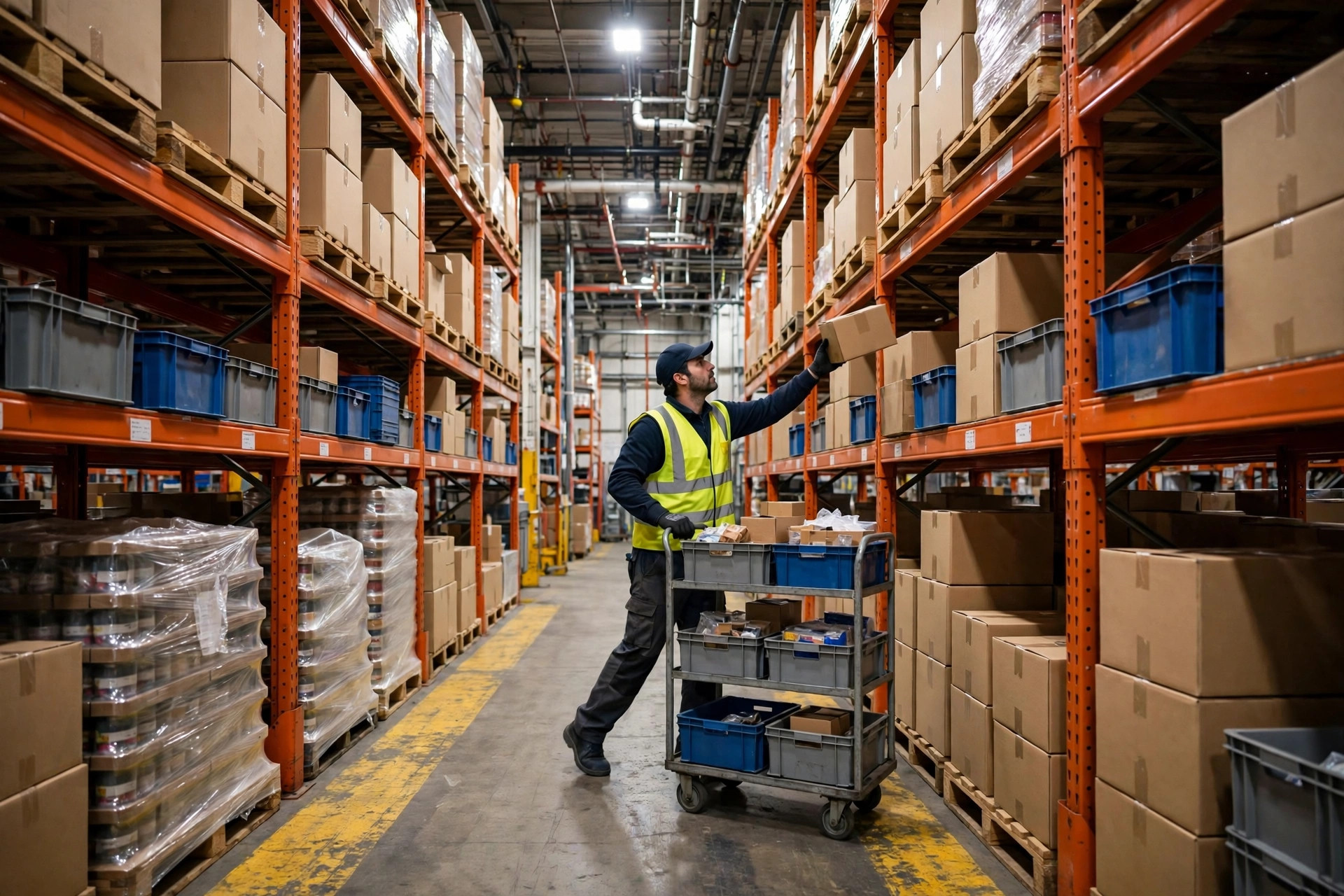
Two Real Warehouses: One That Flew, One That Jammed
In 2023, an apparel e-commerce warehouse in Dongguan, Guangdong — roughly 3,500 SKUs, 8,000 orders a day, 2.3 lines per order — ran parallel zone picking with consolidation. Every afternoon the consolidation area exploded, and the mis-ship rate hit 8 per 10,000 orders. They switched to four pick-and-pass zones with a powered conveyor moving totes between them. Three months in: productivity rose from 120 to 190 units per hour, six consolidation positions were eliminated, and mis-ships dropped to 3 per 10,000. Why did it work? Apparel velocity is relatively even across zones, so takt times balanced. The project lead told me: "Once the line is running, the totes walk themselves downstream. We just pick."
The cautionary tale came in early 2024 from a cosmetics warehouse in Zhejiang: 2,800 SKUs, 5,000 orders a day, copying the same playbook. But 65% of order lines concentrated in the hero-product zone (Zone A), with Zones B and C seeing barely any picks. Within a week it fell apart: Zone A pickers were crushed, totes queued at Zone A, Zone B pickers stood idle. Throughput dropped below the old system. They had to split Zone A into two parallel stations, A1 and A2 — an express lane at the worst bottleneck — before takt times leveled out. The lesson in one line: SKU distribution decides whether pick and pass lives or dies. Forcing it onto a warehouse with lopsided velocity means paying to build your own traffic jam.
The Selection Line: Pick and Pass vs Zone Picking vs Batch Picking
Don't let an integrator sell you "the most advanced model." Selection comes down to three sets of numbers: order profile, SKU distribution, and volume thresholds.
| Dimension | Pick and Pass | Zone Picking (parallel + consolidate) | Batch Picking |
|---|---|---|---|
| Order profile | 2–6 lines per order, SKUs spanning zones | Many lines per order, cross-zone | 1–2 lines per order |
| SKU velocity distribution | Balanced across zones (critical) | Doesn't matter, consolidation absorbs it | Long tail is fine |
| Daily volume threshold | Pays off above ~3,000 orders/day | Works from 1,000 to 5,000 | 5,000+ small-item high-frequency |
| Labor structure | No consolidation roles, but every zone must be staffed | Consolidation is a labor black hole | Fewest people |
| System requirements | WMS must support zone-sequenced release and jam alerts | Consolidation logic must be solid | Wave logic must be solid |
My dividing line, stated bluntly: around 3 lines per order, SKU velocity reasonably balanced across zones, daily volume above 3,000 — that's the sweet spot. Single-line small-item warehouses should go batch picking. Warehouses with severely skewed SKUs should fix ABC slotting first and put pick and pass on hold. Force it without matching these three criteria and you'll most likely die on jams.
Three Ways to "Pass": Conveyor vs Manual vs AMR — the Investment Math
The "passing" itself has three implementations, with costs differing by an order of magnitude.
| Method | Speed / takt | Investment scale | Fits | Biggest trap |
|---|---|---|---|---|
| Powered conveyor | 0.5–1.0 m/s, continuous flow | ~$200–400 per meter; a full line starts in the tens of thousands | 5,000+ orders/day, fixed pick path | One fault stops the whole line; rerouting means tearing it out |
| Manual pass (carts / hand-to-hand) | ~80–120 totes/hour per person | Near zero | Under 3,000 orders/day, pilot phase | Wrong-zone passes, lost totes; high hidden management cost |
| AMR / mobile robots | ~60–100 totes/hour per unit | Tens of thousands per unit, system in the hundreds of thousands | Changing paths, multi-floor | Scheduling algorithm is the whole game; charging eats uptime |
Run the numbers: an 80-meter powered conveyor at $250 per meter is $20,000 in equipment, plus installation and controls — landing near $35,000–40,000. For 8,000 orders a day, lifting productivity from 120 to 190 UPH saves 4–5 pickers; payback comes in just over a year. But at 2,000 orders a day? The labor savings won't cover a $40,000 line in a decade, and the conveyor sits half-empty.
So here's my rant: a small warehouse doing two or three thousand orders a day installing a conveyor-based pick and pass system is a textbook fake requirement — it serves nobody except the integrator cashing the check. Start with manual passing and carts, prove the flow, and only talk conveyors once volume justifies it. Get the sequence backwards and you're burning cash.
The Counter-Intuitive Truth: More Zones Kill Faster
The instinct says "finer zones mean more specialization, more speed." Wrong.
System takt time in pick and pass equals the takt time of the slowest zone. The math: with 4 zones, each jam-free 95% of the time, an order passes all 4 zones without queuing with probability 0.95^4 ≈ 81% — one in five orders queues somewhere. With 8 zones it's 0.95^8 ≈ 66% — one in three jams. That's why experienced engineers cap zones at 3 to 5, staffing two pickers in parallel in one zone rather than opening another.
Remember this: pick and pass optimizes flow, not division granularity. Fewer zones are more stable, not less advanced. Any proposal offering "8 zones, 12 zones" — ask for the jam probability math first.
Maintenance Pits: When the Line Stops, the Whole Warehouse Stops
First, conveyor uptime. Powered conveyors advertise MTBF in the tens of thousands of hours, but roller motors and photoelectric sensors are consumables. No backup motors and sensors in the spares cabinet, and one failure stops you for half a day. A line at 99% availability sounds great — 300 days × 16 hours = 4,800 hours a year, and 1% is 48 hours of downtime. Forty-eight hours in peak season and your big promotion collapses. Lock the spares list at acceptance.
Second, scanning. A missed or double scan at a zone read point corrupts the tote's identity. My hard requirement: scan success rate above 99.9%, and any tote that fails to scan gets auto-diverted to an exception lane. Never let the system "guess."
Third, WMS wave release. Pick and pass dies when the WMS releases too much at once and work-in-process chokes the line. The veteran's parameter: cap line WIP at zones × one zone's 10-minute capacity. This must be tunable — peak and off-season are not the same number.
Fourth, people. A picker doing one zone gets stale in about 3 months — speed rises, then declines. A rotation schedule is mandatory, or the UPH curve sags after six months. In pick and pass, people are still the core engine.
Closing: Whether the Money Was Worth It Comes Down to One Number
The jam rate — the share of orders queued more than 5 minutes at any zone. In the first month after go-live, check it weekly: under 5% means takt times are balanced and the money was well spent. Above 10%? Don't add headcount — go back and re-zone, re-slot the SKUs. Zone it right and pick and pass is a money printer. Zone it wrong and it's the most expensive bottleneck generator in the building.
By Da Liu, Automation Engineer