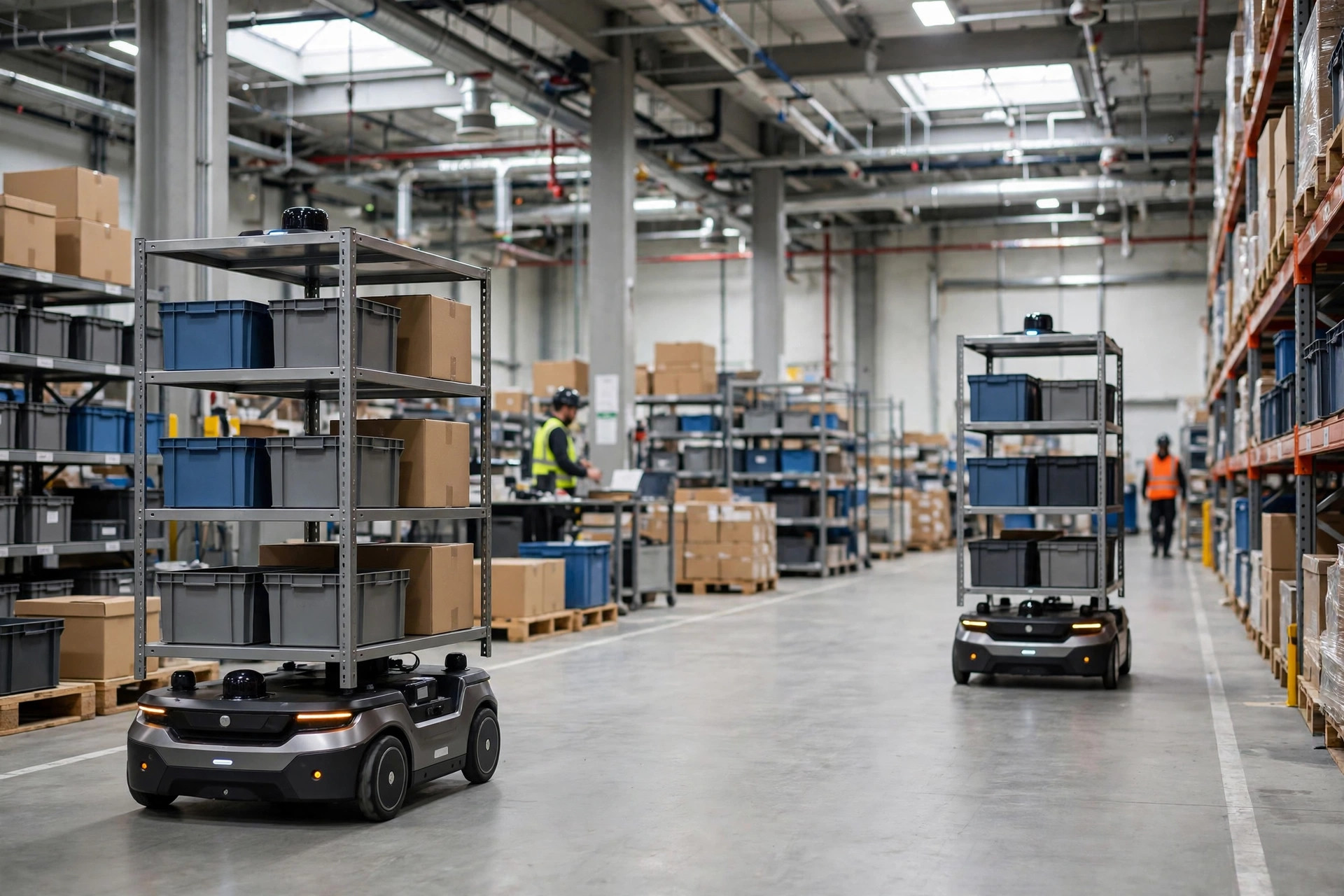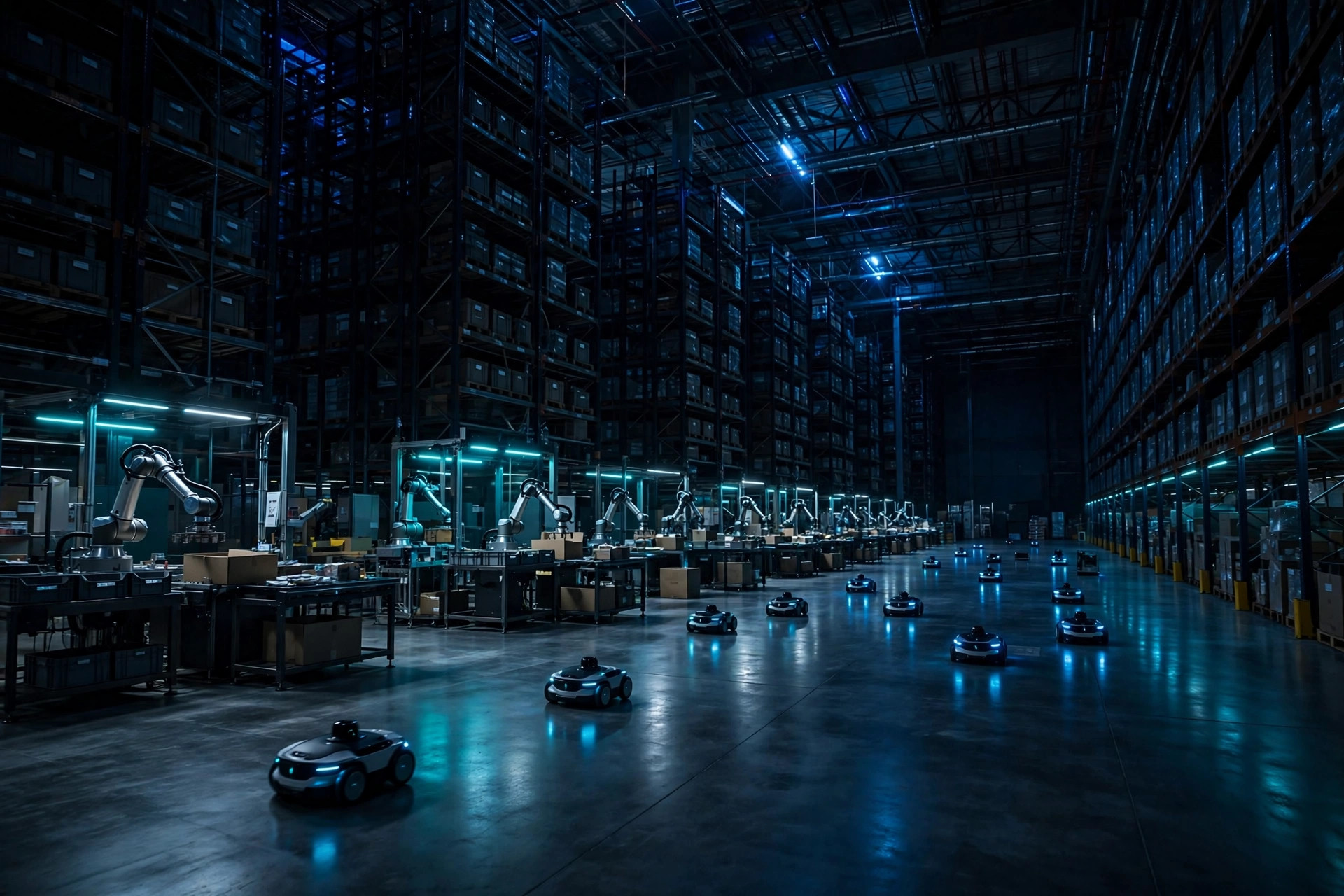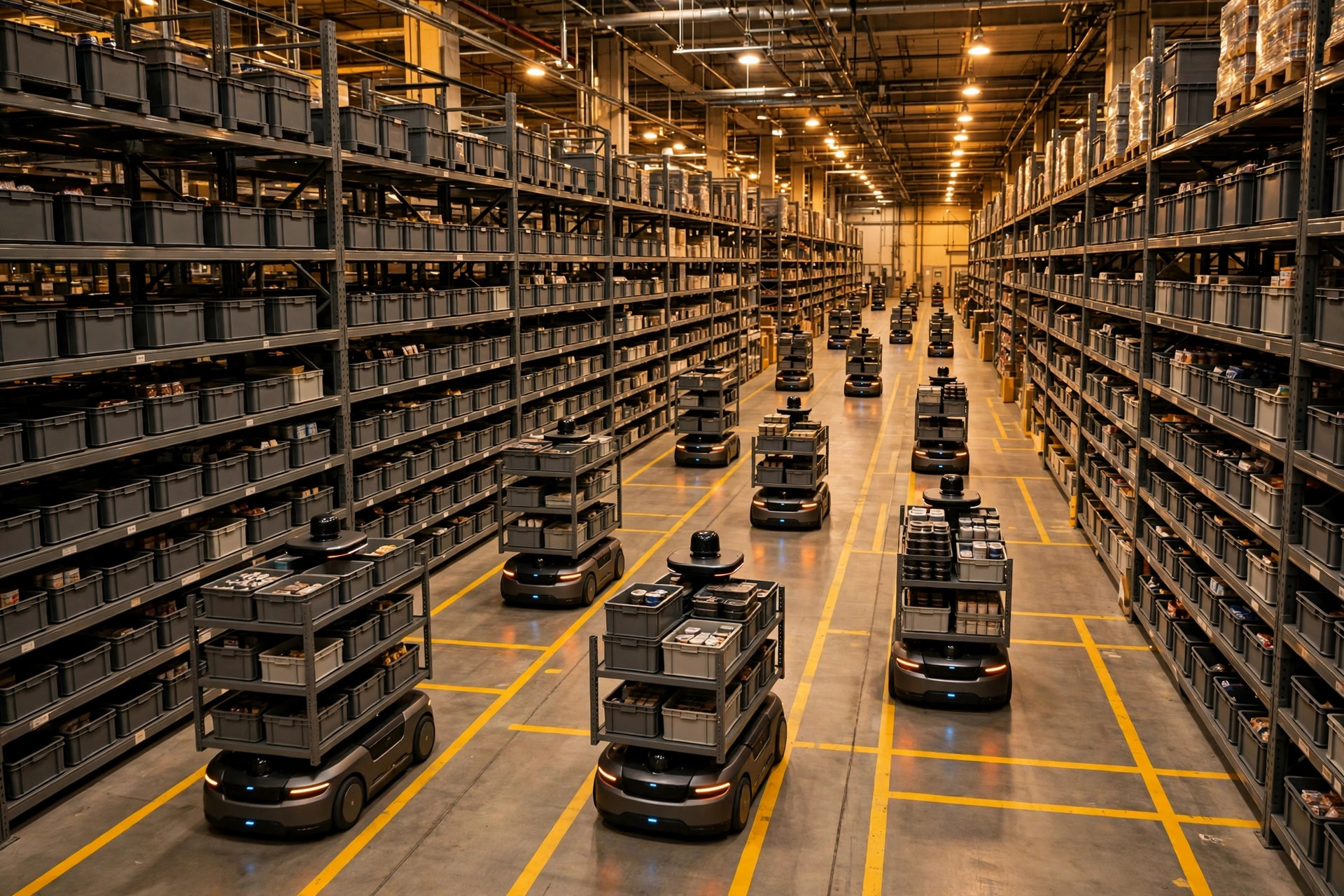
Here's a number that stings: in the goods to person vs person to goods debate, the same GTP system runs 420 units per hour at Warehouse A and 240 at Warehouse B. Same robots. The difference? The workstation. In my experience, 90% of GTP projects spend the money on robots and bury the problems in the workstation.
You can think of it this way: in a goods-to-person setup, the robots are just delivery drivers. What decides how fast you eat is the design of the table. An awkward table wastes even the fastest driver.
What goods to person actually does
In classic person-to-goods picking, operators push carts up and down the aisles — travel eats 60% or more of a picker's time, a figure you'll find repeated across industry reports. Goods to person flips it: AMRs or shuttles bring the tote to the station, and the operator stands still doing three motions — pick, scan, place.
It's like putting wheels on supermarket shelves so they queue up at the checkout while the cashier stays put.
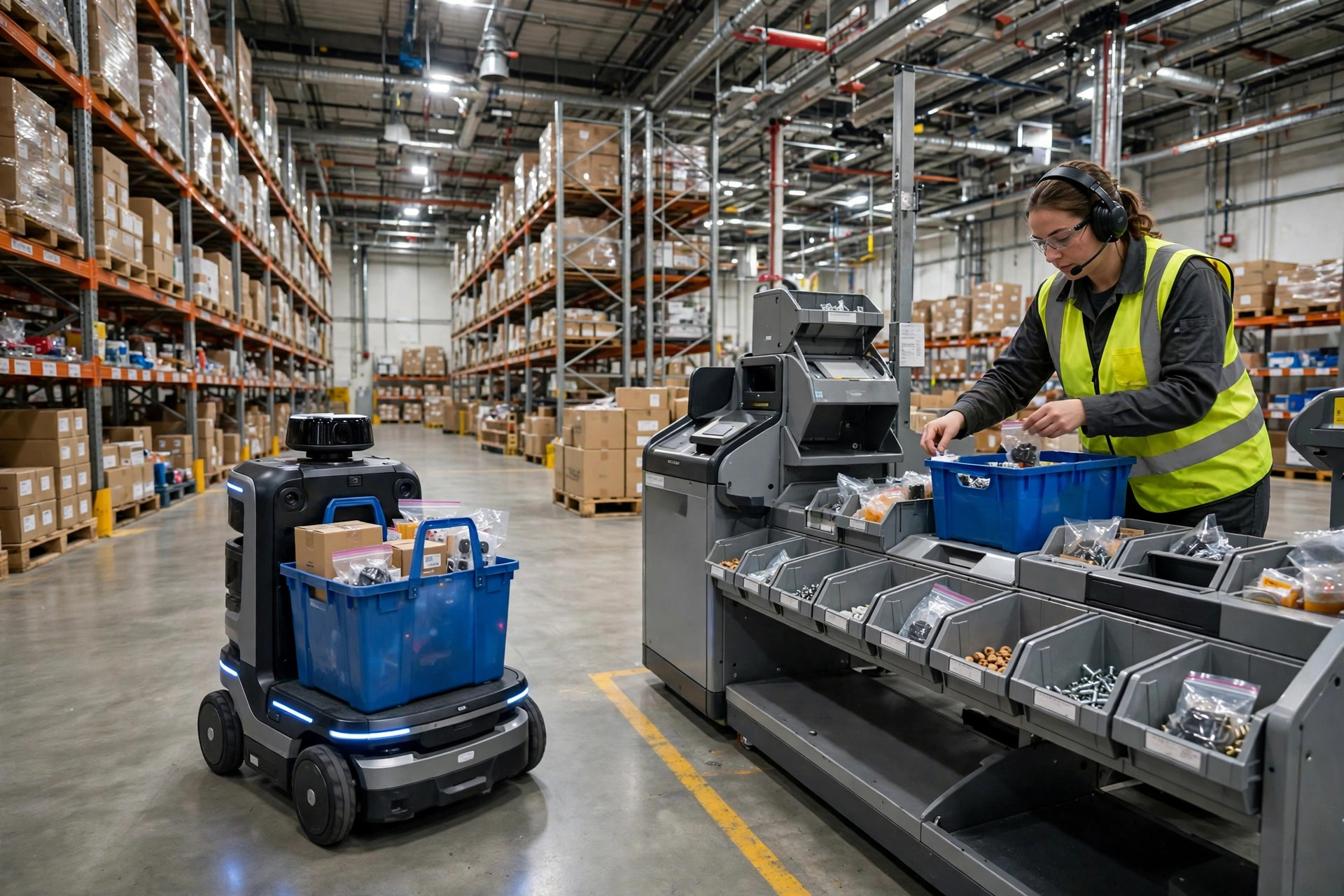
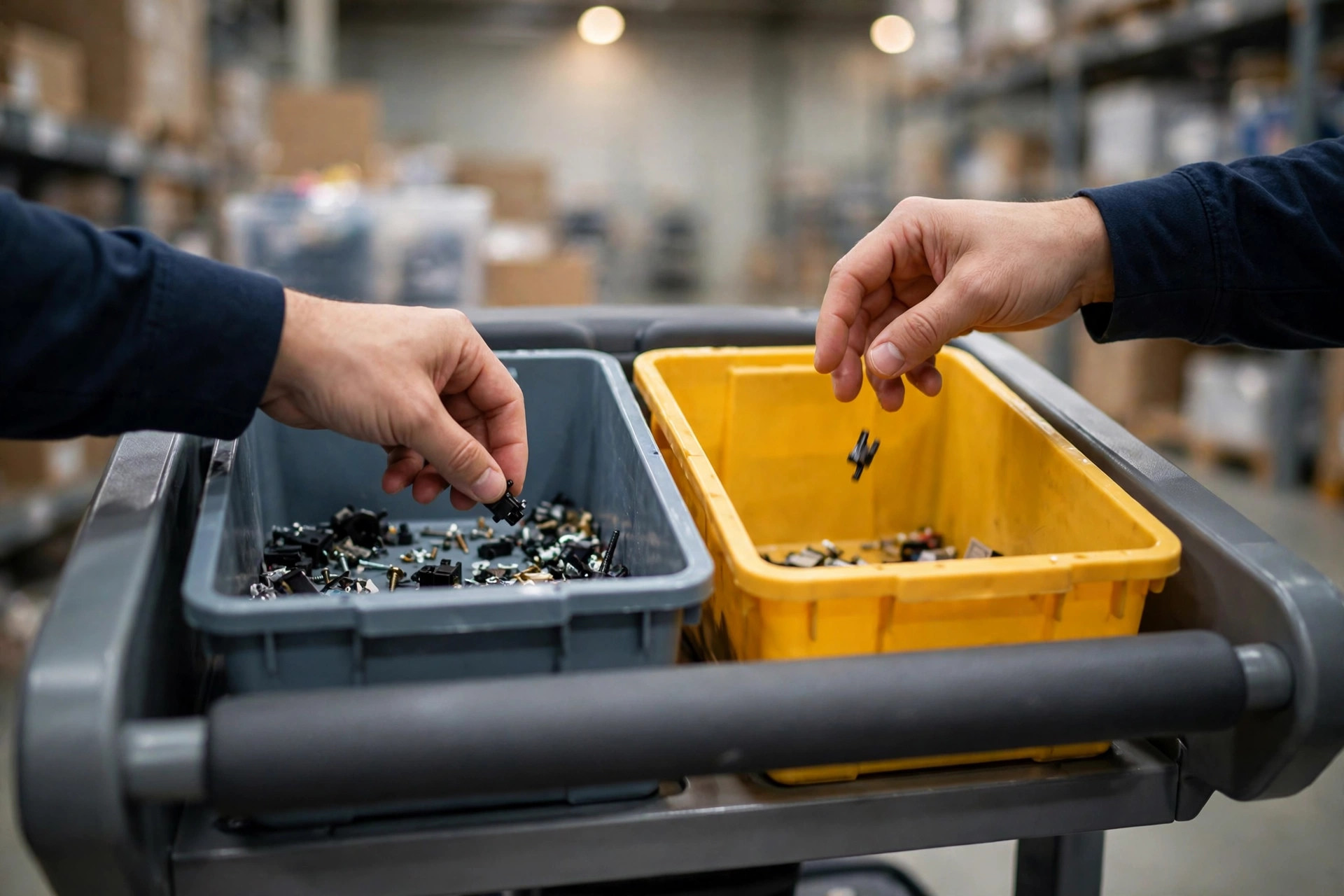
A standard GTP workstation: one or two pick faces with totes at waist height (adjustable is better), 4–8 buffer positions behind it where robots queue for their turn, a scanner, and a screen telling you "take 3 units from Tote A, drop into Order Tote B."
The takt math: robot delivers tote → operator picks → scans → places → empty tote cycles out. A human pick cycle runs 6–10 seconds in practice; that's 360–600 theoretical picks per hour, and after you factor in hit rate and robot wait time, real-world stations land at 300–450 UPH — the range you'll see across published integrator case data.
AMR or shuttle? One line: AMRs are taxis — flexible, easy to scale by adding units, great for irregular layouts or if you might relocate. Shuttles are subways — faster, steadier takt, but once the rails are in, the layout is frozen; they suit tall racking in long-term facilities. Both are just "delivery drivers" — don't agonize over brands before you know your floor plan and lease term.
Goods to person vs person to goods: where's the line?
Time to take aim at a pseudo-requirement: GTP is not a magic efficiency pill. The worst project I ever saw: a food distributor doing 800 orders a day, under 500 SKUs, 70% full-case picks — and they bought GTP anyway. The robots spent all day parading full cases around the floor, and UPH came in lower than the old manual process. That money basically funded the integrator's sales quota.
The line comes down to four things:
| Dimension | Go goods to person | Stay person to goods |
|---|---|---|
| Daily volume | 3,000+ orders/day and growing | Under 2,000/day, volatile |
| SKU count | 2,000–20,000, spread-out velocity | Under 1,000 SKUs, or 80%+ full-case orders |
| Order profile | Split-case heavy, 3+ lines per order | Single-line or full-case dominant |
| Waves | Stable, plannable waves | Orders drip in all day |
The core logic in one line: GTP buys you the elimination of travel time. If your orders barely involve travel — full-case picks, few SKUs, a compact pick zone — your robots are just taking expensive walks.
Case: a 3C accessories DC in Dongguan, 2023. 9,000+ SKUs, 14,000 orders a day, 4.2 lines per order on average. Twelve AMRs and four workstations, measured at 380 UPH per station — more than triple the old manual rate, because travel time dropped from roughly 65% to near zero. That's the GTP comfort zone.
Counter-case: a general-merchandise warehouse in Yiwu, 2022. 20,000 SKUs looked perfect on paper, but 80% of orders shipped full case. After go-live, robots shuttled full cases back and forth while operators finished each pick in five seconds and then stood waiting for the next robot. The bottleneck moved from "people walking" to "robots queuing." UPH beat manual by only 30%, and the payback math came out to seven years. What integrators won't tell you: GTP's worst enemy isn't low volume — it's "too tidy" freight.
Workstation design: the devil lives in the buffer
Get the principle and the selection right, and the workstation is still where most projects die.
Pitfall one: not enough buffer positions. Robots arrive on takt; a station needs at least four buffer slots — one being picked, one waiting, two in transit or returning. Cut it to two and robots queue in the aisle: system uptime still reads 99%, effective output drops 20%. It's like a restaurant with two tables — the kitchen can be lightning fast, but guests just stand around.
Pitfall two: ergonomics. An operator repeats pick-and-place thousands of times a day; a tote position 10 cm off means thousands of extra bends. I saw a DC that squeezed its high-velocity tote position down to knee height to save 30 cm of width — four pickers quit in three months. Recruiting cost more than the floor space they saved.
Pitfall three: dual stations aren't a cure-all. Two pick faces per operator can lift UPH another 30% in theory, but only if inbound takt keeps up. When the wave peaks and both faces wait for totes, people start checking their phones. My advice: run single-face for three months, prove with data that inbound isn't the bottleneck, then go dual.
One maintenance note on its own: for AMRs running laser or QR-code navigation, the floor is everything. Dusty concrete and worn QR codes mean 5 cm of drift — enough to miss a grab. Most warehouses budget robot maintenance but forget floor maintenance: concrete patching and QR code replacement run into the tens of thousands a year. And charging: confirm the site's transformer headroom before the equipment arrives, not after, or you'll discover the power isn't there.
The uncomfortable truth: doubled UPH doesn't mean halved cost
One last counterintuitive point: taking UPH from 100 to 400 doesn't necessarily cut your cost per pick. Robots depreciate, charge, need maintenance, and occupy space — the charging and buffer zones eat floor area, and rent is money too. Across the projects I've costed, GTP usually cuts cost-per-pick by 20–40%, far less sexy than the UPH multiple suggests.
So is the money worth it? Watch this one number: put your three-year volume forecast, labor cost trend, and total robot cost of ownership (equipment + implementation + three years of maintenance + floor rent) into one sheet and compute cost per pick. If that number drops, go. If it doesn't, your order profile isn't there yet — do ABC slotting and location optimization first. That's a free 30% improvement.
Don't automate for automation's sake. The robots don't deserve the blame.
By Da Liu, Automation Engineer