Among all deviation events in pharmaceutical warehousing, the pharmaceutical cold chain temperature excursion warehouse scenario is the one most often underestimated on the floor. The temperature curve has crossed its limit, yet the product looks completely unchanged, so the first instinct is to wait and see. Industry post-incident reviews suggest that this hesitation is precisely where risk compounds. One boundary should be stated at the outset: the warehouse is not the party qualified to decide whether the product remains acceptable. That decision belongs to the product owner's quality function, based on product-specific stability data. The warehouse's responsibility is to make that decision possible — with evidence. Where regulatory specifics are uncertain, the owner's quality agreement and the latest local regulatory requirements govern; this article addresses only the warehouse-side logic.
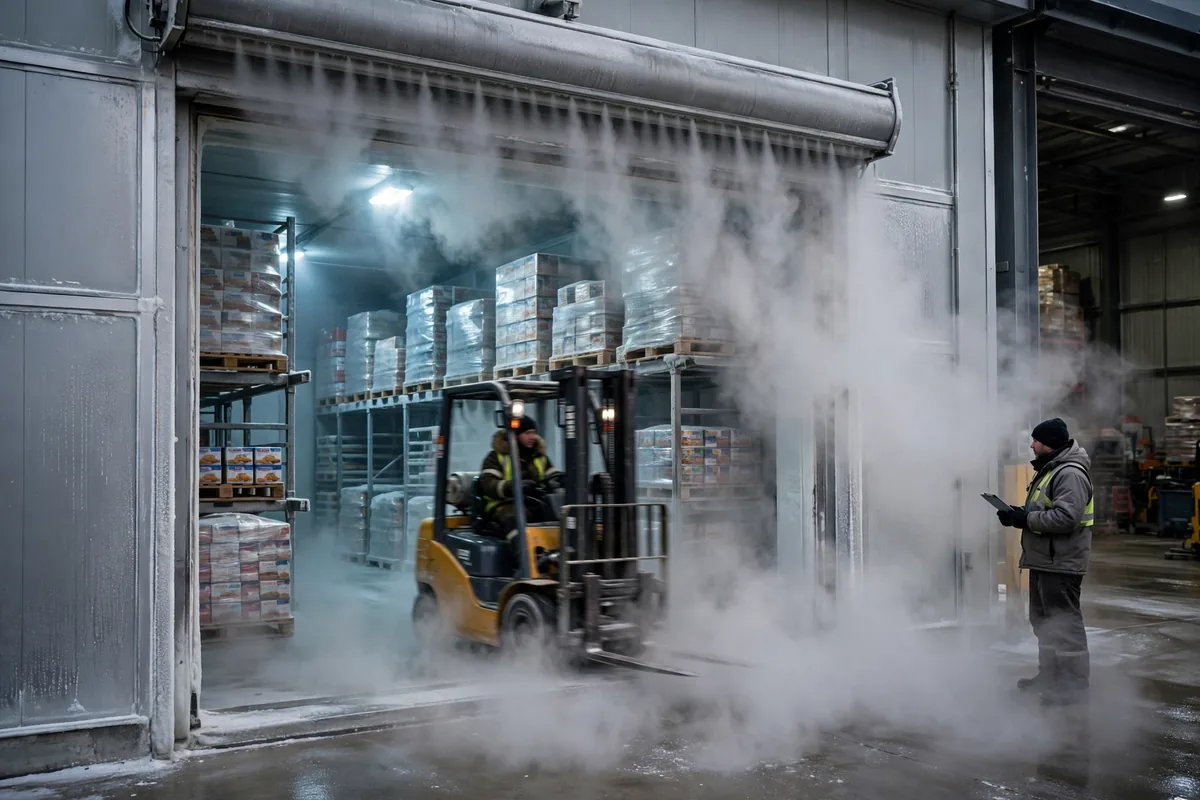
In the summer of 2022, during an exceptional European heatwave, a third-party pharmaceutical warehouse in the Netherlands experienced sustained elevated temperatures in a cold room over a weekend. According to staff involved in the subsequent review, the monitoring system did raise alerts, but the on-duty procedure did not distinguish a sustained excursion from a brief fluctuation, and the affected stock was not formally quarantined until a further shift had passed. No patient impact was identified, but the owner's audit finding was not about temperature at all. It was about the timeline: the intervals between excursion, detection, and quarantine could not be fully reconstructed. The case illustrates a structural point — in excursion handling, the primary problem is rarely the temperature itself. It is the chain of evidence.
Pharmaceutical cold chain temperature excursion response: quarantine first, judge later
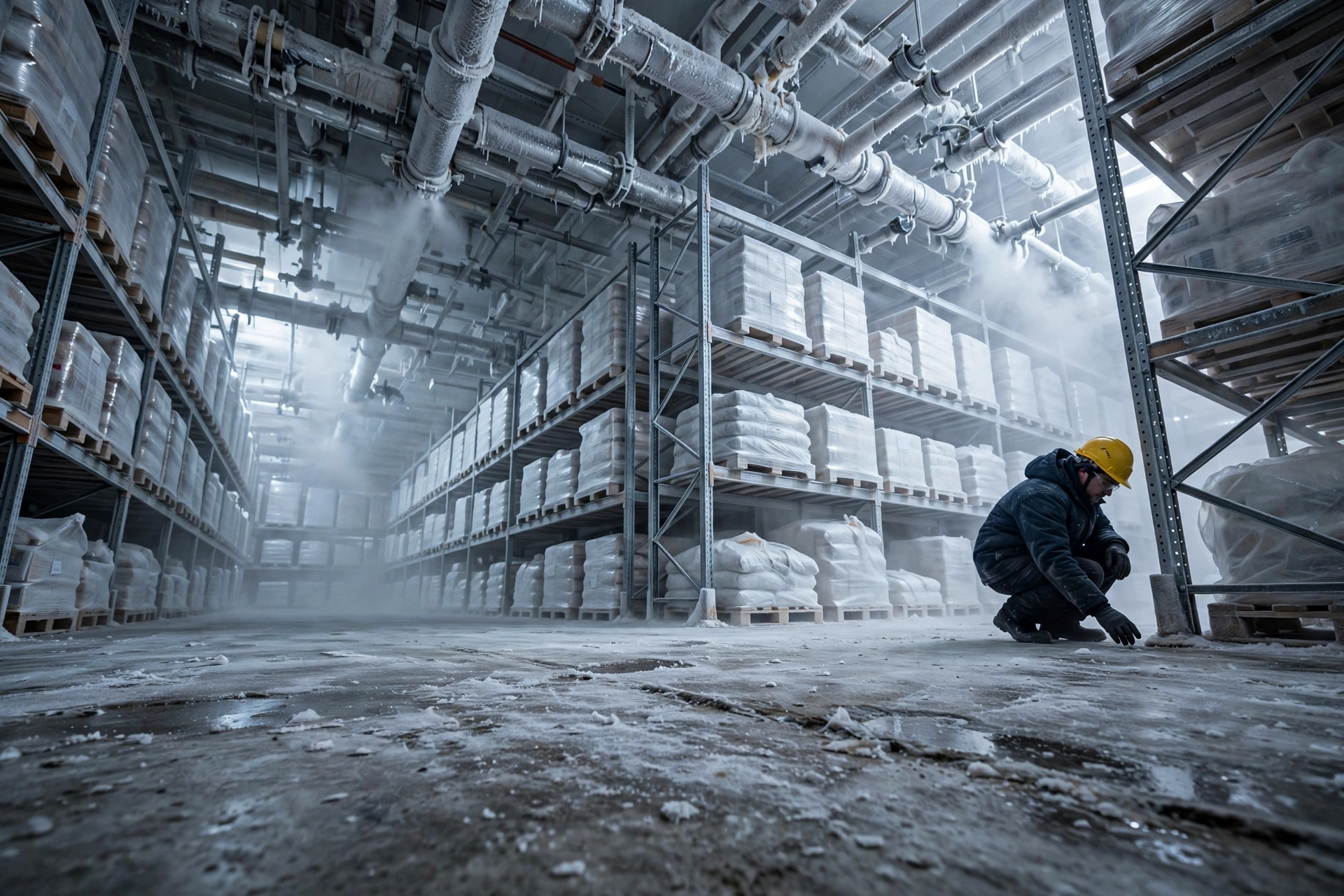
Once an excursion is confirmed, the sequence of warehouse actions should be fixed: physical quarantine first, system hold second, assessment last. Physical quarantine means moving affected batches to a designated hold area, or clearly marking and segregating them in place, with picking and dispatch prohibited. The system hold means setting the batch status in the WMS to quality-pending so it cannot enter any outbound wave. The order matters because a system hold depends on manual entry and therefore lags, while physical segregation takes effect immediately as the final line of defense.
A second scenario comes from comparing drills with real events. In 2023, a pharmaceutical logistics operator in northern Germany found during an exercise that night-shift staff needed considerable time simply to locate the quarantine procedure for the affected batches. After the process was changed so that an alarm automatically generated a quarantine task, drill completion times fell noticeably. These figures come from internal exercise records and were not independently audited, so they should be read as directional rather than precise. Still, they point to a consistent finding: the bottleneck in excursion response is usually not technology but process accessibility. Where the document lives, who may sign, and whom the night shift calls — if these three questions have no answer before an event, they will have no answer during one.
A further counterintuitive point deserves emphasis: the temperature returning to range does not close the event. A recovered curve only shows that equipment status has normalized. What the product experienced depends on the magnitude and duration of the deviation, which is exactly what the stability budget framework, discussed below, is designed to evaluate. Treating a green curve as case closure is the most common misjudgment observed at site level.
The stability budget behind every temperature excursion: why "how much, how long" matters more than "whether"
Understanding temperature excursion warehouse handling requires understanding a concept routinely used by owner quality teams: the stability budget. During development and registration, a product accumulates stability data describing the combinations of temperature and duration within which quality is maintained. The budget can be understood as the total deviation a product can absorb across its lifecycle. Each excursion consumes part of that budget, and consumption is a function of both amplitude and time. Consequently, when a quality team evaluates an event, it does not ask whether an excursion occurred. It asks three quantifiable questions: how high did it go, how long did it last, and what has this batch already been through?
The implication for the warehouse is direct: the granularity of its records determines the fate of the goods. Consider two responses to the same two-hour excursion. If the warehouse can supply minute-level continuous temperature records, the in-store location distribution, and a batch-level inventory of what was exposed, the quality team may be able to calculate budget consumption batch by batch and release part of the stock. If the warehouse can only offer a verbal approximation of "a few hours, roughly," the prudent disposition is often to reject or return the entire quantity. The economic difference can be shown with an illustrative comparison:
| Situation | Data the warehouse can provide | Room for quality assessment | Likely outcome |
|---|---|---|---|
| Complete records | Minute-level curve, batch locations, prior excursion history | Budget consumption calculated per batch | Partial release, partial disposition |
| Fragmentary records | Alarm start and end only, no batch-location mapping | No basis to differentiate batches | Whole quantity treated conservatively |
Batch sizes and values vary by product, so no specific figures are assumed here, but the logic is robust: the more complete the data, the less product must be sacrificed. In other words, what a warehouse buys with its investment in monitoring is not compliance as such, but the owner's range of options when something goes wrong.
This produces a genuine trade-off. Many operators treat monitoring density and record retention as cost items and configure them at the minimum acceptable level. Over a full lifecycle, however, the marginal cost of monitoring is small relative to a single whole-batch write-off — and smaller still relative to the erosion of owner trust that follows. In interviews, researchers repeatedly hear the same observation: owners rarely change logistics providers because an excursion happened, since excursions over long operating horizons are nearly impossible to eliminate entirely. They change providers because, when one happened, the data were not there.
Working with the owner and quality team: what the warehouse hands over, and what it does not
Procedurally, a complete excursion disposition usually has four stages, and the warehouse's deliverable at each stage should be agreed in advance in the quality agreement. The first is notification timing: the maximum interval between confirming an excursion and formally notifying the owner's quality function should be written into the agreement and rehearsed, not reconstructed from a contact list during the event. The second is the data package: raw temperature records, the list of affected batches and quantities, the time quarantine was completed and by whom, and equipment repair or initial cause findings — delivered once, completely, rather than across several rounds of follow-up questions. The third is custody during assessment: quarantined goods remain in a controlled environment, their status is not changed unilaterally, and nothing is shipped "pending paperwork." The fourth is execution of the conclusion: release, partial release, return, or destruction, each matched to a defined system status change and archived documentation.
The other side of the boundary matters equally: the warehouse should not overstep. A well-meant remark from site staff — "this temperature should be fine" — once written into a record, can become adverse evidence in later questions of liability. The warehouse states facts: times, locations, readings. The conclusion on acceptability comes only from the owner's quality function. This distinction carries particular weight in the European regulatory environment; in all specifics, the owner's quality agreement and the latest local regulatory requirements should be followed, and the warehouse should not invoke a particular regulation to vouch for the goods on its own authority.
Summarized as a decision sequence, the workflow is: detect the excursion, quarantine physically and freeze in the system, notify within the agreed window with a complete data package, hold under controlled conditions pending assessment, then execute the written conclusion and archive it. The sequence looks like common sense, yet incident reviews repeatedly locate failures between the first two steps — quarantine done but notification late, or notification sent but the data package incomplete. The value of a procedure lies not in its complexity but in whether a duty operator at three in the morning can execute it without having to think.
Over a longer horizon, the direction of travel is from incident response toward budget-based management: owners and warehouses sharing batch-level excursion histories, with monitoring data shifting from evidence produced after an event to a continuously maintained balance sheet. That shift raises the data capability expected of warehouses and redraws the competitive boundary of cold chain services. The differentiator of the future may not be whose cold room runs colder, but who can prove the complete temperature biography of every batch. Whether that judgment holds will depend on how quickly regulatory expectations and owner requirements evolve — a question that remains open.
By Dr. Chen, Supply Chain Researcher