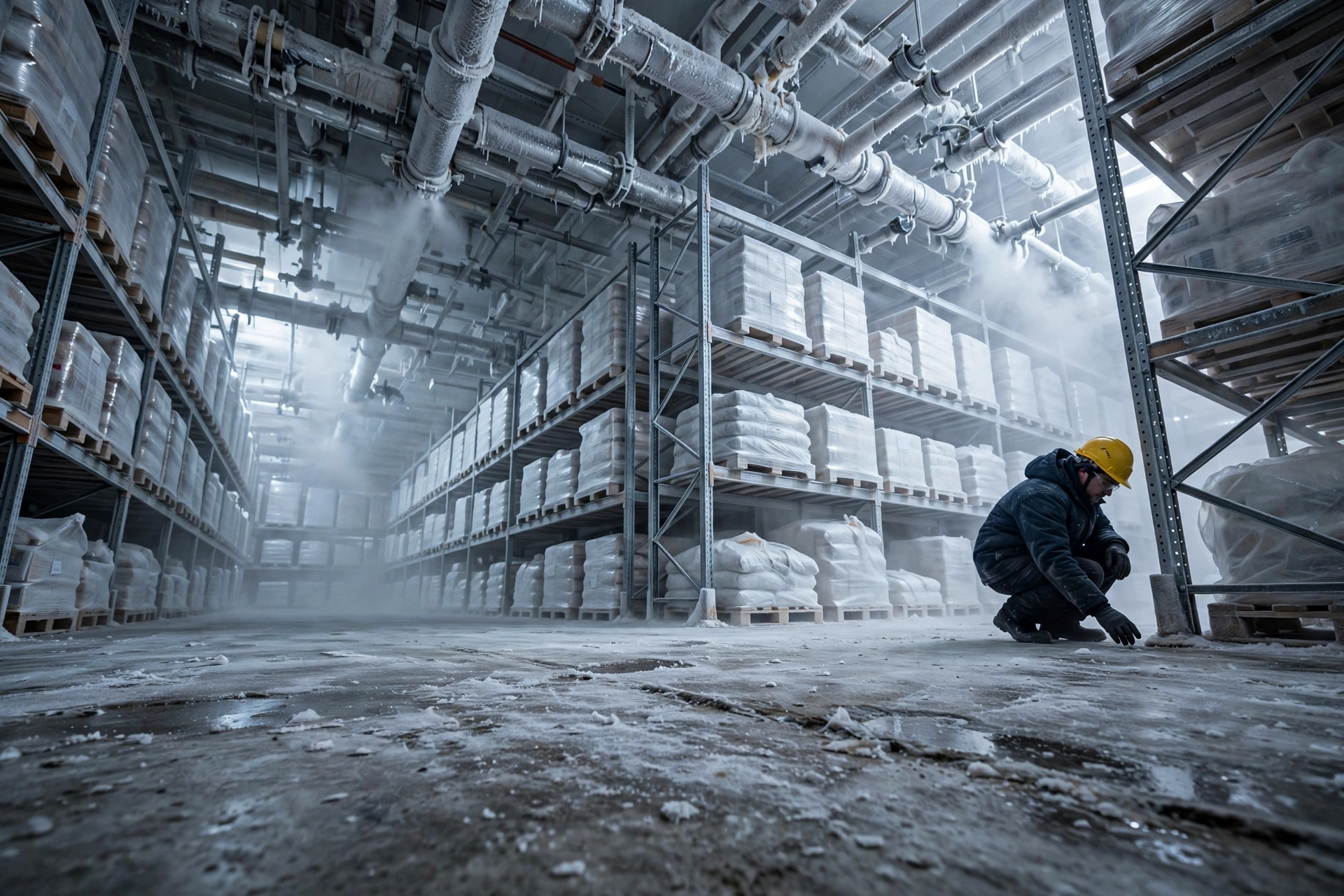
Cold storage floor frost heave is usually discussed as an insulation problem, and the data does not support that framing. According to published guidance from US cold storage builders, water in the soil below a sub-zero slab freezes and expands by about 9% in volume. That expansion lifts the floor, cracks the slab, and pulls racking out of plumb. Insulation slows the downward flow of cold; it produces no heat of its own. As long as the room stays below freezing, the freezing front keeps advancing into the soil, and heave becomes a question of timing rather than possibility. The two scenarios in this article are illustrative, assembled from publicly documented failure modes rather than records of any single project.
Cold Storage Floor Frost Heave Starts With Three Conditions
Heave needs three conditions at once, and removing any one of them stops it: frost-susceptible soil, water within reach of the freezing front, and a sustained sub-zero temperature. Silts, silty sands, and lean clays are the classic offenders, fine enough to hold capillary water and open enough to move it toward the front. Under a freezer the front never gets a spring thaw. It advances month after month, year after year, and the ice lenses beneath the slab keep growing. Nothing is visible on the surface while this happens, which is why the published timeline matters: in facilities where underslab heating was omitted or undersized, slab damage typically appears within 12 to 24 months.
That timeline sets a practical inspection rule. During the first two years of operation, floor elevations and rack plumb should be re-surveyed on a schedule, not left until doors stop aligning or forklifts start bouncing over a ridge. By the time the symptom is obvious at floor level, the repair is no longer a floor repair. It is demolition, excavation, a new heat system, and a re-pour, with product and racking moved out of the way first.
The counterintuitive point is worth stating plainly. In cold storage floor frost heave prevention, heating is the required item and insulation is the adjusting item. Insulation determines how much energy the heating system must supply; it cannot determine whether heave will occur. Spending the whole budget on thicker insulation while deleting the heat system is equivalent to putting a thicker lid on a well that is still leaking cold. The real decision is not heat versus insulation. It is how the two are sized together: thicker insulation lowers the running cost of heating, while thin insulation forces the heater to run hard for the life of the building, at the expense of both energy bills and equipment life.
Costing the Heated Slab Against Frost Heave: Glycol Loop Versus Electric Mat
There are two mainstream heated underslab systems, and published guidance draws a clear line between them. A glycol loop circulates warm fluid through embedded PEX tubing in a sand bed, with supply temperatures typically running 40 to 55 degrees Fahrenheit, roughly 4.4 to 12.8 degrees Celsius. The design target is to hold the soil at the slab-soil interface at 35 degrees Fahrenheit or above, roughly 1.7 degrees Celsius. An electric mat uses resistance heating below the sub-slab insulation and delivers continuous low-power heat. The choice between them turns on scale and heat source, not on which technology is newer.
| Option | Published capital cost | Best fit | Service life and running cost |
|---|---|---|---|
| Glycol loop | $4 to $8 per square foot | New construction above 30,000 square feet | 30+ years; can recover waste heat from the refrigeration plant, lower long-term running cost |
| Electric mat | $2 to $5 per square foot | Smaller facilities and retrofits | 15 to 25 years; simpler to install, higher electricity cost to run |
Consider a hypothetical example. Take a 30,000-square-foot frozen store and apply the published ranges. A glycol loop costs $120,000 to $240,000 to install; an electric mat costs $60,000 to $150,000. On first cost alone, the mat looks half as expensive. The running picture reverses part of that gap. Published heat input for underslab heating typically ranges from 5 to 15 BTU per hour per square foot, depending on insulation and operating temperature, which for 30,000 square feet is 150,000 to 450,000 BTU per hour. A glycol loop can be heated with condenser waste heat from the refrigeration plant, effectively using heat that would otherwise be rejected outdoors. Over a long operating life, that recovered heat can repay the higher first cost. In a small facility the fixed cost of piping, manifolds, and pumps does not spread thin enough, and the electric mat is the rational choice.
One timing constraint is absolute: the heating system must be installed before the slab is poured. Cables or fluid loops go into the subgrade preparation, insulation goes on top, and only then is concrete placed. Retrofitting heat under an existing slab means either cutting the slab to install heat trace, which is extremely disruptive, or pouring a topping slab with new underslab heat embedded. Published guidance puts the topping-slab route at an additional $15 to $25 per square foot, before reworking clear heights and door thresholds. Money saved by deleting heat at construction can return tenfold as a retrofit.
Insulation Against Frost Heave Is Calculated, Not Maximized
Extruded polystyrene, known as XPS, is the standard sub-slab insulation, with a nominal value of about R-5 per inch. Thickness follows operating temperature. A frozen store running 0 to minus 10 degrees Fahrenheit typically needs R-20 to R-30, or 4 to 6 inches. A sub-zero store running minus 20 to minus 40 degrees Fahrenheit needs R-30 to R-40, or 6 to 8 inches. Total floor system cost tracks the same gradient: published ranges put frozen storage floors at $25 to $35 per square foot and sub-zero floors at $35 to $45. For the hypothetical 30,000-square-foot frozen store above, the complete floor system is therefore on the order of $750,000 to $1,050,000. Treat that as a comparison benchmark, not a quotation.
Two construction details cause a disproportionate share of failures. The first is joint layout: insulation should be installed in two layers with staggered joints, so no joint runs straight through the assembly. A continuous joint is a thermal bridge, an open channel for cold to reach the soil. The second is edge insulation. Cold enters from the sides as well as from below, so vertical XPS must wrap the slab perimeter, including the dock face and wall-to-slab transitions. Floors often fail first at doorways and wall lines, not in the middle of the room, and an unclosed edge is usually the reason. A third detail belongs on the same list: the vapor barrier, 20 mil polyethylene or heavier with sealed seams, placed on the warm side of the insulation, above the heated layer.
The second illustrative scenario follows the same logic. A store is built with R-30 insulation and a working heat system, but edge insulation stops halfway around the perimeter. In the second winter, fine cracks appear near the doorway and forklifts feel a slight rise in the floor. Neither the insulation thickness nor the heater output is at fault. The edge was never closed. Repair means breaking out the doorway floor, interrupting refrigeration, and moving stock, and the downtime costs far more than completing the edge insulation during construction would have.
The accounting, in summary, has three lines. First, heat is mandatory and insulation is the variable; the order cannot be reversed. Second, the choice between glycol and electric mat follows facility size and the availability of waste heat, not novelty. Third, acceptance should check three things: whether the soil temperature sensor genuinely sits at the slab-soil interface, whether insulation is laid in two staggered layers, and whether the perimeter, doorways, and wall lines are fully closed. Money spent on the floor before the pour is the cheapest money in the project; money spent after commissioning is the most expensive. The exact insulation thickness and heat input for any real store still belong to the structural engineer, calculated from the soils report and the operating temperature. The ranges in this article are for pricing the conversation, not for placing the order.
By Dr. Chen, Supply Chain Researcher