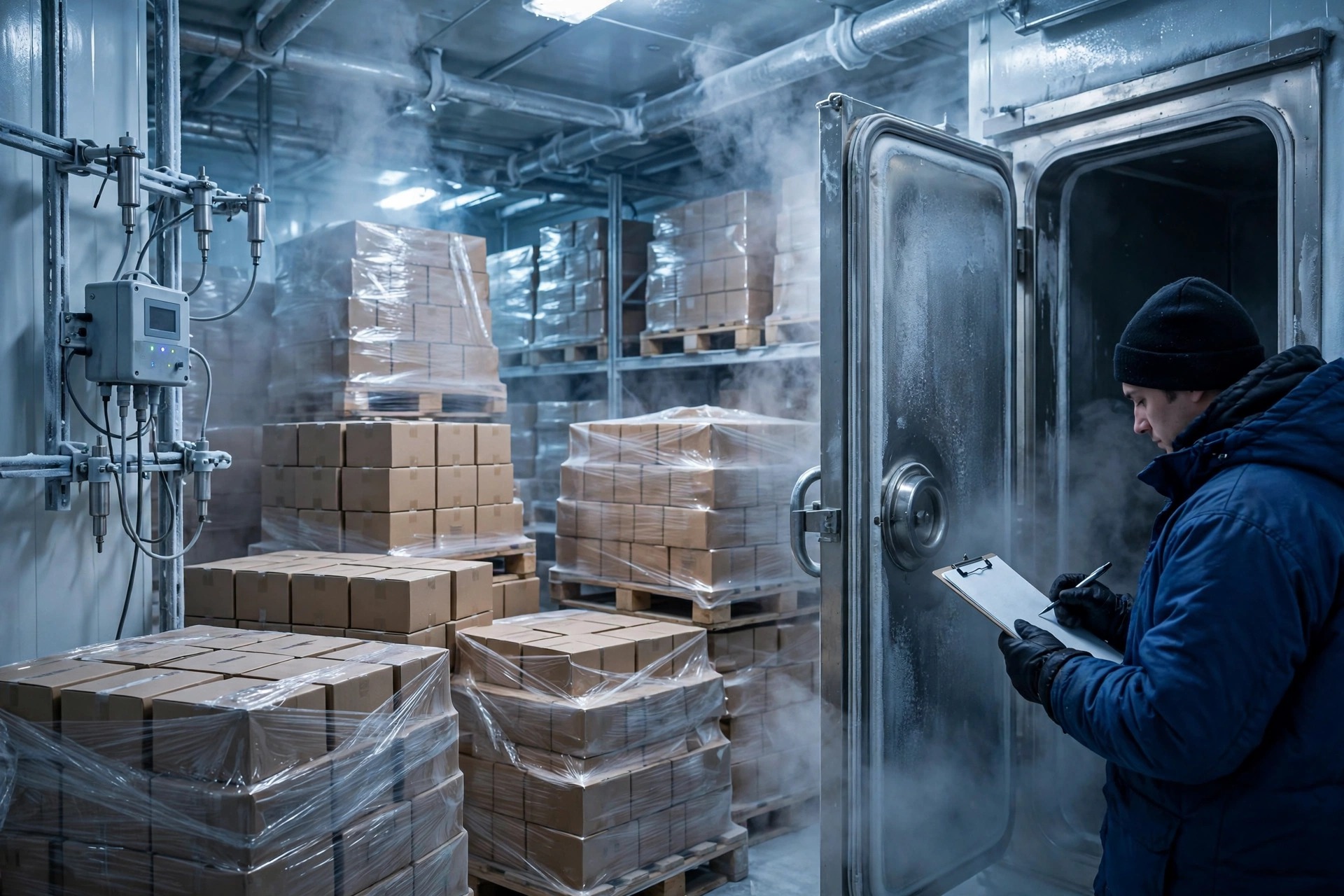
We had a client, a generic drug distributor, who put a batch of oral solid-dose product into a 3PL cool store last summer. The contract said one innocent line: store per the product label. The room was run at 15 to 25 degrees Celsius. One July weekend, a condenser clogged, the room climbed to 26.8 degrees, and nobody noticed for more than three hours. The product owner asked first whether the batch could still be sold. The 3PL asked first whose fault it was. Both questions were fair, and both were too late. The contract had never spelled out who detects an excursion, who quarantines, and who decides. In pharma cool storage, the temperature is the headline, but responsibility is the actual account.
Who Set 15–25°C in the First Place
The number needs unpacking, because two different figures get confused. The 15 to 25 degree band is the ambient range commonly used in EU Good Distribution Practice warehouses and written on many product labels. The United States Pharmacopeia defines controlled room temperature differently: 20 to 25 degrees, with excursions permitted between 15 and 30 degrees, and transient spikes up to 40 degrees allowed for no more than 24 hours provided the mean kinetic temperature stays at or below 25 degrees. Both figures are correct, and they belong in different places. The first is the everyday operating band for many cool stores; the second is the compendial definition of controlled room temperature. What governs any specific batch is always the approved label and the manufacturer's stability data. The pharmacopeia supplies the default; a stricter label overrides it.
Humidity follows the same rule: no invented numbers. The pharmacopeia defines a dry place as one that does not exceed 40% average relative humidity at controlled room temperature. That is a sourced figure. What humidity a given product actually needs comes from its label and quality documents. Some products fear moisture, some fear dryness, and the warehouse's job is to turn the documented number into a number in the room, with evidence to prove it. A humidity target with no document behind it is a liability waiting for an audit.
The zones should be settled once, before receiving starts, so nobody argues at the dock door. Under the standard pharmacopeial categories, refrigerated is 2 to 8 degrees, cool is 8 to 15 degrees, frozen is minus 25 to minus 10 degrees, and the ambient band is 15 to 25 degrees. A cool store is not simply a room that feels cool. It is a band with an upper and a lower limit. Check each batch against its label before deciding which zone it enters, and make that check inside the system, not in a conversation.
When Pharma Cool Storage Goes Out of Range, Blame Comes Last
Another client's story is more instructive. One winter night, a 3PL cool store alarmed and the night operator assumed a drifting probe. He acknowledged it twice before walking over, and the product had sat near 27 degrees for almost two hours. The batch was eventually released after assessment, but the audit report carried a heavy sentence: detection was late and the investigation was incomplete. Here is the logic that has to be established before any contract is negotiated: the excursion itself is not the violation. Failing to detect it, failing to quarantine it, or releasing product without a sound investigation is.
Under EU GDP guidance and US current good manufacturing practice, the handling chain is fixed. Quarantine the affected stock at once, physically separated, system-locked, and clearly labeled. Record the full time-temperature profile: when the deviation started, how high it went, how long it lasted. The quality unit assesses the impact against the manufacturer's stability data, not against warehouse experience. The disposition decision is signed by the quality owner; the warehouse does not release on its own authority. Finally, there is a corrective and preventive action that fixes the cause, not the alarm log. US regulation states the point plainly: warehousing procedures must store drug products under appropriate conditions of temperature and humidity, the quality control unit approves or rejects those procedures, and unexplained discrepancies must be thoroughly investigated with conclusions documented.
The responsibility split can be drawn as a table, and a contract negotiation should walk through it line by line:
| Step | Owner | What counts as done |
|---|---|---|
| Zoning and daily monitoring | Warehouse | Sensors at the mapped worst-case points, continuous recording, alarms answered by a person |
| Alarm response and quarantine | Warehouse | On site within the agreed time, quarantine first, discuss later, never release then backfill records |
| Impact assessment and release | Product owner's quality unit | Written conclusion from stability data; warehouse executes, never signs for quality |
| Calibration and temperature mapping | Agreed jointly | Probes calibrated on schedule; mapping repeated after layout changes or seasonal shifts |
| Compensation and insurance | As contracted | Trigger conditions and caps in figures, never left as "to be negotiated" |
The row that causes the most arguments is the third. A 3PL salesperson eager to close will promise verbally that the warehouse covers any excursion, while the contract says compensation follows actual loss to be negotiated. When a real event arrives, product value, recall cost, and customer claims are three numbers no warehouse can accept on the spot. The correct wording is that the warehouse owns detection, quarantine, records, and prompt notification; the quality decision belongs to the owner's quality unit; and the compensation trigger, deductible, and cap are fixed figures in the quality agreement. A 3PL should pay for losses caused by its own failure, not underwrite the owner's quality judgment.
Here is a counterintuitive point that saves more product than any new air conditioner: do not set the alarm threshold at 25 degrees. Many stores alarm exactly at the limit, which leaves no time to react. Set a warning line, for example near 23 degrees, so the team has time to check the cooling unit, move stock, or arrange a transfer. Sensor placement follows the same logic. Do not mount probes where they are convenient to read. Mount them at the worst-case points the temperature mapping found: near doors, against walls, at the top of racking. Those are the places that go out of range first. Mapping is not a one-time handover exercise either. Repeat it after a major layout change, an equipment replacement, or before summer arrives.
The Humidity Bill in Pharma Cool Storage Usually Arrives Before the Temperature Bill
Temperature has instruments watching it. Humidity is often managed by feel. The risks run in both directions: too damp and packaging absorbs moisture, labels wrinkle, and tablets take up water; too dry and some packaging turns brittle while static builds up. The more awkward fact is that humidity damage is less visible than a temperature spike, so it is often discovered a whole batch too late. A contract should fix at least three humidity points: the control target comes from the product label and quality documents, written as a figure; humidity probes are calibrated, placed at worst-case points, and recorded continuously, exactly like temperature probes; and there is a backup plan for dehumidification, stating who acts and within what time when equipment fails or power is lost.
A piece of sales honesty to close on: when you take on pharma cool storage, the most expensive item is not the cooling unit. It is the evidence chain. Continuous temperature and humidity records, calibration certificates, temperature mapping reports, excursion investigation records, and quality release signatures: with those in place, an audit passes; with one missing, even perfect temperature control cannot be proven. A warehouse never sells only space and cooling. It sells the ability to prove its own innocence when something goes wrong. When a product owner evaluates a 3PL, touring the building matters less than sampling three excursion investigation records. Check the response time, the quarantine action, and the quality signature. If all three are solid, the warehouse is probably solid too.
Next time you negotiate a contract, ask these three questions: how many minutes until someone is on site after an alarm, and is it written into the contract; who signs the release decision, and will the warehouse ever sign in quality's place; are the compensation trigger and cap stated as figures, or left as something to negotiate later. If all three have clear answers, then talk price. If any one of them is vague, do not rush to sign, however low the price looks.
By Susan, 3PL Sales Director