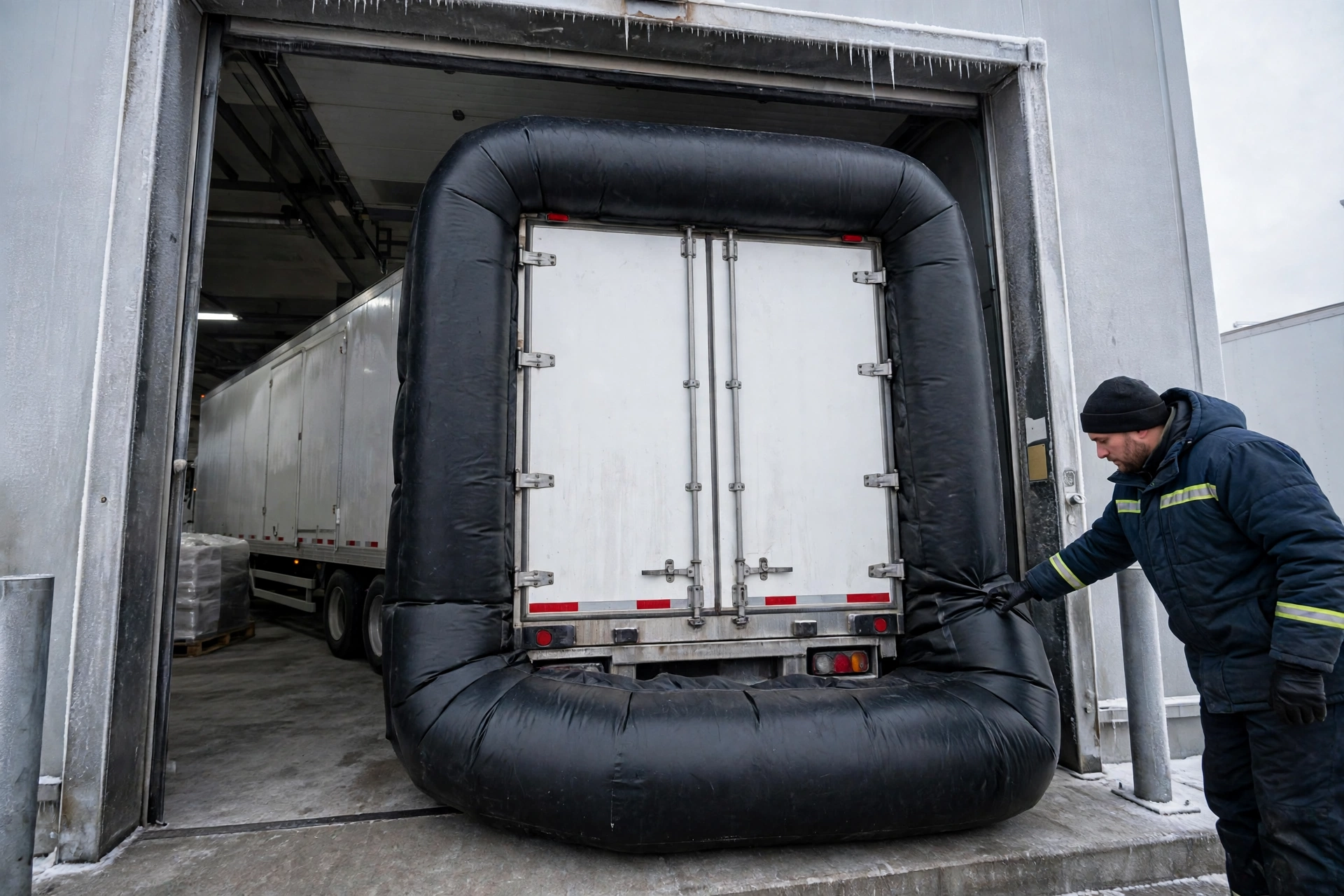
A cold storage air curtain is not a fan bolted over a doorway. It is a wall built out of moving air, and a wall is only as good as the way it is built. In November 2024, a food cold-chain warehouse in eastern China asked me to look at its electricity bill. The cold room sat at minus 18 degrees Celsius, the air curtain over the door ran all day, and the refrigeration plant still used noticeably more power than a similar warehouse next door. The nozzle was tilted outward, so the air jet scattered before it reached the floor. Cold air kept flowing out along the floor, warm air kept pouring in across the top, and the curtain was burning electricity on both sides of the same doorway. This is like bailing out a leaking boat with a bigger bucket while leaving the hole open: the harder you bail, the faster the water comes in.
Cold Storage Air Curtain Principles: The Wall Fights Two Airflows, Not the Wind
What really fights at a cold room doorway is two airflows. Cold, heavy air inside the room slides out along the floor. Warm, humid air outside pushes in across the top of the opening. A cold storage air curtain blows a high-speed jet downward from above the door, hits the floor, and turns back, standing up an invisible barrier between those two flows. When the barrier holds, moisture stays out, frost builds up slowly on the evaporator coils, defrost cycles stay short, and the compressors stop chasing the temperature all day. When the barrier fails, the curtain becomes a second electricity bill: the motor runs, the cold leaks, and the plant pays twice.
Here is the counterintuitive part: faster air is not better air. A jet that is too slow bends under crosswinds and the turbulence kicked up by forklifts, so the wall breaks in the middle. A jet that is too fast drags surrounding air into the stream, a process engineers call entrainment, and pulls more warm, humid air into the cold room than it keeps out. You are then paying to invite warm air inside. According to technical guidance from the Air Movement and Control Association, the jet must reach the floor with enough velocity to form back pressure, and the cold side of the opening should sit at positive or equal pressure relative to the warm side, because negative pressure on the cold side works against the barrier.
Cold Storage Air Curtain Selection Line: Velocity, Volume, and Door Height
Selection comes down to three numbers: door height, the velocity of the jet when it reaches the floor, and the air volume covering the full door width. Height decides how far the jet must travel, and the farther it travels, the more speed it loses, so the discharge velocity must be worked backward from the floor, never read straight off the nameplate maximum. A widely used rule of thumb in industry material is that the jet should still be moving at about 2.0 to 2.5 metres per second when it reaches the floor, and the nozzle length must cover the whole door width, with no gap at either side, because a short nozzle leaves an open leak at the corner.
In March 2025, a pharmaceutical cold store in northern China asked me to test a newly installed unit. The doorway was 3 metres wide and 3.5 metres high, the room held 2 to 8 degrees Celsius, and forklifts passed through more than a hundred times a day. A handheld anemometer at floor level read only 1.2 metres per second, and the nozzle was half a metre shorter than the doorway, so the corner leaked openly. The supplier said the machine was fine and blamed the mounting angle, which was off by 15 degrees. I reset the angle flush with the doorway and realigned the outlet, floor velocity recovered to 2.3 metres per second, and condensation at the doorway fell sharply the same day. The selection line is clear: a door height of 3 metres is a threshold. Below it, a standard cold-room model can cope. Above it, you need a high-door model with larger air volume, and nozzle length, discharge velocity, and motor margin must all pass at the same time. One missing item is a pseudo-requirement, not a solution.
Take an illustrative example to see the money. Picture a frozen store at minus 18 degrees Celsius, a doorway 3 metres wide and 3.5 metres high, open for a cumulative 6 hours a day, with about 40 degrees of temperature difference across it. This is an illustrative example, not a measured case. If the curtain cuts doorway cold loss by roughly three tenths, the refrigeration work saved each month is worth several thousand yuan in electricity at ordinary industrial tariffs, and the exact figure must be confirmed against the meter. Then subtract the curtain's own consumption: motor power, daily running hours, and whether a door switch cuts it back when the door is closed. A unit running at full speed all day with no door interlock can eat half of what it saves. The line is simple: a curtain with door interlock, full speed while the door is open and low speed while it is closed, earns the right to talk about saving energy. A unit running at full speed around the clock is fooling itself.
| Door and temperature gap | Recommended approach | Trap to avoid | | Door under 3 m, gap around 10 degrees | Curtain alone, nozzle covering full width | Short nozzle leaking at the sides | | Door over 3 m, gap over 20 degrees | Curtain plus high-speed door, two layers | Curtain alone against a large gap | | Forklifts passing hundreds of times a day | Door interlock plus high-speed door | Curtain at full speed all day | | Humid site with condensation at the door | Curtain plus door seals to block moisture | Tuning velocity while ignoring humidity |
Cold Storage Air Curtain Pairing With High-Speed Doors and Seals: One Layer Cannot Hold a Large Gap
A cold storage air curtain hates being treated as a cure-all. Across a gap of more than 20 degrees, one wall of air rarely holds on its own. A forklift passes, a crosswind pushes, the wall tears open, cold air escapes, moisture enters, frost builds on the evaporator, defrost runs longer, and room temperature swings wider. The correct pairing works in layers: the high-speed door shortens the open time, opening and closing in a second or two, so the exchange window narrows first; the curtain holds the airflow exchange during those few open seconds; the door seals block the slow seepage around the frame. Each part does its own job, and none of them can replace the others.
In December 2024, a fresh-food distribution warehouse in southern China showed the opposite pattern. The doorway had only a curtain and no high-speed door, because a roller shutter had been broken for six months and left half open. The curtain ran at maximum, ice still formed at the doorway, forklift tyres slipped, and a worker fell. After a high-speed door was fitted and the seals were repaired, the curtain dropped from maximum to medium, the ice layer melted within three days, and the refrigeration plant started fewer times each day. This is like defending a city gate: archers alone are not enough without the gate and its bolt.
Cold Storage Air Curtain Maintenance Traps: Frost, Dust, and Install-and-Forget
The most common way a curtain dies is not a burnt-out motor. It dies slowly, from dirt and from frost. Moisture is heavy at a cold-room doorway, dust builds on the outlet grille, the airflow turns uneven, and weak spots appear in the wall. In low temperatures, frost at the nozzle edge narrows the outlet a little at a time, air volume falls, condensation appears at the doorway, then frost, then ice, and by the time anyone notices, the evaporator already carries a thick coat of frost. Heated models add another trap: the heater stops ice forming at the nozzle, and when the heating element fails without anyone checking, the nozzle freezes shut and the wall breaks outright.
The maintenance routine is short and strict: check the outlet grille and filter every month, measure floor velocity every quarter, check the heater and the door interlock before winter, and look at the doorway floor every week during the frosting season. When floor velocity falls below 1.5 metres per second, check dust, check the nozzle angle, and check whether the motor belt is slipping, and do not wait for ice before acting.
Whether this money is worth it comes down to one number: after the curtain is fitted and paired with a high-speed door and seals, floor velocity holds above 2 metres per second and the refrigeration plant's monthly electricity use genuinely falls. When that number falls, the money was well spent. When it does not, one of velocity, volume, pairing, or maintenance is lying, and tracing them in order always finds the fault.
By Da Liu, Automation Engineer