The decisive step in Peru coffee export warehousing is not the port. It is what happens to the beans before they leave the dry mill. According to the USDA Foreign Agricultural Service Coffee Annual for Peru, published in May 2025, production in marketing year 2025/26 was forecast at 4.2 million 60-kg bags, up 8 percent year on year, while exports in 2024/25 reached 3.9 million bags. Peruvian agriculture ministry data put 2024 exports at roughly 255,670 tonnes worth about $1.127 billion, shipped to 57 countries. The United States was the largest market, taking 27 to 28 percent of exports, followed by Germany at about 19 percent and Belgium at about 11 percent. Read together, these figures point to a structural shift: Peru coffee export warehousing is no longer a contest over whether beans can get out, but over whether they arrive in good condition, in the right grade, and on time.
Start with the structure of the trade. Peru is one of the world's leading exporters of organic coffee, with roughly 90,000 hectares certified organic, and it ranks around ninth among traditional coffee exporters. Production sits on the eastern slopes of the Andes, in Cajamarca, Cusco and the Amazonas region, among others. Altitude is high, farms are small, and growers are dispersed. That structure creates the first warehousing problem: it is not building a big warehouse, it is collecting beans from thousands of smallholders, grading them, controlling their moisture, and assembling lots a buyer can trust. In a system of scattered collection and scattered shipment, one wet batch can contaminate a whole container, and the damage only shows up at destination, as a discount, a downgrade or a rejection.
Why Collection Is Where Peru Coffee Export Warehousing Most Often Fails
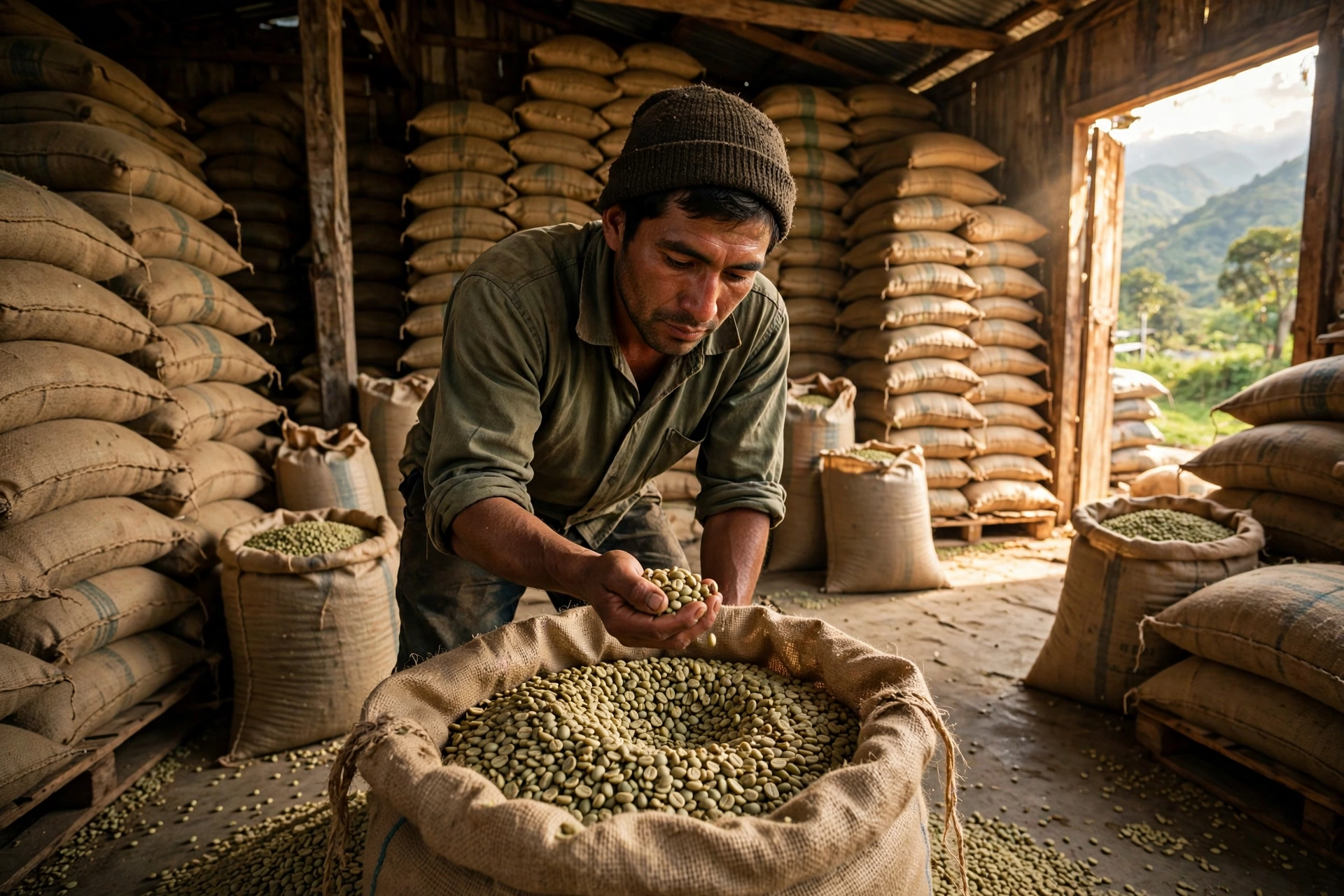
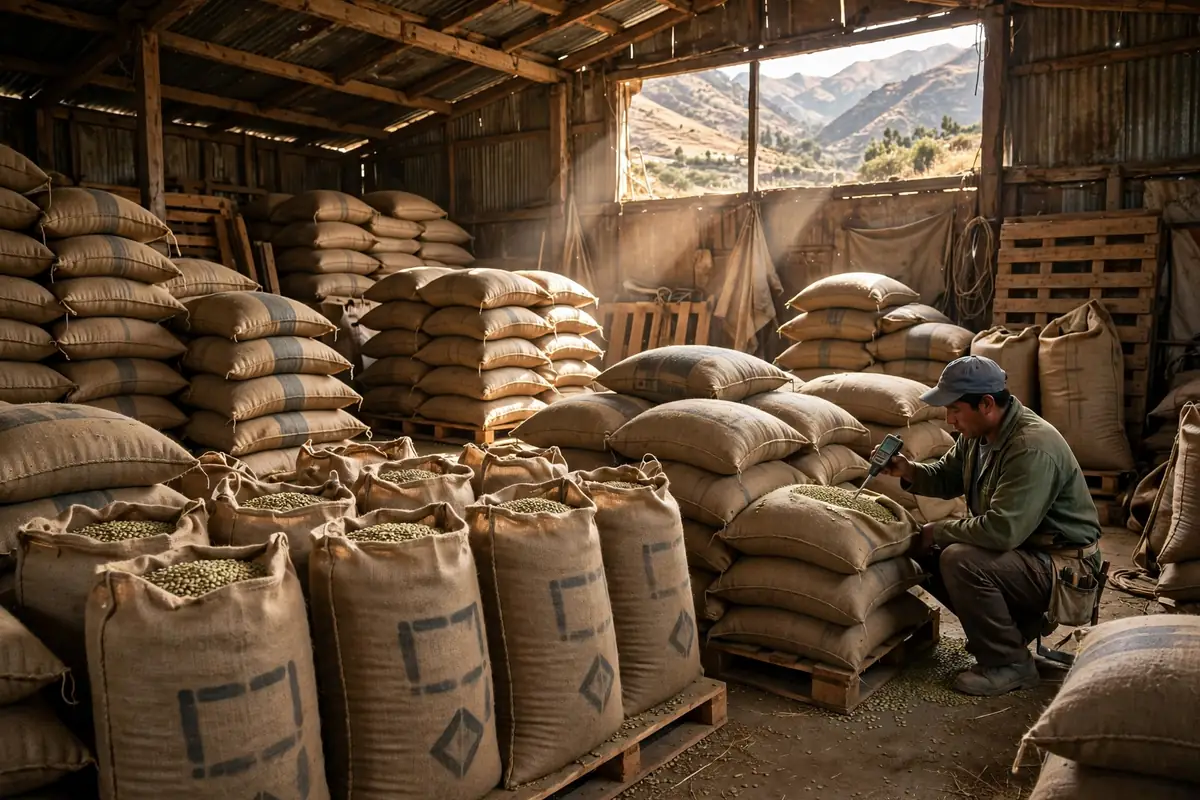
Consider a cooperative in Cajamarca. As an illustrative scenario, imagine 120 smallholder families delivering about 180 tonnes of parchment coffee in the 2024 season to a collection point in a plain building in town. Growers walk in over mountain roads carrying jute sacks. Some lots are washed, some are natural processed, and moisture content ranges from 11 to 14 percent. If the buyer at the gate relies on feel and experience alone, the problem surfaces two months later: once lots are blended, the moisture of the whole batch is pulled upward, and at the dry mill in Lima part of it has to be downgraded. The time saved at collection is paid for, with interest, at grading.
The same USDA report puts the average export price in 2024/25 at about $229 per 60-kg bag, up 28 percent on the year. Rising prices magnify the value of grading: the same beans, graded finely, earn a clear premium on the top lots; graded coarsely, the premium is averaged away. From a research perspective, this is where Peruvian coffee warehousing differs most from Brazil and Colombia. Brazil wins on scale and mechanisation; Peru wins, or loses, on the ability to grade a smallholder system. Grading is not an add-on inside the warehouse. It is the profit centre of the whole export chain.
A second scenario sits at the dry mill. Take an illustrative northern mill processing about 900 tonnes of green coffee in the 2024 season: hulling, screening, colour sorting, then warehousing by cupping score. The most valuable equipment in that building is not the huller. It is the colour sorter and a small climate-controlled sample room. The sorter removes mouldy, black and broken beans; the sample room keeps a sealed sample of every lot until the buyer confirms receipt. It looks old-fashioned. It is, in practice, the exporter's only defence: when a quality dispute arises at destination, the retained sample is the only arbitration evidence. An exporter without retained samples has no argument. They settle.
Moisture Is the Real Cost Centre of Peru Coffee Export Warehousing
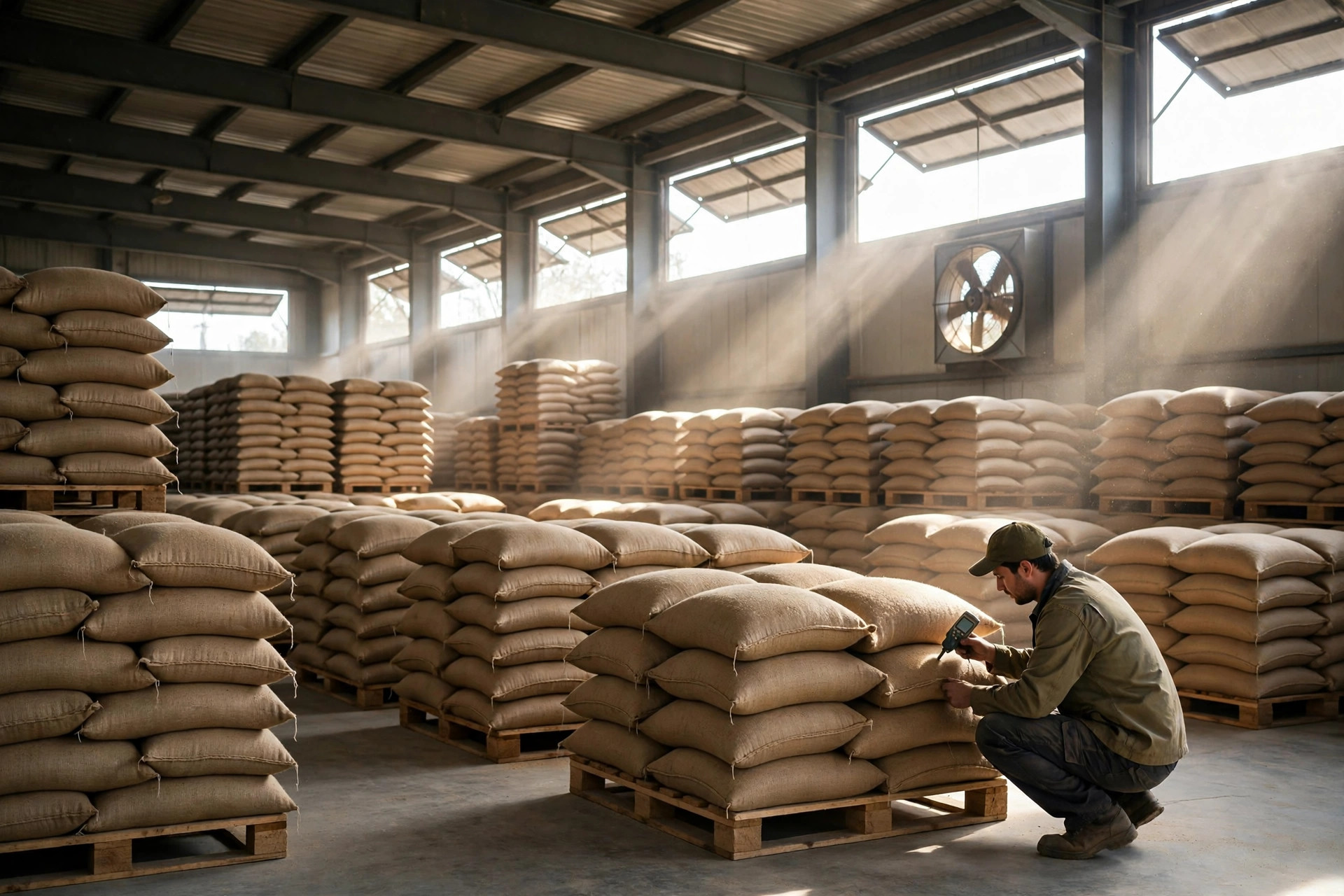
Green coffee fears two things above all: damp and taint. The Andean producing regions have long rainy seasons, and beans travelling from the producing zones to Lima cross mountain passes. One rain-soaked truck, one night stacked outdoors, can push moisture back up by one or two percentage points. Above roughly 12.5 percent, mould risk rises materially, and the exact ceiling varies by contract, so buyers' specifications govern rather than any single textbook number. Good warehousing practice is unglamorous: never mix processing methods, moisture levels or grades in one stack; keep sacks off the floor and away from walls on a damp-proofed base; test moisture on every intake during the rainy season; dry anything over the limit before it enters storage, and never leave the problem for loading day.
Here is the counterintuitive judgement. For a Peruvian coffee exporter, the most expensive item in warehousing is often not rent. It is waiting. Waiting for a vessel, waiting to consolidate a container, waiting for the buyer's shipping instructions, while beans sit in the warehouse and both financing cost and mould risk climb. Many exporters assume a bigger warehouse solves the problem. In practice, what is scarce is turnover: the shorter the beans stay in storage, the smaller the risk. Conversely, exporters who load beans before moisture has come down, in order to catch a sailing, can find a container opened three weeks later to a smell of mould. The claim on that one container can cost more than several years of warehouse rent. The later the reckoning, the larger the bill.
The port leg deserves the same unbundling. Callao is Peru's largest container port and the default choice in most people's minds, yet 2024 data show the northern port of Paita handled about 64 percent of coffee export departures. The reason is simple geography: beans from the northern producing zones reach Paita sooner, over a shorter inland leg, with less time exposed to damp. The warehousing implication is direct: warehouses should follow the beans, not the fame of the port. A big warehouse in Lima, fed by long hauls from the north, saves management cost and spends it again on damage and time. Northern exporters who mill and store near the producing zones, and send only consolidated full containers to Paita, run a shorter chain.
Where the Money Goes: A Cost Framework for Peru Coffee Export Warehousing
The table below is a cost framework for an illustrative exporter shipping about 300 tonnes a year. The figures are an illustrative scenario, shown only to explain the cost structure, not as industry averages:
| Stage | Illustrative share of cost | Key action | | Collection and intake testing | About 15% | Test moisture sack by sack; stack by processing method | | Dry milling, grading and colour sorting | About 25% | Screening, colour sorting, cupping, retained samples | | Moisture-controlled storage | About 20% | Raised, separated stacks; regular moisture checks | | Inland transport and port | About 25% | Ship from the nearest suitable port; avoid long rainy-season hauls | | Documentation and inspection | About 15% | Organic certification, certificates of origin, pre-shipment inspection |
Grading and moisture control together account for close to half the total. That points to a clear investment order: detection equipment and grading capacity first, warehouse floor area second. A warehouse with testing but no grading can store a lot of coffee and capture little value; a dry mill with strong grading can earn a premium on every lot even from a modest building.
Looking ahead, the USDA projects exports recovering to 4.2 million bags in 2025/26, with prices still in a high range by decade standards, and certified organic area holding near 90,000 hectares. For warehousing, that implies two things. First, traceability requirements from buyers will only tighten, and lot management will need to reach down to the cooperative, and in some cases the village. Second, high prices will draw in new entrants, but entrants without grading and moisture discipline will enter fast and exit fast.
The open question for Peru coffee export warehousing is therefore not whether there is enough warehouse space. It is whether the identity of each lot is clear: producing zone, processing method, moisture, grade, certification, retained sample. When those six pieces of information travel with the beans, the coffee commands its price. When they do not, even the best origins sell at commodity rates. Warehousing, in this trade, is less about storing goods than about issuing each lot a credible identity document. The more solid that document, the harder Peru's bargaining position with buyers in the United States, Germany and Belgium.
By Dr. Chen, Supply Chain Researcher