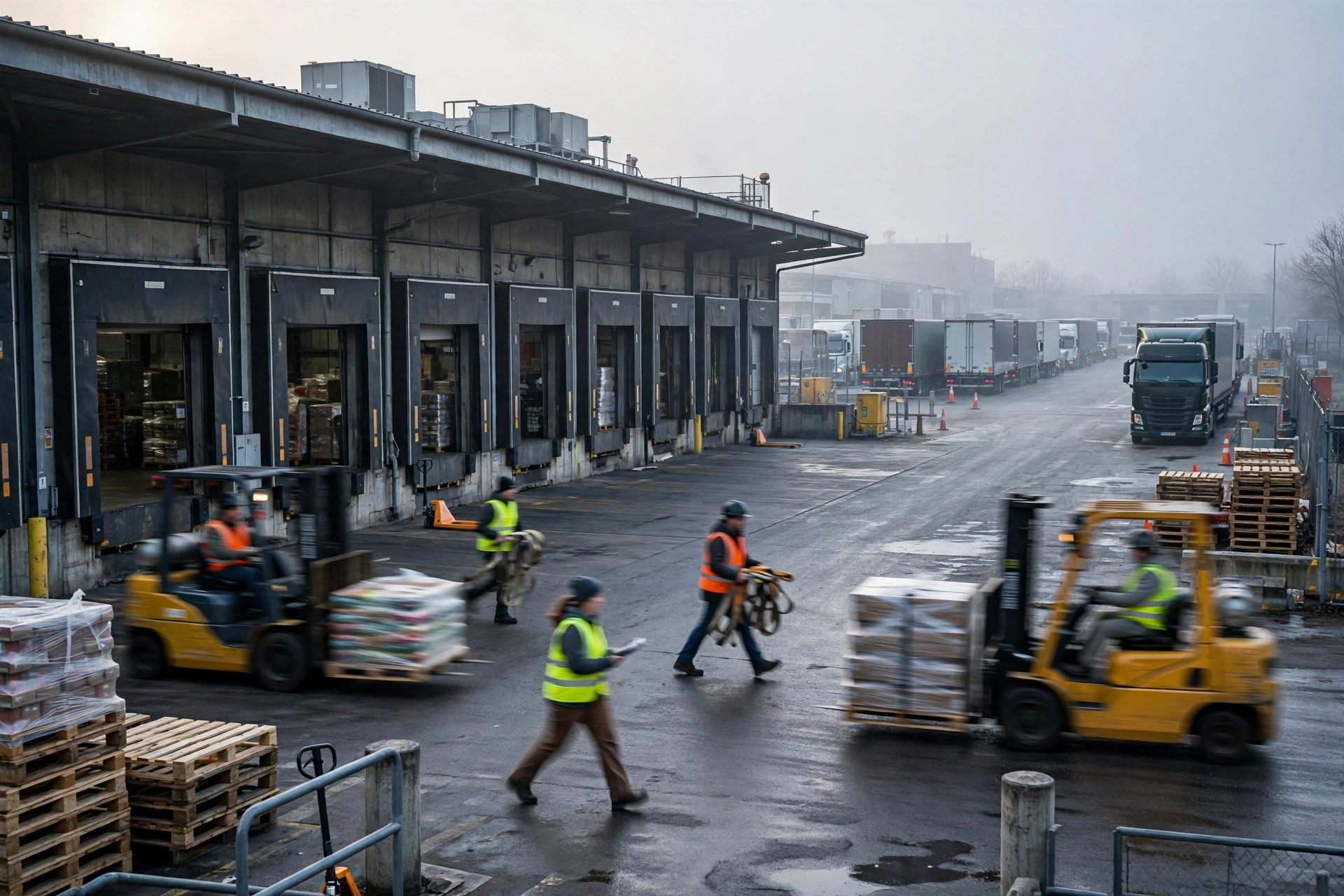
It was a Tuesday in mid-November, the nastiest two weeks of peak season, and our dock scheduling had completely fallen apart. I got to the warehouse at 6:40 in the morning and nine trucks were already lined up outside the gate. The driver of the first one, bundled up in a heavy coat, walked straight up to me: "Boss, I've been here since 3 a.m. When am I getting a door?"
Inside it was worse. Over the radio, my inbound lead was fighting with my outbound lead over Door 3. Inbound needed it for a container; outbound had a 7 a.m. pickup promised on that same door. Neither would budge. Drivers waiting outside, two leads fighting inside, forklifts spinning in circles in between. That was our peak-season ritual: dock gridlock, inbound and outbound fighting over doors.
Let me be straight with you, folks. I've run warehouses for over a decade, and I see this every single year. When the dock can't keep up, eight times out of ten the problem isn't too few doors — it's that inbound and outbound were never staggered. Here's the dock scheduling system we run now, and how we got there.
How the mess started
We have 12 dock doors, and in peak season we handle 40 to 60 truck moves a day. Sounds like plenty of doors, right? But inbound and outbound want the same hours, and their habits are opposites.
Inbound trucks all love the early morning. Drivers want to get unloaded early so they can grab their next load, so 6 to 9 a.m. is the inbound rush. Outbound is ruled by cutoff times, and carriers send their pickups in the morning too — get the freight out early, maybe squeeze in another run that afternoon. The result: 20-some trucks squeezing through 12 doors before lunch, and by 2 p.m. the dock sits half empty while the forklift guys scroll their phones.
The worst part was that inbound and outbound were fighting over the same window with the same crew. The dock apron is only so big. Forklifts going in and out, inbound pallets and outbound pallets piling up in the same staging area. One day an outbound pallet got clipped by an inbound forklift — freight everywhere, and the two guys nearly came to blows. That's when it clicked for me: the number of doors is fixed, but time is flexible.
Two dumb ideas we tried first
Dumb idea number one: split the doors. Six doors permanently for inbound, six for outbound. Sounds fair, right? It blew up in week one. In the morning, the six inbound doors had lines out the gate while four of the six outbound doors sat empty. In the afternoon it flipped — outbound was desperate while inbound doors sat idle. We'd split the doors but not the busy-ness. We basically cut twelve flexible doors down to six.
Dumb idea number two: first come, first served. Even worse. Drivers learned to show up at 2 or 3 a.m. to hold their spot. The early ones felt entitled, the late ones cursed. One morning two drivers nearly fought over who arrived first, and security had to step in. My leads hated it too — which door goes to inbound today, which to outbound tomorrow, all decided by who shouted loudest.
After both ideas failed, I sat down with my leads. The conclusion was one sentence: stop messing with the doors, start messing with the clock.
What our staggered dock schedule looks like
The system is simple. We cut the day into blocks, and inbound and outbound each get their own.
- 6 a.m.–10 a.m.: Inbound only. Supplier trucks, returns, everything inbound. Ten of the twelve doors go to inbound.
- 10 a.m.–12 p.m.: Buffer. Finish unloading whatever is left; outbound trucks start arriving and lining up, but nobody backs into a door yet.
- 12 p.m.–6 p.m.: Outbound only. Carrier pickups, parcel trailer pulls, all outbound. Ten doors to outbound.
- 6 p.m.–10 p.m.: Second inbound shift. Mostly replenishment trucks and suppliers who missed the morning window.
Two doors stay flex all day — wherever the fire is, they go. We call it "10 plus 2": ten doors on schedule, two on rescue duty.
Why cut it this way? Because we pulled two years of arrival logs. About seventy percent of inbound trucks show up before 10 a.m.; about seventy percent of outbound pickups happen after noon. Cut with the drivers' habits, not against them, and you spend half the effort.
Three details that make dock scheduling actually work
A schedule on paper means nothing if drivers don't buy in. These three details cost us real tuition.
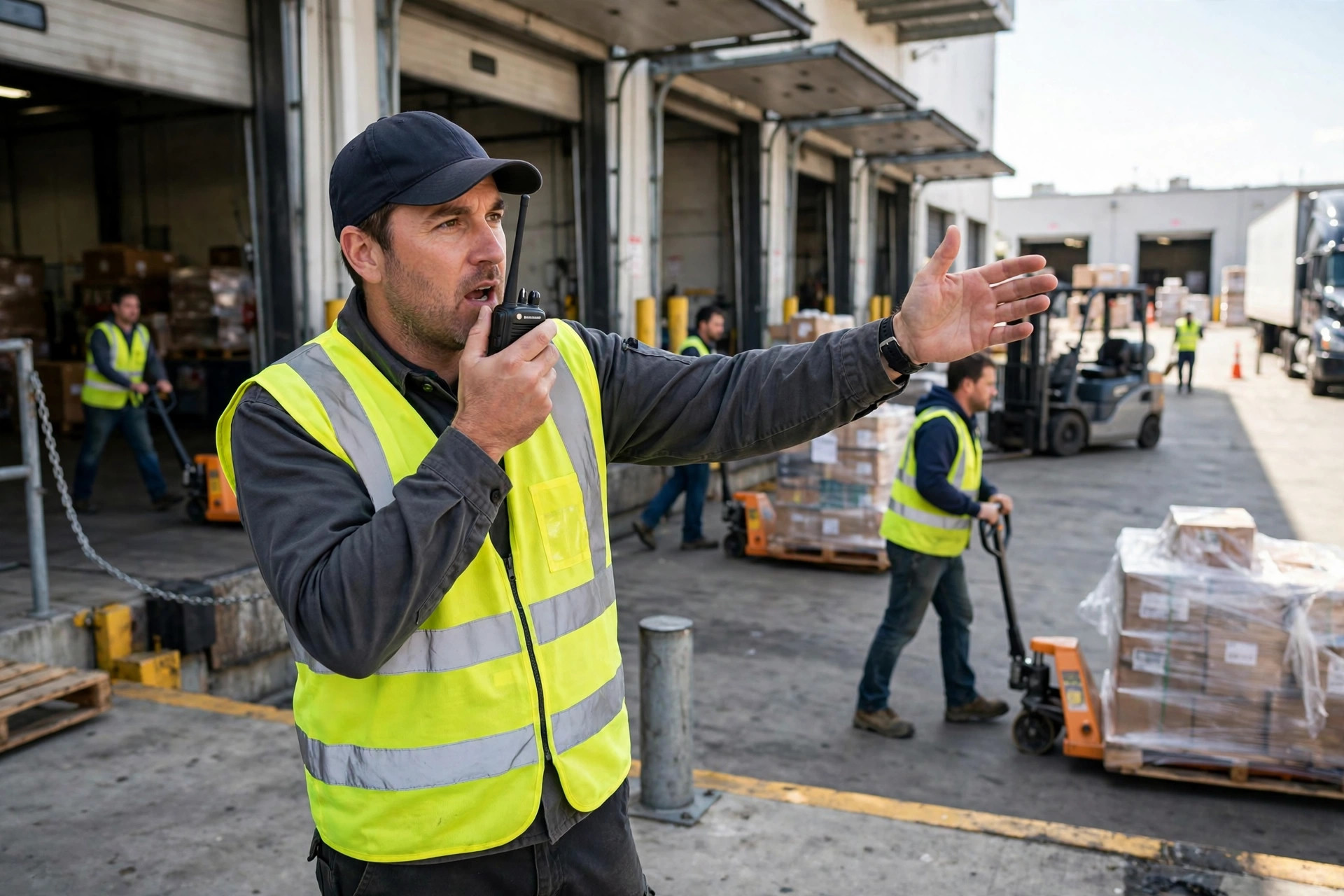
First, drivers must call one hour before arrival. The dispatcher keeps a board: what time, which door, which carrier. The driver calls an hour out, and the dispatcher tells him, "You're on Door 7, probably backing in around 8:20." Once a driver knows the wait, he stops stewing at the gate. After we started the call-ahead rule, the line of idling trucks outside basically disappeared. Honestly? Drivers don't need speed. They need to know how long the wait is.
Second, 30 minutes late and you lose your slot. This used to kill us — a driver runs late, the lead feels bad, squeezes him in, "it's just one truck," and the whole day unravels. Now it's iron law: more than 30 minutes late, your slot is gone, you go to the last open window of the day. Drivers grumbled for the first two weeks. Then everybody started showing up on time. Rules are like that — make one exception and you'll make ten.
Third, the dispatcher has to be a veteran. We tried putting a rookie on it once. Lasted a month. Dock dispatching runs on feel: which supplier unloads slow, which carrier's driver is easy to work with, when the wind is bad and you need extra time to back a trailer in. Now it's Old Li training Xiao Wang — Li has eight years on the dock, and Wang shadowed him for six months before he was allowed to build a schedule alone. When veterans train rookies, what they pass on isn't the process. It's the touch.
Then we ran the numbers
Feelings don't convince anyone. Numbers do. Here's our November data from last peak season — early November before staggering, late November after, with roughly the same truck volume.
| Metric | Before staggering | After staggering |
|---|---|---|
| Average driver wait | 2–3 hours | Under 40 minutes |
| Daily door utilization | ~55% (slammed at peak, dead off-peak) | ~80% |
| Dock overtime | 2–3 hours a day | Basically zero |
| Driver complaints / blowups | 3–4 a week | 1 a month |
| On-time outbound rate | Around 90% | Above 95% |
These are our own logbook numbers, not some industry study — but the trend is real. The most visible change was overtime: the dock crew used to work until 9 p.m. every night in peak season. After staggering, they're out by 6:30. Morale lives in what time you get home.
The counterintuitive take: it's not the doors, it's the clock
Every peak season I hear peers say, "If we just had more doors…" Let me be straight: I've run a 200-person mega-warehouse and a 30-person small shop, doors from 6 to 30. My verdict: when the dock can't keep up, eight times out of ten it isn't too few doors — it's inbound and outbound stacked on the same hours.
Doors are fixed assets. Time is a liquid asset. Twelve doors with inbound and outbound crushed into the same window is really six doors doing the work. Stagger the hours and all twelve doors rotate all day — throughput more than doubles. Adding doors costs money and months. Rewriting the schedule costs nothing, and you can try it tomorrow.
Staggering isn't magic, though. Two situations it can't fix: suppliers who won't honor any arrival window no matter what — that's a contract problem, put the window in the agreement; and a warehouse so full the staging area itself is buried — that's a capacity problem, not a dock problem, and no schedule will save you.
Three reminders for fellow operators
First, before you publish a schedule, pull two years of arrival times. Don't cut the blocks by gut feeling — cut with the drivers' habits.
Second, once the rules are set, enforce them like iron for the first month. Make one exception and you'll be making ten.
Third, don't cheap out on the dispatcher role. Give it to a veteran. Half the dock runs on the schedule, half on the person.
That's how we run it now. This peak season, we never had nine trucks lined up at the gate again. Drivers know when to come, how long they'll wait, and which door is theirs. A dock isn't afraid of being busy. It's afraid of being chaos. Get the clock sorted and busy stops being scary.
By Chen Feng, Warehouse Operations Manager