Pallet Conveyors Aren't Carton Conveyors: Selecting and Maintaining Heavy-Duty Lines
Here's the conclusion up front: a pallet conveyor and a carton conveyor are two different animals. Selection logic, drive systems, and maintenance priorities share nothing in common. Applying carton-line experience to a pallet line is a mistake I've watched happen three times, and every time it ended with dead equipment and a delayed go-live. If you're buying a pallet conveyor, remember one thing: it's designed by the ton, not by the piece.
The Table That Kills Carton-Line Thinking
When I scope a project, the first thing I draw is this comparison table — it's the fastest way to get carton-conveyor assumptions out of everyone's head:
| Factor | Carton Conveyor | Pallet Conveyor |
|---|---|---|
| Load per unit | A few kilos to tens of kilos | Full pallets, commonly several hundred kilos and up |
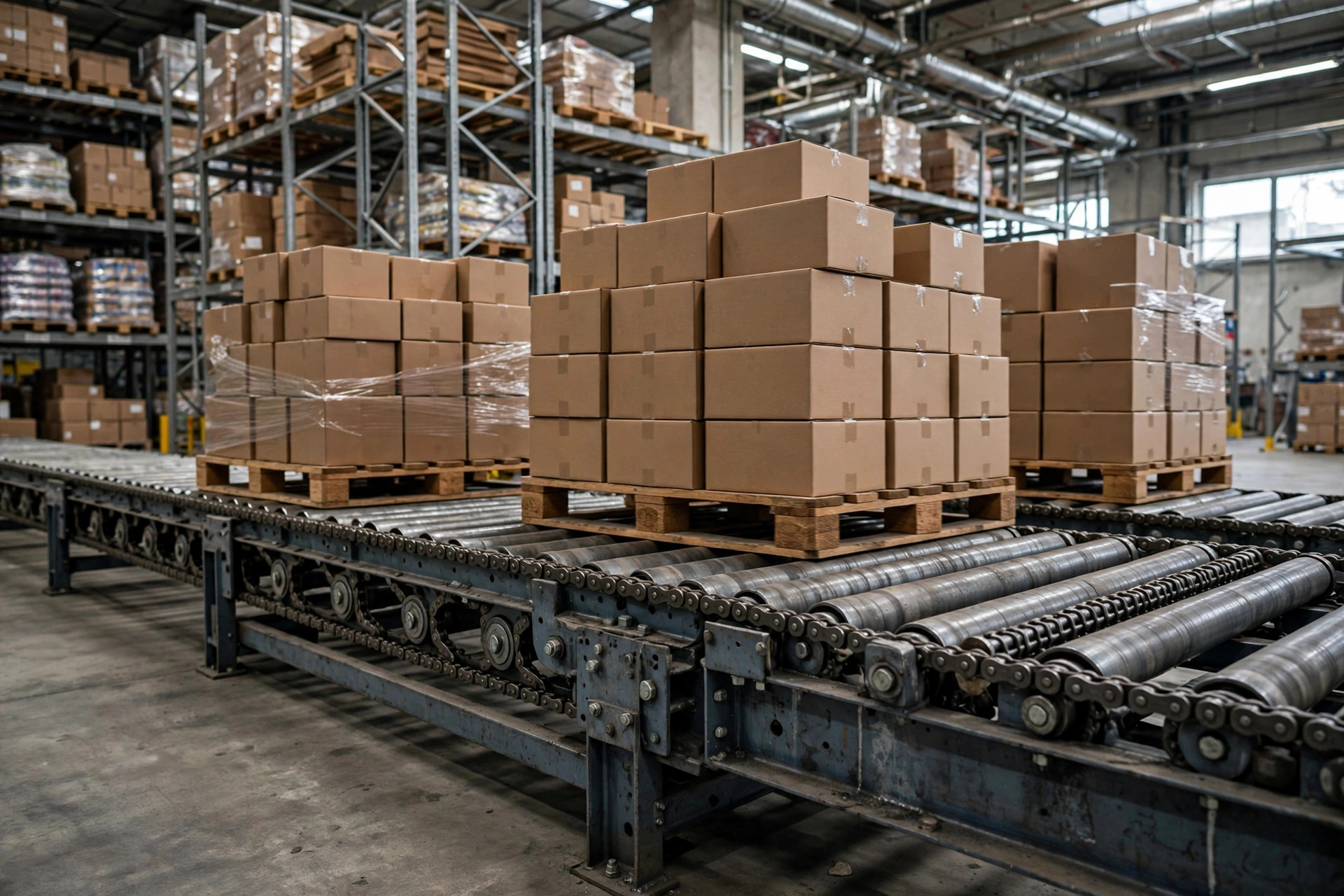
| Drive type | Light rollers, belts, modular belts | Chains, heavy-duty chain rollers, motors an order of magnitude stronger |
| Frame | Light profiles, sheet-metal stands | Heavy steel frames, often anchored into the concrete floor |
| Pace | Fast, chasing takt time | Slow, stability first |
| Maintenance focus | Belts, sensors, small motors | Chain tension, bearings, lubrication, wear parts |
| Cost of one stoppage | A few hundred delayed orders | An entire inbound/outbound line blocked |
The most expensive part of a pallet conveyor isn't the purchase price — it's the rework and downtime when you pick the wrong one.
Three Steps to Decide Whether You Need One at All
Not every warehouse earns its pallet line. Before selection, run these three checks:
1. Do the volume math. If you're moving only a few dozen pallets a day, a forklift plus a good driver is probably cheaper. Pallet conveyors are for steady, high, repeatable flow — not for "move something now and then." Low utilization means you still pay full maintenance.
2. Map the route. Are the pallets traveling fixed, repeated, high-frequency paths — receiving to AS/RS infeed, sortation to staging? Routes that change daily make a conveyor a burden; routes that never change make it a money printer.
3. Run the labor numbers. A pallet line doesn't replace "a forklift" — it replaces the repetitive labor of forklift drivers on fixed routes. Put three shifts of labor cost, forklift wear, and injury risk side by side. Most facilities running several hundred pallets a day see payback within a couple of years.
If any of these three fails, fix your forklift process first and revisit later.
Selection in Five Steps — Skip None
Step 1: Size for maximum load, never average load.
This is the biggest trap. The vendor asks "how heavy are your pallets," the warehouse says "usually four or five hundred kilos," and the motor gets sized to that. Peak season arrives, pallets hit a ton, and overload protection trips daily. Burn this rule in: selection uses maximum load times a safety factor. Averages are accounting numbers, not engineering numbers.
Step 2: Let the process pick the drive type, not the price.
Chain conveyors suit long, heavy, straight runs. Chain-driven roller conveyors suit sections needing lateral transfers and diverting. Pallet lifts and turntables handle direction changes and floor-to-floor moves. Ask one question: what is this section's job? The job determines the drive. Picking the wrong drive to save money costs multiples of the purchase price in rework.
Step 3: Lock the WMS interface before signing the contract.
A pallet line is not an island — it talks to the WMS: release signals, arrival confirmation, fault alarms, scan-to-pallet binding. The most common project argument is "who sends the signal, in what format." My practice: attach the signal list and timing diagram to the contract, and get both the equipment vendor and the WMS implementer to sign it. Negotiating interfaces the night before go-live is beyond rescue.
Step 4: Leave maintenance space. Don't squeeze that last half meter.
People and tools must fit alongside and under the line for servicing. Plenty of warehouses push conveyors against the wall to save floor space, and then nobody can reach the chain when it stretches. Space isn't waste — it's money saved later.
Step 5: The go-live-night checklist. Check every box.
Run empty for a full shift — listen for noise, watch for heat. Run at maximum rated load for a full shift — watch motor current and chain tension. Simulate a power cut and restore — make sure pallets don't get stranded mid-line. Simulate WMS disconnection — verify emergency stop and alarms. Four boxes unchecked, no sign-off on acceptance. Three of the disasters I've seen skipped exactly this step.
Three Disasters I've Seen Firsthand
Number one: a 3PL warehouse in Dongguan, 2023. Motors sized to an "average" of four to five hundred kilos; peak-season pallets routinely exceeded 800 kilos, and the drives tripped constantly. The fix: upsized motors with variable-frequency drives, plus relabeled load plates for the whole line. Lesson: maximum load goes in the contract.
Number two: a cold-chain warehouse in Ningbo, 2021. At well below freezing, standard grease solidified, chains stretched, and sprockets started skipping. The fix: low-temperature grease and a scheduled lubrication plan. Lesson: ambient temperature is a selection parameter, not a footnote.
Number three: an AS/RS infeed at a manufacturer in Shenzhen, 2024. Pallet quality was all over the place — broken boards, protruding nails, oversized decks — and the chain line jammed every other day. The fix: a pallet inspection and reject station at the line's entrance; non-standard pallets never enter. Lesson: a pallet conveyor only accepts standard pallets; feeding it junk pallets is like pouring sand into an engine.
Maintenance: Pallet Lines Are Raised, Not Repaired
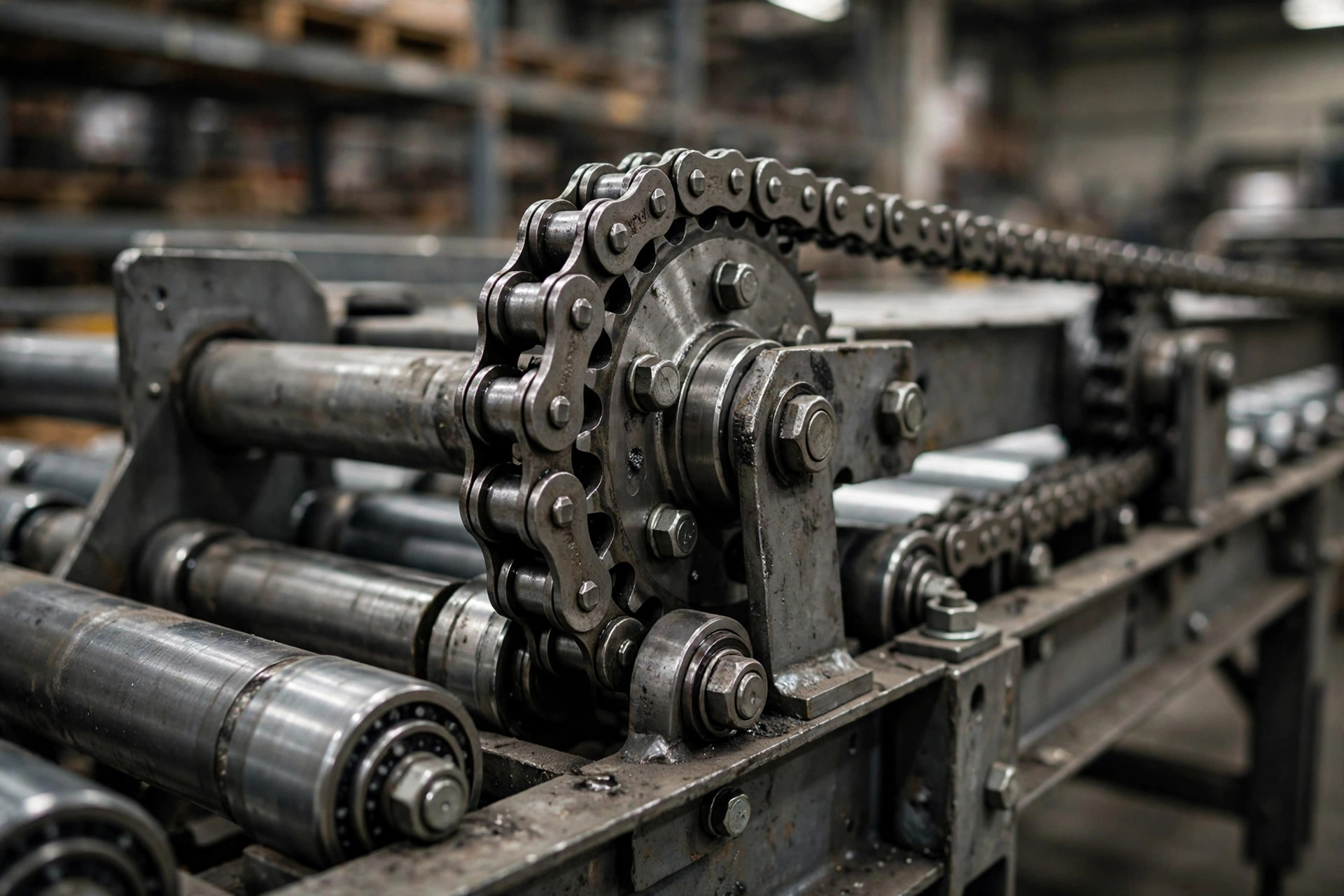
Maintenance runs in three tiers. Print it and tape it inside the control cabinet door:
Monthly: chain tension, top-up lubrication points, visual check of rollers and sprockets, e-stop test. Quarterly: log and compare motor current (a quietly rising current is the early warning of a dying bearing), measure chain elongation, torque the anchor bolts. Annually: evaluate wear parts for batch replacement, back up the control system, re-check line levelness.
One more habit: keep a "medical record" for each line — every alarm, every part swap, with time, symptom, and fix. Look back after six months and the patterns jump out: which chain section keeps failing, which shift runs it hardest. Data beats memory.
The Counterintuitive Truth: Slow Is the Smart Design
First-time buyers often complain a pallet conveyor is slow. Carton lines fly; pallet lines crawl. That's not backward technology — it's a design choice. The slower the speed, the smaller the start-stop shock, the longer the chains and bearings live, and the lower the maintenance bill. I've seen people crank up the speed anyway: chains stretched in three months, bearings seized in six, and every second saved got paid back in repairs. The pallet conveyor's trade-off is written into physics: trade speed for lifespan. Accept it — don't fight it.
A pallet conveyor buys you stability, not speed. Ask one more question at selection time — "what's the maximum load?" — and take one more look during maintenance — "is the chain loose?" — and the line will serve you honestly for a decade.
By Lin Xiao, WMS Implementation Consultant