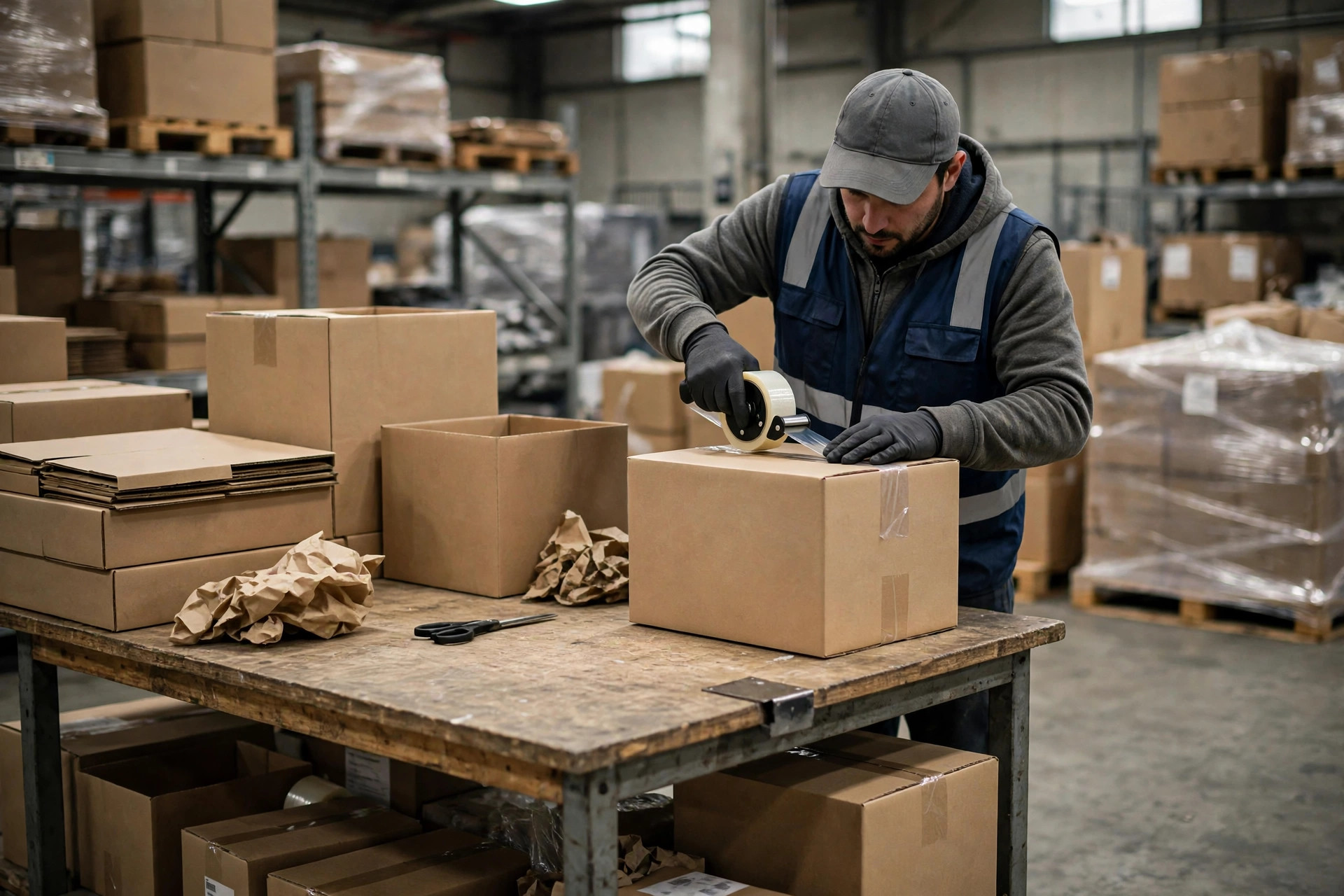
A pallet stretch wrapping machine is the kind of purchase a small warehouse owner thinks about for months, then buys in one afternoon after something goes wrong. That is what happened to us. We run a 3,000-square-meter warehouse with a crew of about a dozen people, and in peak season we ship a few dozen pallets a day. For years we wrapped everything by hand: one person walking around a pallet holding a roll of film, the tightness depending entirely on whose hands were doing it that day. Then a customer sent us a photo of a carton that had shifted halfway off a pallet in transit. That photo is what finally made me work out whether automating the wrap was worth it for a warehouse our size.
Let me be blunt up front: we cannot afford to burn money the way a big operation can. The full inline setup the big guys run looks wonderful in a sales video. Bring it home and the footprint alone will eat you alive, never mind the maintenance. A big warehouse asks about cycle time. We ask how long it takes to pay for itself, who fixes it when it breaks, and what it costs us when it sits idle.
Semi-Automatic Pallet Stretch Wrapping Machines: The First Machine a Small Warehouse Should Look At
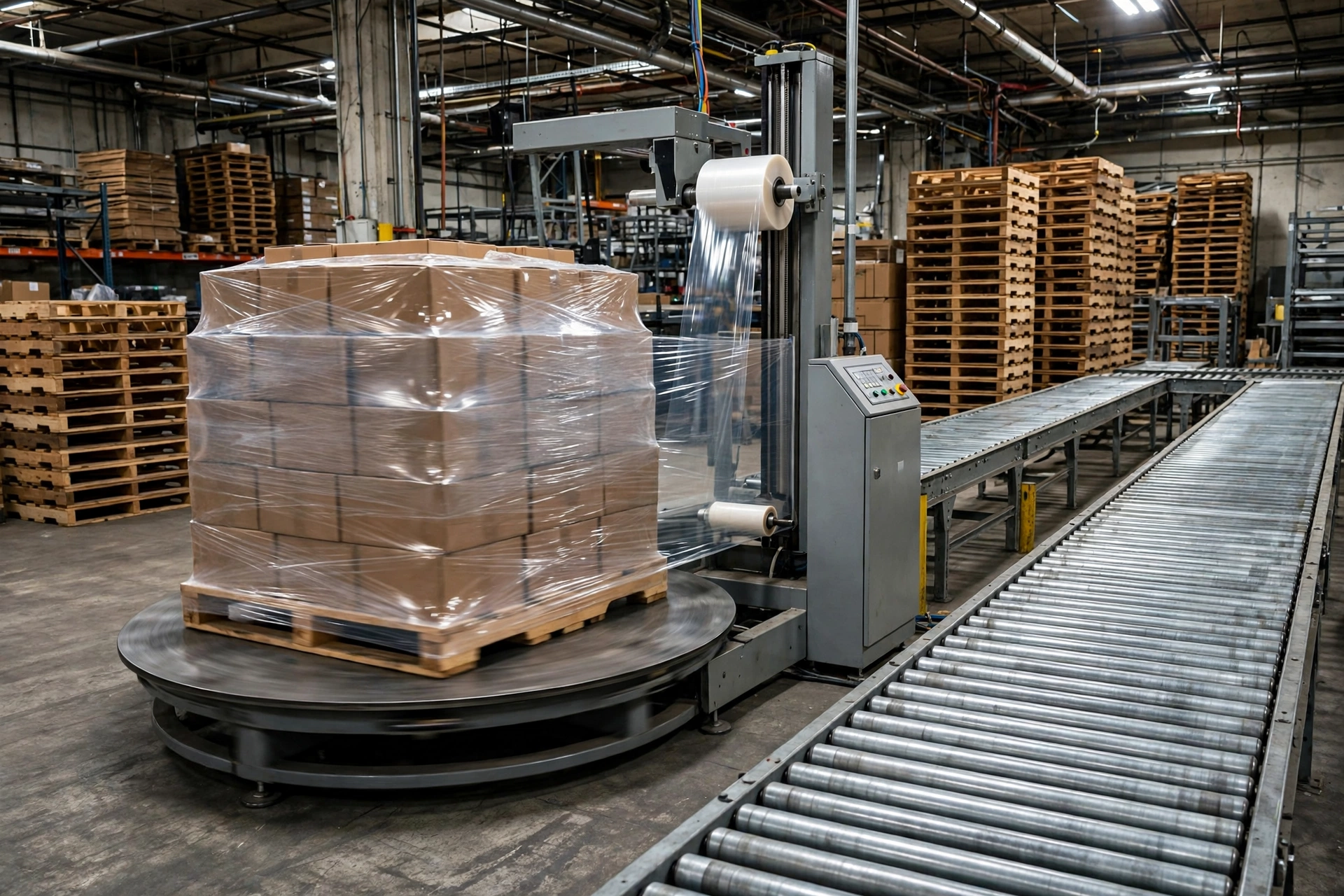
The turntable semi-automatic is the most common starting point. A forklift sets the pallet on the turntable, someone presses start, and the film carriage travels up and down while the turntable rotates, wrapping the load layer by layer. When it finishes, a person cuts the film and the forklift takes the pallet away. One operator can keep a steady rhythm going, and the wrap comes out far more even than anything done by hand.
It fits a particular kind of warehouse: volume that is neither tiny nor huge, pallets mostly one size, loads roughly the same height, and a spare patch of floor a few square meters in size. That was us when we started. Flip the situation around and the case gets weaker: pallets of wildly different sizes, very tall or very heavy loads, or only a handful of pallets a day. Then the machine spends most of the day idle, and hand wrapping is actually more flexible.
Before looking at a price list, measure three things: the maximum pallet size and weight, the maximum load height, and whether a forklift can still turn comfortably once the machine is in place. One more thing people overlook is the pre-stretch unit. Before the film reaches the load, two rollers stretch it longer and thinner, so the same pallet uses less film and the tension comes out more even. How far it stretches and how much film it saves depends on the machine nameplate and the manufacturer's data. Do not trust a number a salesperson quotes out loud. If it is not written down, it does not count.
The Rotary-Arm Option: When the Pallet Is Too Heavy for a Turntable
A turntable has a built-in weakness. When a pallet is very heavy, or the load is tall and the center of gravity is high, the turntable struggles and the load sways while it spins. A rotary-arm machine does the opposite: the pallet stays still and the arm carries the film carriage around it. Heavy, tall and unstable pallets are exactly what it handles best.
A building-materials warehouse next door to us ran into this (illustrative scenario). Their pallets were regularly overweight, and a normal turntable simply could not spin them safely, so two workers had to wrap together, one steadying the load and one walking the film around it. After they switched to a rotary-arm machine, the pallet just sat on the floor while the arm did the circling. The machine costs more and takes more floor space, but for them, a stable wrap mattered far more than a fast one.
The arm needs a clear safety zone while it rotates, and nothing can be stacked next to it, so a cramped warehouse may not be able to fit one at all. Before buying, take a tape measure, mark the circle on the floor and see for yourself.
Fully Automatic Pallet Stretch Wrapping Machines: Do Not Rush Into This One
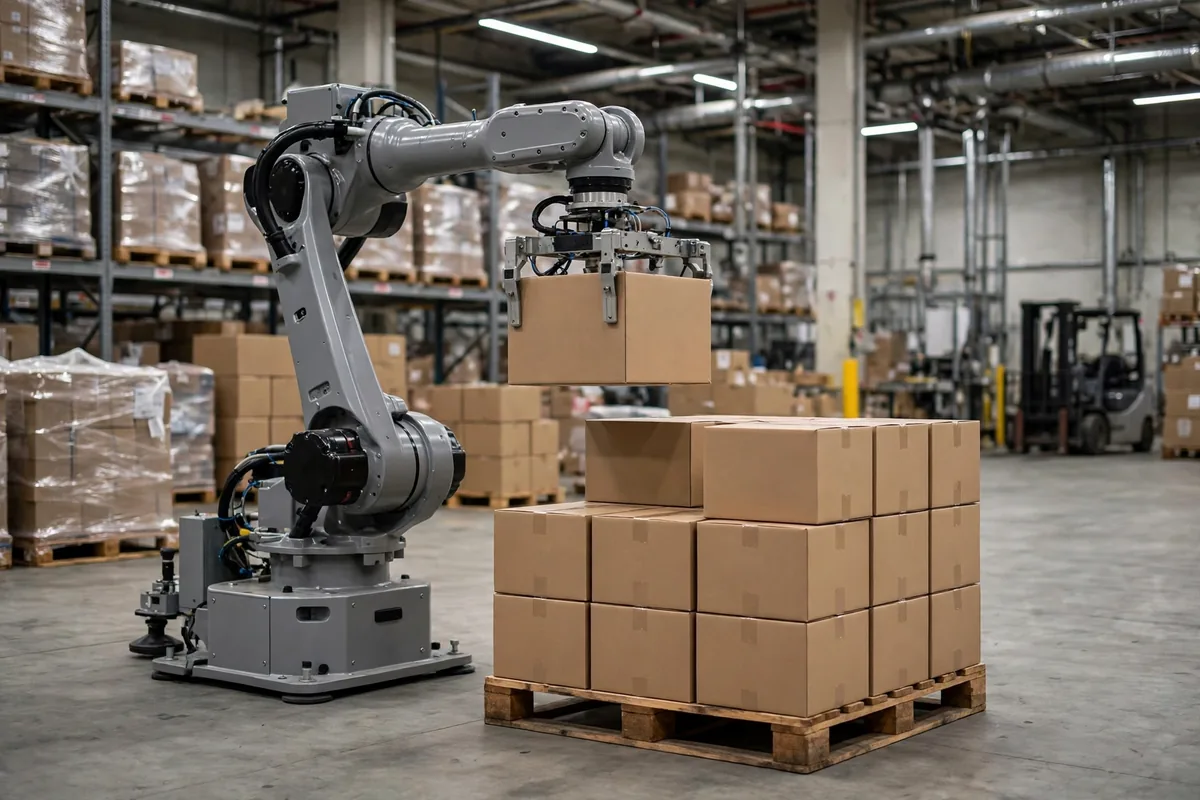
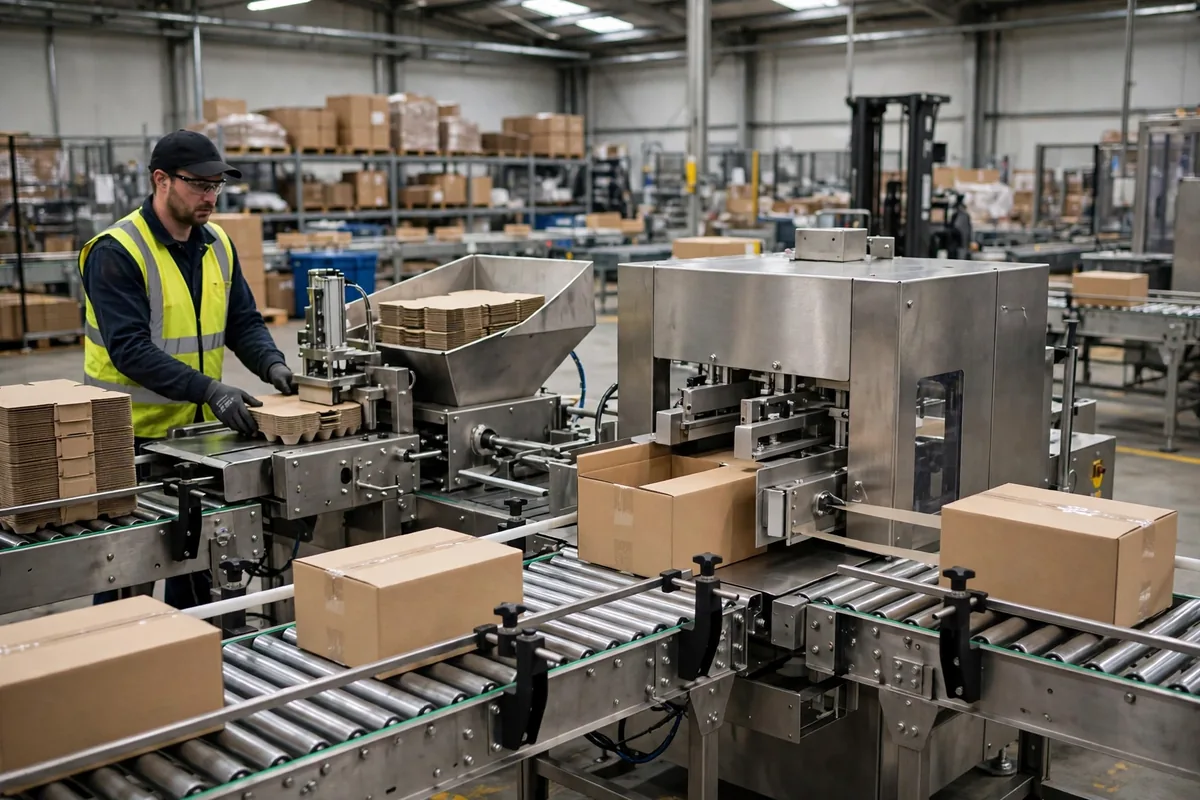
A fully automatic inline wrapper is a different category of equipment. Pallets come in on a conveyor, the machine wraps them, cuts the film and sends them out, with nobody touching them in between. It looks great, but it is never just one machine. It is a line. It needs conveyors, infeed and outfeed space, someone who can tune the settings, and someone who can fix it when it faults.
I ran the numbers for our own warehouse (hypothetical worked example): suppose we ship a few dozen pallets a day. A fully automatic machine would spend most of the day waiting for work while depreciation and maintenance kept running anyway, and the labor it saved would not cover what it cost to own. A semi-automatic works a few hours a day and the rest of the time it just sits there, which costs us nothing extra. Your numbers will differ, but the method is the same: take your own daily pallet count, your labor cost and the supplier quotations, and run them through.
More automation is not automatically better. The right level of automation is the one that matches your volume and your load types.
Hand Wrapping Versus Machine Wrapping, Counted Honestly
| Comparison | Hand wrapping | Semi-automatic | Fully automatic inline |
|---|---|---|---|
| Time per pallet | Slowest | Steady | Fastest, if upstream keeps up |
| Wrap consistency | Depends on the person | Even, tension adjustable | Most consistent |
| Floor space | No fixed spot needed | One machine plus handling space | A full line with conveyors |
| Suitable volume | A handful a day | A few dozen a day | Large and stable volume |
| Maintenance | Almost none | Regular servicing | Needs skilled maintenance |
| Biggest weakness | Tiring, inconsistent | Needs an operator at peak | Loses money when volume drops |
Every row in that table has to be read against your own warehouse, not copied blindly. Our own lesson went like this (illustrative scenario): just before peak season we almost bought a fully automatic machine. The sales calculation promised payback within a year. I went back and pulled our pallet counts for the previous few months, and our off-season volume was less than half of peak. A fully automatic machine would have been mostly a decoration in the off-season, and the payback period more than doubled once that was factored in. In the end we bought a semi-automatic machine and hired one extra person for peak season. The money we saved paid for rebuilding our packing bench properly.
Maintenance is the cost small warehouses most often forget to count. Turntable bearings need grease, the carriage chain loosens with use, and a dusty sensor can start misreading. None of that work is hard, but somebody has to remember to do it. Our approach is low-tech: a service sheet on the wall, a monthly check, and one set of wear parts on a shelf so a breakdown does not wait on a delivery. Ask before you buy how fast the supplier responds and how easy spares are to get. A cheap machine with expensive spares and slow after-sales service is not cheap at all.
Here is the counterintuitive part. Most people assume that putting a machine on the wrap automatically saves money. For a small warehouse, how fast it wraps is secondary. What matters first is whether every pallet leaves stable and whether a breakdown is easy to fix. A machine that wraps fast but lets one pallet topple on the road costs far more in claims and lost customers than the labor it saved. A semi-automatic machine that wraps a little slower but sends every pallet out solid is where a small warehouse actually makes its money.
Before you buy, do three small things: measure your largest pallet and tallest load and take those numbers to at least three suppliers for quotations and footprint drawings; go and watch a machine running in another warehouse like yours and ask the owner what works well and what drives them mad; write down your daily pallet counts for the slow season and the peak season and check them against the table above. A pallet stretch wrapping machine bought right is a helper. Bought wrong, it becomes an ancestor you have to look after.
We cannot afford the big-company setup, and we do not need to copy it. If a semi-automatic does the job, start with a semi-automatic, and talk about fully automatic again when the volume genuinely supports it. Small warehouses have their own way of surviving.
By Xiao Ma, Small Warehouse Owner