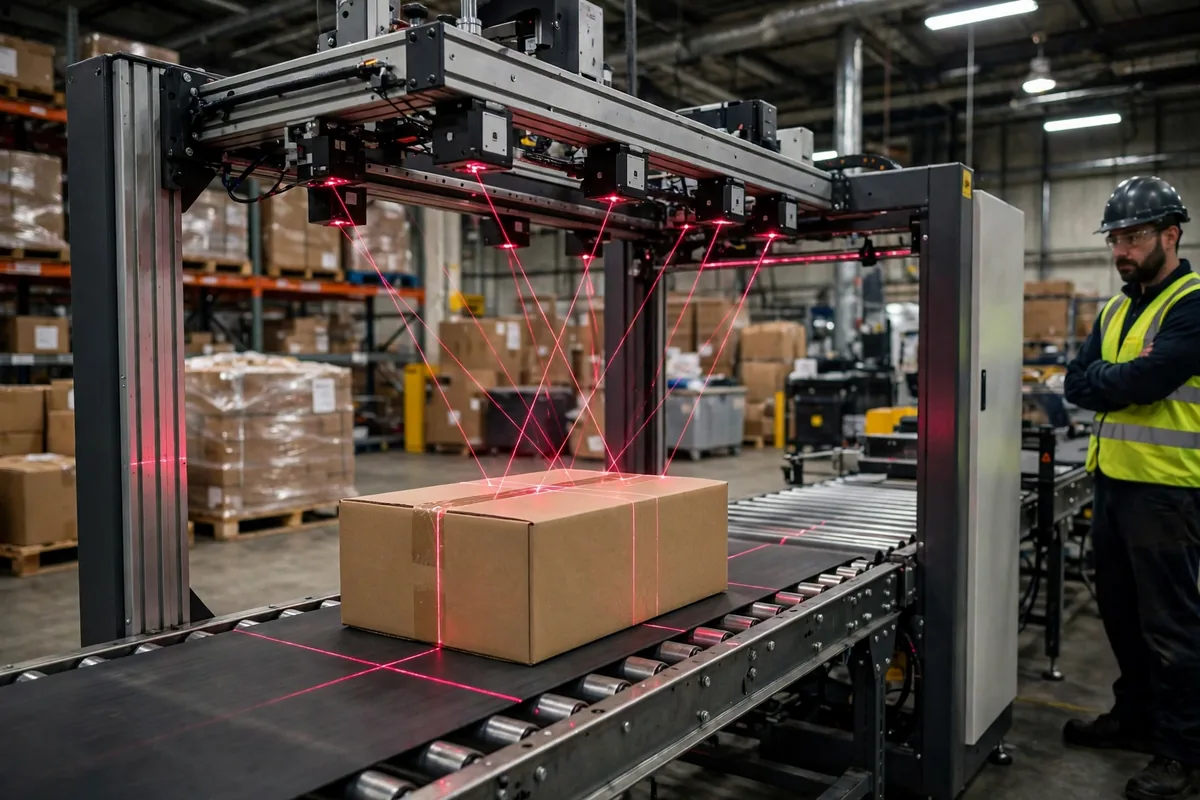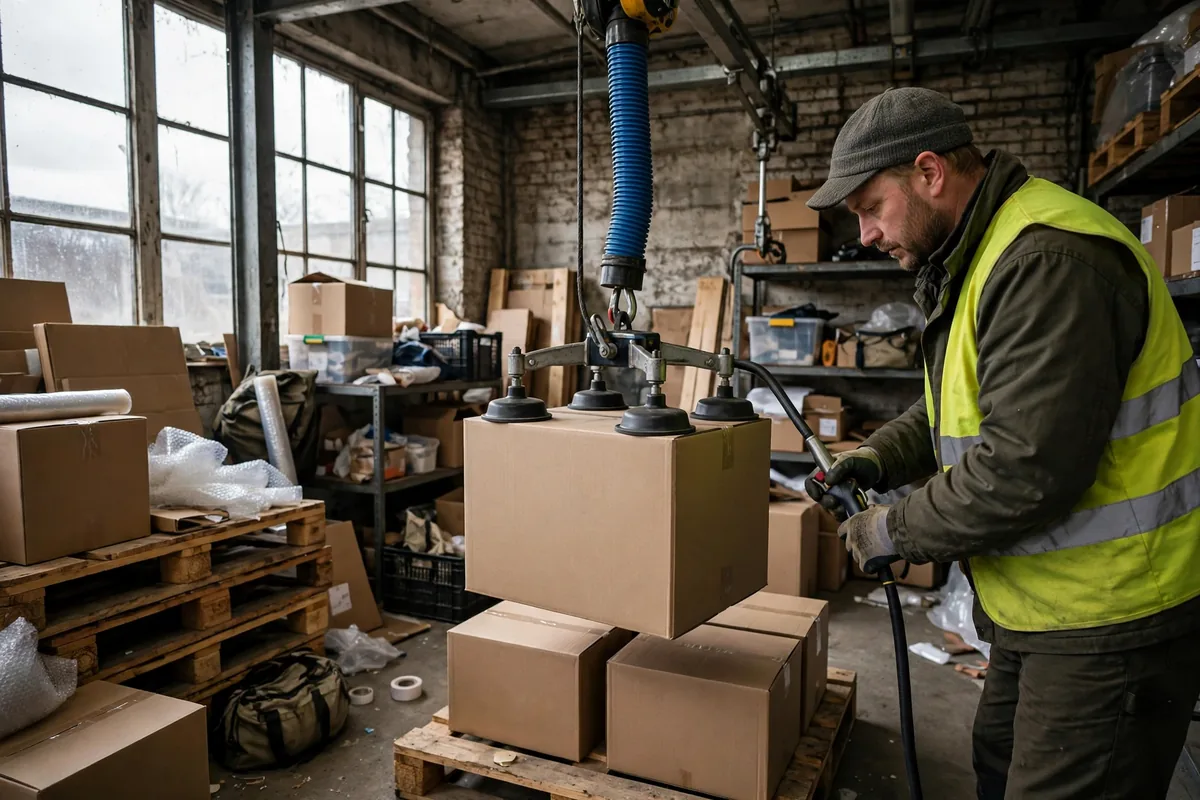
I run a 3,000-square-foot warehouse with seven people total, so let me start with the confession: we cannot afford to buy equipment that sits in a corner. Last autumn, just before peak season, one of my most reliable guys hurt his back lifting a box of tile adhesive. He was out for more than a week, I covered his shifts myself, and that is when warehouse vacuum lifter ergonomics stopped being a brochure phrase for me. A vacuum lifter does not make a small warehouse smart. It simply replaces the bend-lift-twist motion that wrecks backs with a handle you guide while suction cups do the holding.
My first instinct was suspicion. Vendors show you perfect cartons gliding through the air. My warehouse has dented boxes, dusty bags, and whatever packaging a supplier felt like using that month. So before spending anything, I listed every load we move by hand each day. The honest result surprised me: only part of our freight can actually be vacuum-lifted, and buying the machine only made sense once I accepted that.
What a vacuum lifter can actually hold, and where ergonomics breaks down
A vacuum lifter works on pressure difference. The cup seals against a surface, air is drawn out, and the load hangs from that seal. Three things decide whether it works: how smooth and airtight the surface is, whether the weight sits inside the rated range, and whether the center of gravity behaves. Sealed cartons, film-wrapped goods, and flat panels are easy wins. Rough, porous, or sagging sacks leak air, sway, and let go.
Case one, from my own floor. This March we took in bagged cat litter, not brutally heavy per bag, but murder on shoulders when you carry hundreds of them. I tested a standard round cup on the bags and it would not seal; the unit alarmed the moment it lifted. A foam-sealed cup worked better if someone flattened the top of each bag first, but in peak week nobody has time to pat every bag into shape. We ended up moving that product with a two-person lift and a flat cart, which was faster. The lesson cost me nothing and saved me a bad purchase decision for that product line: test with your ugliest load, never with the vendor's demo carton.
Case two went the other way. A small appliance we ship year-round comes in a flat, uniform carton. Before the lifter, my packer squatted, hugged the box, turned, and set it on the bench, four motions repeated all day. With the lifter she guides the handle and the box floats over. After a week she told me she could pick up her kid after work without sore arms. That sentence convinced me more than any specification sheet.
Here is the counterintuitive part I now repeat to other small owners: the lifter treats repetition, not maximum weight. A very heavy item you move ten times a day can be handled by two people and a cart. What injures people is the medium box lifted three hundred times. Count bends per day, not just kilograms, when you judge whether this equipment fits your floor.
The payback math for a small warehouse
Let me run a hypothetical example, with invented round numbers rather than market prices, so you can swap in your own figures. Hypothetical example: assume one entry-level lifter with a jib and installation costs a single fixed sum; assume roughly three hundred carton moves a day, work that currently ties up two people in rotation plus peak-season overtime; assume the lifter frees one person to help picking, cuts sick days, and reduces damage claims. On those assumptions the payback lands somewhere in a one-to-two-year band. The whole calculation stands or falls on one question: do those three hundred moves happen every day, or only during a short peak? A warehouse busy ten days a month owns a machine that gathers dust for twenty, and renting or buying used is the smarter play.
| Option | Upfront cost | Peak-season staffing | Back-injury exposure | Load limits |
|---|---|---|---|---|
| People plus hand carts | Almost none | Movers cannot help picking | Depends on luck and form | Handles almost anything, slowly |
| One vacuum lifter | Equipment plus installation | Packing bench frees a helper | Repetitive bending drops sharply | Only smooth, airtight surfaces |
My decision framework has three questions. First, do you repeat the same lift more than two hundred times a day? If not, stop. Second, is more than half of that volume actually vacuum-friendly? If not, the machine becomes furniture. Third, will a named person own daily checks? Equipment nobody owns is scrap within a quarter. If all three answers are yes, negotiate price. If only one or two are yes, fix the process first: raise heavy stock to waist height, match bench height to your conveyor, and stop storing cartons on the floor where every pick starts with a deep bend. Those cheap changes save a lot of backs on their own.
Do not expect miracles either. Our throughput rose a little. The real return was a peak season with nobody on sick leave and a roster that did not change daily. For a small warehouse, a full crew is money.
Suction cup upkeep and what happens when a load drops
The scariest failure is not a breakdown; it is a cup that aged quietly. Rubber hardens, edges crack, foam seals wear thin, and the lifter still holds good cartons while letting a marginal one fall. We learned this the expensive way before a big sale event last year, when a box dropped mid-swing and damaged the machine inside it. The claim ate every cent we had saved by stretching cup life.
Now cups are consumables in my building. We keep a spare set on the shelf, the checklist lives on the jib post, and whoever starts the shift does one empty test lift and listens for leaks. A wrong sound means the cup gets changed that day, no debate. Around that, we built simple drop protection. Nobody stands under a suspended load, ever, and that rule is taught on day one. The vacuum system should hold briefly if power fails; check the manufacturer's current documentation rather than trusting a sales promise. Fragile or high-value goods get low, slow trial lifts before joining the normal flow. And we taped the swing radius of the jib onto the floor, because the place where a lifter arc crosses a forklift route is where accidents wait.
This is where warehouse vacuum lifter ergonomics becomes a daily habit rather than a purchase. One cheap trick before you replace anything: clean the cup first. Warehouse dust and paper powder break seals, and a wiped, dried cup often recovers completely. With seven people and no dedicated technician, I split upkeep into thirty-second daily habits written at the top of the handover log. Machines do not mind being used. They mind being ignored.
If your freight is mixed, small-batch, and different every week, warehouse vacuum lifter ergonomics may honestly not fit you, and this equipment may not either, no matter how smooth the demo videos look. List your loads, test the worst one, run the three questions, then decide. Backs are your crew's livelihood and your business capital at the same time, and that account deserves slow arithmetic.
By Xiao Ma, Small Warehouse Owner