We had a client, a German food distributor, who nearly fell out with us over a pallet exchanger. In the autumn of 2024 he moved more than 800 pallets of ambient snacks into our warehouse near Rotterdam. Three weeks after signing, his quality manager walked the floor and said, flatly, that wooden pallets could not enter the clean zone: everything had to be transferred onto plastic pallets before putaway. Our warehouse manager went pale. This was not a matter of swapping a few boards. Transferring several hundred pallets by hand would have tied up two shifts a day and swallowed a dedicated re-palletising area. The client wanted hygiene compliance, we wanted to protect throughput, and in the end a single machine sat in the middle, forcing both sides to put cost and responsibility on the table.
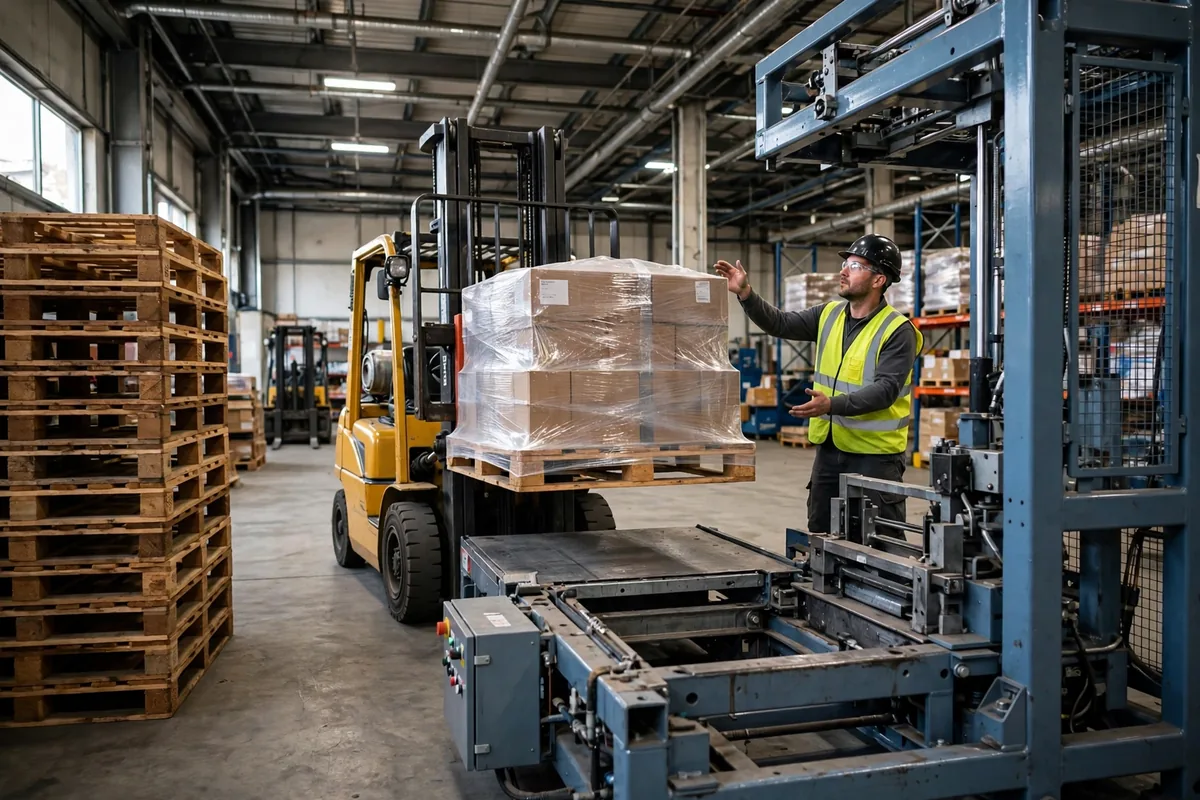
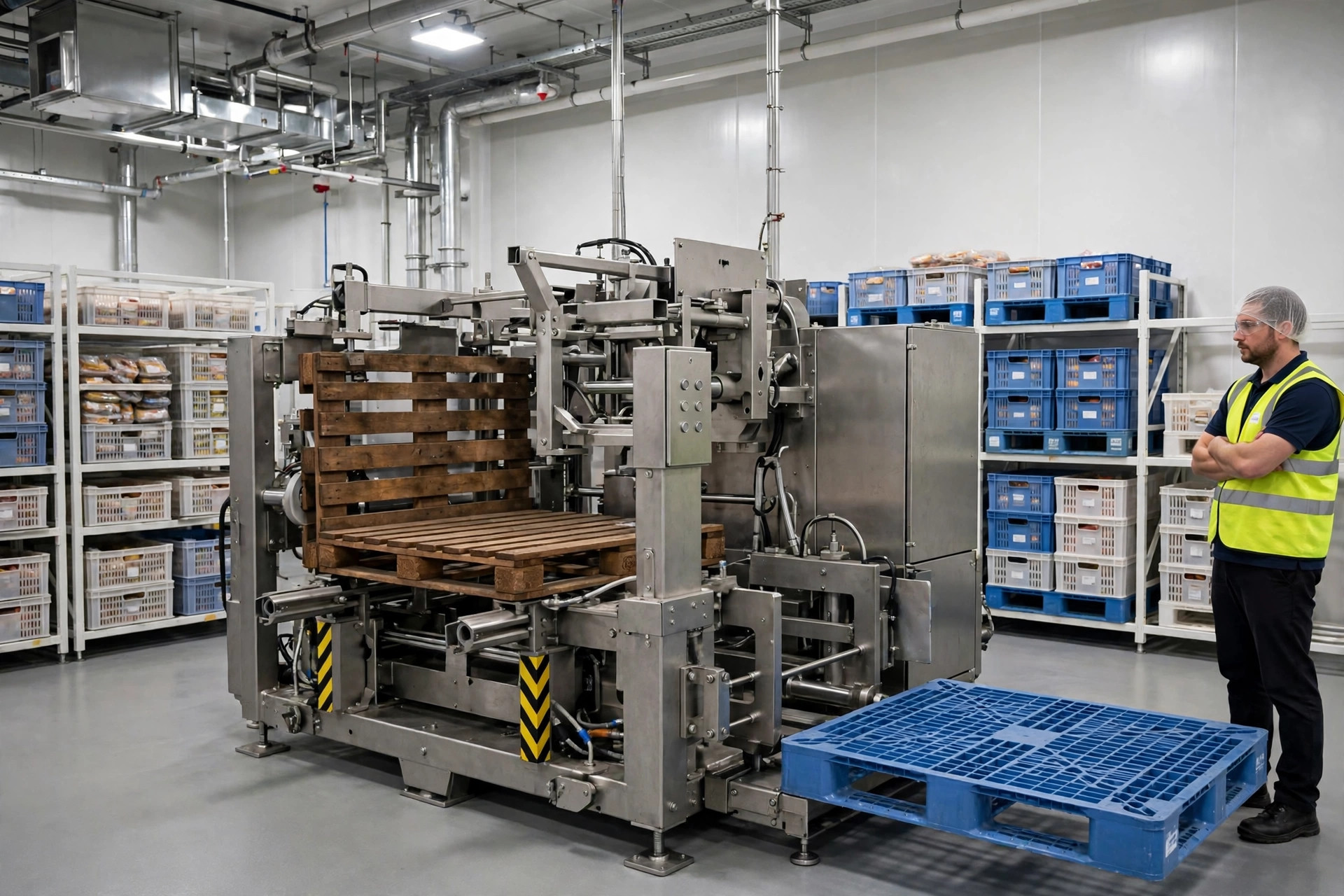
What the machine actually does is simple to describe and easy to underestimate. A full pallet goes in, the load is clamped, the pallet underneath is swapped, and the load comes out exactly as it went in — same orientation, same layers, goods untouched. Food and pharma clients do not value it mainly for speed. They value it because it removes the moment when human hands touch the goods. Manual transfer means breaking the pallet down, moving cartons, and rebuilding it, and every touch adds breakage risk and contamination risk. Auditors love to linger on that step. With a machine swap, the goods are never broken down, and the audit trail is one clean line: when, which shipment, from which pallet to which pallet.
What a Pallet Exchanger Really Changes: More Than the Board
Most people think a swap is about material — wood out, plastic in, done. What the client is really buying is three things at once: a compliant pallet material, a traceable pallet source, and a transfer process that does not contaminate the goods. A European food warehouse will typically require inbound pallets to be washed or brand-new plastic; a pharma client may go further and demand that the swapping station be physically separated from storage, with its own cleaning log. The machine does not create those management rules, but it makes them executable. Put the same rules on a manual process and they drift within a week, because people under time pressure cut corners that no supervisor can watch all day.
There is also a detail that bites late: pallet dimensions. A EUR/EPAL board and a client's own plastic pallet are not always the same height, and their fork openings do not always line up. The machine has to handle both types, or the swapped load comes back out and the storage equipment needs readjusting. Before signing, get the pallet types the client might use over the next three years written into an annex — not just the words "plastic pallet". I have seen a warehouse buy a machine, only for the client to change supplier and arrive with boards 12 millimetres thicker, sending the clamps back to the factory for modification while manual labour covered two months of volume.
The Cost Question: Manual Transfer Versus a Pallet Exchanger
Costing this honestly means counting more than the cost per pallet. Manual transfer looks cheap until you add four hidden items: floor space for the transfer area, breakage, overtime, and audit rework. Machine swapping looks expensive until you subtract those same four. The table below uses a mid-sized warehouse swapping about 120 pallets a day as a scale illustration; treat the structure as the lesson and verify the figures against your own operation before quoting anyone:
| Cost item | Manual transfer | Machine swap |
|---|---|---|
| Direct labour | Two shifts a day of heavy manual work, hard to staff | One operator watching the machine, doubling as scan checker |
| Floor space | A transfer zone permanently occupied, squeezed at peak | One fixed machine footprint, fixed travel path |
| Breakage and contamination risk | Breakdown and rebuild raises damage and mix-up odds | Load never broken down, shape preserved |
| Audit trail | Handwritten logs, backfilled after the fact | Automatic record per pallet, retrievable on demand |
| Peak flexibility | More volume means more people, and people may not be available | Overtime running covers peaks; the bottleneck moves upstream |
Here is the counter-intuitive part: the more pallets you swap, the better the machine looks — true, but only up to a point. A warehouse with wildly uneven swap volume can lose money on a machine first, because the machine is a fixed cost. On a quiet day with only 20 pallets to swap, depreciation still runs, while manual labour can simply be stood down. So the real negotiation is not "buy or not buy". It is "where does the volume come from" — can the client commit to a minimum monthly swap volume, or can the swap be priced per pallet as a separate service line, with the client covering the shortfall when volume dips?
Who Pays: Three Lines the Contract Must Contain
The most common dispute in food and pharma swapping is not the price of the machine. It is that the contract never mentions swapping at all. The client assumes it is part of "the hygiene service a warehouse should provide"; the warehouse assumes it is a "special client requirement". Both sides are half right, and the contract is blank where it matters. I split swapping into three lines on every quotation now: first, a per-pallet swap fee covering labour or machine depreciation; second, who supplies the pallets and who bears loss and washing costs for plastic pallet circulation; third, a repricing trigger if the client tightens the standard later — moving, say, from "swap to plastic" to "swap and wrap" should reopen the price, not be absorbed silently.
Rent or buy comes down to client structure. One large client on a three-year-plus contract makes buying sensible, even with customisation for that client's pallet type. Many clients, mixed pallet types, and one-year rolling contracts make renting safer: when the lease ends you can change machine type, and a change of pallet type does not strand you with the wrong asset. There is a middle route I have used twice: the warehouse provides space and labour, the client provides the machine or pays its rent, and the machine remains the client's property to remove at contract end. It takes an extra week to negotiate, but in three years neither deal produced a single dispute over the equipment — clear ownership removes half of all arguments.
A second case, on the pharma side, shows why audit cost belongs in the calculation. In early 2025 a pharma distributor required all wooden pallets swapped for clean plastic before putaway, with the swapping station keeping its own cleaning log traceable by batch number. We covered the first six weeks manually, and an audit sample found three shipments whose recorded swap times did not match inbound times. The client paused new inbound for two weeks. Once the machine was running, swap times were stamped automatically, with batch number, pallet identifier, and operator bound together in one record. An auditor can now pull the history in minutes. For pharma, price the cost of one failed audit alongside the labour saving, and the payback logic changes completely.
Before deciding which type of equipment your warehouse actually lacks, it helps to separate the two families clearly — see this comparison of inverters and changers for where each one fits. And if I could leave one piece of advice, it is this: for the strictest hygiene clients, bring them to watch a live swap before signing. Let them see a pallet go in, change underneath, and come out untouched. That ten-minute demonstration does more than ten lines of promises in a quotation, and once they have seen it, a per-pallet fee becomes an easy conversation instead of a fight.
Next time you negotiate a contract, ask these three questions: is the swap fee per pallet or bundled? Who bears pallet loss? And what triggers repricing when the standard tightens? Get those three answers in writing, and the machine will never quietly become a hygiene project the warehouse funds alone.
By Susan, 3PL Sales Director