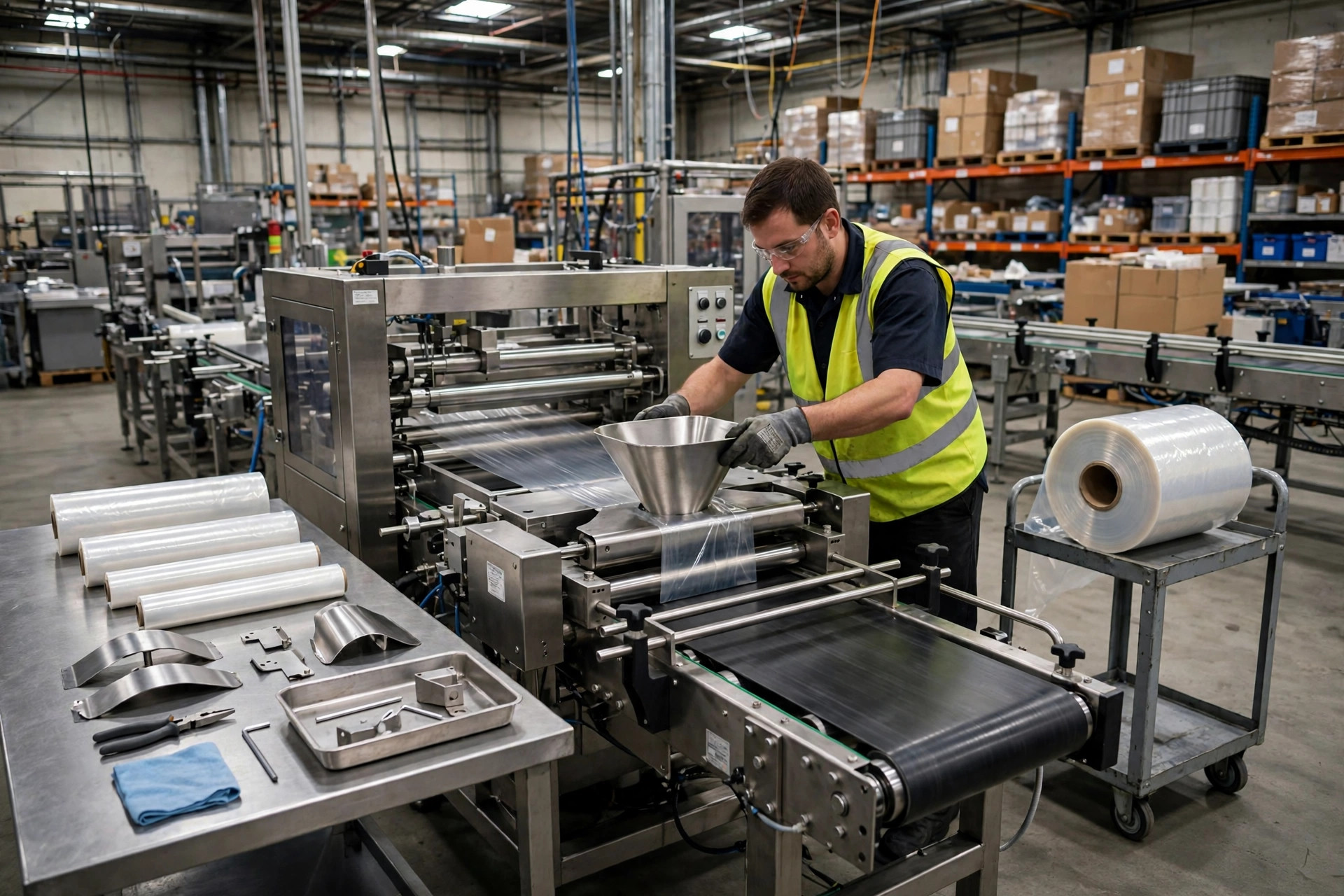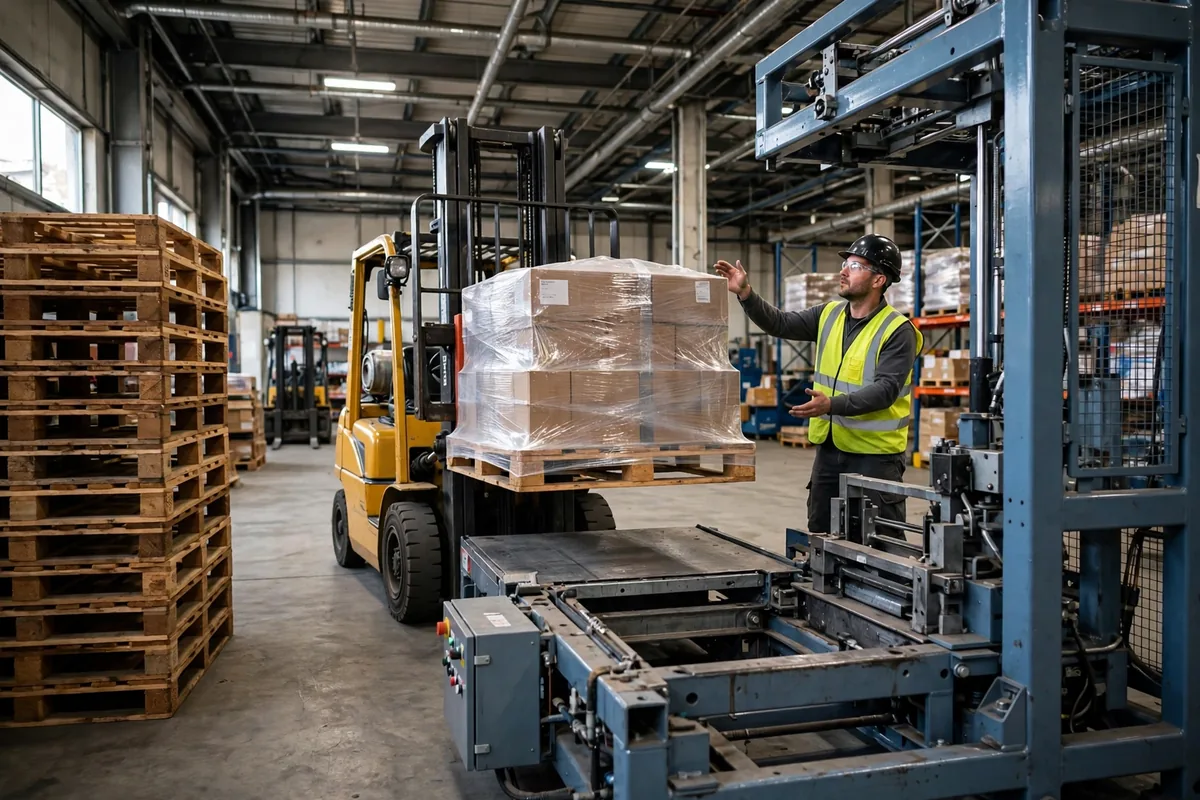
A pallet exchanger does exactly one job: it swaps the pallet underneath a load without moving the goods. Think of it as changing a pallet's shoes while the load stands still — the machine grips the load, pulls the old pallet out, and slides a new one in. It sounds simple. Pick the wrong type, and the machine will cost you two extra labor-hours a day and push your damage rate up.
Start with the principle. A fixed exchanger is a workstation bolted to the floor. A forklift brings the load in, the machine clamps, flips or lifts, completes the swap, and the forklift takes it away. A mobile exchanger carries the whole mechanism on a moving chassis and walks up to the load instead. One way, the goods come to the machine; the other way, the machine comes to the goods. That is the whole dividing line, and every comparison below grows out of it.
All speed and damage figures in this article are hypothetical worked examples used to show the order of magnitude between the two types. They are not any manufacturer's measured data.
What a Pallet Exchanger Really Swaps: Look at the Load First
Before you compare machines, answer three questions: how heavy is the load, how fragile is it, and where does the swap happen?
In 2024, a beverage warehouse asked me to look at their plan: 300 pallets a day needed swapping onto export pallets, full pallets of bottled water at roughly 900 kilograms each in our hypothetical example. They liked a mobile unit because it looked flexible — you can push it anywhere. I had them run the cycle-time math first. A mobile unit takes about 3 minutes per swap, so 300 pallets is 15 hours — more than a full shift. A fixed unit takes about 90 seconds, so 300 pallets is 7.5 hours, exactly one shift. At that volume, flexibility stops mattering. Cycle time alone kills the mobile option.
Here is the counterintuitive part: the fastest machine is not necessarily the cheapest machine. A fixed unit cycles faster, but every swap needs a forklift round trip. A mobile unit cycles slower, but it eliminates the forklift trips, and damage can actually come out lower. Speed and damage often pull in opposite directions.
There is another dimension people keep missing: how much the load hates being handled. Bagged powder, unstable mixed cartons — a clamp-and-flip fixed machine can be risky no matter how well it grips. In those cases a lift-type or mobile unit with a gentler motion is the better call. Look at the load first, then the spec sheet. Get the order backwards and the whole comparison is worthless.
Fixed vs Mobile Pallet Exchanger: Where the Selection Line Falls
One table makes the line obvious:
| Comparison | Fixed | Mobile |
|---|---|---|
| Cycle time per swap (hypothetical example) | ~90 seconds | ~3 minutes |
| Daily volume where it pays | 200+ pallets a day | Under 200 a day |
| Floor space | Fixed station, ~15 sq m | No fixed station, moves as needed |
| Forklift dependence | Forklift needed for every swap | Barely any forklift trips |
| Damage risk | Flip-type demands stable stacking | Gentle motion, good for fragile goods |
| Best fit | Export swaps, one central swap point | Multiple locations, scattered swaps |
The dividing line is really a single number: does daily volume cross about 200 pallets (in our hypothetical example's terms)? Above it, a fixed unit's daily cost gets spread thin and its cycle-time advantage shows up in full. Below it, a fixed unit sits idle half the day, and a mobile unit that goes where it is needed wins on cost.
Second case: in 2025, a pharmaceutical distributor swapped only 60–80 pallets a day, but across three zones, and the goods were glass-bottled medicines that hate vibration (hypothetical example). They were leaning toward a fixed unit too, and I talked them out of it. One fixed station would have meant forklifts hauling loads from three zones to a single point — 40 extra forklift trips a day, wiping out every second the faster cycle time saved. They ended up with two mobile units, pushed to wherever the swap was needed, and their damage rate came out lower than their old manual swapping. Low volume, scattered locations, fragile goods: mobile is the right answer.
One clarification worth making: pallet exchangers, pallet inverters, and pallet changers get used interchangeably, but the mechanisms and the use cases differ. For how pallet inverters compare with pallet changers, that guide covers the distinctions between the machine types — this article only compares fixed versus mobile and how to choose between them.
The Maintenance Pitfalls Start After the Purchase
Once the selection is made, the maintenance pitfalls are just beginning. The most common failure on a fixed unit is wear in the clamping mechanism: the clamps open and close hundreds of times a day, and if they go six months without adjustment, one side grips harder than the other and loads start tilting. The most common failure on a mobile unit is the battery and the drive wheels: it runs around the warehouse all day, and any uneven floor eats the drive mechanism first. One repair can take it out for three days.
My advice is one line: get the wear-parts list and unit prices written into the contract. Clamp pads, hydraulic seals, drive wheels, batteries — get their replacement intervals and prices before you sign. The machine price is paid once. Consumables are paid every year. Plenty of buyers compare machine prices and never compare consumable prices, then discover they cannot afford to run what they bought.
So is the money worth it? It comes down to a single number: fully loaded cost per pallet swapped. Take equipment depreciation, consumables, labor, and damage claims, and spread them across every pallet. In our hypothetical example, a fixed unit swapping 300 pallets a day comes out around $0.80 per pallet; a mobile unit swapping 80 a day comes out around $1.60. But if your volume is only 80 pallets, the fixed unit's idle time pushes its per-pallet cost to perhaps $2.40. Volume decides everything. Count how many pallets you actually swap each day first, and only then choose which type.
By Da Liu, Automation Engineer