According to operational data shared by several third-party logistics providers in China, packers in a typical e-commerce warehouse walk back and forth between carton stacks, bubble-wrap rolls, and pallet piles dozens of times per shift — yet the packaging consumables area usually occupies only 5 to 8 percent of total warehouse floor space. Here is the curious part: almost every slotting project optimizes finished-goods SKUs with careful ABC classification, while almost nobody runs a serious slotting exercise for cartons, stretch film, and labels. Consumables generate no revenue and tie up no inventory capital; many warehouse management systems do not even give them SKU codes. So on the layout drawing, they always end up in "whatever corner is left." But the moment the packing station runs out of cartons, the entire pick-and-pack line stops. That causal chain is exactly why consumables slotting deserves a serious discussion.
Why the Packaging Area Always Gets the Leftover Corner
Consider two scenes.
The first is an e-commerce warehouse in East China during the 2024 Singles' Day peak. Over three years, its carton specifications had ballooned from 8 to more than 40 — different marketplaces imposed different box standards, and the promotion added another dozen odd-sized items. The consumables area was still laid out the way it had been three years earlier: all cartons piled on open floor about 40 meters behind the packing stations, bubble wrap and tape scattered to one side. Replenishment staff pushed carts back and forth 6 to 8 times an hour, each round trip costing over five minutes of walking. The hidden loss was search time: packers had to dig through stacks of look-alike cartons to find the right size, adding roughly 20 seconds per order. At 20,000 orders a day during the peak, "finding the box" alone consumed well over a hundred labor hours daily.
The second scene is a 3PL warehouse in South China, early 2025. The pallet area had long been mixed with finished-goods staging, on the logic that "pallets can go anywhere." Forklifts were routinely blocked by pallet stacks in the main aisle during peak hours; the safety officer counted more than 30 incidents in a single quarter where pallets had to be moved just to clear the way. It took a customer audit flagging an aisle-compliance issue before the warehouse carved out a dedicated pallet zone — marked, numbered, with stacking height limits. Afterward, average forklift transit time through the main aisle dropped by roughly a third.
Both cases point to the same root cause: consumables are not managed as inventory with flow patterns. Finished goods get ABC classes and turnover rates; consumables have them too — one flagship carton size might burn through a thousand units a day while a specialty bubble mailer moves a few dozen a week. But because consumables never enter the inventory ledger, nobody tracks their consumption frequency, and slotting has nothing to work with. The cost of that absence gets booked, trip by trip, as walking, searching, and waiting.
Doing the Math: The Cascade Cost of a Consumables Stockout
Many people underestimate a packaging stockout because they only see "we're out of boxes." Let us unpack the cascade.
Imagine a warehouse processing 5,000 orders a day with 10 packing stations. At 10 a.m., the flagship carton size runs out. The replenishment run — fetching cartons from the storage area, breaking the bundles, staging them at the stations — takes about 25 minutes. The line does not fully stop: quality checkers keep checking, but the packing action stalls, and overall output drops by roughly 60 percent. At 120 orders per person per hour, 25 minutes of disruption costs close to 300 orders. Those 300 orders either become overtime or slip to the next day — converting directly into overtime pay or on-time-delivery penalties.
A simplified comparison of two layouts — consumables staged within a one-minute walk of packing versus at the far end of the warehouse, a five-minute walk away — shows the daily gap for one replenishment worker:
| Metric | Adjacent to packing | Far-end consumables area |
|---|---|---|
| Round trip per replenishment | ~3 minutes | ~12 minutes |
| Trips per shift (peak) | 10–12 | 10–12 |
| Walking time per shift | ~0.5 hours | ~2 hours |
| Stockout response time | under 5 minutes | 15–20 minutes |
| Search time for boxes/film | low (clear zoning) | high (mixed piles) |
The figures are order-of-magnitude estimates from typical warehouse travel paths; exact numbers vary, but the direction is certain: every extra 10 meters between consumables storage and the packing station raises both labor cost and stockout risk. The counterintuitive finding is this — most people treat consumables slotting as a nice-to-have refinement, but the data suggests it is one of the determinants of the packing line's capacity ceiling. Optimizing finished-goods slots saves pickers' footsteps; optimizing consumables slots protects the continuity of the whole packing operation. The leverage of the latter is arguably larger.
Three Layers of Consumables Slotting Logic
If we treat consumables as inventory with flow patterns, slotting logic falls into three layers.
The first layer is consumption-frequency tiering. The method is straightforward: record daily consumption of each consumable for two to four weeks, then sort them into high, medium, and low frequency tiers. The high tier is usually just 3 to 5 specifications — the flagship carton, the standard bubble wrap, packing tape — yet it can account for over 70 percent of total consumption. Slots for this tier must meet two conditions: closest to the packing stations, and on a replenishment path that does not cut through the packing work zone, so carts and packers are not fighting for the same floor. Medium-frequency items go to the next-nearest positions; low-frequency specialty packaging can sit farther out, as long as it remains reachable. Here is a trade-off worth noting: the highest-frequency consumable does not necessarily belong in the closest slot. High-frequency items also generate the most replenishment trips, and if their storage hugs the packing stations, constant forklift and pallet-jack traffic disrupts packing work. The better answer is "near but not touching" — a one-minute walk away, with a buffer between the replenishment aisle and the packing benches.
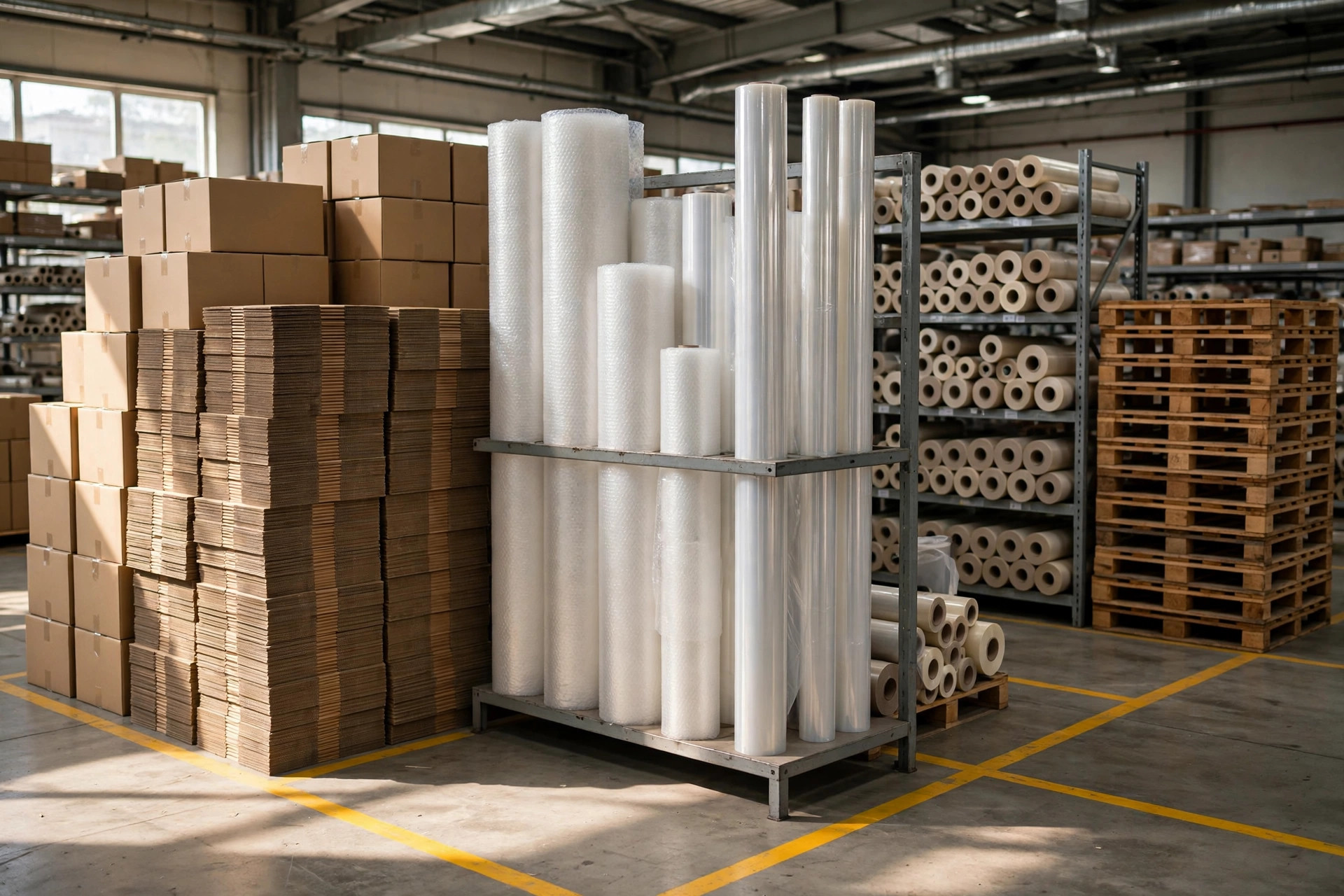
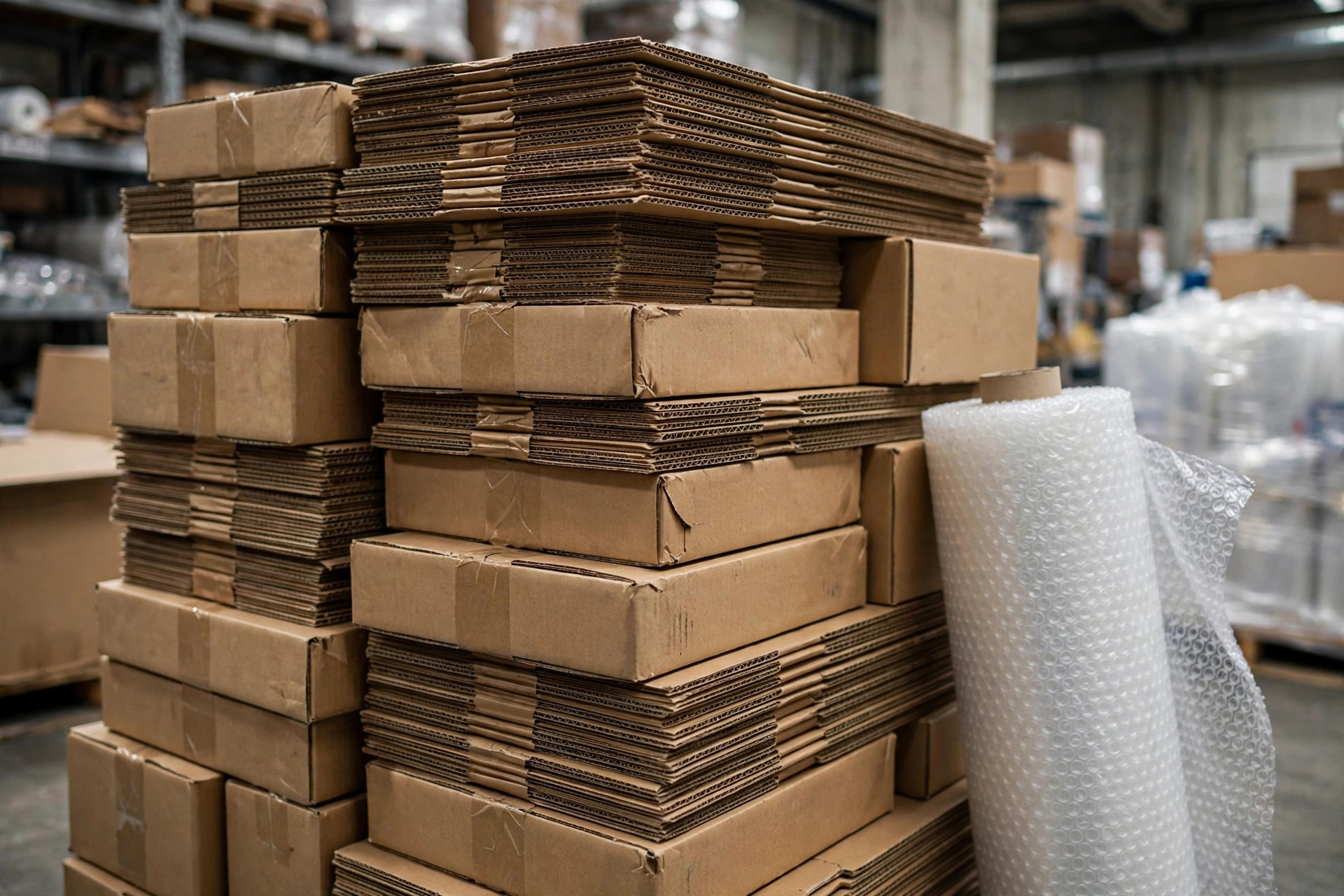
The second layer is form-and-safety zoning. Cartons crush and absorb moisture; they belong on racks or pallets, stored off the floor. Bubble-wrap and stretch-film rolls are cylinders with roll-away risk and need upright racks or chocks. Pallets are both consumable and carrier — stack height should be capped (around 2 meters is a common rule of thumb, depending on pallet material) and kept clear of fire lanes. Small high-value items like labels and ribbons do best in lockable shelving to prevent loss. Get the form zoning wrong and the first two layers of logic fall apart — crushed-carton waste sometimes costs more than a few extra steps.
The third layer is the replenishment mechanism. Once slotting is in place, the real test is never running dry. A simplified two-bin system works well in practice: each high-frequency slot gets a minimum-level mark (say, when less than half a pallet remains), and the packing lead checks levels at shift handover, triggering a replenishment task below the mark. Better-equipped warehouses use floor scales or simple visual kanban. The point is not technological sophistication but clear ownership — in many warehouses, the root cause of a packaging stockout is not missing stock but "everyone assumed someone else would restock."
A Trend Worth Watching: Consumables Slotting Enters Lean Layout
Two trends deserve attention. First, with e-commerce return rates staying high, reverse-logistics packaging — re-shippable boxes, return-specific mailers — is becoming a new variable in the consumables area. The number of packaging SKUs keeps creeping up, and the cost of casual piling will only grow. Second, some newly built automated warehouses now reserve dedicated consumables aisles and replenishment docks at the design stage instead of squeezing them into leftover corners after go-live — a sign the industry is redefining consumables from "back-office supplies" to "production inputs."
The other side of the coin: for a small warehouse under a thousand orders a day, a full slotting program for consumables may not pay back. "Keep high-frequency packaging next to packing, check levels weekly" is enough. The value of a methodology is in its layering, not in one-size-fits-all application.
Back to that opening figure: the consumables area takes up 5 to 8 percent of the floor but guards the lifeline of packing-line continuity. When we talk about warehouse lean transformation, perhaps the first question to ask is a simple one — how far are your cartons from the packing station? That distance is where all consumables slotting logic begins.
By Dr. Chen, Supply Chain Researcher