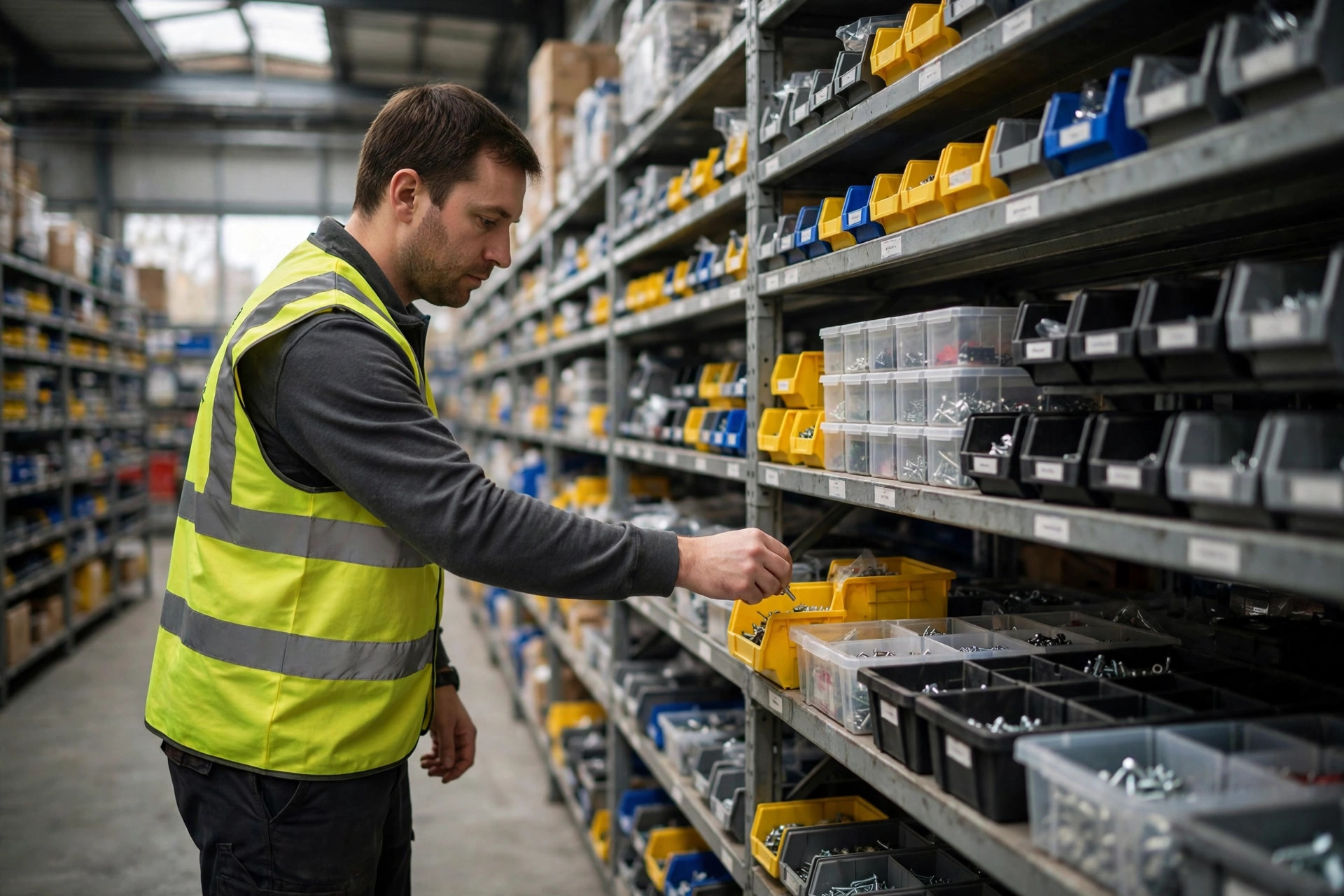
A picker in an auto-parts third-party warehouse walks more than twenty thousand steps a day, yet the front row of the pick face holds a bulky item shipping only a few dozen order lines a month. The problem is not the worker; it is the slotting method. ABC classification looks at order frequency and ignores volume. COI index slotting closes exactly that gap: it ranks locations with the Cube-per-Order Index (COI), which puts volume and frequency into a single formula. The two cases in this article use illustrative data to walk through the calculation.
Why ABC Classification Slots Small Parts Poorly
ABC classification sorts SKUs into A, B, and C tiers by order lines or shipped volume. It answers one question, which SKU matters, but not a different one: how much space does this SKU deserve. A bulky, high-frequency SKU can be both A-class and unworthy of the golden pick face.
Consider an illustrative example. At a 3PL auto-parts warehouse in eastern China, March 2025 picking data showed twelve bulky A-class SKUs occupying 58 percent of the front pick-face area while contributing only 31 percent of order lines. Twenty small-parts SKUs, squeezed into the back rows, contributed 47 percent of order lines on 19 percent of the area, and pickers walked 2.4 times farther to retrieve them. ABC itself is not wrong. The error is using it to answer a question it cannot answer: the allocation of space.
A second case points the other way. In a second-quarter 2025 review, an electronic-components distributor found sensor modules stored on high shelves because their order lines earned only a B rating. Pickers climbed for them hundreds of times a day. Frequency ranking had conflated importance with location, and small high-frequency SKUs are its most common victims.
How to Calculate the COI Index: A Five-SKU Worked Example
The COI index formula fits on one line:
COI = cubic volume occupied by the SKU ÷ order lines in the period
The unit is cubic meters per line. The smaller the COI, the more picks each unit of volume buys, and the closer the SKU belongs to the pick-path start. Two measurement rules matter: occupied volume means the actual space the SKU takes in its location, bin and clearance included, not one unit's net volume; and the period is usually one month, or a rolling twelve-week window where seasonality is strong.
Here is a five-SKU worked example, all figures illustrative:
| SKU | Order lines per month | Occupied volume (m³) | COI | COI rank | ABC (by lines) |
|---|---|---|---|---|---|
| Chip resistor | 620 | 0.4 | 0.00065 | 1 | A |
| Small connector | 480 | 0.6 | 0.00125 | 2 | A |
| Sensor module | 210 | 2.8 | 0.01333 | 3 | B |
| Wiring harness | 190 | 6.5 | 0.03421 | 4 | B |
| Plastic housing | 260 | 12.0 | 0.04615 | 5 | A |
The arithmetic is straight division: 0.4 ÷ 620 = 0.00065, 0.6 ÷ 480 = 0.00125, 2.8 ÷ 210 = 0.01333, 6.5 ÷ 190 = 0.03421, and 12.0 ÷ 260 = 0.04615. Sort by COI from smallest to largest, and assign locations outward from the pick-path start.
The plastic housing row carries the lesson. By order lines it is A-class; by COI it ranks last. Putting it in the front row spends twelve cubic meters on 260 picks a month. The same space given to resistors and connectors buys 1,100 picks. ABC answers how important a SKU is; COI answers the space return on it. Different dimensions produce different slotting.
Using the COI Index Together with ABC
COI and ABC are not alternatives. They divide the labor: COI sets the location ranking, ABC sets the replenishment policy. One answers where a SKU goes, the other how it gets replenished.
| Dimension | COI index | ABC classification |
|---|---|---|
| Question answered | Where to place it | How to replenish, how much |
| Location | Smaller COI sits closer to the pick-path start | Does not directly set location |
| Replenishment | Does not directly set replenishment | A: daily or kanban, B: weekly, C: on demand |
| Review rhythm | Recalculate monthly | Review as order mix changes |
In practice the combination yields four standard treatments: small COI plus A rating, golden zone with high-frequency replenishment; large COI plus A rating, like the plastic housing, an accessible mid-zone location with large, infrequent batches; small COI plus C rating, a small slot at the golden zone's edge, replenished on demand; large COI plus C rating, a distant or high location. The working method is to slot by COI first, attach an ABC-based replenishment policy to each SKU, and review both on one slotting map monthly.
Three COI Profiles of Small High-Frequency SKUs
Small high-frequency SKUs are not one kind of inventory. Their COI behavior falls into three profiles, each calling for different treatment.
The first profile is tiny volume times extreme frequency: chip resistors, screws, washers. COI usually sits below 0.001, picks are extremely frequent, and the space occupied is minimal. The treatment is the smallest bin, full-case replenishment, and a location at natural reach height. No spare space needs reserving, and replenishment frequency can run high.

The second profile is small volume times medium-to-high frequency with large variance: connectors and terminals. COI is still low, but models can differ severalfold in size, so calculating from one unit's volume distorts the result. The treatment is to compute COI from average volume plus a safety allowance, keep bins flexible, and keep models separated rather than mixed, so a large model does not spill into its neighbor's slot.
The third profile is small parts that appear as a kit: a screw, a washer, and a clip that regularly share an order. Each SKU's COI is low alone, but their value lies in the combination. The treatment is to store them adjacently as a group, even if one member's COI rank is a few places lower, rather than splitting the group across aisles to satisfy the ranking. The gain from correlated picking outweighs the gain from a strict per-SKU ranking, a point the limitations section returns to.
A Counterintuitive Judgment: The Lowest COI Does Not Always Go First
COI ranking invites a tempting conclusion: the lowest-ranked SKUs belong as close to the pick-path start as possible. In practice, extremely high-frequency small parts mean extremely high-frequency replenishment. Replenishment carts moving in and out block the pick aisle, and a golden-zone bin that is too small empties by midday, interrupting picking with stockouts. Space return and replenishment cost must be calculated together; optimizing one half eats the gains from the other.
This trade-off suggests two adjustments. For SKUs with extremely low COI, size the bin one notch larger than the formula suggests, cutting replenishment trips. Alternatively, place a replenishment buffer behind the golden zone, so staff need not push carts into the pick aisle on every trip. The objective of slotting was never to minimize one metric, but total picking travel plus total replenishment waiting.
Three Limitations of the COI Index, and How to Compensate
COI is not a universal formula. Three limitations deserve a clear statement before applying it.
The first is seasonal fluctuation. An air-filter SKU doubles its order lines in summer, and its COI moves with them, so a full-year average mis-slots it. The compensation is a rolling twelve-week window, recalculation before peak season, and dedicated seasonal locations for SKUs with sharp peak-to-trough swings.
The second is new products with no history. A new SKU has no order lines, so COI cannot be computed. The compensation is to borrow a comparable SKU's COI for a provisional location, then re-slot after thirty days.
The third is correlated picking, which COI ignores. COI is a per-SKU metric; it cannot see that two SKUs are almost always picked together. The compensation is order-correlation analysis: measure how often SKUs co-occur on the same order, and place high-co-occurrence SKUs adjacently even if their COI ranks differ by several places. The kitted small parts of the third profile depend entirely on this compensation.
COI brings volume back into slotting decisions and measures the space return on each SKU. Yet it rests on one assumption: that picking means a person walking. As small-parts picking shifts toward bin-based goods-to-person systems, walking cost disappears, and ranking will rest instead on retrieval cycle time and equipment throughput. Whether volume and frequency remain the two most important variables in that formula is worth calculating again.
By Dr. Chen, Supply Chain Researcher