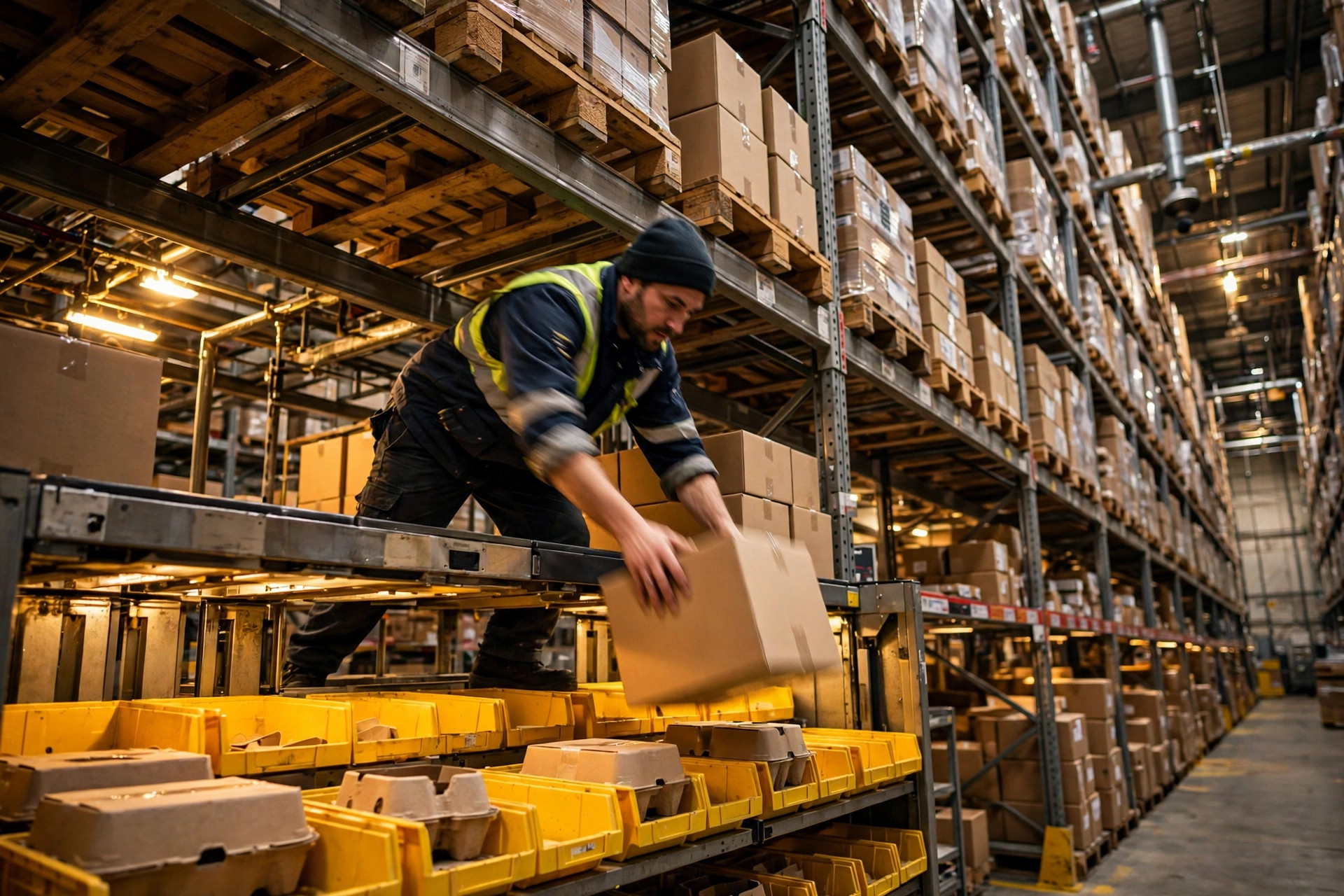
Golden zone slotting sounds like consultant jargon. Translated into human: put your best sellers at waist-to-shoulder height, where a picker's hands already are. Industry field tests routinely show 15%–40% faster picking from that one move alone — no robots, no software, no capital spending. My warehouse is 3,000 square meters of rented concrete with five people and zero automation budget, and this free trick is a big part of how we survive peak season. Here's the whole playbook, no gatekeeping.
Our misery: 400 bends a day
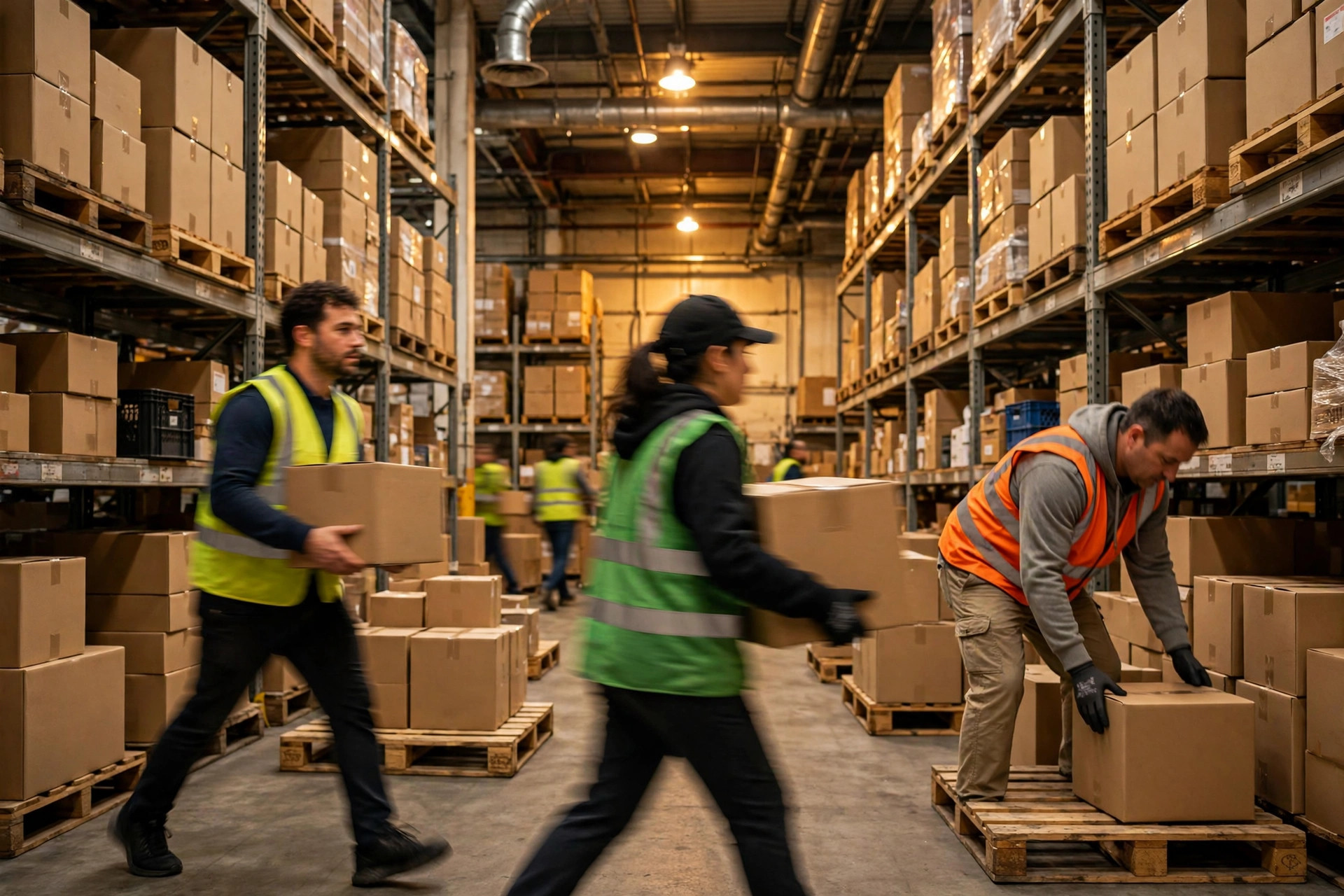
Xiao Liu, our fastest picker, is 25 with the back of a 45-year-old. Last November, before peak season, I shadowed him for a full shift and counted: roughly 400 bends and 200 tiptoe-reaches in a single day. At clock-out he told me, half joking, "Boss, two more years of this and I'm retiring early — on medical grounds."
That got me thinking: where exactly is our picking time going? Not walking — our pick zone is only about 800 square meters, there's only so far to walk. A week of shadowing showed the real thief was reaching: bending for bottom-level cartons, stretching for second-level stock, climbing step stools for the heavy stuff. Three extra seconds per reach, 2,000 picks a day — that's 100 minutes gone, every day.
How do the big guys solve this? Their WMS has a slotting module that auto-computes the optimal location for every SKU. Sounds fancy. Costs fancy too — the quotes I got were more than two years of Xiao Liu's salary. We can't burn that kind of money. So we went the chalk-and-spreadsheet route instead.
Where the golden zone is: waist to shoulder
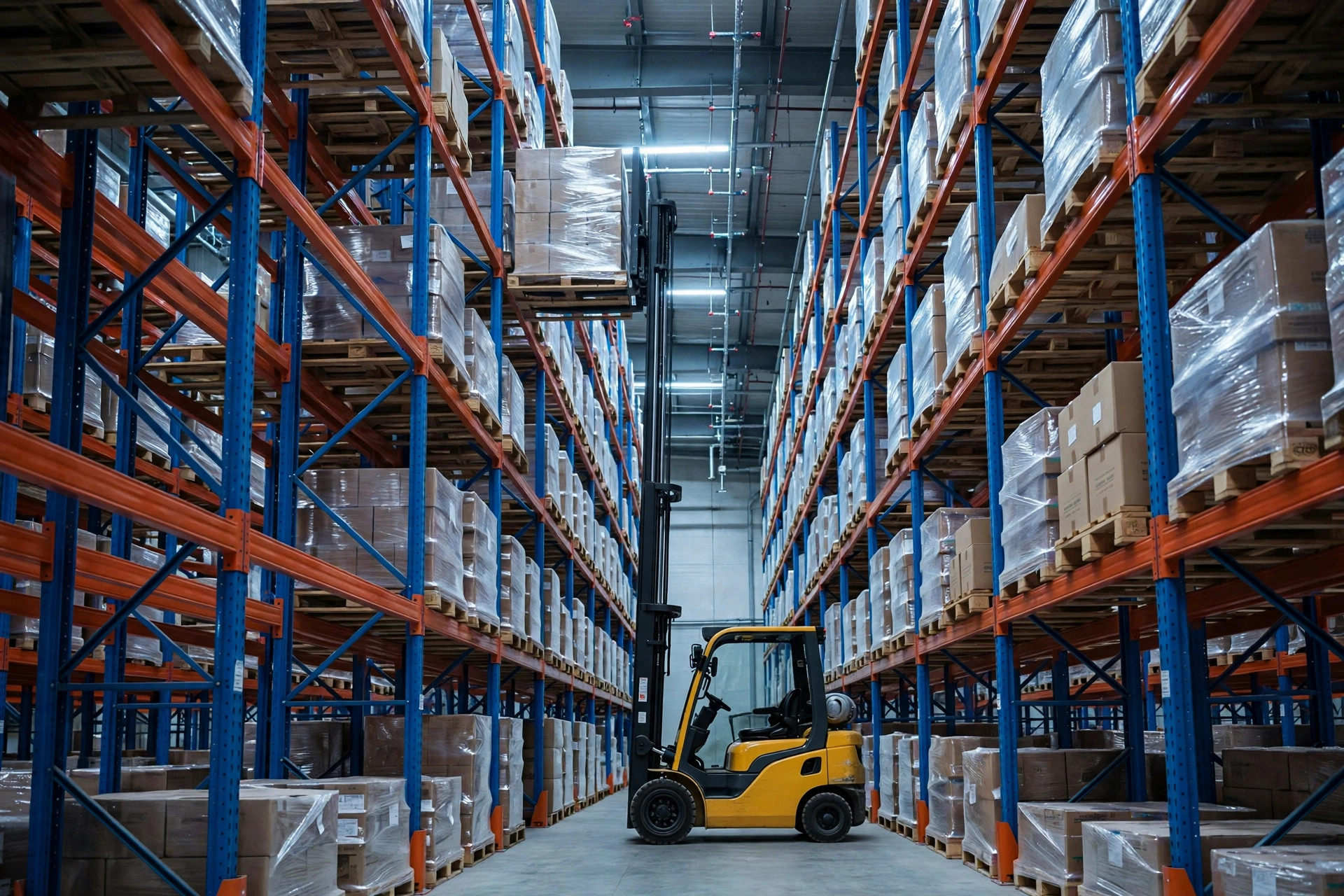
Ergonomics textbooks describe the golden zone as the band between waist and shoulder height — roughly 0.75 to 1.5 meters off the floor, though the exact numbers vary by source. We don't do academic precision in a small warehouse; just remember "waist to shoulder." No bending, no tiptoeing, cartons arriving at your hands like a food delivery.
Why is this band faster? Three reasons. First, the motion is smallest — 2 to 3 seconds saved per pick. Second, no bending or stretching means less fatigue, so the afternoon shift doesn't collapse. Third, labels sit at eye level, so finding the right carton is fastest. Industry measurements put the picking speed gain at 15%–40% when fast movers live in this band. That's a wide range because every warehouse is different; honestly, I'd have been thrilled with the low end.
Our method for marking the zone was gloriously low-tech: a tape measure and chalk, one afternoon. I drew two lines on every rack upright — one at 0.75 meters, one at 1.5 — and declared everything between them the golden zone. The team laughed and asked if I was starting an art class. They stopped laughing the next day.
The golden zone slotting cheat sheet: height × ABC
Marking the zone is only half the job. The other half is deciding who gets to live there. That takes ABC classification, done the cheap way.
Export one week of outbound orders — yes, that shipping report already in your system, opened in Excel — and sort SKUs by units shipped. The top 20% of SKUs will typically cover about 80% of your units. Those are your A items: the true best sellers. The next 30% are B items, the steady performers. Everything else is C: slow movers and dead stock. Ten minutes of work, and more honest than any slotting algorithm — data doesn't flatter.
Then the placement rules, which I printed on A3 paper and taped to the wall for the whole warehouse to follow:
| Height band | Who lives there |
|---|---|
| Waist to shoulder (~0.75–1.5 m) — the golden zone | A items only. True best sellers, nothing else. Scarcity enforced |
| Shoulder to overhead reach (~1.5–2 m) | B items. Reachable with a small stretch |
| Floor to waist | Heavy goods + C items. Heavy stock low is just safety common sense, and the pallet jack lives down here anyway |
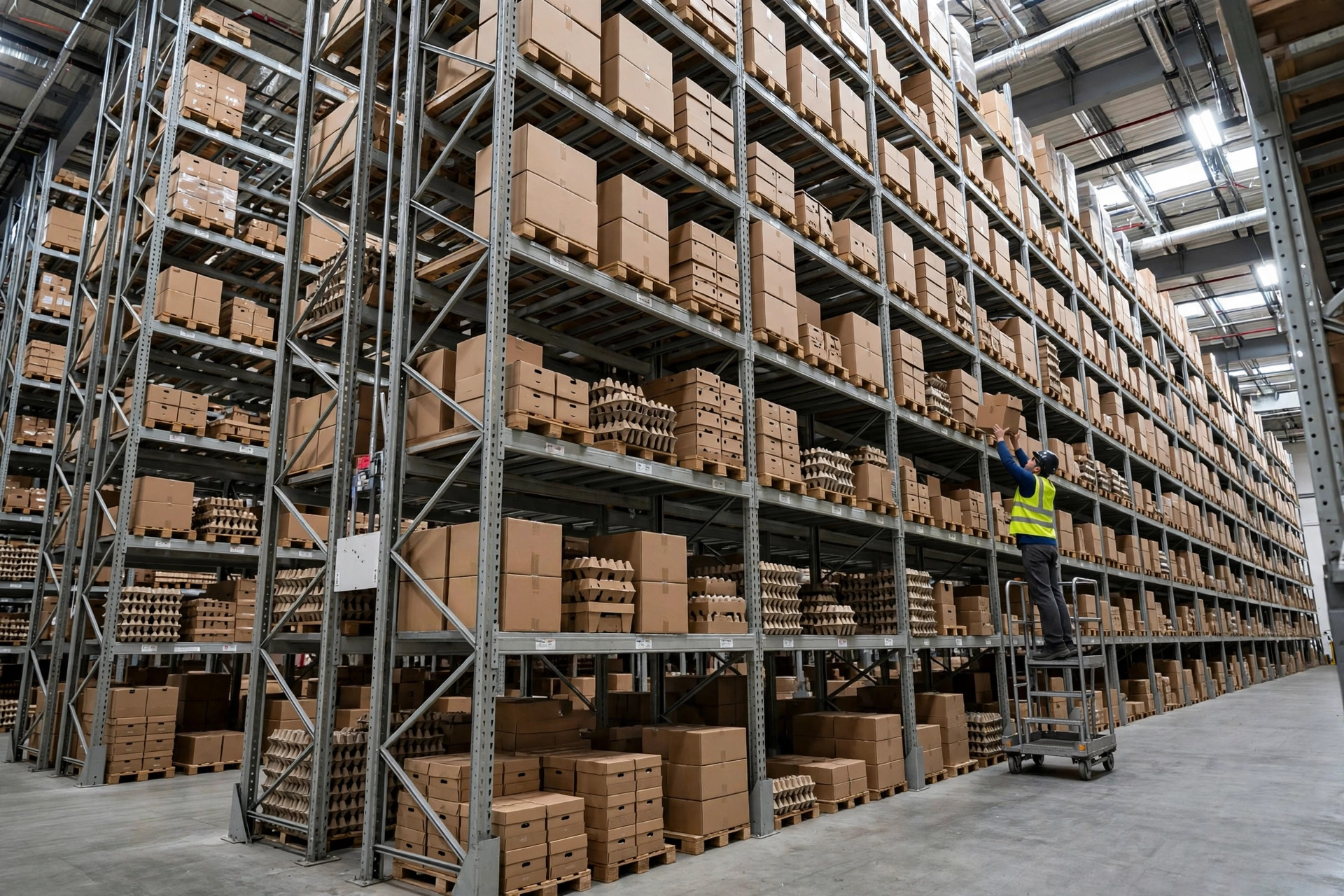
| Above 2 m, ladder territory | C slow movers, dead stock, backup inventory. Accept the climb — you barely go up there |
Real numbers from our floor: last November we re-slotted to this table. The biggest move was a carton shipping 200+ units a day, relocated from the top beam to waist height. Xiao Liu's average order — 12 lines — went from just over two minutes to under ninety seconds. Roughly a third faster. That December, five people shipped what took seven people the year before. We hired nobody. The overtime money we saved bought the whole warehouse a very good dinner. The golden zone paid for it.
The cautionary tale is Lao Chen's warehouse next door. His best sellers lived on the top level for years. I suggested a re-slot twice; he said moving locations would "disrupt shipping." After the 2024 peak, one of his pickers missed a step coming down a ladder and sprained an ankle — medical bills plus lost shifts cost him tens of thousands of yuan. That money would have paid for a full warehouse re-slot twice over. The safety bill always comes due.
Two counterintuitive lessons
First: a bigger golden zone is not a better golden zone. Our first attempt crammed the top 30% of SKUs into the golden band, and Xiao Liu complained it was harder to find things than before. Makes sense in hindsight — we'd traded bending effort for searching effort, net zero. We pulled half the SKUs back out and kept only true A items. Performance went up. The golden zone works because it's scarce, not because it's big.
Second: the golden zone is worth more to a small warehouse than a big one. A big distribution center can throw headcount or automation at a bad layout. We have five people; every picker-minute is margin. And our re-slot cost literally nothing — a piece of chalk and one sheet of A3 paper — which makes the ROI technically infinite. My favorite kind of math.
The copy-paste playbook for fellow small warehouses
Re-run ABC every quarter. Best sellers expire; last season's hero is this season's dead stock. Don't let corpses squat in the golden zone.
Re-slot one week before every peak or season change. It's locked on our calendar: the Sunday before every major sales event, the whole team re-slots, and I buy bubble tea after. The ritual cuts resistance in half.
Don't wait for software. An order export plus Excel got us most of what a slotting module does. When we hit 30,000 square meters, maybe then we'll buy the fancy module.
Train new hires on the wall chart. Chalk lines plus one A3 sheet, and a new picker is productive in half a day — faster than memorizing location codes.
Big companies compete on equipment. We compete on wits. Golden zone slotting costs nothing, so there's no excuse not to do it this Sunday afternoon. Move your best sellers to waist-to-shoulder height, and your pickers will thank you on Monday.
Small warehouses have their own way to survive.
By Xiao Ma, Small Warehouse Owner