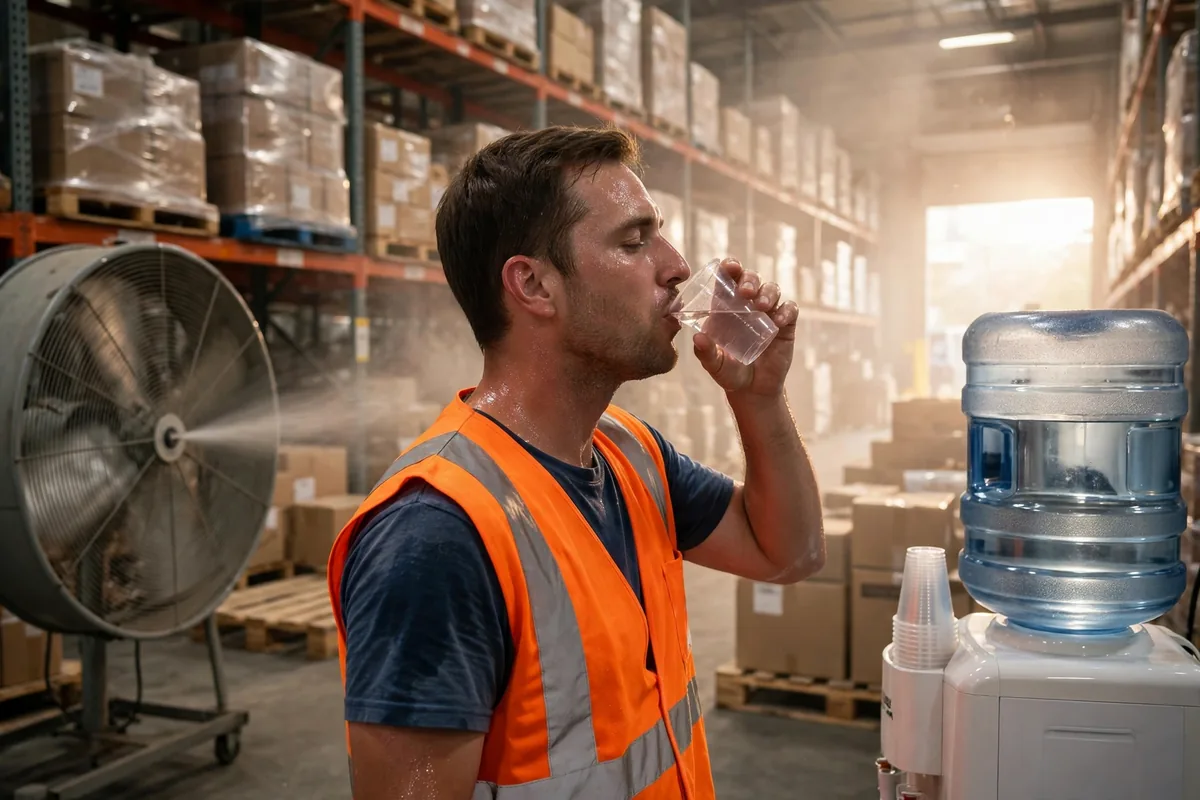
Let me tell you something. After all these years on the road, I have learned that OSHA warehouse heat stress prevention compliance is not paperwork. It is the difference between a worker walking out of a warehouse and being carried out. The thing I dread most in summer is not traffic. It is backing into a warehouse to unload. Late August 2024, I hauled a load into a warehouse out in Ontario, California. The truck had barely stopped before sweat was running down my back. On the dock, a young guy was carrying boxes, and with every trip his steps got slower and his face got paler. The supervisor grabbed his arm, sat him down in the shade, handed him water, and fanned him until he came around. I stood there thinking one thing: if nobody had been watching, that kid could have gone down right there between the pallets.
That is what OSHA warehouse heat stress prevention compliance is really about. On August 30, 2024, OSHA published its proposed rule on heat injury and illness prevention, docket number 2024-14824, covering indoor and outdoor workplaces. Warehouses are indoors, and they count. Let me be straight about one thing up front: this is still a proposal. It is not a final rule, and it is not law yet. But a warehouse that uses "not final yet" as an excuse to do nothing is playing a dangerous game, because enforcement is already happening under other authority.
The 80 and 90 Degree Lines: What OSHA Warehouse Heat Stress Prevention Compliance Actually Asks
The most useful part of the proposal is the two heat index triggers, and they are simple enough for anyone to remember. At a heat index of 80 degrees Fahrenheit, the first trigger kicks in: the warehouse has to provide drinking water, a cool or shaded rest area, and a gradual acclimatization schedule for new hires and returning workers. Nobody gets thrown into the hottest job on day one. At 90 degrees, the high-heat trigger kicks in: mandatory paid rest breaks, proposed at a minimum of 15 minutes every 2 hours, plus closer observation for symptoms and a heat hazard alert.
I have seen enough warehouses to know why those two lines matter. The people who get hurt most are almost never the veterans. Veterans know when to drink, know when to step into the shade, know what their own limits feel like. It is the new hire who gets hurt, because he does not want to look soft in front of the crew, so he keeps pushing until his legs give out. The proposal writes acclimatization in for new and returning workers precisely because of that. Whoever makes the schedule needs to hear this: ease new people in over their first days, keep them out of the hottest hours and the heaviest work. That is not being soft on them. That is keeping them alive.
California adopted an indoor heat standard in 2024, and warehouses fall under it. Washington, Oregon, Minnesota, Maryland, Nevada, and other states have their own state heat rules too. Whatever state you operate in, check that state's current policy on the official site, because the rules are not the same everywhere.
The Rule Is Still a Proposal, But Heat Stress Enforcement Did Not Wait
This is where the story gets confusing, so let me lay out the timeline plainly. The public comment period closed on January 14, 2025. A hearing was held in July 2025. The record closed on October 30, 2025. As of October 2026, no final rule has been published. The Department of Labor plans a supplemental proposal in December 2026, and there are also reports that the process has stalled. It sounds like nothing is happening. It is not.
Enforcement is already running on the Occupational Safety and Health Act's general duty clause, together with OSHA's National Emphasis Program on heat, revised April 10, 2026 and in effect through April 2031. In plain language, that means this: even before any new rule takes effect, if a warehouse lets people work in dangerous heat and someone gets hurt, OSHA can come after it under the general duty clause. Waiting for the final rule before preparing is a bet, and the bet is placed with other people's health.
I saw the other side of this a few summers back, at a receiving dock where a driver had been waiting over an hour in the sun for his trailer to be unloaded. He did not want to keep the engine running and burn fuel, so he was baking in the cab. He asked if he could wait somewhere shaded. The warehouse told him the rule was to wait outside. Nothing happened to him that day, but I kept thinking about it on the drive home. A person is not a pallet. A warehouse that will not offer water and shade even to the drivers coming through its gate is telling every driver in the region what kind of place it is.
The Compliance Math: Prepare for OSHA Warehouse Heat Stress Prevention Now or Wait for the Final Rule
I love running the numbers, so let us run this one as a worked example. Under the proposed high-heat trigger, once the heat index hits 90 degrees, workers get at least 15 minutes of paid rest every 2 hours. Over an 8-hour shift, that adds up to 60 minutes of rest. I can already hear the objection: an hour a shift, across a whole crew, across a whole summer, that is a lot of freight not moving.
That is the wrong way to count. Count the other side. One worker goes down with heat stroke and the whole shift falls apart. The work stops, an ambulance comes, investigators ask questions, operations stall, and the costs pile up in ways nobody budgeted for. And if the outcome is truly serious, no amount of money fixes it. Those 60 minutes of rest buy a full shift where everyone walks out on their own feet. That is the real compliance math: the money you spend on prevention is small and visible, and the trouble it saves you is large and invisible until it is too late.
There are a few things a warehouse can do right now, and none of them are complicated. First, write down a site heat plan and an emergency response procedure. The proposed rule explicitly requires both, so do not wait for an inspector to show up before writing them. The plan should say who watches the heat index, what happens at 80 degrees, what happens at 90 degrees, who watches for symptoms, and who gets called first when someone shows signs of trouble. Second, water and shade cannot be for show. Water has to be close at hand and plentiful, and the rest area has to be genuinely cool. Third, ease new and returning workers in gradually. Fourth, say the heat index out loud at the start of every shift, and say plainly when people must stop and rest.
| Trigger | What the warehouse should do |
|---|---|
| Heat index 80°F | Provide drinking water, set up a cool or shaded rest area, acclimatize new and returning workers gradually |
| Heat index 90°F | Mandatory paid rest, at least 15 minutes every 2 hours, closer symptom observation, heat hazard alert |
| Someone shows symptoms | Stop work immediately, move them to shade, follow the emergency response procedure |
| Every day | Keep the written heat plan and emergency procedure ready, announce the day's heat index at shift start |
If I ran a warehouse, I would tape that table to the wall of the rest area, not file it in a drawer. A plan nobody can see is not a plan.
Here is the counterintuitive part, and I mean it: most people treat heat safety as a favor warehouses do for workers, a cost with no return. It is the other way around. Heat safety is insurance the warehouse buys for itself. Shippers should look at it the same way. When you choose a warehouse, ask how it handles summer heat. A warehouse that cannot even manage water and a rest area is not a warehouse you want holding your freight through peak season, because when its people go down, your freight stops too.
A rested worker is still a worker. A worker on the floor is a crisis. There is an old saying where I come from: keep the green hills, and you will never lack firewood. In this business, the green hills are the people doing the work. Before summer arrives, get the water ready, sort out the rest area, write the plan, and look after the new people. On the day the heat index climbs to 90 degrees, you will be glad you did.
By Shifu Zhao, Trucking Veteran (15 yrs)