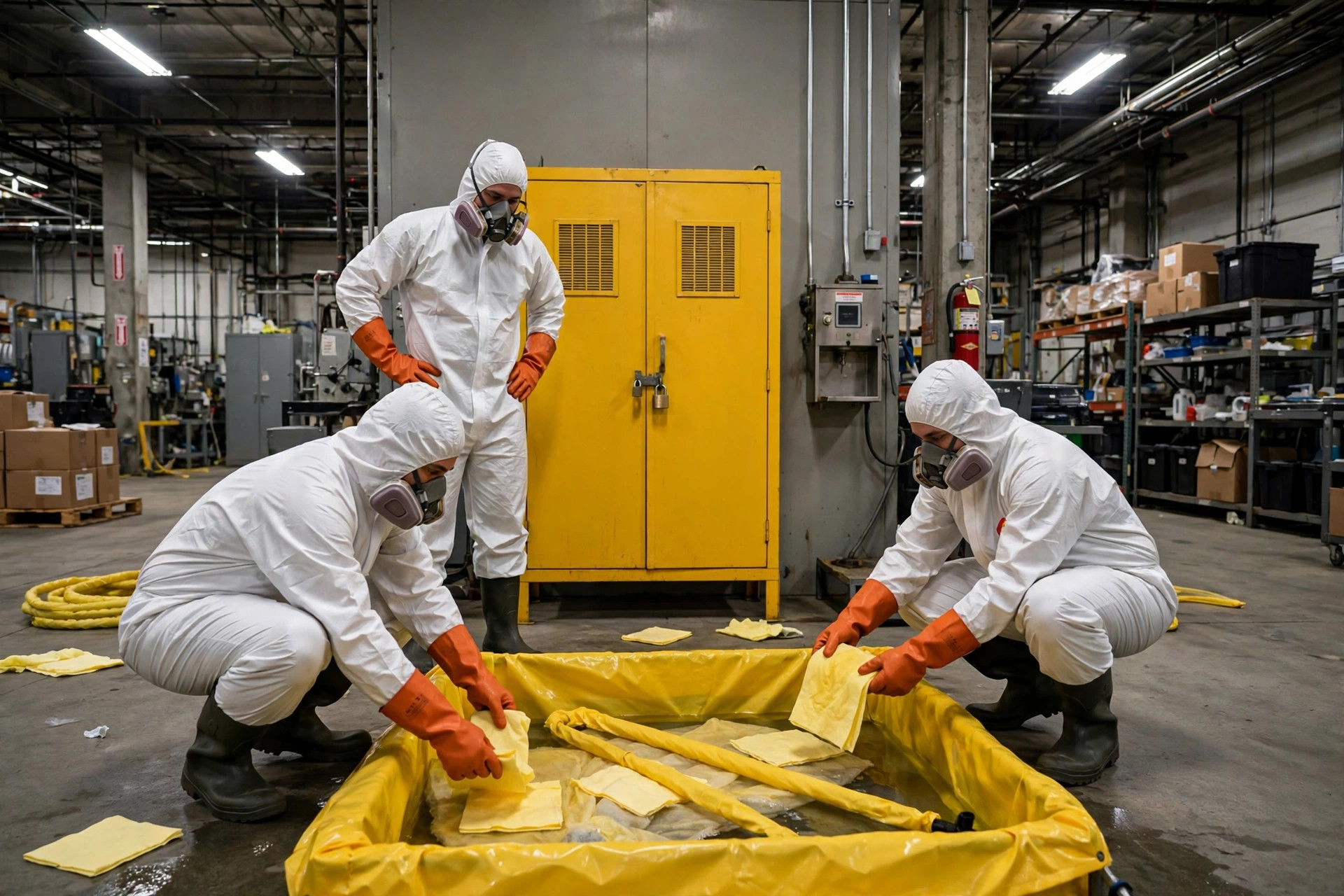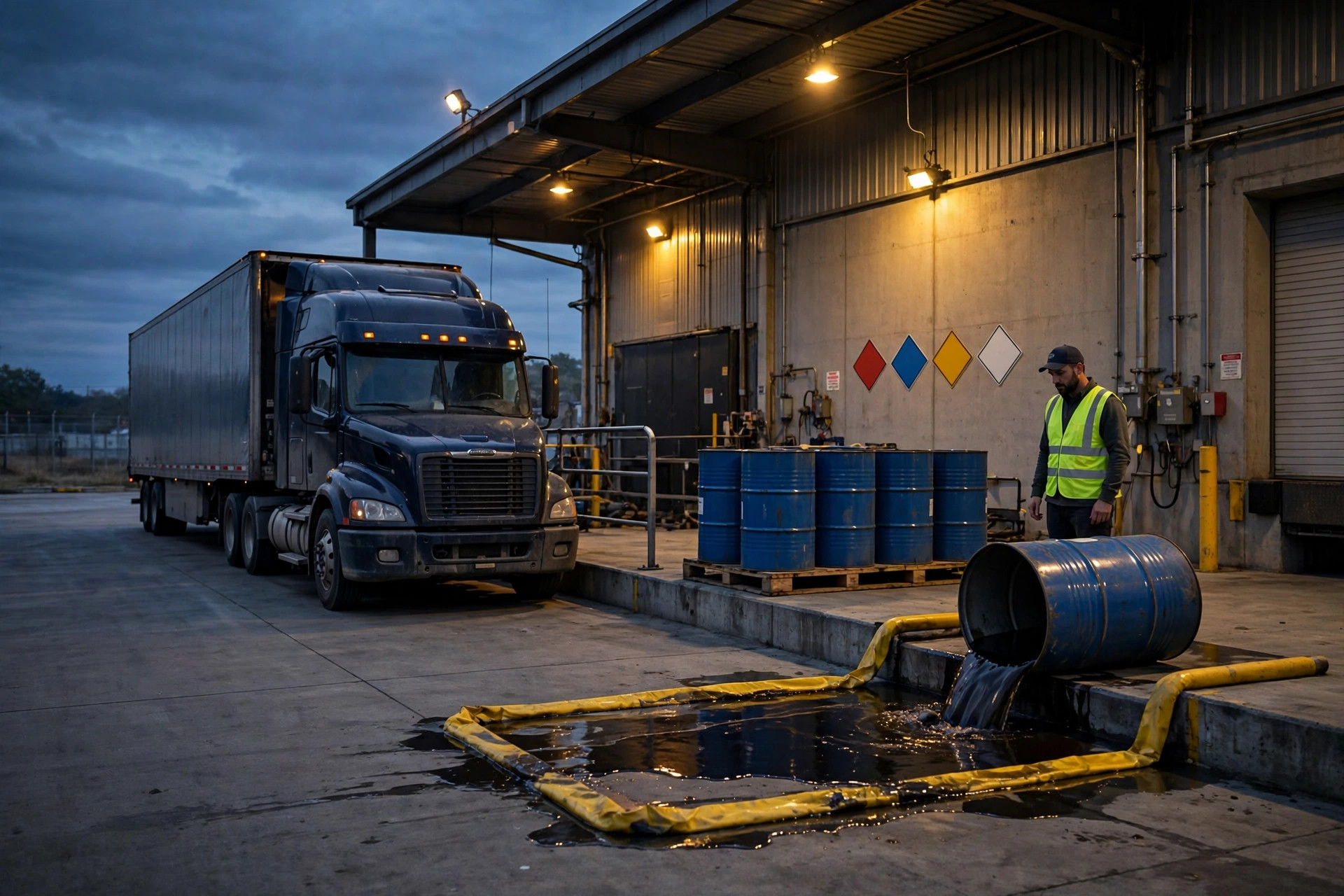
One night in October 2023, I was queued up to unload at a hazmat warehouse east of Houston. It was past 2 a.m. when my turn came, and the night shift was just two guys. As the forklift driver and I pulled the third pallet off my trailer, he shone his flashlight under it and said, "Driver, take a look at the bottom of this drum." A 55-gallon steel drum, a wet ring around the base, a small dark patch spreading on the pallet, a sharp smell in the air. Not a gusher — a seep.
Let me tell you something. Fifteen years behind the wheel, I've been in and out of hazmat warehouses hundreds of times. I've seen spill drills too — some real, some pure theater. But that night gave me chills. One of the night-shift guys ran to the office to dig out the SDS and figure out what was in the drum. The other went hunting for absorbent socks and pads. They called the shift manager. Nobody picked up. In the end it was me, the driver, who grabbed their spill kit and diked around the leaking drum first, pads underneath. The whole thing took about twenty minutes. Nobody panicked, but nobody moved sharp either — everybody looked like they were trying hard to remember what the instructor had said at the last drill.
The next morning the manager showed up, and his first question wasn't "is the spill contained" — it was "who saw this happen." Right then I understood: this warehouse drilled for inspections, not for spills.
That tells you everything. With one spill drill a year, when the real thing hits, people remember maybe thirty percent of what they practiced. Muscle memory goes stale in three months.
The warehouse with the biggest drill panicked the most
Back in the fall of 2019, I watched a "showpiece" drill at a warehouse in New Jersey. Two weeks' notice, half the shift shut down, the local fire department invited, banners up, group photo at the end. The manager told me they did it every year — passed every inspection, beautiful pictures.
Then the following spring, a forklift clipped a 200-liter plastic drum inside the warehouse and knocked it over. Product all over the floor. The crew's first instinct wasn't the drill script — it was to pull out their phones and call the manager. By the time he arrived, the stuff had run across the floor and into a storm drain. Cleanup took three days, and the local environmental agency got involved. I won't speak to the fines on their behalf.
Now compare a warehouse in Ontario, California. No showpiece drills, ever — but I respect their approach. Every quarter, a 30-minute tabletop exercise: a few people around a floor plan, and the manager throws out a scenario off the cuff — "A drum tips over by dock 3. Who's your first call?" Can't answer? It goes on the list, and you get asked again next week. Twice a year, no-notice spot drills — night shift or day shift, random, no warning, straight into a debrief afterward.
Which one stays calm when it's real? The second one. I heard later that warehouse had a real small leak in 2021 — three people on nights, containment done in seven minutes. The manager found out the next morning. That's what "drilled in" looks like.
A spill-drill script checklist you can actually use
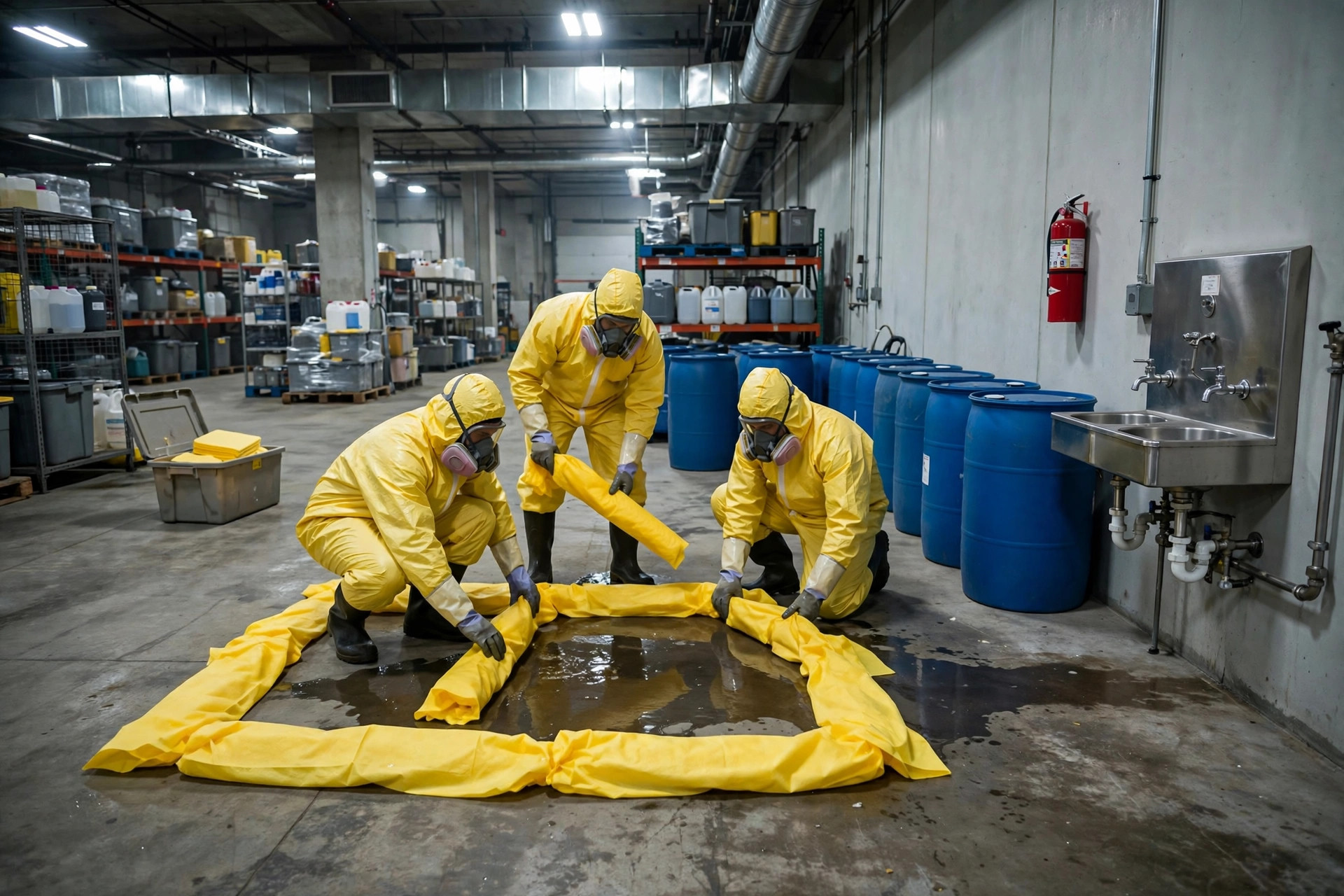
Enough theory. Here's something a warehouse or shipper can actually use — a table of what a working drill script should cover, based on everything I've seen over the years:
| Phase | What to practice | The trap most warehouses fall into |
|---|---|---|
| Set the scene | Give "what happened," not "what to do" | Handing out the full script in advance = an open-book exam |
| First response | Who spots it, who gets the first call, response time | Everyone waits for "the person in charge," nobody dikes first |
| Containment | Booms, pads, shut the valve — in that order | Practicing "suiting up" but not "dike first, clean second" |
| Comms and reporting | Internal chain + triggers for calling fire and environmental agencies | Dead phone numbers, SDS nowhere to be found — never tested in drills |
| Evacuation | Upwind muster point, headcount | Muster point downwind = evacuating into the plume |
| Debrief | Within 48 hours, everyone who drilled must attend | All praise, no hard questions — same mistakes next time |
Pin this table on the office wall; it beats any drill manual. Before each drill, the manager picks two or three phases to spring on the crew. No need to run the whole thing every time — a full drill burns labor hours and bores people.
Don't phone in the debrief — four questions are enough
Most debriefs are theater. The most honest one I've seen is four questions, everyone takes a turn:
- Which move felt smoothest today?
- Where did you get stuck, and why?
- If this had been real, which step would have gone badly wrong?
- What scenario do you want next time?
Don't underestimate those four. They force everyone to turn "I did the drill" into "I figured something out." Keep the debrief on file — inspectors ask for it. OSHA has clear training requirements for hazmat emergency responders, including annual refresher training — check the latest requirements on OSHA's official site; I won't quote numbers I can't stand behind.
The counterintuitive take: once a year is just the compliance floor
Here's the counterintuitive part: warehouses that stage one big annual drill often handle a real incident worse than the quiet ones. Why? A big drill is an open-book exam — everyone prepares, and what gets practiced is the choreography. A real spill is a closed-book test, and nobody gives you prep time. Drill once a year and the moves fade within three months.
The combo that actually works: one full-scale drill a year (for the inspectors, for coordination) + one tabletop every quarter (for judgment, for the call chain) + two no-notice spot drills a year (for real reactions). It doesn't cost much — a tabletop takes thirty minutes, and a spot drill costs the manager some mischief, not money.
If you're a shipper choosing a warehouse, ask one extra question: when was your last drill, what was the scenario, and can I see the debrief notes? If the answer comes with a lot of stammering, think twice before your freight goes in.
There's an old saying where I come from: train a thousand days to fight for one. In hazmat, you don't drill for the audience — you drill for the "what if." Don't wait until something's actually leaking to try to remember what the instructor said.
By Shifu Zhao, Trucking Veteran (15 yrs)