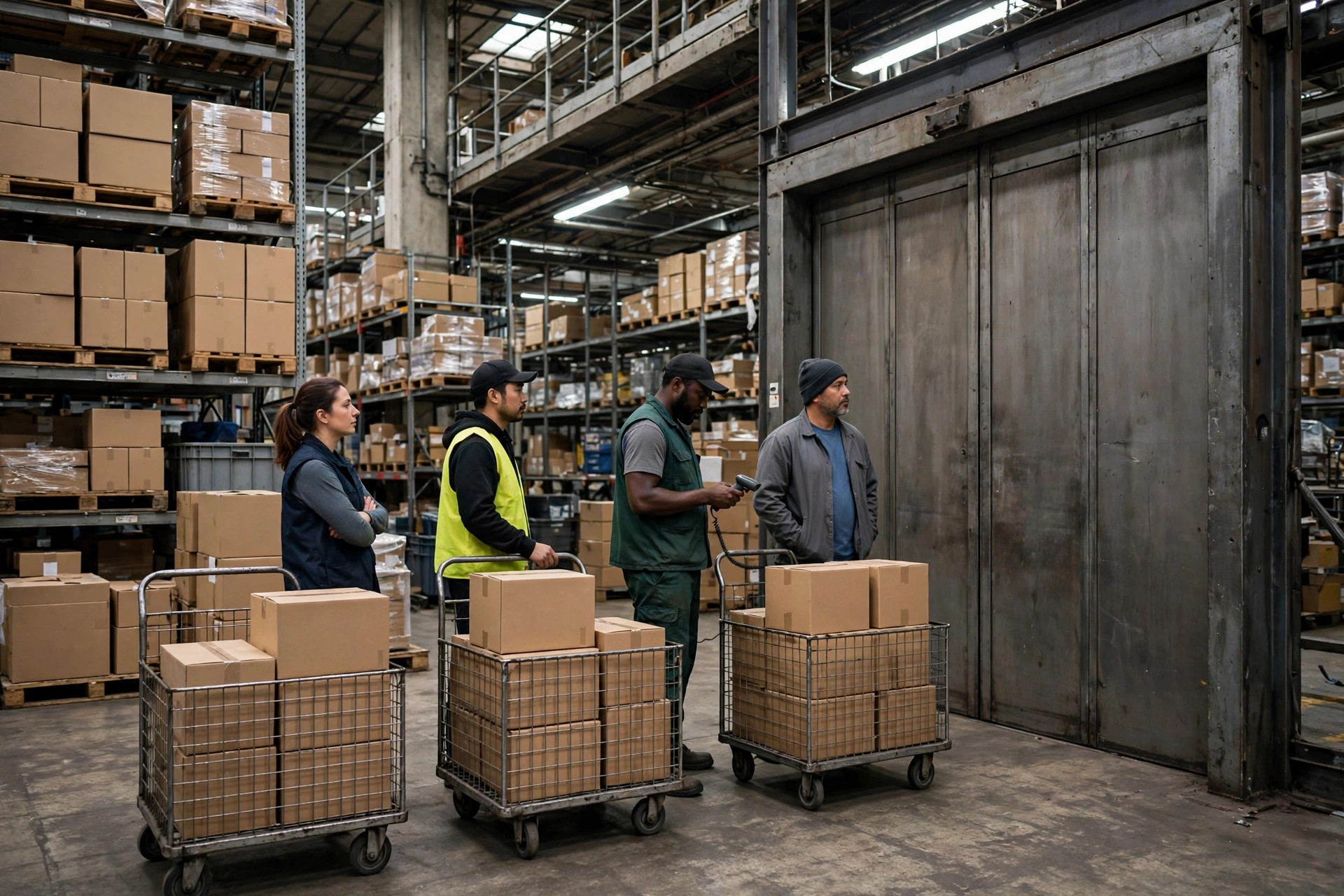
Last month I walked a three-story warehouse in Vernon during a flow audit. At ten in the morning, six picking carts were lined up in front of the freight elevator on the second floor, pickers leaning on their carts and scrolling their phones. The supervisor told me the average wait was twenty minutes. I didn't say a word. I pulled out my phone and started the stopwatch: doors open, load, doors close, ride up, doors open, unload. One full round trip took just over three minutes. A single 5,000-pound freight elevator, trying to swallow picking, replenishment, and returns for three floors all morning. That is an invisible ceiling.
Let me say something unpopular: most picking-efficiency problems in multi-story warehouses are not lazy pickers or bad slotting. It is the freight elevator. If your elevator cannot keep up, do not talk to me about cross-floor picking optimization. Fix the artery first.
Is Your Elevator Big Enough? Do the Math First
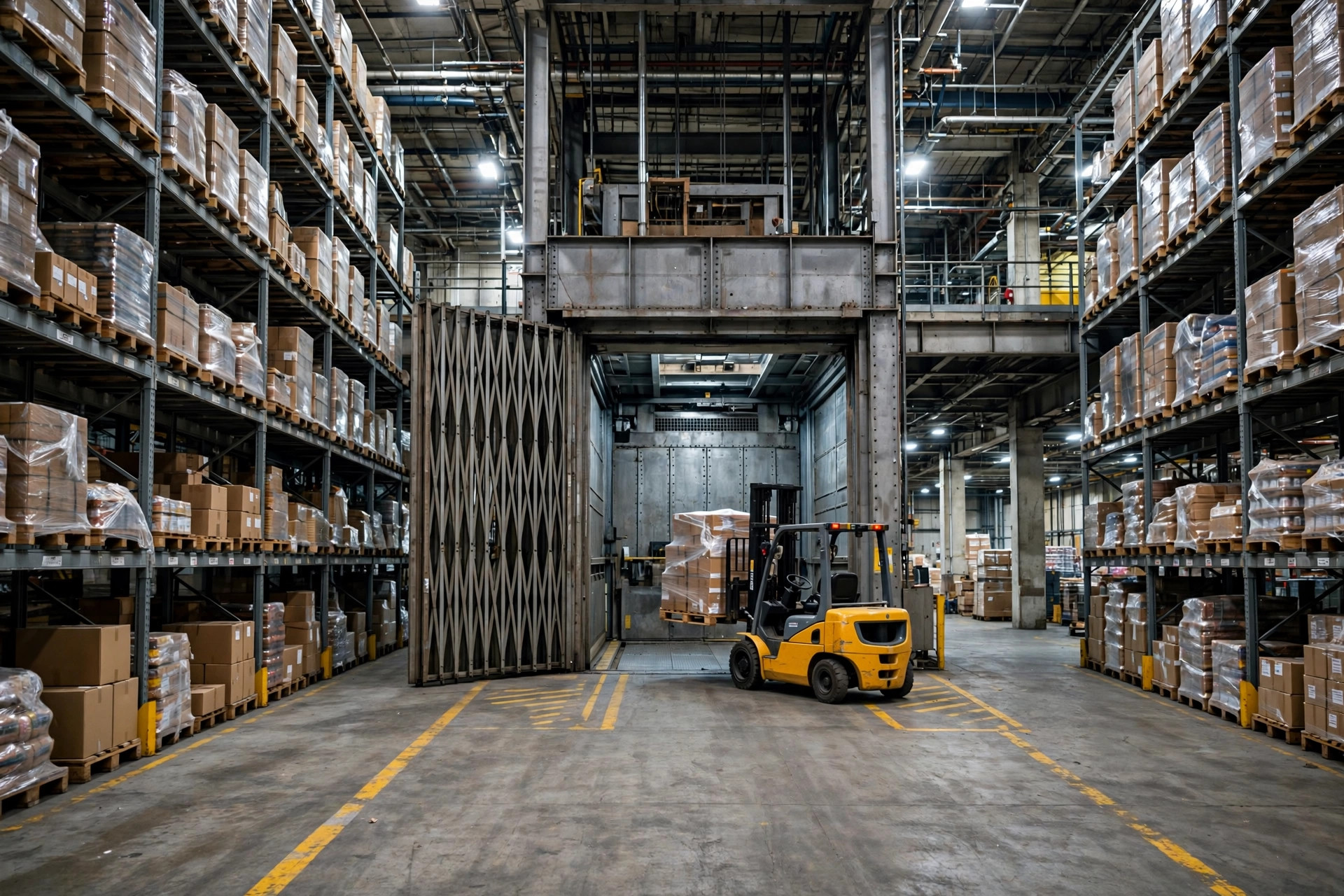
Elevator throughput works like a conveyor: it all comes down to cycle time. One complete trip means waiting, doors opening, loading, doors closing, traveling, doors opening, unloading, doors closing again. Those seconds add up. A typical industrial freight elevator travels around a meter per second. The doors take a dozen seconds each way. A forklift needs a minute or two to move two pallets in and out. Add it all up in a three-story building and a round trip runs three to four minutes. That is normal.
So what does a 5,000-pound car — big enough for two pallets — actually move? Fifteen to eighteen cycles an hour in theory, thirty to thirty-six pallets. And that is the brochure number: nobody calling the car from another floor, nobody mashing the wrong button, no forklift blocking the landing. Knock off thirty percent for real life and you are looking at roughly twenty pallets an hour, steady state.
The math is simple: take your daily cross-floor pallet volume, divide by picking hours, and compare against that twenty. The Vernon building was pushing more than three hundred cross-floor pallets a day in peak season across an eight-hour picking window — about forty pallets an hour against an elevator that could do twenty. You want to talk pick-path optimization? Close the twenty-pallet gap first.
One thing most people miss: pickers riding with carts and forklifts moving full pallets are two completely different loading patterns. Carts look small — you can fit four or five in a car — but people getting in and out, the doors cycling, the safety checks... it eats just as much time as a forklift load. I have watched buildings mix carts and pallets in one queue, everyone waiting on everyone else. Separate them. Run full-pallet moves in dedicated windows and picker trips in their own slots. Do not let them fight.
Treat the Elevator Like a Production Line: Schedule It
A freight elevator is not a lobby button. It is production capacity, and it needs a schedule. Three rules I give every multi-story operation. They are embarrassingly low-tech. They work.
First, elevator reservations. Skip the smart-scheduling software — small buildings cannot justify it, and big ones already have it. A whiteboard does the job: each floor books the car in thirty-minute blocks, wipe and rebook daily. In peak season, first booked, first served, no grace period. I tried this at a two-story e-commerce warehouse in the City of Industry — fifty thousand square feet, more than ten thousand orders a day in peak — and a whiteboard cut elevator queues from forty minutes to under ten.
Second, stagger waves by floor. Never release wave drops for all three floors at once. Offset them by fifteen to twenty minutes so the elevator load curve flattens out. Floor one releases, floor two follows fifteen minutes later, floor three behind them. The car always has work and never gets slammed. Pair it with your WMS wave plan; it costs almost nothing.
Third, and this is the big one: keep your fastest movers on the main floor. This is ABC slotting 101, yet multi-story buildings get it wrong constantly — hot SKUs end up on the third floor because there happened to be space up there. In cross-floor picking, eighty percent of order volume usually comes from twenty percent of SKUs. Pin that twenty percent to the shipping floor and cross-floor traffic drops in half. My verdict is blunt: the main floor is not where you put whatever does not fit upstairs. Fast movers belong there as a deliberate strategy.
When the Elevator Dies, You Need a Plan B
This is the most expensive lesson I have ever learned in this business. In 2023, a building's elevator motor burned out. The service company said parts would take three days. For three days, everything above the ground floor moved by hand up the stairwell for small items; full pallets simply stopped shipping. The client's customer service line melted down. The owner ended up paying double for rush parts.
Since then, every multi-story client of mine gets a freight-elevator-down checklist. The essentials:
Write response time into the maintenance contract. Standard coverage and a four-hour on-site guarantee are not the same price, but a multi-story building cannot afford to cheap out here. One day of a dead elevator costs more than years of premium coverage.
Split smalls from pallets in the contingency plan. Small items can move by bucket brigade up the stairwell — map that route in advance, before the day you discover the stairwell is full of junk. Full pallets? Accept it: shipments stop or get rerouted. That is the trade-off, and the client should hear it from you before it happens, not after.
Do not skip preventive maintenance. Ropes, governors, door operators — inspected on schedule per ASME A17.1, replaced when they are due. I have seen too many buildings treat the elevator as a forget-about-it asset until the day it quits. Two deep services a year cost far less than one emergency repair.
One more, the unglamorous one: a multi-story building should ideally have two elevators, even if the second one is smaller. Not for throughput — for redundancy. One goes down, the other keeps half your capacity alive, and the whole operation does not flatline. Run this math when you are buying or leasing the building. Adding one afterward costs more than double.
New Elevator or New Process? Run the Numbers Before You Dig
Which brings the inevitable question: why not just add another elevator and be done with it? My answer: do the math — and do the process math first.
Adding an industrial freight elevator — shaft, pit, equipment, inspection — runs into the hundreds of thousands of dollars, with permitting and construction taking the better part of a year, longer if an older building needs structural work. Yes, throughput doubles. But if your real problem is three floors releasing waves at the same time, you have just spent six figures fixing a scheduling problem. Painful.
My order never changes: fix the process first, then talk hardware. Whiteboard reservations, staggered waves, fast movers on the main floor — nearly free, and together they can take one elevator from fifty percent utilization to over ninety. Squeeze it dry. If that is still not enough, then run the hardware math, and every dollar of that elevator lands exactly where it is needed.
Flip it around: if the process is already dialed in, the car runs at ninety percent-plus utilization all day, and queues are still fifteen minutes at peak — stop hesitating. Add the car. The freight elevator is the lifeline of a multi-story warehouse. Being cheap about it always costs double in the end.
One thing you can do tomorrow: walk to your elevator, time one full cycle, and work out how many pallets it moves in an hour. Then pull yesterday's actual cross-floor pallet count. Put those two numbers side by side, and you will know exactly which floor your bottleneck lives on.