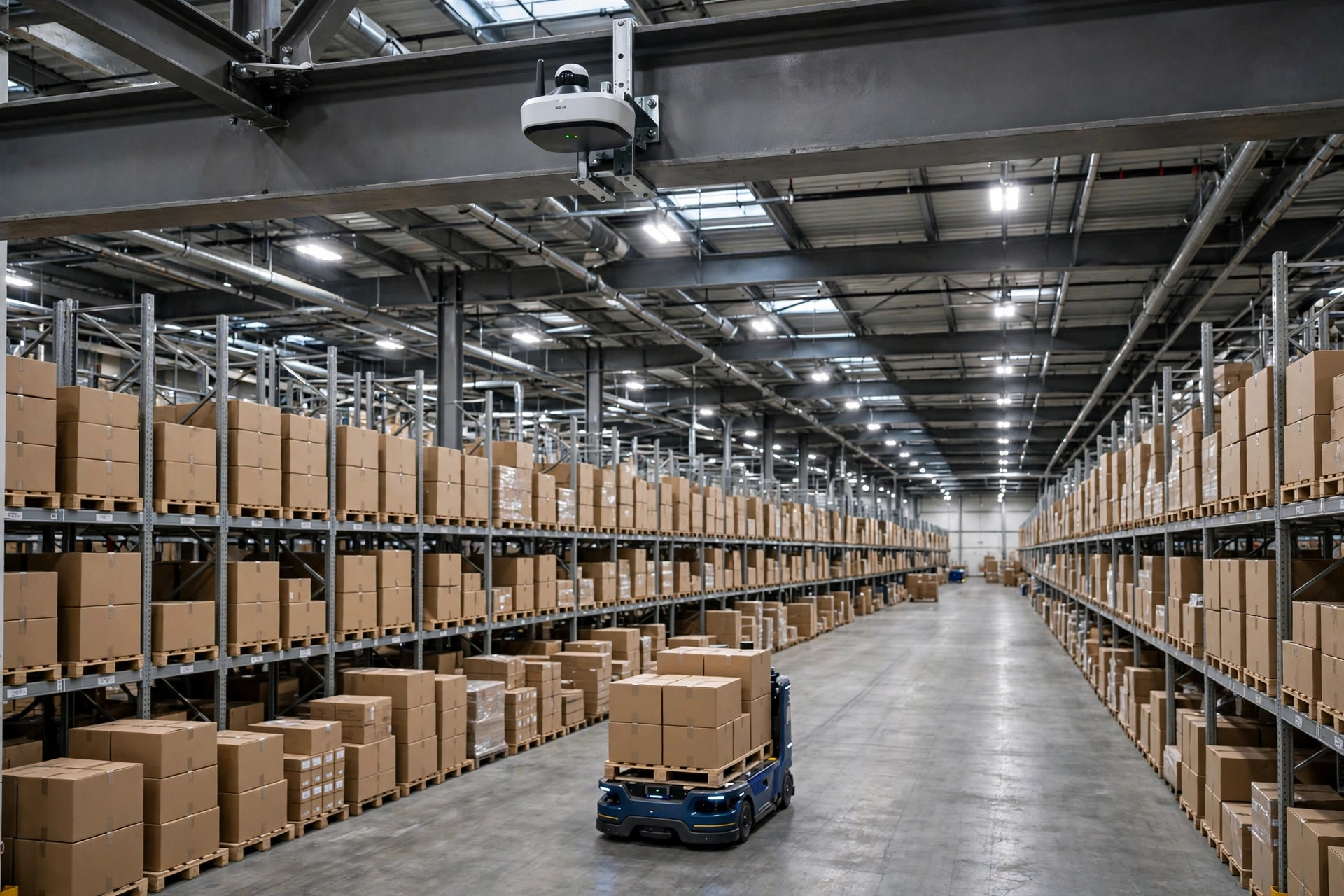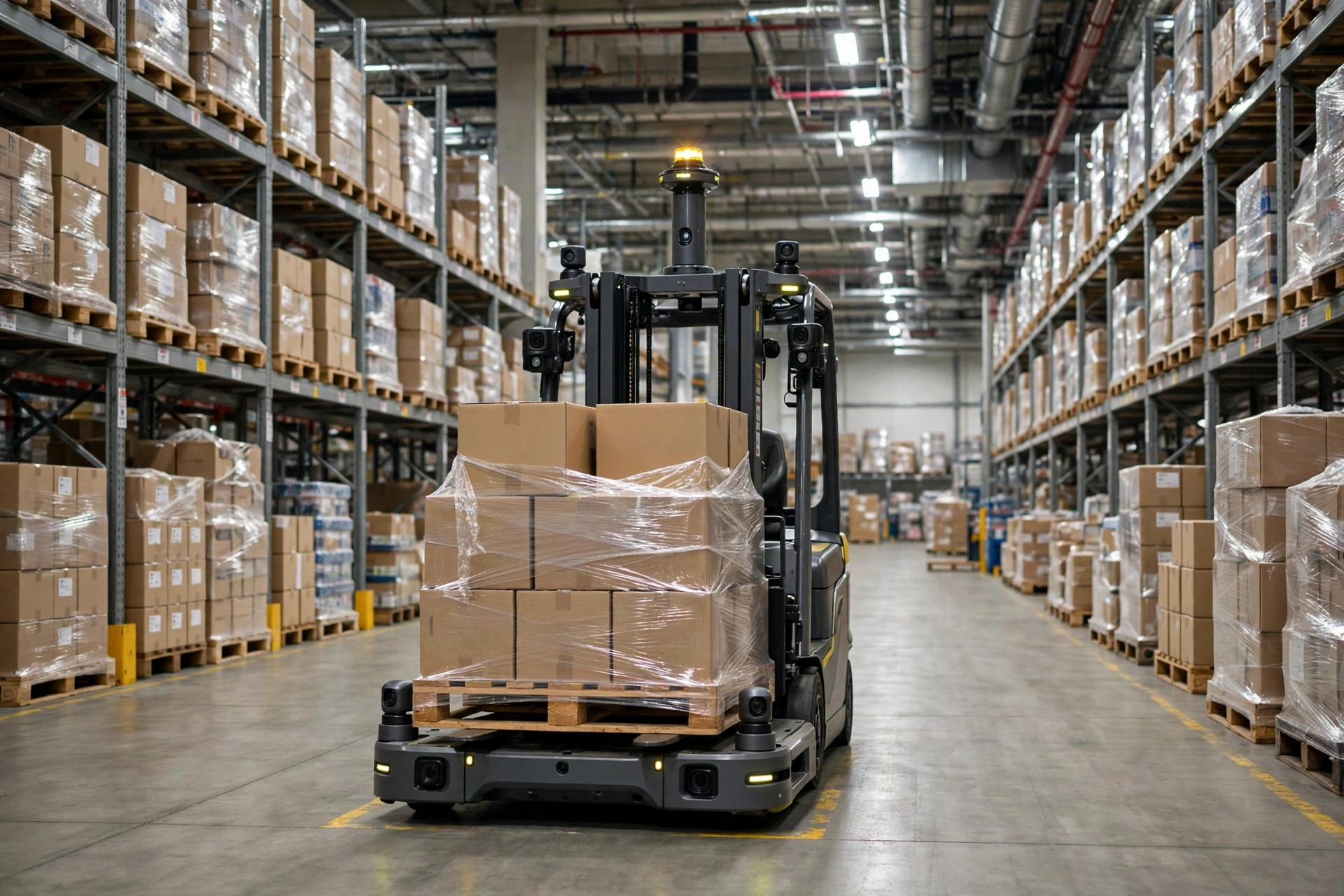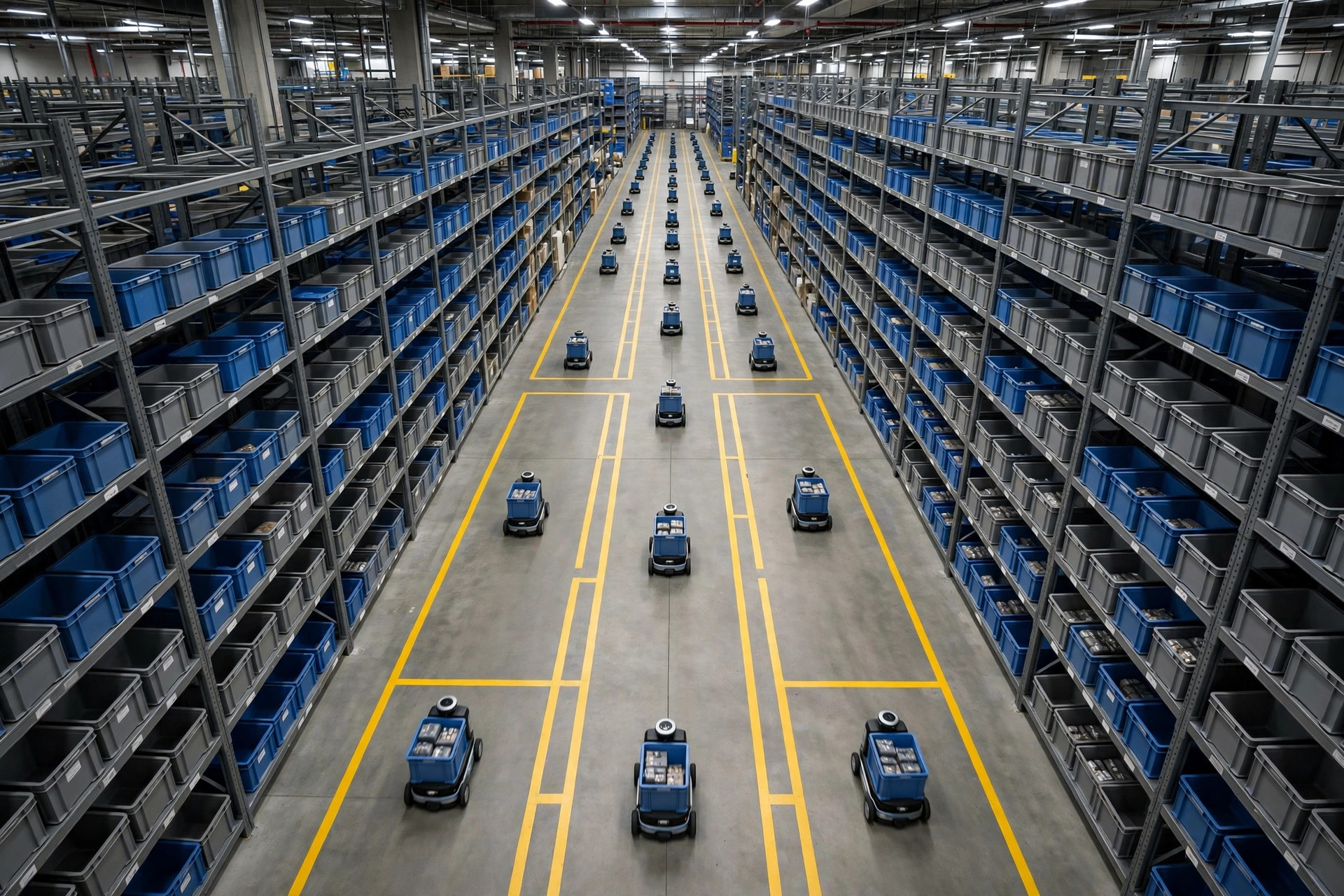
Picture this: forty autonomous mobile robots sharing one warehouse floor. They meet at intersections and yield to each other. They pass in narrow aisles without a scratch. Honestly, they're more disciplined than human drivers at rush hour. The first time I watched this from a mezzanine in a distribution center in Arizona, I stood there for a good twenty minutes with one question in my head: who is conducting this orchestra? After an afternoon with their engineers, I had the answer. There is no single "super brain" calling every move. There is a system called multi-agent scheduling. This article breaks it into three pieces — how jobs get assigned, how robots find their way, and what happens when two of them want the same patch of floor — and then tells you at what fleet size it is actually worth the trouble.
Two numbers to set the scale. In 2012, Amazon paid $775 million for Kiva Systems, bringing shelf-carrying robots into its fulfillment centers. By 2023, Amazon said it had more than 750,000 robots deployed across its warehouses. In a little over a decade, mobile robots went from pilot projects to standard equipment in big facilities. And behind that 750,000 figure, the hard part was never making one robot drive. It was making dozens or hundreds of them share one roof without colliding, deadlocking, or leaving half the fleet idle. That is the problem multi-agent scheduling exists to solve.
Who Gets the Job
The scheduler's first duty is task assignment: handing a job like "pick up a tote at rack A and deliver it to pack station B" to the right robot. Simple to describe, full of trade-offs in practice.
There are two mainstream schools. One is auction-based: every time a job appears, all idle robots place a "bid" based on how far they are from the rack, how much battery they have left, and whether they already have something nearby. Lowest bid wins. The other is centralized optimization: a central server collects every job and every robot's state, then computes the globally optimal assignment in one shot.
Auctions are fast and survive single points of failure — one robot going offline doesn't stop the rest from taking jobs. The price is local optimality: total mileage across the fleet runs higher than the theoretical optimum. Centralized optimization produces beautiful plans, but with dozens of robots and hundreds of new jobs per second, the solver can't keep up with real-time pace, and when the server hiccups, the whole floor hiccups with it.
My take is blunt: for fleets under 50 robots, auctions plus a handful of simple rules are plenty. Don't chase global optimality on day one. The mileage you save won't cover the complexity and debugging time it costs you. I once saw a 30,000-square-foot e-commerce warehouse with 12 robots running a scheduler with full global optimization. Engineers tuned it for three months, and peak season was still saved by a human tapping manual assignments on a tablet. In algorithm selection, "good enough" is worth its weight in gold.
How They Find Their Way
Once a job is assigned, the robot needs a route. AMRs don't read signs like people do. They read maps.
The warehouse floor is divided into an invisible grid. Each cell is either drivable or an obstacle. The scheduler runs a pathfinding algorithm in the A* family to compute a route from start to finish for each robot. It sounds like phone navigation, but the warehouse version adds a layer of traffic law: main aisles become one-way streets, intersections get yield points, charging zones and manual work areas become slow zones, and loaded robots travel different virtual lanes than empty ones.
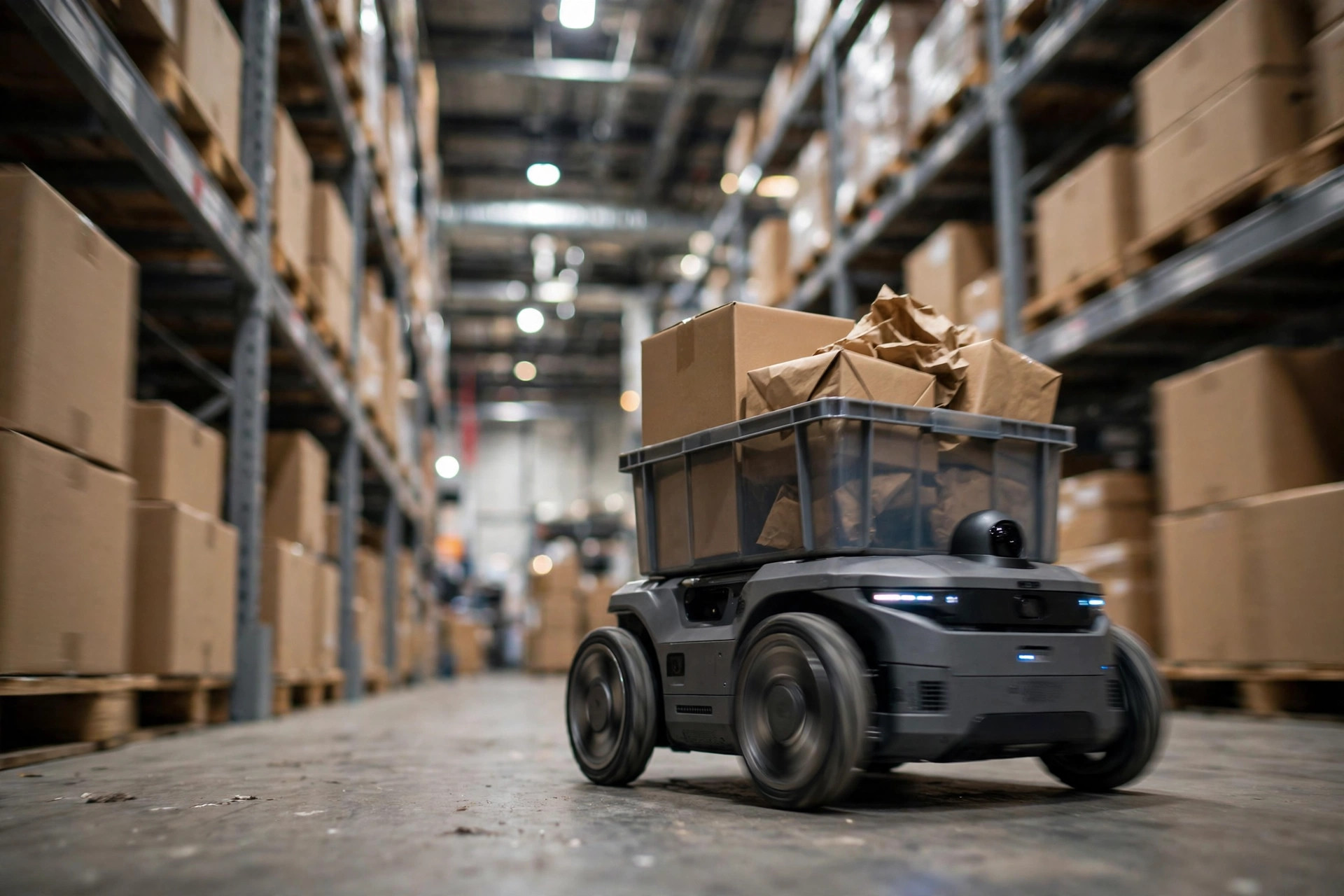
Here's a pitfall I stepped in myself, so you don't have to. Robots kept emergency-stopping at one corner, logs full of obstacle alerts. We replaced the lidar, retuned parameters three times, nothing worked. It turned out a new high-power access point had been installed above that corner, and its radio bursts were knocking out localization packets for a few milliseconds at a time. The robots thought they had lost their position fix, so they braked and waited for instructions. Lesson: when path planning misbehaves, check Wi-Fi coverage and floor flatness before blaming the algorithm. Algorithms can't fix the physical environment. That sentence will appear once more.
What Happens at the Intersection
Dozens of robots share one road network, so meetings at intersections are routine. Conflict resolution decides who goes first, who yields, and — most importantly — how to guarantee two robots never end up nose-to-nose in a one-robot-wide aisle with neither willing to back up.
The workhorse technique is the reservation table. Each robot doesn't just plan its own route; it "books" the road segments it will occupy in the next few seconds, reserving space in both time and geography. When the next robot plans its route and sees a segment already booked for a given time slice, it reroutes or waits a beat. Priority rules are usually first-come-first-served, loaded robots over empty ones, and a robot rushing to charge beats everything — because a dead robot costs more than a traffic jam.
Deadlock is the nightmare scenario. Two robots meet head-on in a narrow aisle, and each one's reservation table says "I have the right of way." Standstill. You don't prevent deadlock with roadside negotiation. You prevent it with road network design: main aisles as loops, narrow aisles strictly one-way, so a head-on meeting is structurally impossible. When I evaluate a scheduling system, deadlock count is a mandatory metric. Run it for a week straight — if deadlocks hit double digits, the road network design is wrong. Don't let anyone soothe you with "rare edge case."
When It's Worth It
Finally, the question I get asked most: at our fleet size, do we need multi-agent scheduling?
Here's my dividing line. Under 10 robots, don't bother with centralized scheduling. Per-robot intelligence plus fixed traffic rules plus a tablet for manual intervention is enough. Centralized scheduling at that scale is a sledgehammer for a nail, and an awkward sledgehammer at that. At 20 to 50 robots, centralized task assignment plus road network traffic rules start paying back clearly — this is multi-agent scheduling's sweet spot. Past a hundred, you need zones and hierarchy: the central system only handles cross-zone job flow while each zone governs itself, or the central server's compute and communication latency will give out first.
Two scenarios where I'd tell you not to touch it. First, old warehouses with uneven floors and irregular rack spacing, where localization drifts all day. A scheduling algorithm in that physical environment just runs around putting out fires. Second, warehouses with extreme demand tides — say, peak-season volume ten times normal, 20 robots enough on a quiet day and 80 needed in December. Scheduling solves "how to run." It doesn't solve "not enough robots." Fix elastic capacity first, then talk intelligence.
Three recommendations you can act on tomorrow:
First, before buying a single AMR, pull a week of task data from your WMS and build a heat map of where and when jobs cluster. Then size the fleet and pick the scheduling approach. If you don't know what your own workload looks like, you're not ready to pick an algorithm.
Second, design the road network first. One-way aisles, loops, charging zone placement — sketch it on paper and run the worst case through it: two fully loaded robots meeting in the narrowest aisle, five robots needing a charge at the same peak hour. If it doesn't work on paper, it won't work on the floor.
Third, don't accept "the robots are moving" as success. Watch three numbers: average job wait time, deadlocks per week, and charging queue time. When those three look healthy, the scheduling system is genuinely healthy.