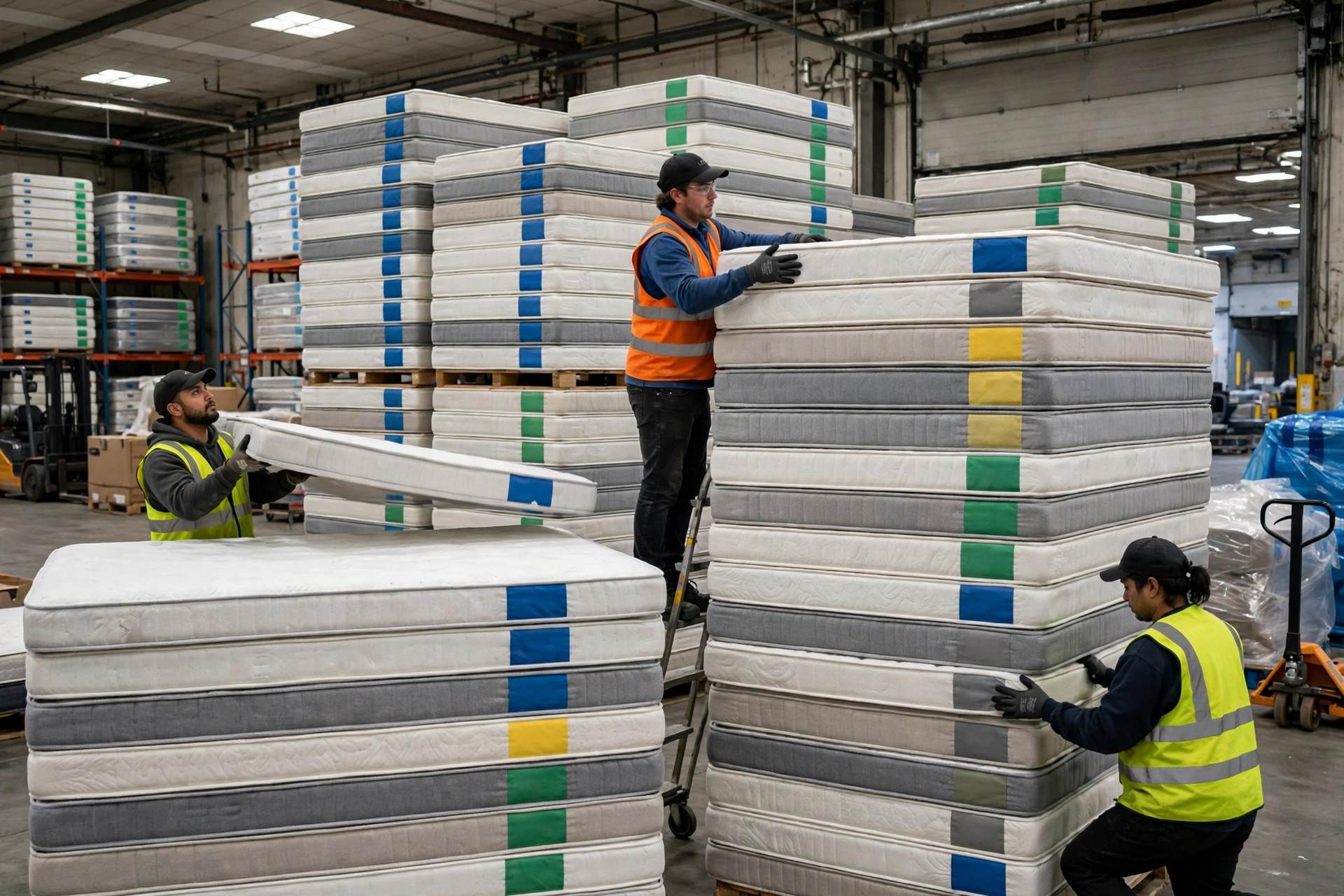
It was 6:30 in the morning when I walked into our mattress warehouse storage zone. The night shift was wrapping up, a forklift was setting the last stack into place, and Lao Zhang was running his palm along the edge of the stack, layer by layer, feeling for any corner that had caved in. That hand check is second nature in our warehouse now. Three years ago, nobody did it. Back then, everybody figured a mattress was just a big soft block. You could pile it anywhere. Let me be honest with you: that attitude cost us plenty.
The problem showed up on a peak-season night shift. Last November, a truck arrived with sixty mattresses, and the driver was in a hurry to unload and catch his next job. He wanted us to stand them on their sides along the wall. One row on edge, he said, holds a dozen more, and unloading goes faster. The shift lead gave in. The mattresses stood there looking neat, saving floor space. Three days later, when we pulled them for shipping, three had creases pressed into their sides and wrinkled fabric. The customer refused them on the spot. Those three came back, took up a returns slot, and cost us two extra trips with the pallet jack. I do not blame the driver; he was on a schedule. The real fault was ours: we had no hard rule about how a mattress gets stored, so the decision got made on the fly, under pressure.
We tried a few fixes after that. Somebody suggested side storage with dividers between the mattresses to hold them up. We tried it for a week. The dividers had to be carried in, they took floor space, and they tipped over when the night crew was short-handed. Somebody else said to strap them tight. Strapping held them, sure, but the straps left marks in the fabric, and a marked mattress ships just as badly as a creased one. After a full round of trying, we landed on the truth. A mattress does not fear weight. It fears uneven weight. Laid flat, the load passes evenly down through the stack, and every mattress carries about the same. Stood on its side, gravity pushes everything onto one edge, and the filling slowly slides to one side. A soft mattress shows it in days. A firm one holds out longer, but longer is not the same as safe. It just fails later.
So here is what we do now, written on the wall and repeated at every handover. Rule one: flat is the default. Every mattress lies flat. Side storage is allowed in exactly one case: freight that arrives and ships the same day, leaning against a flat wall or a solid panel, never floating, never leaning on other freight. Rule two: cap the stack. Our stacks run no higher than twelve mattresses, and soft models drop two more off the top. Past that height, the bottom mattress is basically holding its breath. Rule three: the bottom layer earns its place. The first mattress in a stack is the firmest, most durable model in that batch, or it sits on a flat pallet. Never straight on the floor. When damp creeps up through concrete, the bottom mattress is the first one it reaches.
This March gave us the second lesson. A new hire, trying to be fast, mixed two sizes into one stack. A smaller mattress sat on top of a larger one, its corner hanging in the air, carrying weight it was never built to carry. An old hand felt it during picking: the overhanging corner had already gone soft. We broke the stack down and restacked it, six people, more than half an hour. I told the kid that day that the minutes he saved mixing the stack were paid back twice over in the rebuild, plus one mattress. Since then the rule is one stack, one size, one model, and every label faces out. Labels out is not about looks. It means the picker can identify a mattress without tearing the stack apart. Every time you tear a stack apart, the mattresses take another beating, and somebody risks a pulled back.
Mattress Warehouse Storage Rule One: Flat Is the Line, On-Side Is the Exception
Should the mattress and its matching foundation share a stack? We argued about that one too. Stored apart, picking means running two zones. Stored together, a hard foundation corner can gouge a mattress. Our compromise works: matched pairs sit in neighboring stack positions, separated by a pallet board or corner protectors, so one picking trip completes the set without the two damaging each other. When the mattress position and the foundation position line up, short shipments drop. Put simply, mattress warehouse storage is not about cramming things in. It is about letting the picker move less, open fewer stacks, and make fewer mistakes.
Mattress Warehouse Storage Stack Rules: How High, and What Goes at the Bottom
Run the damage account on one crushed mattress and you will see why we get stubborn about this. One ruined mattress is not one mattress of cost. Two people spend time processing the return. Somebody picks a replacement. Somebody breaks down and rebuilds the stack. The returns slot stays occupied, and the next delivery has nowhere to go. One bad mattress drags three or four jobs behind it. Flip it around: a stack built to the rules lets the picker walk up, read the label, and take the top unit, while the forklift makes one clean move. We tracked the labor in our own warehouse, and one rebuild of a mixed stack costs more labor hours than building several proper stacks from scratch. You do not need a price tag to see that. Count the hands and the hours and the math is clear enough.
| Method | Floor space | Load on the mattress | Picking | Risk | | Flat stack | Uses more floor | Even, slow to deform | Top-down by label | Low | | On-side against a wall | Saves floor | All on one edge, filling slides | Hard to pull from the middle | High | | Vertical standing | Saves the most floor | Concentrated at the base | Needs bracing, slow | Highest |
Keeping Them Dry and Dust-Free: Labels Out, Foundations Paired
Moisture and dust hit differently in a humid warehouse than a dry one, but the logic is the same. A mattress hates damp, hates dust, and hates damp plus pressure most of all. Our routine is plain, and it works: pallets under every stack, a hand's width of air between the stack and the wall, a dust cover over the full stack with the opening left loose enough to breathe, and no mattresses near the door or anywhere the roof has ever leaked. In the rainy season, the patrol round adds one extra pass just to feel the bottom layer and the wall side of each stack. Somebody always asks whether the cover is an extra step. It is. It is also far cheaper than reworking a whole stack that got damp. And here is the counter-intuitive one: leaving aisles between stacks looks like wasted space, but it makes picking faster, rebuilds rarer, and damage lower. A warehouse packed wall to wall looks efficient on paper and fights you at every move.
Floor Stacks or Racking: The Trade-Off
We run both floor stacks and racking, because each earns its place. Fast-moving best sellers stay in floor stacks, where a forklift grabs them in one move. Slow movers go on racking, stored in separate levels so no mattress carries the weight of the whole stack. Racking needs flat, full-width decking, though. A mattress draped across two beams with its middle hanging will sag in the middle over time. Floor stacks are cheap; racking protects the bottom layer. The line in our warehouse is practical, not theoretical: freight that will ship within a month stays in floor stacks, and anything sitting longer than a month goes on racking. High levels need people and equipment to reach, so on a short-handed night shift, we leave high-level freight alone whenever we can.
Fellow warehouse folks, there is no deep science here, just a few hard rules that have to survive the busy season. Flat. One size per stack. Labels out. A solid bottom layer. Aisles between stacks. When peak season is screaming and a driver is pushing to unload faster, those rules do not bend. Bend them once, and you will spend triple the labor cleaning up after it. At handover, one more pass along the stack edges and one more look at the labels beats any rework after the damage is done.
By Chen Feng, Warehouse Operations Manager