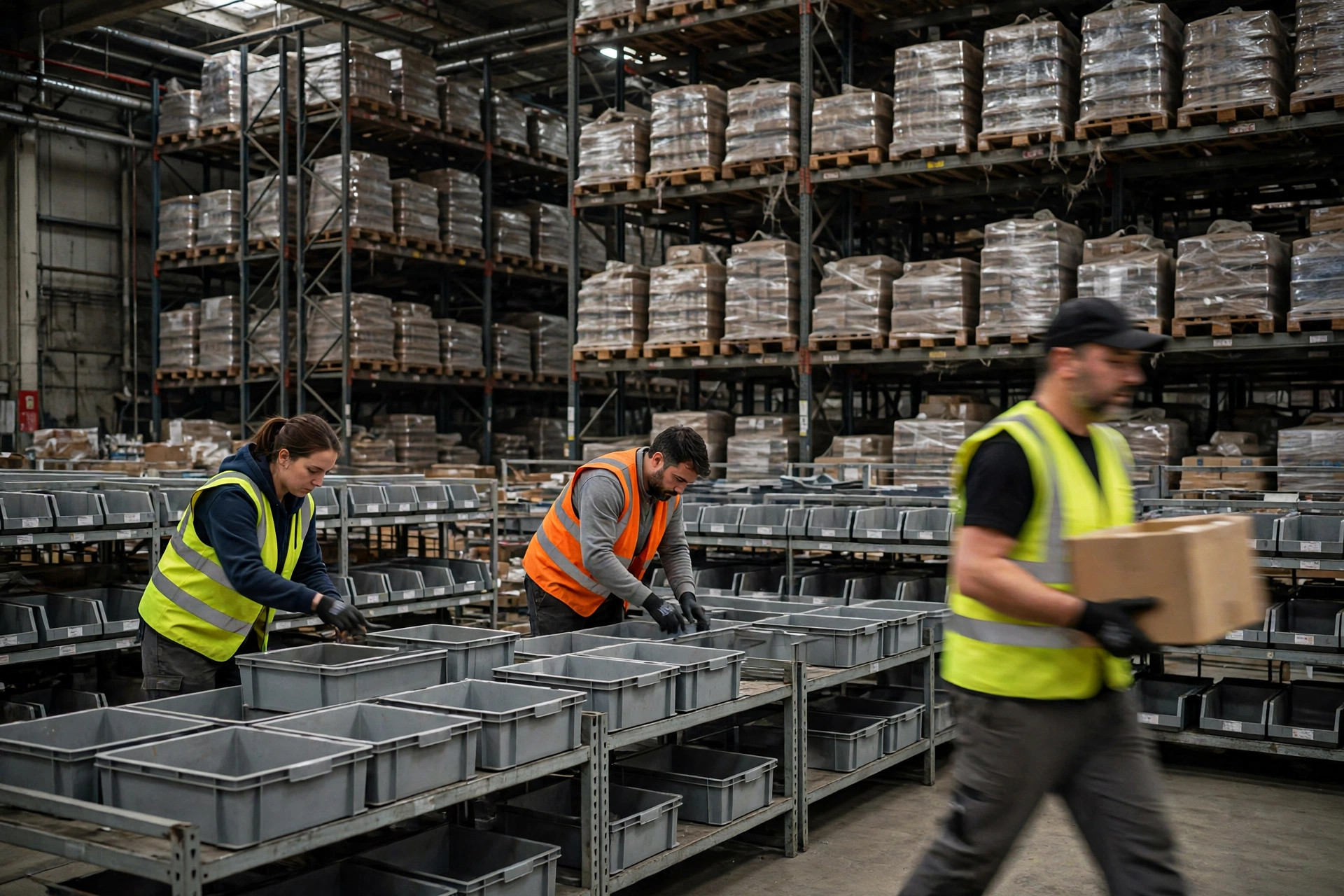
Sports equipment warehouse storage looks like a straightforward storage problem. In practice, it tests three things at once: shape, timing, and process. Shapes range from a single basketball to a fully assembled treadmill. Timing is seasonal, with back-to-school and ski-season weeks pushing an otherwise quiet warehouse into peak mode. Process enters because bicycles and fitness machines often do not move as finished units; they are assembled, tested, then shipped from inside the warehouse. Any one of these pressures can be handled on its own. When all three coincide in the same peak, slotting, labor, and error rates come under strain at the same time. This article starts from that overlap: sports equipment warehouse storage should be planned as a single account covering how goods are stored, when they move, and what work happens to them in between.
Sports Equipment Warehouse Storage by Form First, Then by Velocity
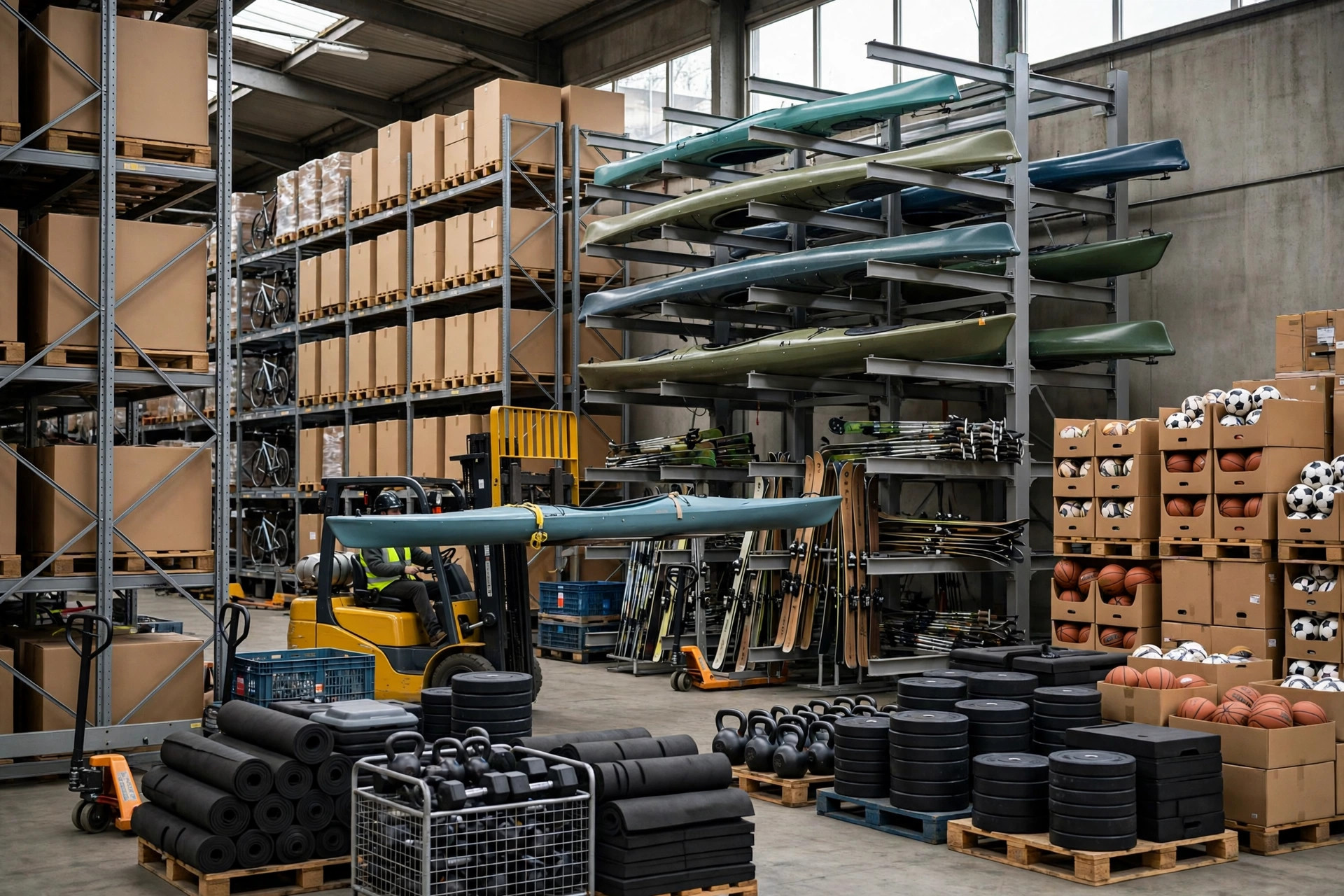
The first group is balls and small equipment. Basketballs, soccer balls, badminton rackets, and yoga mats are individually light and relatively regular, suiting standard pallets and shelf racking. Their difficulty is not size but variety: one ball model may come in three sizes and two colors, and the most common picking error is the wrong specification, not quantity. The second group is fitness machines. Treadmills, ellipticals, and strength machines are heavy and bulky; they arrive as flat-pack cartons and, once assembled, cannot return to their original volume. A warehouse therefore needs two locations at once: high racking for flat packs, and a marked floor area for assembled units. The third group is water and winter equipment. Kayaks, paddleboards, skis, and snowboards are often longer than a conventional rack beam. Laid across beams they invade the aisle; stood upright without support they fall. They call for cantilever racking or dedicated hanging frames. Seasonality adds a complication: these items barely move off-season and ship in bulk at peak, so peak-density slotting locks much rack space into goods unmoved for months.
A workable method is a two-layer sort: rack type by physical form, slot height by velocity. Fast movers go to the ergonomic picking zone at waist height, slow movers to high or distant locations. Form decides what rack you use, velocity decides where goods sit, and the two decisions do not interfere. Slotting by category alone produces a familiar sight: snowboards unmoved for six months closest to the door, basketballs shipped daily at the back.
Bulky and Awkward Items: The Most Injury-Prone Part of Sports Equipment Warehouse Storage
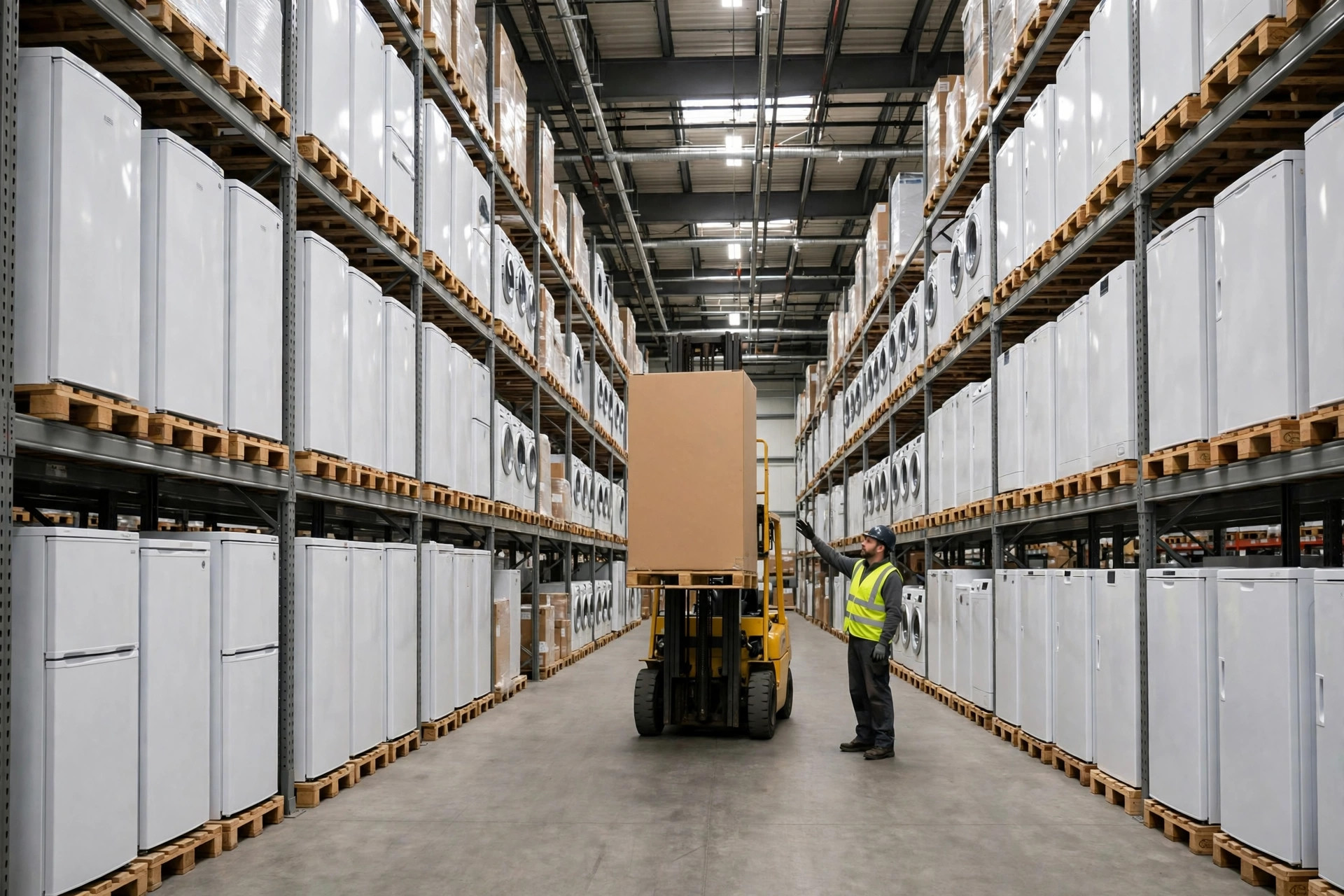
For bulky, awkward items, the binding constraint is rarely weight capacity. It is length and center of gravity. Long items suit cantilever racking, which has no beams blocking the side, so goods of different lengths can be pulled out directly and mixed on the same rack. Two rules still apply: arm spacing must be checked against the longest item, and heavy items go low, light items high. Flat-packed fitness machines suit heavy-duty beam racking, packed flat and layered by weight, heaviest nearest the floor. Assembled units cannot go onto high racking at all; they belong in marked floor zones with generous circulation, because their next step is usually inspection, labeling, and loading, and the travel path matters more than storage itself.
Handling deserves its own calculation. Two people carrying a treadmill flat pack, versus one operator using a forklift with extended forks, looks like a question of headcount. In substance it is a trade-off between damage and efficiency: manual handling is flexible but risks scuffed packaging and back injuries, while mechanical handling is stable but requires aisle width and turning radius planned in advance. Much damage occurs not in transit but in the last move inside the warehouse. The first principle for bulky items is therefore to minimize moves: slot goods on receipt in the order they will leave and be assembled, handled ideally twice, once in and once out.
Seasonal Peaks: Slotting Rotation and Labor Around Back-to-School and Ski Season
The seasonality of sports equipment is easy to read. Before the school term, schools and clubs buy balls, training gear, and team equipment in bulk: many product types, small quantities per order, concentrated deadlines. Around ski season, skis, boots, and protective gear ship within a few weeks: long items, large volumes, more returns. The school peak tests picking accuracy and consolidation; the ski peak tests large-item aisles and packing capacity. Staffing both peaks with the same roster tends to produce picking errors in one and blocked aisles in the other.
One warehouse practice is worth noting. A general sporting-goods warehouse in eastern China rotates slots twice a year: in August it moves school-season balls and small training items near the picking area and pushes ski equipment to distant cantilever racking; in late October it reverses the rotation. Each rotation takes about two days, and the payoff is shorter picking routes throughout the peak. A second case comes from North America, where a distributor hires temporary workers four weeks before ski season but assigns them only to packing and moving, keeping picking and assembly inspection with experienced staff. The logic: during a peak, the most expensive resource is not labor cost but experienced staff time lost correcting temporary workers' errors.
The counterintuitive judgment follows: during a peak, add checkers and exception handlers before pickers. More pickers raise throughput, but a rising error rate creates returns and re-picks that consume more time than the extra picks gained.
Assembly Lines Meet Storage: Bicycles and Fitness Machines
Bicycles and fitness machines turn storage into a process question. A bicycle may arrive as a complete carton, or as frame, wheels, and components in separate cartons to be assembled, adjusted, and inspected in the warehouse. A treadmill flat pack multiplies several times in volume once assembled and can never return to its original rack. Assembly locations must therefore follow the process sequence — kitting, assembly, inspection, finished-goods holding — placed adjacent to one another. Kitting areas should hold complete sets; starting assembly one component short stalls the station and clogs it with half-built units.
The economics are best shown as a comparison. Shipping fully assembled uses the most transport volume but the least warehouse process. Assembling in the warehouse uses the most space and labor but produces the lowest return rate, because the product arrives ready to use. Leaving assembly to the store minimizes warehouse work but depends entirely on the store's capability. None is universally best; where online retail dominates and return costs are high, in-warehouse assembly often has the lowest total cost, while bulk supply to distributors favors direct shipment or store assembly. This lifts the decision from "where is there an empty slot" to "which fulfillment method has the lowest total cost."
| Method | Warehouse footprint | Labor and process | Return risk | Best fit |
|---|---|---|---|---|
| Ship fully assembled | Large floor area for finished units | Least | Higher; transit damage is hard to attribute | Bulk supply to distributors |
| Assemble in warehouse, then ship | Kitting area plus finished area | Most, including inspection | Lowest; arrives ready to use | Mainly online retail |
| Assemble at store | Kit racking area only | Least in warehouse; store takes over | Depends on store capability | Channels with assembly capability |
A Judgment to Take Away: Draw the Travel Path Before Buying Racking
Taken together, these points suggest a sequence. Many warehouses buy racking first, assign slots second, and only then discover narrow aisles or an assembly area too far from the outbound dock. The attribution here points the other way: first draw the travel path for each product, from receipt through storage, assembly, and inspection to dispatch, counting handling steps and turning radii; then choose rack types and slot heights from that path; and only then rotate slots for seasonal peaks. Racking should serve the travel path, not the other way around.
This judgment has its limits. A small warehouse may have no room for a separate assembly line, and copying a large warehouse's zoning would add cost without benefit. The practical approach is a flexible zone: ordinary goods most of the year, cleared two weeks before a peak for bulky storage or assembly, then restored. That is trading time for space. Looking ahead, as customization grows, assemble-to-order work is likely to rise, the storage-assembly boundary will blur, and the warehouse will drift toward a small assembly point. Whether that becomes mainstream depends on customized-order growth and return costs, worth watching in the next two years' data rather than deciding now.
By Dr. Chen, Supply Chain Researcher