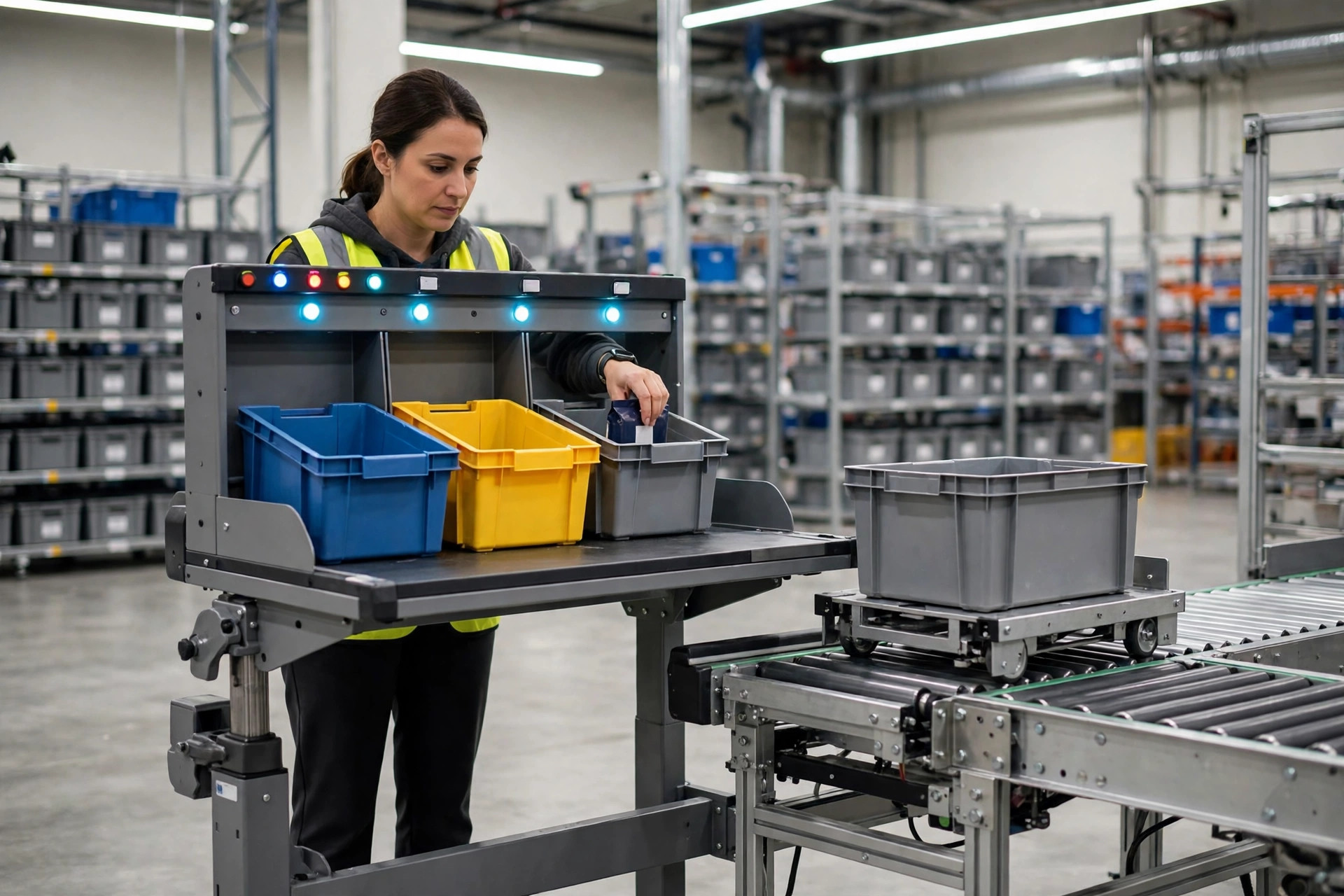
After twenty years in American supply chain, I have watched too many warehouses pour money into shuttles, racking, and conveyors, then pinch pennies on the workstation itself. Let me be blunt: goods to person workstation ergonomics has two sides. One side is how fast the equipment runs. The other is how a human being feels after standing there for a full shift. The first side shows up in the vendor's proposal. The second shows up in turnover and injury reports. Most owners only watch the first, and only discover the second when they cannot hire or keep people.
Start With the Person, Then the Machine
Here is what I have seen too many times. A goods-to-person project passes acceptance testing on a single metric: orders picked per hour. On demo day the operator stands straight, moves crisply, and the numbers look great. Three months later I walk back in and the same station has burned through two rounds of workers, with throughput down noticeably. The equipment did not get worse. The station was simply never designed for the person standing in it.
I saw a textbook version of this at a third-party warehouse a few years back. To save floor space, the source carton sat at waist height on the operator's left, while the finished tote sat near the floor on the right. Every order ended with the operator bending down to lift a full tote onto the conveyor. Over a shift, that added up to hundreds of bends — my illustrative estimate based on watching that station, not a published statistic. Within half a year, complaints and call-offs at that station were visibly higher than at the one next to it. The fix was almost embarrassingly small: a lift table under the finished tote, so the tote's rim rose as it filled and the operator never had to bend. The lesson stuck with me. Every bend you design out is money you do not spend later on recruiting.
Look at it from both sides. Vendors love to talk cycle times and throughput, as if people were parts with unlimited uptime. They are not. Shoulder height, arm reach, and the angle at which eyes meet a light or a screen — those are the real constraints on a station. The first step in designing one is not drawing the equipment layout. It is putting a person there and walking through a full day of motions: reach, place, scan, confirm. Whatever feels awkward is what needs to change.
Three Traps in Goods-to-Person Workstation Design
The first trap is a one-size-fits-all pick height. Goods-to-person brings the goods to the operator, which sounds like the operator stops moving. But goods sit at different depths inside a carton. When a deep carton arrives with small items settled at the bottom, the operator still has to lean in and fish them out. I watched an e-commerce warehouse hit exactly this during peak season: deep cartons of small items, hundreds of reaches a day, shoulders giving out first. The fix is not exotic. Tilt the carton toward the operator, or use a lift that keeps the product surface at a comfortable hand height. A few inches sounds trivial until you multiply it by a whole shift, and then by a whole year on that job.
The second trap is lights and screens placed where nobody's eyes naturally go. The pick light sits overhead, the screen sits off to the side, and the put wall sits somewhere else again. Every order becomes a little neck workout: look up, look down, turn, find the slot. Each motion is small; repeated thousands of times a day, it is the neck that files the complaint. The better arrangement puts the light, the screen, and the slot in one visual band, so confirmation happens with a shift of the eyes, not a twist of the neck.
The third trap is designing for one body type. If a station only works smoothly for a tall, strong operator, it will eventually sit empty. Adjustable station height, an adjustable footrest, and the option to sit or stand are not perks. They are what let different people take the job at all. On one project I worked on, making stations height-adjustable visibly eased night-shift hiring — I am reporting what I observed, not quoting a measured statistic. A posting that had sat unfilled for weeks was filled within days of the change. Coincidence? Maybe partly. But I have seen the pattern repeat often enough to trust it.
Run Three Numbers Before You Judge a Station
Clients often ask me whether ergonomic options are worth the extra money. My answer is always the same: run three numbers first, then decide.
| The number to run | Cost of leaving the station as-is | Payoff of fixing it |
|---|---|---|
| Turnover | Constant recruiting and training, short-staffed peaks | Experienced operators stay, rookie ratio drops |
| Fade across the shift | Fast in the morning, slow by afternoon, average dragged down | Steady pace all day, no late-shift collapse |
| Injury and absence | Strains, shoulder and neck complaints, claims and call-offs | Easier motions, fewer complaints and absences |
Every row of that table has a real version I have witnessed. The most underestimated is the second one. Managers look at daily averages and blame the equipment, when the real story is that people tire. After a station is fixed, daily volume does not always jump overnight — but the swing narrows. And narrow swings are what let you promise ship times and build schedules you can actually keep.
The decision framework is one sentence: make the motion easy first, then chase speed. That trade-off sits at the heart of goods to person workstation ergonomics: every unit of speed bought with the operator's body is speed the operation pays back later, with interest. Get the order backwards and the faster the station runs, the faster it burns people out. A station that makes someone want to quit in three months is not productive, no matter how many extra picks per hour it squeezes out. Those extra picks never cover the cost of recruiting and training the replacement.
There is also a cheap test that beats any assessment form. Before a new station goes live, put two operators of very different heights on it for a week and let them complain. Height differences expose every one-size-fits-all assumption: the tall one hates the low light, the short one cannot reach the bottom of the carton. On one project, that single trial week drove three revisions to the lift travel and the screen mount angle, and the station launched with zero rework. A week of trial is far cheaper than a line shutdown for retrofits.
A Goods-to-Person Workstation Pre-Launch Checklist
So what does good goods to person workstation ergonomics look like when it is finished? It does not require buying every premium option at once. Run through this checklist, and if a station passes eighty percent of it, it is already ahead of most of its peers.
The list is short. Is the pick surface floating around elbow height? Are the light, screen, and slot in one visual band? Can the station adjust to bodies of different sizes? Is there an adjustable footrest and an anti-fatigue mat? Can exceptions — a short pick, a damaged item — be handled without leaving the station? And finally, after an hour of continuous work, do the operator's shoulders and back have anything to say? If they do, the station is not done yet. Run the checklist with the operator present. Their nod is the only sign-off that counts.
Here is the counterintuitive part, and it is the judgment I would leave you with. The fastest station in the building is rarely the one with the fastest equipment. It is the one where the operator is still moving well at the end of the shift. Equipment is bought for the system; the station is built for a person. When the person is comfortable, the system is genuinely fast — and not a moment before.
By Lao Mi, Supply Chain Veteran (20 yrs)