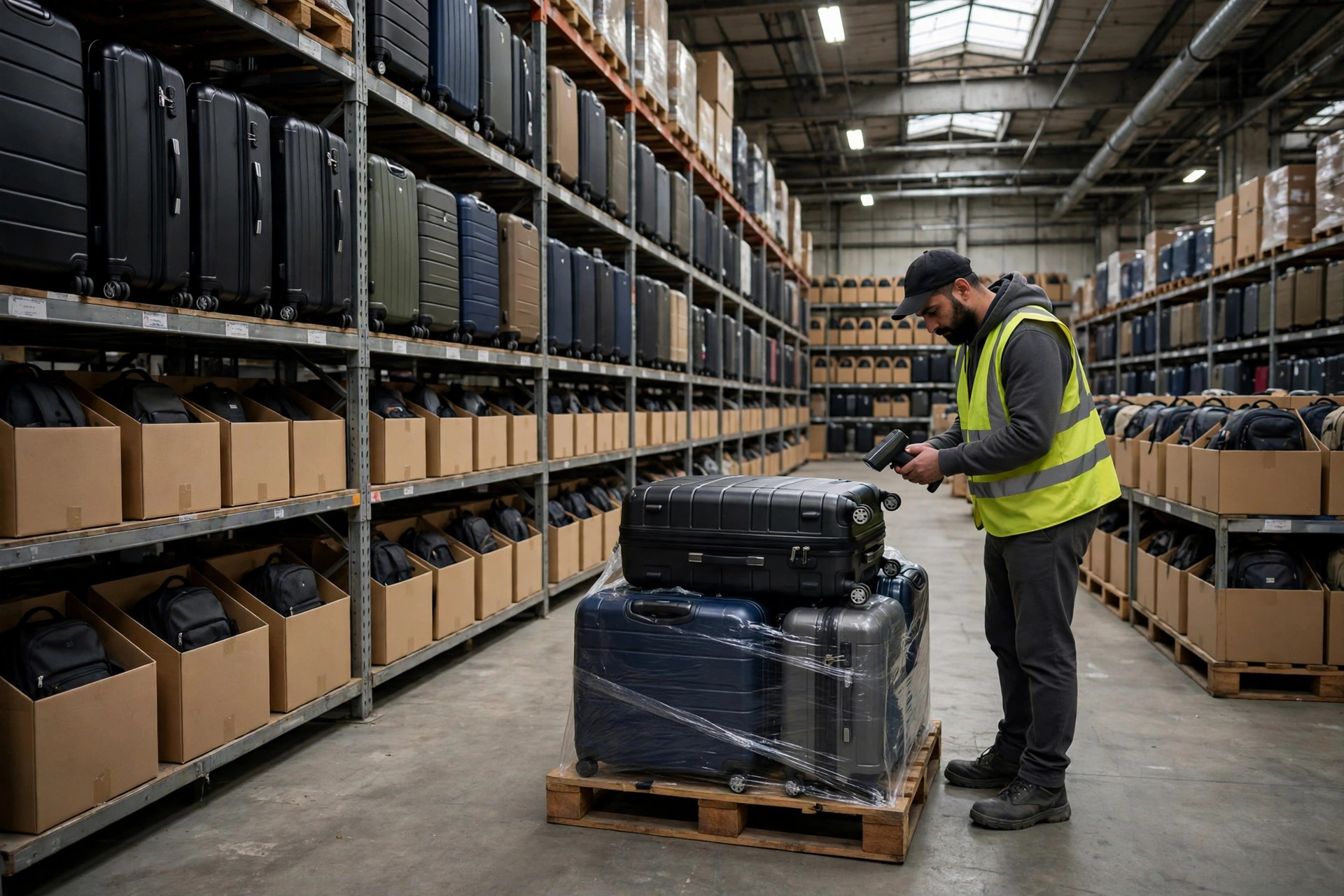
Luggage bags warehouse storage sounds simple until you actually run it. You stack the cases, shelve the backpacks, and then the problems show up one by one: cases crushed under their own stack, glossy shells scuffed in handling, dark and light bags bleeding color onto each other, sets broken apart that nobody wants to buy, and tags missing when a return lands. I learned all of this the expensive way, and this is the ledger I run now.
What Luggage Bags Warehouse Storage Gets Wrong
Start with crushing. In October 2024 I had 300 three-piece luggage sets sitting in my Dongguan warehouse, stacked five high to save floor space. The bottom layer came out dented, and three pull handles were bent out of shape. Only a little over 260 sets were still sellable at full price. The rest went out discounted, and that one batch ate nearly twenty percent of my margin. Since then my rule has been simple: hard-shell cases stack no more than three high, soft bags never carry weight, and only light goods go on top.
Then scuffs. A glossy suitcase shell hates hard contact. In April 2025, during a shipping rush at my Shenzhen warehouse, workers dragged cases across the floor to move faster, and a batch of shiny shells picked up more than a dozen visible scratches. Customers saw them on arrival and sent them straight back. That week my return rate jumped to 9%. I changed the routine: a thin film layer between cases, carry by the handle, never drag. Within a month, scratch-related returns fell back to around 2%.
Color transfer is the quiet one, and it is the hardest to undo. Dark nylon backpacks stored pressed against light canvas bags over a summer will leave a grey shadow on the light fabric that does not wash out. In July 2025 I lost more than 40 light-colored bags that way, all sold off as defective stock. Now dark and light live on separate racks, no exceptions, no mixing because a shelf happened to have room. Once color transfer happens, the whole batch is gone, and no discount fully recovers it.
Inbound inspection changed too. I used to put whole batches straight onto racks. Then I kept finding cases with perfect outer cartons and bent handles inside. Now we open and check about one in ten units from every batch: handle, zipper, wheels. If two or more fail, we open the whole batch. It adds about half an hour per batch, but catching a bad batch at the door is far cheaper than handling it as a pile of customer returns.
Storing Luggage Sets Without Losing the Set
Sets are where the math gets interesting. A 20-inch, 24-inch, and 28-inch set nested together takes the footprint of a single case. Split them apart and they eat three slots. Nested sounds like the obvious win. It is not. When a customer buys just one size, someone has to break the set open on the spot, repack it, and double-check the pieces. Outbound slows to roughly half speed, and picking the wrong size gets easier, not harder.
My split now is seventy percent stored as full sets, thirty percent broken out as single pieces for single-size orders. Every week I count which sizes actually sold solo, and next week I break out a few more of those. That seventy-thirty split did not come from a guess. I counted three months of outbound orders line by line. Break out too many and the racks fill up. Break out too few and single orders crawl. Seventy-thirty is the ratio that runs smoothest in my warehouse. That is the part of luggage bags warehouse storage most sellers get backwards: they optimize for floor space and then pay for it in picking time.
One detail makes the split work. Every broken-out single gets a single-piece label on the outer carton, easy to tell apart from full sets at a glance. Before I did that, pickers grabbed the wrong size all the time, and each wrong pick cost a round trip in shipping plus a repack. In peak season I also move the singles zone two rows closer to the outbound door. A few dozen fewer steps per picker adds up to a dozen extra orders a day.
Here is the counterintuitive part: the biggest space hog is not the large case. It is the broken-apart set. One three-piece set split across three slots takes nearly twice the volume of the same set nested. Racks fill up fast, and then you start stacking higher to compensate, which brings back the crushing problem. So before breaking any set, I ask one question: will this size actually sell solo this week? If I am not sure, I leave the set alone.
When the Tag Falls Off, Returns Turn Into Arguments
Tags look trivial until a return arrives. The most common luggage return fight goes like this: the customer says the tag was never there, the seller says the customer cut it off, and nobody has proof. Without evidence, the platform usually sides against you, and you eat the loss.
My fix is low-tech and it works. At inbound, every case and every bag gets photographed, with a separate close shot of the tag, filed by product code. Before outbound, someone checks the tag is still on. If it fell off, we reattach it and log it. When a return comes back, we compare it against the inbound photo. If the tag does not match, we follow the platform process with pictures attached. Arguments dropped sharply once every dispute had a photo behind it.
The photo file pays off a second way. At month end I flip through it and the pattern jumps out: which style gets returned, and for what. One backpack style came back three weeks running with zipper failures, so I asked the supplier to switch zipper batches, and returns on that style fell. You do not need fancy analytics. You need to trace a problem to one part.
Returned stock does not go straight back to the rack either. My restock test has three checks: no new scratches, handle, zipper, and wheels all working, and the tag matching the photo. Pass all three and it goes back on sale. Fail any one and it goes to the defective channel. Before I set that rule in stone, the same case sometimes got returned twice, and I paid shipping both times for nothing.
Stock depth matters here too. I now stock to about 45 days. Luggage is not a fast-moving consumable. One stockout can knock a listing down for a month while it climbs back. Overstock, on the other hand, ties up cash and rack space. Forty-five days is the number I landed on after adding up seasonal sales, supplier lead time, and ocean transit. Before peak season I add about 15 days. In the slow season I trim about 10 days.
| Storage method | Space saved | Outbound speed | Damage risk | Best for |
|---|---|---|---|---|
| Nested full sets | High | Slow, single sizes need breaking out | Low | Three-piece sets sold as sets |
| Single pieces split out | Low | Fast | Medium, watch for scuffs | Hot sizes that sell solo |
| Dark and light on separate racks | Medium | Medium | Low, blocks color transfer | Mixed dark and light backpacks |
| Tag photographed and filed at inbound | No space used | One extra check at outbound | Low | Any style with a high return rate |
Four pitfalls, and dodging them saves real money. First, never stack hard-shell cases more than three high; the floor space you save is worth less than the crushed stock. Second, never drag cases across the floor; scuff returns cost more than the seconds you save. Third, never gamble on dark and light sharing a rack. Fourth, photograph the tag at inbound, because that photo settles the return fight.
I have run this ledger for over a year now. Damage rates fell from around 6% to under 2%, and tag disputes dropped with them. That is what luggage bags warehouse storage comes down to in the end: not bigger racks, but fewer crushed cases, fewer scuffs, no mixed colors, sets that stay sets until they should not, and a photo for every tag. This one I have tested myself, and it works.
By Ah K, E-commerce Seller (5 yrs)