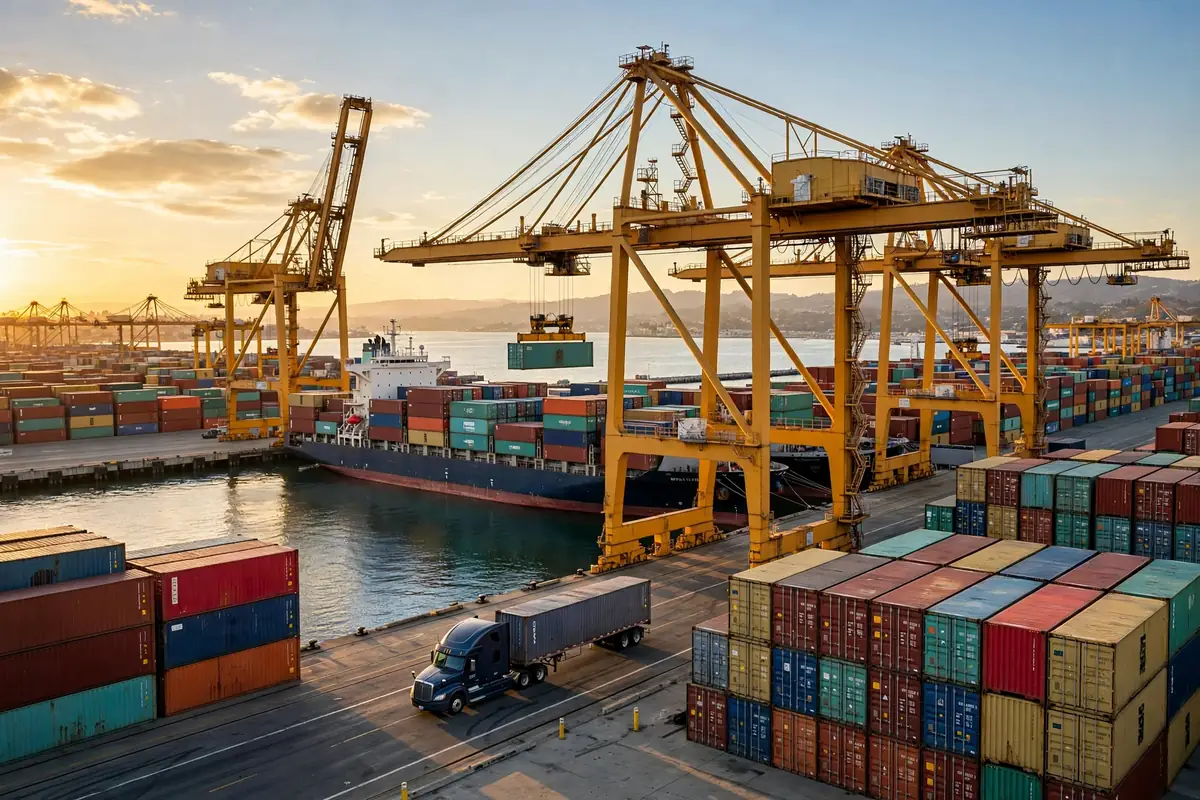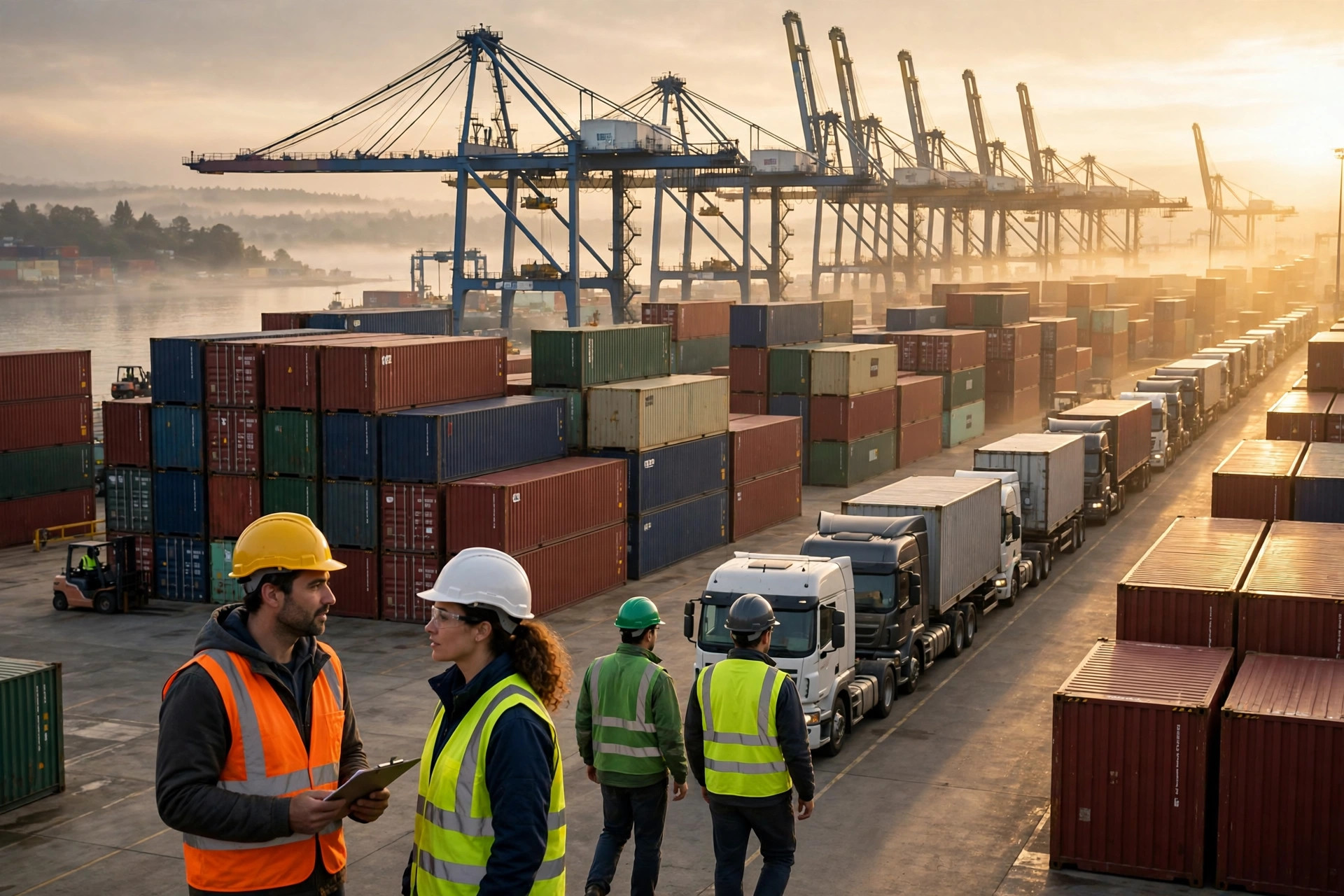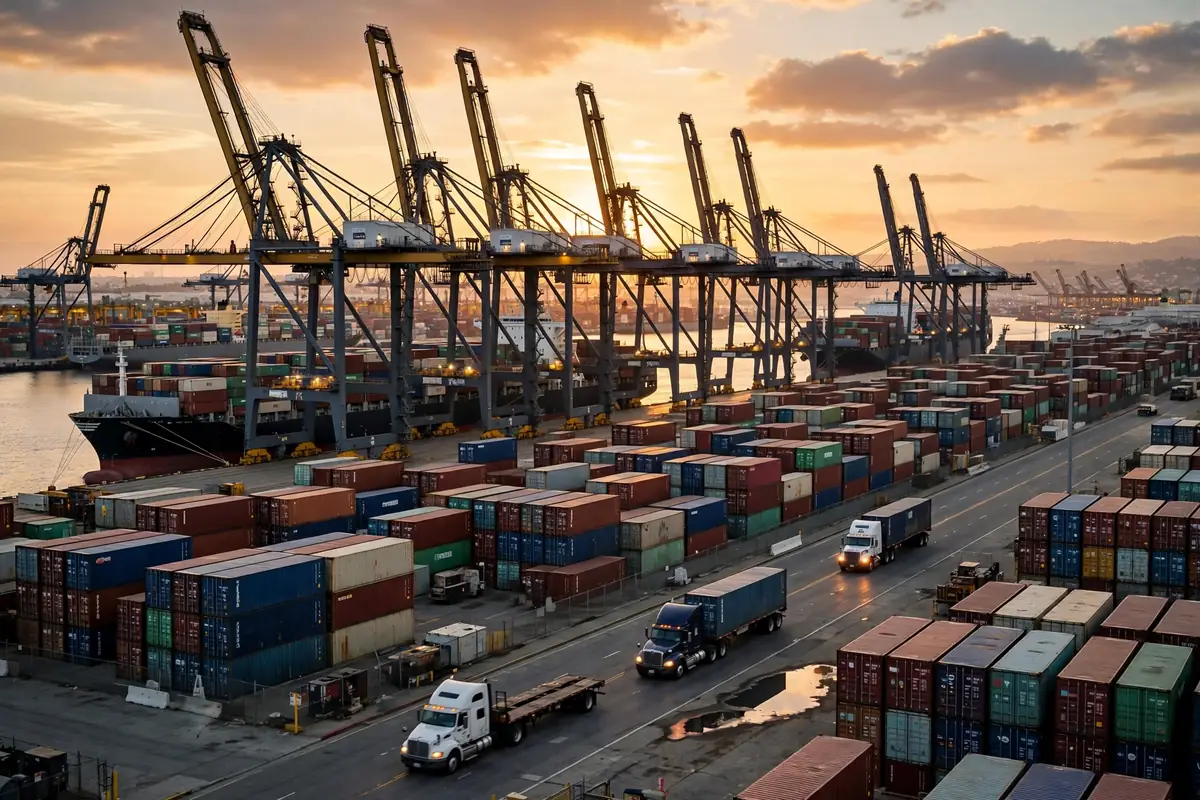
Think of the Port of Los Angeles and the Long Beach port as one machine that has to swallow close to 20 million containers a year. In 2024 Los Angeles moved 10.3 million TEU and Long Beach moved 9.6 million, its busiest year ever. Together that is 19.94 million TEU, with about 10.09 million TEU of imports, roughly a third of all US containerized imports. A machine this big does not fail because one part breaks. It fails because the rhythm breaks: vessels arrive in a bunch, the gate cannot take them in, chassis run short, rail cannot clear the yard, and the warehouses are full. When any one step runs half a beat slow, every ship and truck behind it slows down too.
Start with the principle. A port is a series system, not a parallel one, so throughput is set by the narrowest step. You can understand it as an assembly line: vessel arrivals feed the line, the gate is the first station, yard rehandling is the second, rail and trucking are the outbound stations, and the warehouse is the final buffer. Whatever station runs slowest sets the capacity of the whole line. In 2021 the complex set its all-time record at 20.06 million TEU, and it was also its worst congestion year: average dwell for truck-bound import containers peaked at 8.37 days, and rail-bound imports peaked at 12.41 days. Volume was not the cause of congestion. Broken rhythm was.
Los Angeles-Long Beach port warehouse logistics: four rhythms out of sync
The useful comparison is 2024. The two ports moved 19.94 million TEU, only slightly below the 2021 record, yet the system ran far more smoothly. Truck import dwell stayed near historic averages all year, rising just above 3 days at the September to December peak. The highest monthly average for rail-bound imports was 9.86 days in October 2024, far below the 16.51-day peak of August 2022. Nearly the same volume, very different congestion. That is the rhythm ledger: in 2024 the steps stayed in sync, and in 2021 they did not.
Take the four rhythms one at a time. First, vessel bunching: several large ships arriving in the same week flood the gate and the yard at once. Second, chassis: a box cannot leave the terminal without a chassis, so the yard stacks higher, rehandles multiply, and every rehandle costs money and time. Third, rail: when rail-bound boxes sit in the port, they occupy yard space that truck freight needs. Fourth, warehousing: the Inland Empire is the nearest big warehouse cluster, and when it is full, trucks cannot unload, so they cannot return to the port for the next load, and the whole cycle slows down.
The PierPass appointment system exists to sync that rhythm. The program started in 2005 and switched to an appointment-based model with a flat fee in 2018. All 12 container terminals require appointments for import pickups, usually in two-hour windows. From August 1, 2026, the Traffic Mitigation Fee is $40.63 per TEU and $81.26 for other container sizes, subject to the latest published schedule. Is that money worth it? Look at one number: one extra day of dwell per box, counting detention, rescheduled warehousing, and empty truck runs, rarely costs less than a night appointment. Moving a pickup to the night shift is not about saving money. It is about buying rhythm.
The Long Beach Port buffer: Inland Empire warehouses and falling rent
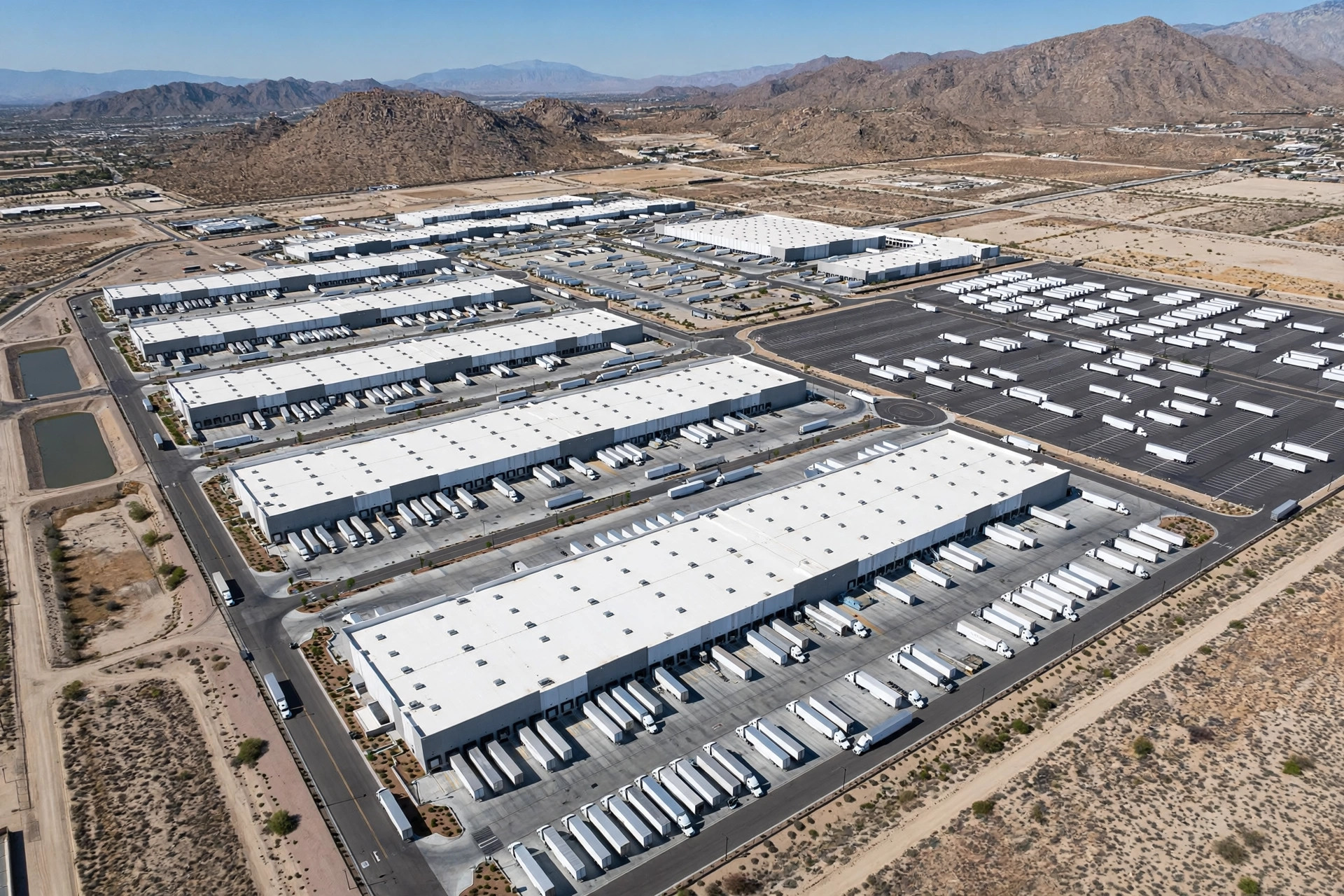
The Inland Empire is the buffer pool for this system, and it is also the most misread part of it. In the fourth quarter of 2025, industrial vacancy there was 8.82 percent and the average asking rent was about $1.00 per square foot per month on a triple-net basis, down 10.7 percent year on year. Vacancy has climbed from its 2022 lows and rents have come off their peak, which looks like a shipper's market. Do not jump to that conclusion. Reading vacancy alone is like reading the nameplate power of a machine without checking its actual load: a fuller buffer pool helps, but if your freight arrives in one bunched vessel call, no amount of buffer space fixes the gate.
Here is a scenario illustration, not a quote. Suppose a shipper moves 200 forty-foot boxes a month, and each extra day of port dwell adds about $100 per box in combined costs. That is $20,000 a month. Moving the warehouse from 30 minutes from the port to 90 minutes away in the Inland Empire might save about $15,000 a month in rent, but each dray takes an extra hour, trucks make one fewer turn a day, and the fleet needs more trucks. The rent saving can easily be eaten by transport cost. The dividing line is not on the rent schedule. It is in your container turn time: fast turns and stable sailings favor being close to the port, while slow turns and bunched arrivals favor a big Inland Empire warehouse plus night appointments. The false need hides here: many shippers lease the big warehouse first and only then ask how freight gets into it. That order is backwards.
Hold at the Los Angeles-Long Beach Port or divert: a decision table
The question shippers ask me most is whether to divert to another port when San Pedro Bay jams up. My answer is to check whether your freight can wait, and whether the diversion math closes:
| Option | Fits when | Cost | Number that decides it |
|---|---|---|---|
| Hold and wait: night appointments | Freight is not urgent, warehouse has slack | Dwell and rescheduling cost | Days per box in port |
| Divert: East or Gulf Coast port | Cargo is East-bound, schedule allows | Extra ocean and inland legs | Extra days and freight cost |
| Split the flow: divert part of it | Large volume, hedging risk | Two operations, more complexity | Split share and both rhythms |
There is also a maintenance trap few people mention: gate appointments, chassis pools, and rail capacity do not align themselves just because you bought a system. Appointments must be booked early, chassis availability must be watched, and rail plans must move with vessel schedules. Software can tell you which step is slow, but fixing the rhythm still takes a person watching three numbers every day: boxes pulled today, yard rehandle rate, and rail dwell in days. If those numbers do not move, the most expensive system is decoration.
The counterintuitive judgment is that the biggest risk in Los Angeles-Long Beach port warehouse logistics is not too much freight. It is assuming volume is the problem and then leasing a bigger warehouse to fix it. 2024 already proved that near-record volume can run smoothly, provided vessel, gate, rail, and warehouse rhythms stay in sync. What a shipper should really buy is not square footage but rhythm: can you get the appointment, are there enough chassis, can rail move, can the warehouse receive. Area is the result. Rhythm is the cause.
Is the money worth it? Look at one number: how many days, on average, does your box take from berthing to entering the warehouse? When that number comes down, rent, freight, and detention all come down with it. When it does not, the cheapest warehouse rent is still a false bargain.
By Da Liu, Automation Engineer