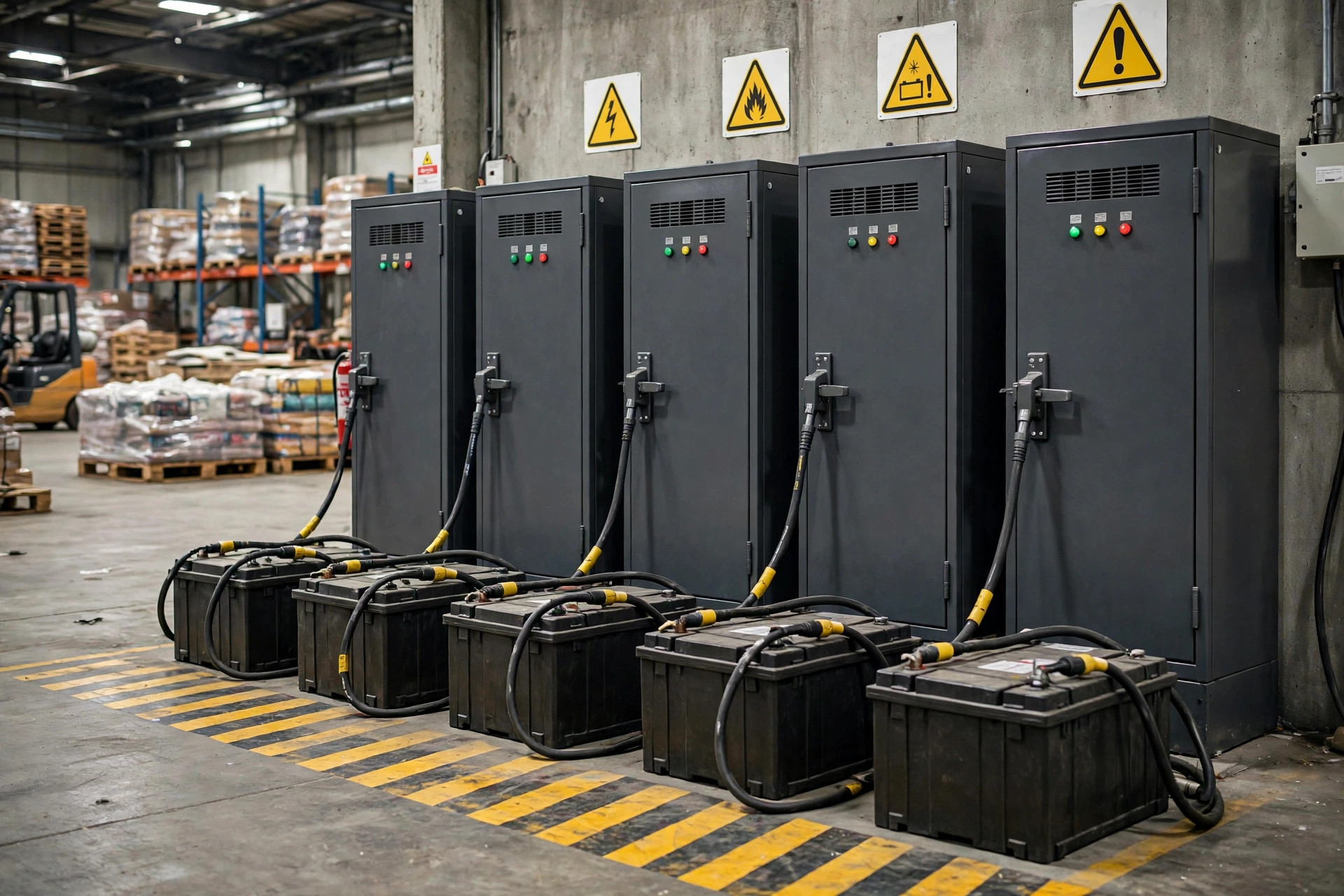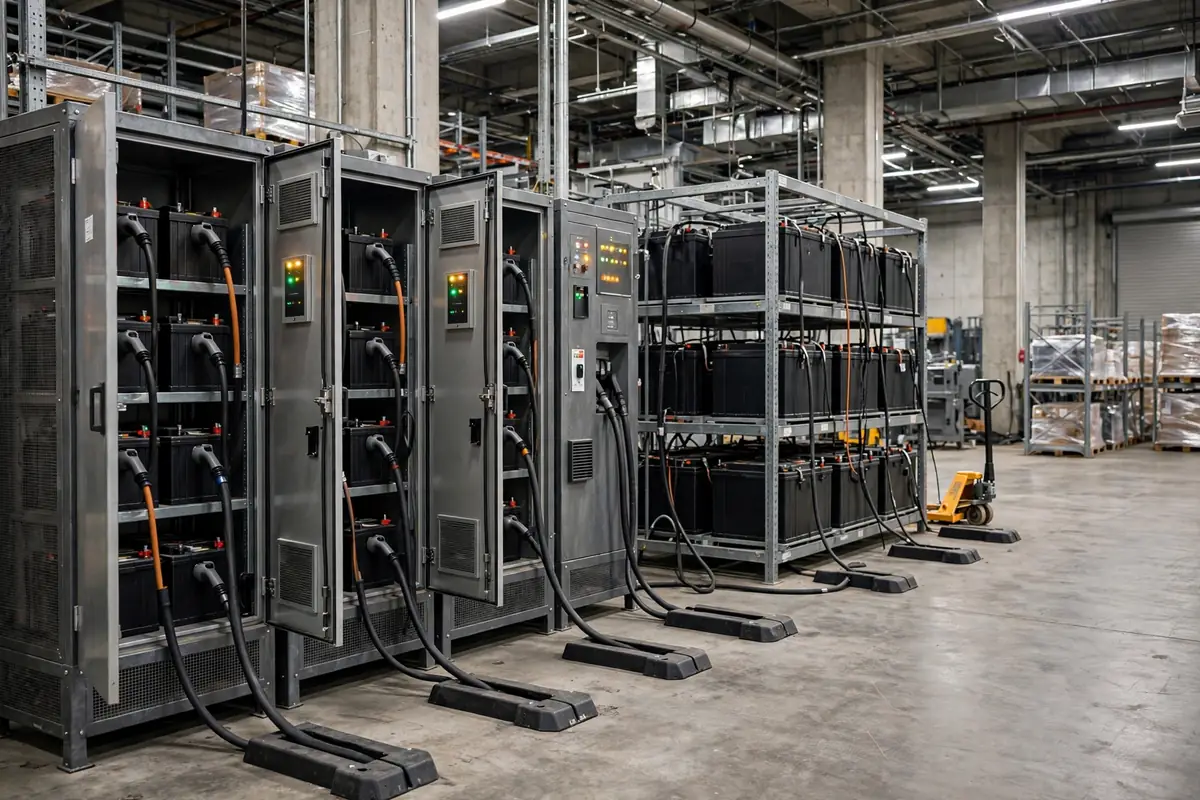
Lithium battery warehouse charging area safety is one of those topics where most people start at the wrong end. They start by shopping for a cabinet, and the more expensive the better. Let me give you the conclusion first: the cabinet is only one link in the chain. If charging, separation, and thermal runaway response are not closed into a loop, the most expensive cabinet is just a pricier steel box.
How Thermal Runaway Actually Starts in a Warehouse Charging Area
Think of thermal runaway as a battery heating itself from the inside. An internal short drives the temperature up, the electrolyte breaks down and releases gas, and then the fire spreads to the neighboring cell, which heats up and follows. You can think of it as a row of firecrackers packed side by side: light one, and the whole row can go. Charging is the riskiest moment because charging is literally forcing energy into the cell. Overcharging, heat from fast charging, and aged cells with rising internal resistance all shorten the fuse.
In May 2024, a third-party logistics warehouse in Zhejiang learned this the hard way. Their forklift lithium batteries were charged in a corner on ordinary racking with power strips, no separate fire zone at all. One night, a battery started smoking near the end of its charge cycle. The night-shift worker smelled it and ran over, but by then the smoke was already thick. Luckily there were no cardboard boxes or pallets stacked nearby, so the fire department contained it to two battery packs and one rack section, and the warehouse still lost two days of operation. The post-incident review found the problem was not the battery brand. It was three missing basics: no smoke detection linked to power cut-off, no dividers between batteries, and a packaging-material staging area just three meters away from the charging corner.
That is the first decision line for lithium battery warehouse charging area safety: figure out which risk tier your charging area is actually in before you buy anything.
The Selection Line for Charging Area Safety: Racks, Cabinets, or a Fire Compartment
Selection should follow conditions, not budget. Here is the blunt version of the line I use:
| Situation | Approach | When it fits |
|---|---|---|
| Fewer than 5 battery packs, charged only while staff are on site | Open charging rack with good ventilation, a dedicated circuit, and smoke detection | Healthy batteries and someone actually patrolling |
| Centralized charging, overnight unattended charging, or more than 10 packs | Charging cabinet with exhaust ventilation and automatic power cut-off | The normal case for most warehouses, and my recommended starting line |
| Large battery volumes, mixed old and new batteries, or a charging area right against storage | Dedicated fire compartment plus cabinets plus gas detection linked to the response chain | Any case where one incident could take out the whole building |
Watch out for one fake requirement: people walk in asking for an explosion-proof cabinet. A normal lithium battery charging area does not need explosion-proofing. It needs fire containment, spread prevention, and early detection. An explosion-proof cabinet is heavy, expensive, and ventilates poorly. Buy the wrong thing and you have paid a premium for a sealed can. Think of it this way: you need a firewall, not a safe. That is the practical core of lithium battery warehouse charging area safety: match the control to the risk tier, not to the catalog price.
A November 2023 case from an e-commerce warehouse in Jiangsu shows the opposite mistake. They spent heavily on cabinets with built-in suppression, but vented the cabinet exhaust indoors and left the cabinet doors propped open for convenience. When a battery went into thermal runaway, the suppression agent discharged inside the cabinet, but smoke poured out through the open door, triggered a building-wide alarm, and evacuated more than two hundred people. The cabinet itself was fine. The installation and the daily habit had broken the chain.
Separation: Distance, Walls, and Where the Pressure Goes
Separation has three parts, and all three are required. First, distance: keep a clear aisle between the charging area and any combustible material. The exact distance should follow your local fire authority's latest requirements, not your gut feeling. Second, walls: where possible, enclose the charging area with fire-rated walls, and make sure the door closes by itself. A fire door propped open is no door at all. Third, venting direction: cabinet exhaust and pressure-relief outlets must point outdoors or into a dedicated exhaust duct, never toward work areas or evacuation routes.
Here is a counterintuitive point: a charging area is not safer the more sealed it is. A fully sealed little room with no exhaust gives thermal runaway gas nowhere to go, and the pressure and toxic smoke will push into the neighboring area instead. Separation means two things at once: keep the fire inside a small zone, and send the smoke and gas somewhere safe. Containment and venting both have to hold.
The Thermal Runaway Response Chain: Detection, Cut-Off, Exhaust, and Suppression in One Loop
A pile of standalone devices that are not linked together adds up to zero. A proper chain looks like this: a smoke or heat detector trips, the charging circuit cuts power automatically so nobody keeps feeding energy into the battery, the exhaust fan starts, the cabinet or zone suppression system activates, and the alarm reaches both the duty staff and the fire control room. Break any one of those five links and the chain is broken.
Two details deserve special attention. First, pick the right detector type: a standard smoke detector is not always sensitive to the gases released in the early stage of lithium battery thermal runaway. Where the budget allows, add combustible gas or carbon monoxide detection, which can buy you considerably earlier warning. Second, the power cut-off must work at the circuit level. Switching off one charger is not enough. The whole charging circuit has to be cut, or someone will just plug into another socket and keep charging.
The Maintenance Traps: Buying the Equipment Is Only the Start
Most charging-area failures I have seen are not purchasing failures. They are maintenance failures. The four traps I run into most often:
First, cabinet filters and air ducts never get cleaned, cooling degrades, and temperatures inside the cabinet creep up with every charge. Second, sensors are never tested. A detector that has sat silent for three years may have a dust-clogged sensor that fails exactly when it matters. Third, old and new batteries get charged together. Old cells with high internal resistance run hotter, and mixing them in means the weakest cell sets the safety level for the whole group. Fourth, charging logs go unread. The same battery pack trips high-temperature alarms repeatedly, shifts change, and nobody follows up.
My routine is simple: test the full chain once a month by pressing the test button and confirming that power cut-off and exhaust actually actuate. Clean ducts and filters every quarter. Grade batteries by health and retire any pack whose internal resistance has clearly risen, instead of hanging on to its remaining value. None of this is glamorous, but in lithium battery warehouse charging area safety, maintenance is where most programs quietly fail.
So is the money worth it? Look at this one number: if a thermal runaway event spreads into the storage area, the destroyed goods, the downtime, and the fire remediation bill routinely run to ten times the cost of a full charging-area upgrade. Cabinets, separation, and the response chain are, at bottom, a small payment for one certainty: that a fire stays inside one cabinet. Once that arithmetic is clear, nobody argues about a cabinet costing a few thousand more.
By Da Liu, Automation Engineer