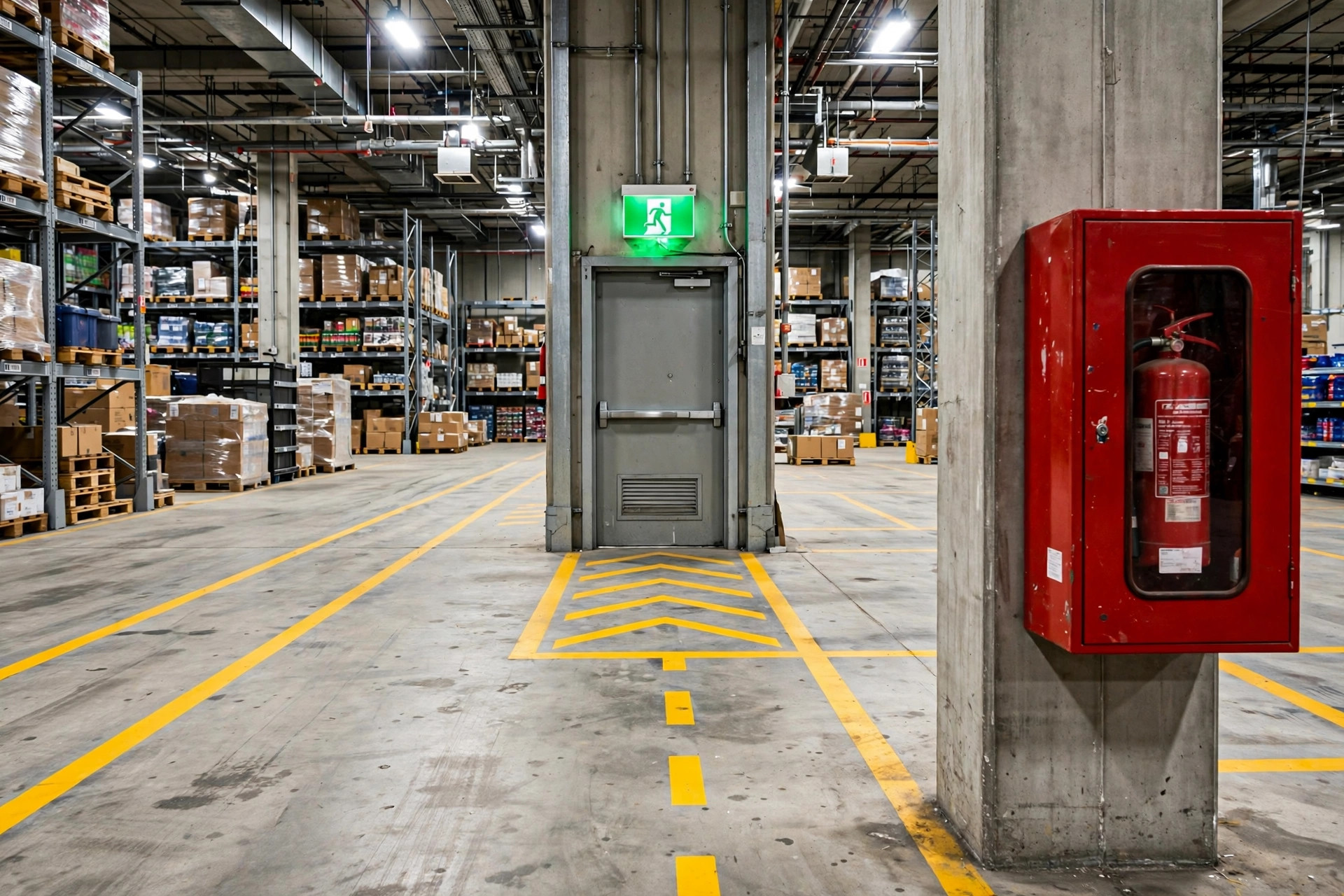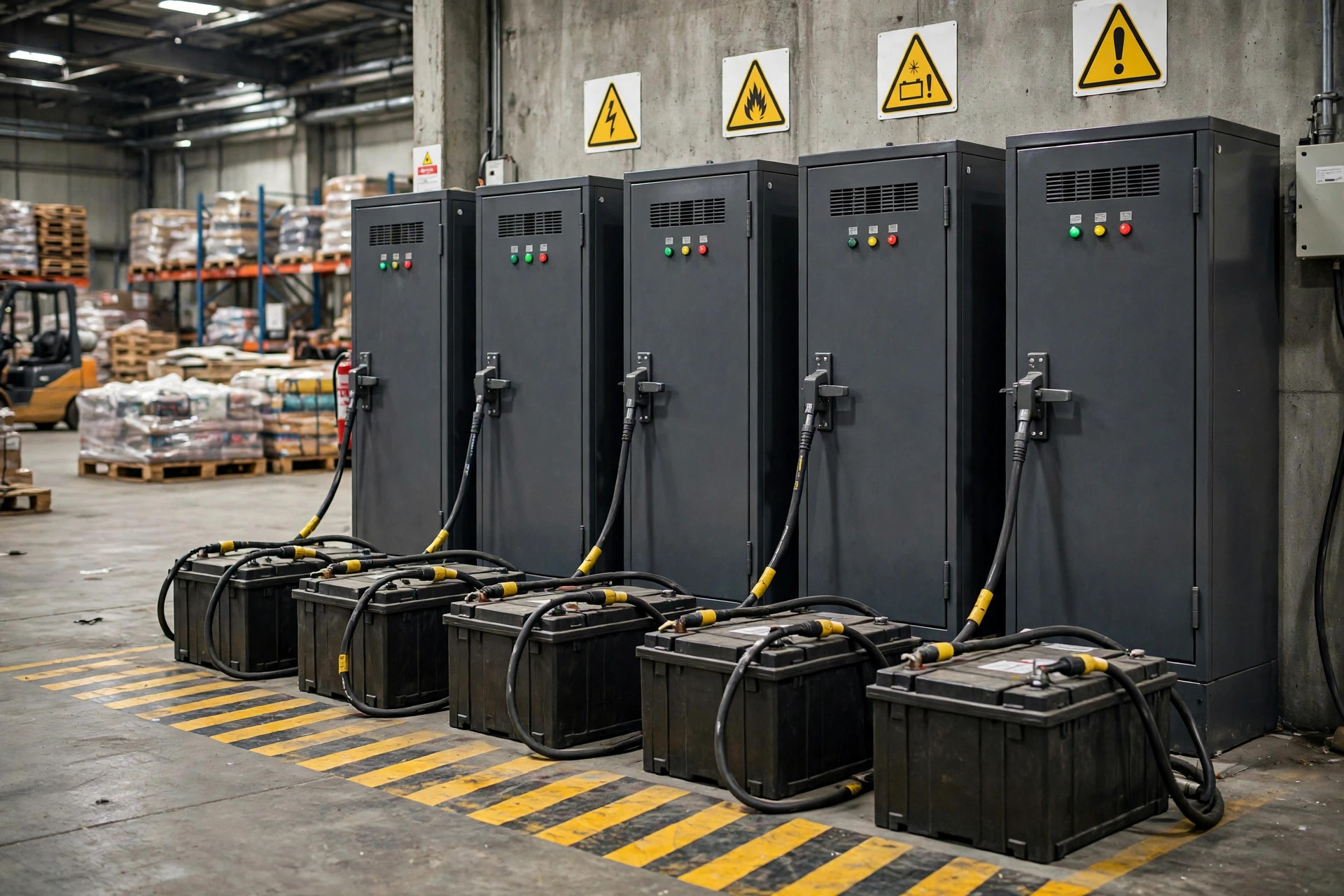
I tell you what — after 15 years behind the wheel, I've spent more hours waiting at warehouse docks than some office folks spend at their desks. And I can tell at a glance whether a charging corner has proper lithium battery charging cabinets or just batteries sitting on the floor.
Late one night last month, around 11 p.m., I was parked at a dock in Rancho Cucamonga waiting on a pickup. One kid on night shift, a forklift battery sitting on the concrete floor charging, cables stretched everywhere. Less than two meters away, pallets of cardboard boxes stacked higher than my head. And the kid was leaning against those boxes smoking, flicking his butt onto the floor when he finished. All I could think was: if one of those batteries goes bad tonight, nobody in this building is getting any sleep.
I've been seeing charging corners like that for years. Back in the lead-acid days, everybody was scared — charging gives off hydrogen, and OSHA's rule 1910.178(g) spelled it out: designated charging areas, fire protection, no open flames, no smoking. Now the batteries are lithium: clean, no smell, no watering, full charge in a couple of hours. So everybody relaxes. But I'm telling you, that "clean" is exactly what makes people careless.
The point: the cleanest-looking battery makes the ugliest fire
Two true stories first.
In September 2024, at the Port of Montreal, a shipping container holding 15,000 kilograms of lithium-ion batteries caught fire and burned for nearly 8 hours. What came out wasn't ordinary smoke — it was hydrogen fluoride, hydrogen chloride, hydrogen cyanide, a cocktail of toxic gases.
In July 2023, at a recycling facility in Commerce, Georgia, a load of recyclables arrived with lithium battery scrap mixed in. It caught fire. Firefighters needed 4 days and 3 million gallons of water to put it out. The battery maker ended up settling for $31 million — $20 million in punitive damages, $11 million in actual losses.
And the background numbers: the U.S. Consumer Product Safety Commission logged more than 25,000 lithium-battery overheating and fire incidents over a recent five-year stretch; New York's fire department counted 277 lithium-ion battery fires in New York City in 2024 alone; and one insurer's survey found one in five businesses has dealt with a lithium battery fire or explosion.
Here's the thing about lead-acid: charging gives off hydrogen, every old-timer knew to be afraid, and the rules were strict. Lithium plays a completely different game, called thermal runaway. In plain English: a cell takes internal damage — a drop, a knock, water exposure, or just a manufacturing defect — and the temperature starts climbing on its own. Researchers have measured the climb at more than 20°C per minute, past 1,000°F. Worst of all, the chemical reaction feeds itself. It doesn't need outside oxygen, and it can reignite hours after it looks dead.
That's the counter-intuitive part: the cleanest-looking battery makes the hardest fire to put down. A lead-acid fire, you hit it with water or foam and it stays down. Lithium in thermal runaway, water only cools it — it won't smother, and you have to guard against reignition all night. New York City's rules put it bluntly: lithium-ion storage over 1 kWh needs approval; lead-acid doesn't trigger until 70 kWh. A seventy-fold difference. The regulators are telling you with numbers: these are not in the same league.
The math: is a lithium battery charging cabinet worth it?
One 48V, 460Ah forklift lithium battery holds 23.55 kWh of energy. A mid-size warehouse with fifteen or twenty of those packs, all charging unattended overnight in the same corner, cardboard nearby — picture that scene yourself.
The Georgia fire: a $31 million settlement, 4 days to extinguish, 3 million gallons of water. A warehouse fire doesn't just burn goods: sprinklers go off, the whole building shuts down, smoke-damaged inventory gets rejected by customers, and the insurance fight drags on for months. A small operation doesn't survive that.
Now the spending side. Smart charging cabinets for small batteries — power tools, scanners — with automatic suppression and temperature-controlled fans, sell for around $899. Industrial fire-rated cabinets for forklift packs: the mainstream is Type 90, tested to the European EN 14470-1 standard — 90 minutes of fire resistance from either side. In one manufacturer's test, the inside of the cabinet hit 1,006°C while the outer skin stayed at 70.6°C. Big cabinets are quoted by size and configuration — check current manufacturer pricing. But stack that against one fire.
One insurer's charging-safety guidance recommends a room with 60-minute fire separation for lithium forklift charging, 2 meters clear around chargers with no storage, and no more than 50 square meters for an unsprinklered charging area. If you're not even doing that, good luck at claim time.
My decision framework is three questions. One: how big are the batteries? Small tool cells, or forklift and AMR packs at 20-plus kWh each? Two: when do they charge — supervised daytime, or unattended overnight? Three: what's around the charging spot? Big batteries plus overnight plus nobody around — that's the highest-risk combo, and it needs a charging cabinet or a fire-separated room, no debate. Small batteries in the daytime: strict housekeeping rules get you most of the way there.
What a charging cabinet is, how to pick one, where to put it
A fire-safe charging cabinet is, plainly put, a big steel box with fire insulation inside. Batteries charge inside it; if thermal runaway hits, the fire stays locked in the box for 90 minutes — enough time for alarms, evacuation, and the fire department. A good one has a few non-negotiables: self-closing doors that shut off oxygen in a fire; smoke and heat detection that cuts power and stops the fan on alarm; perforated shelves for heat dissipation; a spill sump at the bottom so leaking electrolyte doesn't run everywhere.
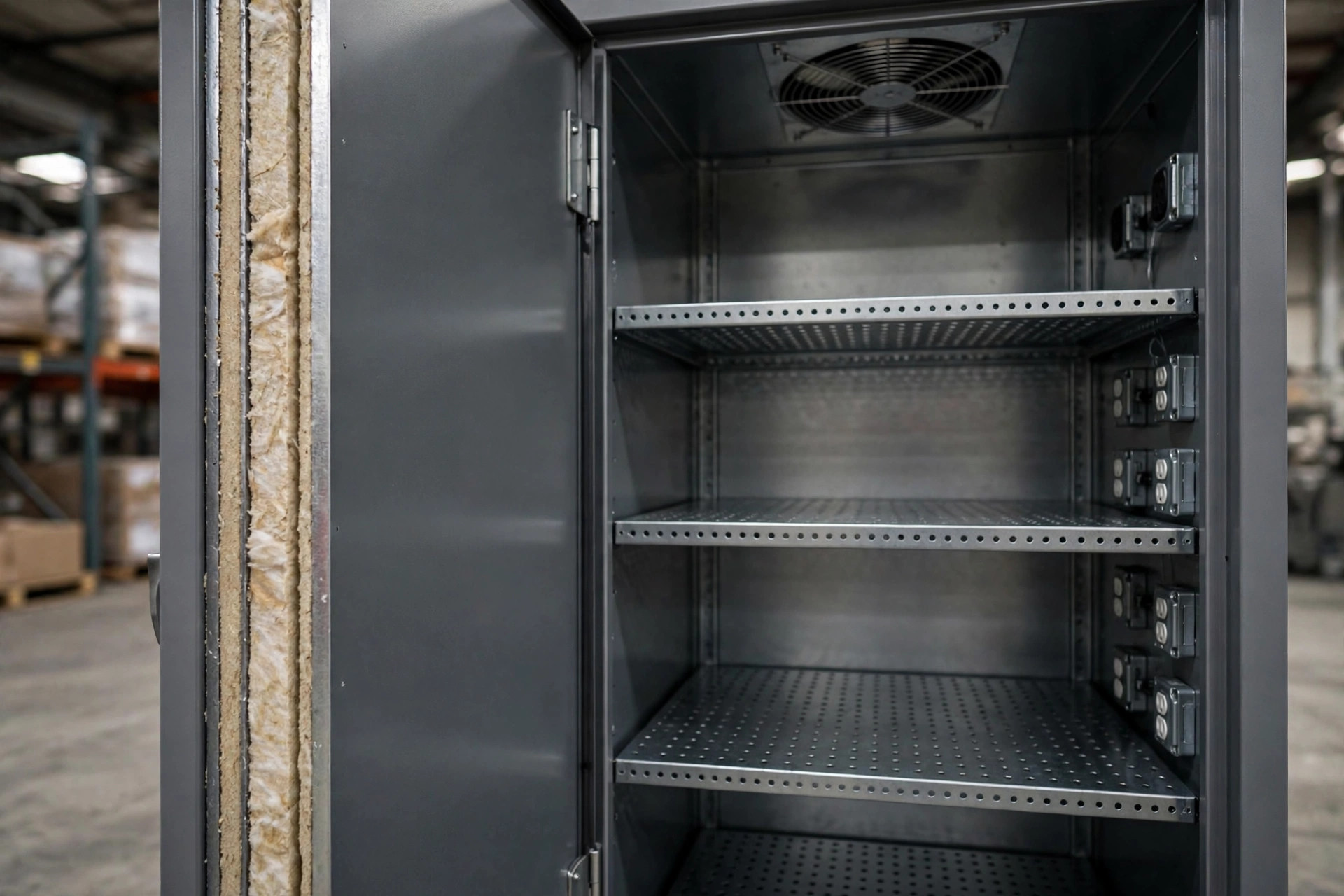
How to pick? First, the fire rating — Type 90 is the mainstream. Don't substitute an ordinary flammable-liquid cabinet made for paint: those are built to keep outside fire out, and tests show they don't even hold 10 minutes — different animal entirely. Second, alarm-linked power cutoff — without it, you've bought an expensive metal box. Third, size: cabinets for forklift packs and cabinets for small cells are not the same thing, so ask the manufacturer before buying. Fourth, whether you need an exhaust duct to the outside — venting toxic smoke beats trapping it indoors.
Where to put it? Three rules: against an exterior wall, near an exit, so the cabinet can be dragged outside if it goes up; 2 meters clear of any storage — that's the insurer's recommendation and also NFPA 505's old rule about keeping charging areas free of combustibles; and never mount chargers directly on combustible sandwich-panel walls.
Charging-area red lines: don't cross these
Years of hanging around warehouses taught me these red lines:
One: no cardboard, pallets, or stretch wrap in the charging area. NFPA 505 says it in black and white — keep charging areas free of extraneous combustibles. Two: no smoking. OSHA 1910.178(g) is an old rule and it still counts in the lithium era. A cigarette butt is an open flame. Three: damaged batteries — dropped, swollen, water-exposed — never enter the charging area. Isolate, tag, and wait for the manufacturer. Most thermal runaways start as invisible "internal injuries"; one good knock can plant the seed. Four: at night with nobody around, no naked charging of big batteries. Cabinet or timed shutoff. Five: inspect chargers and cables on a schedule. Frayed or hot-running cables get replaced, no patching up. Six: don't prop the cabinet door open. A blocked self-closing door means you bought the cabinet for nothing — and this is the violation I see most. Seven: match the extinguisher to the fire. Lithium fires are fought with water for cooling and reignition prevention; dry chemical won't stop thermal runaway. Ask your local fire marshal what to stock — don't guess.
Landing advice for warehouses
A few things that get done, all cheap:
Do the free stuff today: clear 2 meters around charging, hang the no-smoking sign, mark a quarantine zone for bad batteries, unblock the cabinet doors. Costs nothing, doable today.
Then prioritize with those three questions: big batteries and night charging get cabinets first; small batteries in the daytime get disciplined housekeeping first.
Call your insurance broker and ask one question: does installing charging cabinets earn us a conversation about premiums?
OSHA 1910.178(g) and NFPA 505 are the floor. NFPA 855 is the newer standard written specifically for lithium energy storage. Line your charging area up against all three, and inspections stop being scary.
There's an old saying among drivers: better safe than sorry. Batteries are the quietest thing in a warehouse — right up until they're the loudest. A charging cabinet buys you the one thing money usually can't: a good night's sleep.
By Shifu Zhao, Trucking Veteran (15 yrs)