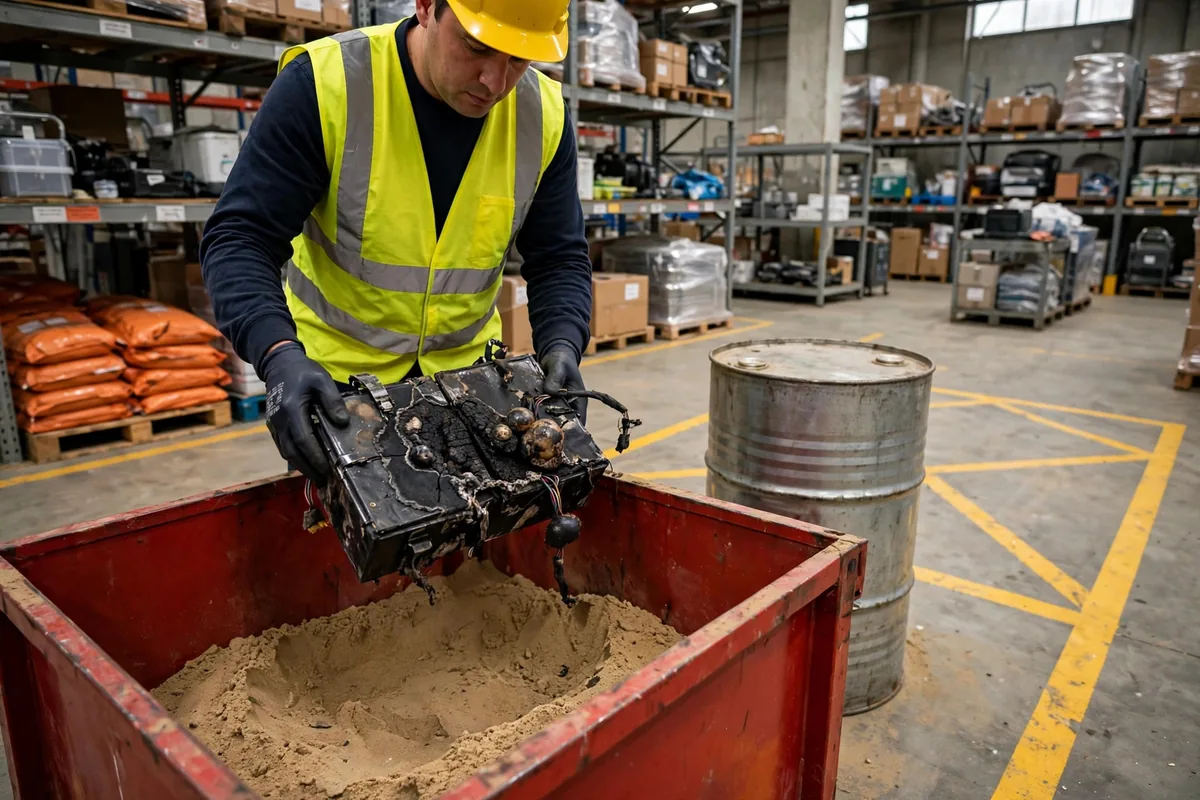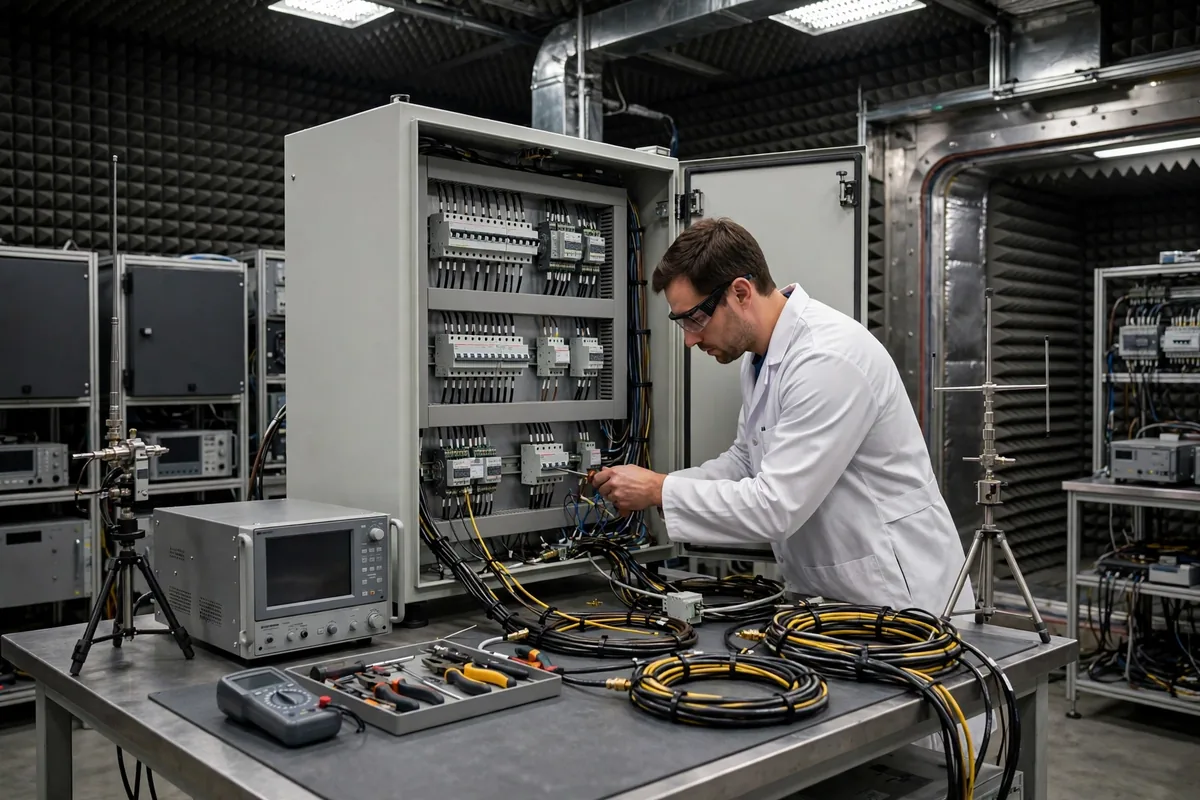
Start with the principle. When people talk about lithium battery export, the first thing they mention is UN38.3, and once they have the report they think the job is done. That is like crash-testing a car, skipping the electrical inspection, and driving it onto the highway — surviving a crash does not mean it will not catch fire. UN38.3 is the lithium battery testing requirement in the United Nations Recommendations on the Transport of Dangerous Goods, Manual of Tests and Criteria. It governs transport safety. Electrical safety certification governs whether the product itself is safe to use. Those are two parallel gates. Passing one does not mean you have passed the other.
UN38.3 has eight tests, T1 through T8: altitude simulation, thermal test, vibration, shock, external short circuit, impact or crush, overcharge, and forced discharge. You can think of it this way: the laboratory is simulating everything the battery might go through between the factory and the end user. Will low air pressure at altitude make it leak? Will heat make it catch fire? Will vibration and shock in transit cause an internal short? Will a runaway charger overcharging it make it explode? Will forced discharge of a cell cause a failure? Each test has a clear pass criterion, and if any one of them fails, that battery model cannot ship as tested.
Let me tell you about a real failure I watched. In 2024, a portable power station factory in Shenzhen had its UN38.3 report in hand and shipped to the United States by air without a problem. Then the sales channel in the US asked for electrical safety certification, and the factory discovered it had never done any. The product sat in a warehouse for more than two months while the factory re-tested, redesigned part of the structure, and completed the paperwork — missing the most important sales season of the year. The root cause was not the laboratory. It was that nobody had put electrical safety certification on the project timeline at the start. UN38.3 is the ticket for transport. Electrical safety certification is the ticket for the market. Both need to be scheduled in advance.
Lithium Battery Electrical Safety: Where the Line Falls
For the US market, lithium battery products commonly face electrical safety standards such as UL 2054 and UL 1642, plus NRTL listing — certification by a Nationally Recognized Testing Laboratory recognized by the Occupational Safety and Health Administration, OSHA. Think of it this way: the UL standard is the exam syllabus, and the NRTL listing is the stamp proving the examiner is qualified to issue the certificate. Which standard applies depends on the product form: cells, battery packs, and products with built-in charging each follow a different certification path, with different test items and sample quantities.
How do you draw the line? I use three decision points. First, product form. A standalone cell, a battery pack, and a finished product with a battery are certified differently. Second, use case. Home energy storage, power tool batteries, and consumer electronics carry different risk levels, and the certification is correspondingly stricter or lighter. Third, sales channel. Large retailers and e-commerce platforms usually have their own compliance checklists and require certification documents before a product can even be listed. Work through those three points first, and only then ask a certification body for a quotation and a timeline. Treat cost and lead time as "per the certification body's latest quotation" — do not apply somebody else's numbers from last year to your product.
There is also a pseudo-requirement I want to call out directly: not every lithium battery product needs the full certification package. Some products only need cell-level certification plus a finished-product evaluation. Some, with a simple structure and low energy density, can follow a much shorter certification path. On the other hand, do not try to "ship first, certify later." The US market traces electrical safety failures aggressively, and fixing certification after a problem costs far more and takes far longer than doing it in advance. The only test that matters is this: what documents does your target sales channel actually require? Certify against the channel's checklist and not a cent is wasted. Certify the full package on a hunch and half the money probably goes to tests you never needed.
| Area | What UN38.3 covers | What electrical safety certification covers |
|---|---|---|
| Test subject | Battery safety during transport | Electrical safety of the product in use |
| Core content | T1 altitude simulation, T2 thermal test, T3 vibration, T4 shock, T5 external short circuit, T6 impact/crush, T7 overcharge, T8 forced discharge | Overcharge, over-discharge, short-circuit protection, temperature rise, structural safety |
| Failure consequence | Fire, leakage, or explosion in transit | Fire, electric shock, or thermal runaway in use |
| Common sticking point | Inconsistent sample condition, expired test report | Structural design failing the standard, missing protection circuit |
That table captures a counterintuitive judgment: passing UN38.3 does not mean the product is safe, and passing electrical safety certification does not mean the transport is compliant. The two test regimes measure two different kinds of risk, and neither substitutes for the other. Many factories treat them as one job, do half of each, and then cannot move forward on either side when something goes wrong.
Packaging and Transport: Lithium Batteries Are Class 9 Dangerous Goods, and Air Is Not Sea
Lithium batteries are Class 9 dangerous goods, and that classification drives everything about packaging and transport. Air and sea freight have different requirements — different labels, different packaging strength, different document lists. Air freight is stricter on state of charge and packaging class, and some battery models are restricted from air transport altogether and can only go by sea. Sea freight is relatively more lenient, but packaging and declaration still cannot be treated casually.
I saw a classic version of this trap in 2023. A batch of lithium battery products was packed to sea-freight standards, then switched to air freight at the last minute to meet a delivery deadline. It was held at the airport: the packaging class and the labels did not meet air requirements, and re-packing and re-declaring cost a full week. The lesson is simple: fix the transport mode first, then pack to that mode's standard. Do not take sea-freight packaging into an air-freight check. The marks on the package, the accompanying documents, and the state-of-charge limit should be checked item by item before departure, with the checklist posted on the shipping office wall. That is far cheaper than fixing it afterward.
One last point, on maintenance. Certification is not a one-time event. Change the cell supplier, change the protection board design, or change a structural mold, and any one of those changes can invalidate the original test report. My recommendation is to keep a change list: any change involving cells, protection circuits, or structural parts should first go through a half-hour judgment — "does this require re-testing?" — before anyone touches the design. That half hour can save months of rework later.
So is the money worth spending? Look at this one number: the sales you lose in your target channel because you lack electrical safety certification, or the sales window you miss while you fix certification afterward, multiplied by your gross margin. If that number is larger than the cost and time of certification, spend the money. If it is smaller, get the channel's compliance checklist in hand first and certify against it. For lithium battery export, UN38.3 is only the starting point. Electrical safety is the gate that decides whether your product can actually stand in the US market.
By Da Liu, Automation Engineer