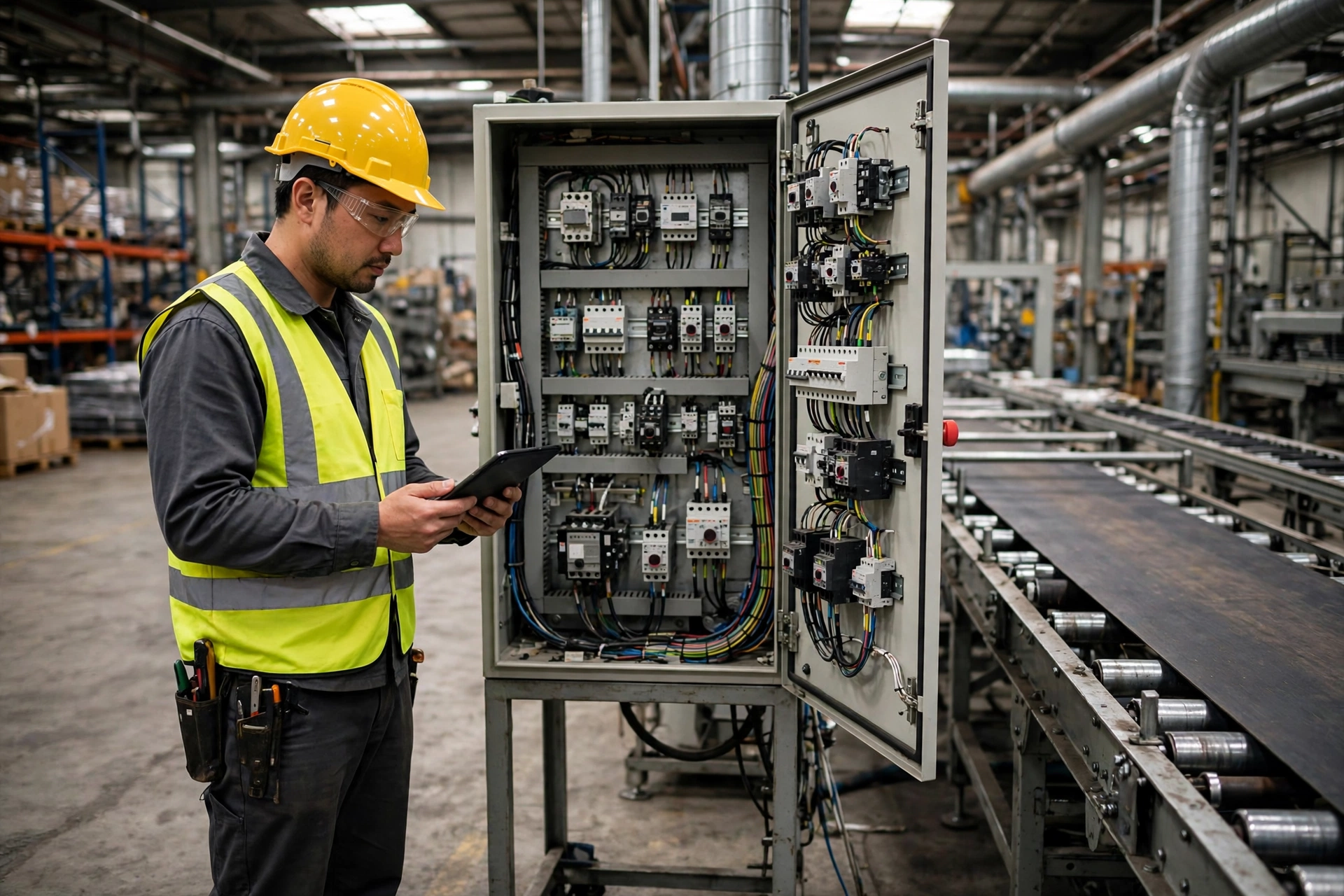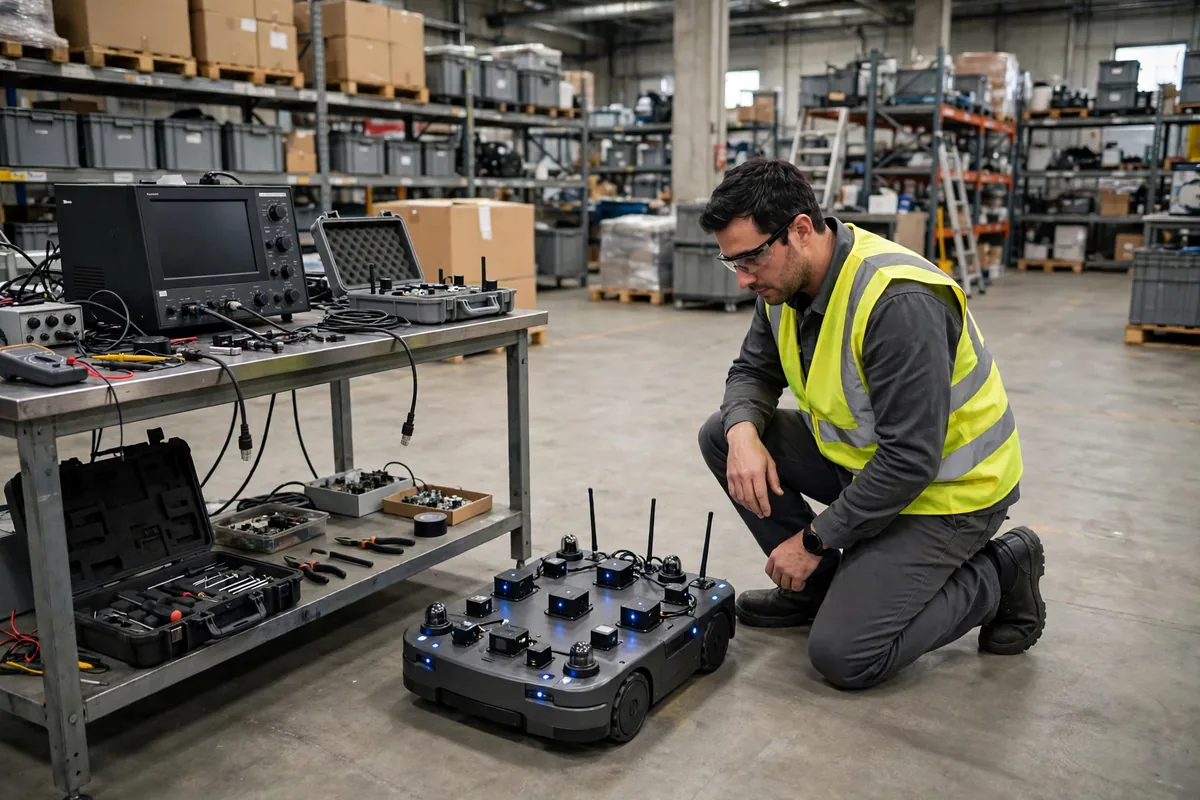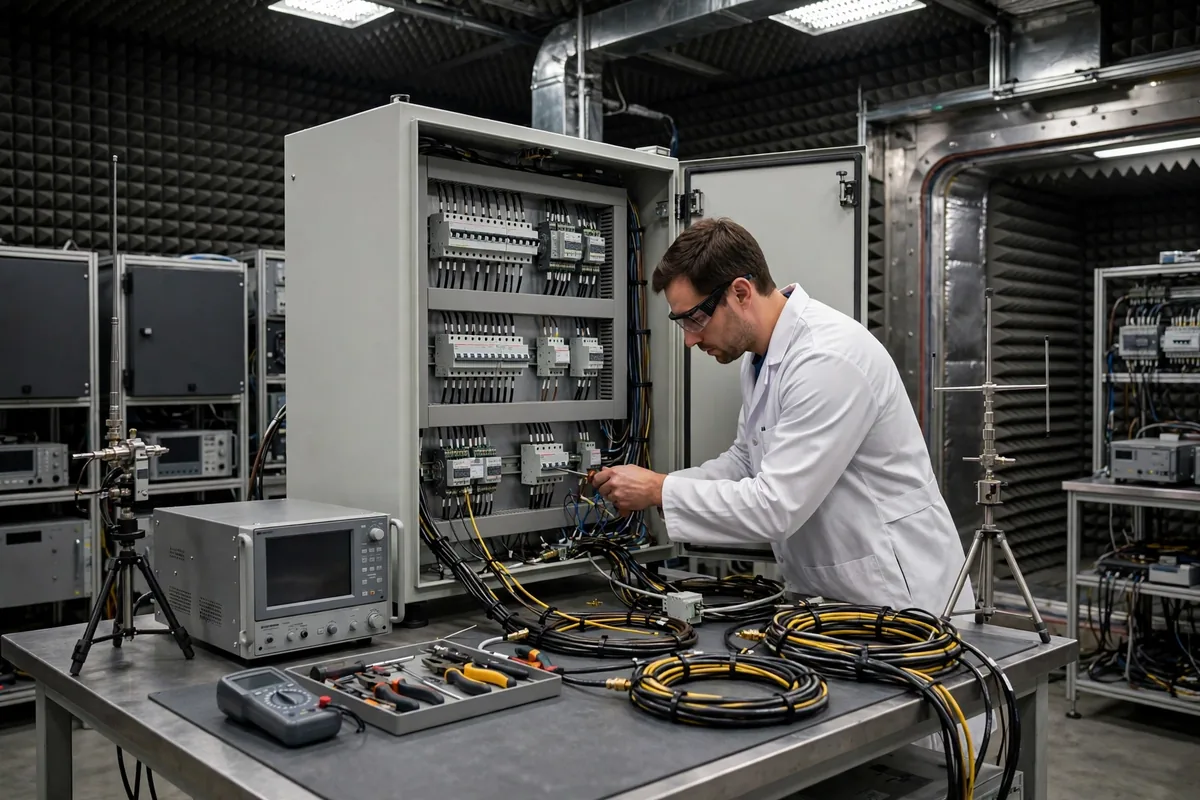
A conveyor and sortation vendor had a prototype running for three months in a customer's warehouse, and the customer was ready to sign a volume order. Before shipping to Europe, the equipment went in for EMC electromagnetic compatibility testing and failed radiated emissions on the first round. Rework, retest, more rework: the delay ran past two months, the window closed, and the customer went with another supplier. Nothing was wrong with the equipment itself. It lost on a step many vendors never plan for.
According to the European Commission's published summary, the EMC Directive is 2014/30/EU, adopted on 26 February 2014 and applicable across EU member states since 20 April 2016. It states protection objectives rather than numerical limits: the disturbance generated by equipment must not exceed a level above which radio, telecommunications, or other equipment cannot operate as intended, and the equipment itself must have a level of immunity appropriate to its intended use. The numbers live in harmonized standards. Manufacturers must assess conformity, compile technical documentation, issue an EU Declaration of Conformity, and affix the CE mark, keeping both 10 years. Radio equipment is a separate path: its EMC protection requirements fall under the Radio Equipment Directive 2014/53/EU, so a controller with Wi-Fi on board is assessed twice, along two different routes.
What EMC Electromagnetic Compatibility Actually Regulates
EMC electromagnetic compatibility regulates two directions at once. The first is emissions: the disturbance your equipment gives off must not be strong enough to stop neighboring equipment from working. The second is immunity: when disturbance from the environment hits your equipment, it must keep performing without unacceptable degradation. Meeting only one direction is not compliance. Many vendors treat EMC electromagnetic compatibility as a one-way problem and only discover the second direction when their equipment misbehaves next to someone else's high-power machinery on a customer site.
The Most Common EMC Failure Points in Warehouse Equipment
Variable frequency drives come first. According to Siemens' published EMC application notes, a variable-speed drive system consists of a control unit, power module, motors, encoders, and connecting cables, under product standard EN 61800-3. The interference originates in the fast switching of power devices: the steeper the switching edge, the stronger the high-frequency disturbance. A long, unshielded motor cable turns into an antenna. On one integrator's project, the cable from a sortation-line drive to its motor ran a dozen meters through a cable tray with no shielding, and radiated emissions exceeded the limit in the tens-of-megahertz range. A shielded cable plus an output filter fixed it.
Servo motors and switched-mode power supplies are the second category. Servo drives are high-frequency switching circuits too, and the harmonics of a power supply's switching frequency travel out along the power line as conducted emissions. The conducted-emission test band runs from 150 kHz to 30 MHz, exactly where switching harmonics are most active. A filter at the power inlet is not optional; on many designs it is the last line of defense.
Wireless modules are the third. Wi-Fi on an AMR, Bluetooth on a scanner, wireless links on sensors: these modules need radio certification of their own, and they are also interference victims. In one warehouse, AMRs near a high-power welding station showed drifting localization and occasional packet loss. It took weeks to confirm that environmental interference was degrading the wireless link, while the equipment itself was fault-free. Passing emissions does not mean the equipment can stand its ground in a real electromagnetic environment.
EMC Requirements for Export: Europe and the United States Are Not the Same Thing
In Europe, the standard depends on equipment type. Multimedia equipment, such as industrial PCs, operator terminals, and servers, uses EN 55032 for emissions and EN 55035 for immunity, replacing the older EN 55022 and EN 55013 on the emissions side, and EN 55024 and EN 55020 on the immunity side. For industrial environments without a dedicated product standard, the generic standards are EN 61000-6-2 (immunity) and EN 61000-6-4 (emissions). Variable-speed drive systems have their own product standard, EN 61800-3, which divides installations into a first and a second environment and defines categories C1 through C4: C1 can be used without restriction in the first environment, while C3 is limited to the second environment, industrial settings. Picking the wrong family of standards wastes the test report.
The United States runs a different system. FCC Part 15 Subpart B covers unintentional radiators, devices that generate radio frequency energy as a byproduct of operation. Equipment is divided into Class A and Class B by intended environment: Class A is marketed for commercial, industrial, or business use and carries the looser limits, while Class B is marketed for residential use, with far tighter limits. At the same distance, radiated limits are roughly 6 to 11 dB stricter and conducted limits roughly 13 to 23 dB stricter. Conducted limits cover 150 kHz to 30 MHz, and radiated limits start at 30 MHz. Compliance can be shown through a Supplier's Declaration of Conformity or through certification. CE marking and FCC compliance cannot substitute for each other: equipment sold in both regions needs both sets of tests.
| System | Basis | Applies to |
|---|---|---|
| EU EMC Directive | 2014/30/EU | Electrical and electronic equipment on the EU market |
| Multimedia equipment | EN 55032 emissions / EN 55035 immunity | Industrial PCs, operator terminals |
| Industrial generic | EN 61000-6-2 / EN 61000-6-4 | Industrial equipment with no dedicated standard |
| Variable-speed drives | EN 61800-3 | Variable frequency drives, servo drives |
| United States | FCC Part 15 Subpart B | Unintentional radiators |
What Remediation Costs: Designing It In Beats Fixing It After the Test The remediation toolkit has four items: filtering, shielding, grounding, and cable routing. A filter at the power inlet suppresses conducted emissions; a shielded motor cable with 360-degree shield termination at both ends suppresses radiated emissions; a shielded cabinet with conductive gaskets keeps the enclosure intact; power and signal cables run in separate trays and cross at right angles. None of this is mysterious. The real cost difference is timing. The table below is a hypothetical example; figures are illustrative only, not quotations:
| Item | Designed in from the start | Fixed after a failed test |
|---|---|---|
| Power line filter | Specified during design; added cost per unit in the tens of dollars | New selection, board rework, rewiring, plus retest fees |
| Shielded motor cable | Specified on the wiring diagram; modest increase | Full cable replacement on site; labor and downtime dominate |
| Cabinet shielding and grounding | Grounding and shielding planned into the enclosure | Cabinet rework, added gaskets, reworked grounding bar |
| Retesting | One pass, test fee paid once | Each retest round billed; remediation measured in weeks |
The counterintuitive finding is that the most expensive part of EMC electromagnetic compatibility remediation is usually not the component. A filter may cost tens of dollars; a retest slot, a rescheduled delivery, and a lost order are on a different order of magnitude. There is a second cost that never shows up on a remediation quote: equipment failing intermittently on a customer site because of inadequate immunity, with remote troubleshooting, site visits, and the slow erosion of customer trust. That is the cost that hurts most.
Many EMC failures are not a single unit failing; they are a system-integration failure. The drive passed on its own. The motor passed on its own. Put them on one line, in one cabinet, sharing one cable tray, and the system fails. System-level electromagnetic compatibility is the integrator's responsibility, not any single component vendor's. If a purchase contract only says the components are CE compliant, responsibility for the assembled system becomes very blurry.
A Pre-Test Self-Check List
Before sending equipment to the lab, run through this list:
- Filter at the power inlet, current rating and leakage current matched to the equipment?
- Drive-to-motor cable shielded, shield terminated 360 degrees at both ends, not through a thin pigtail?
- Power and signal or network cables in separate trays, crossing at right angles?
- Cabinet door seams and ventilation openings treated for shielding, grounding points bare metal?
- Test sample matching production configuration, tested under worst-case conditions, all axes accelerating and decelerating at once?
- Standards cited in the technical documentation the current harmonized versions?
Warehouse automation is only getting denser: more AMRs, more vision cameras, more wireless sensors, more emission sources, and more victims in the same space. The open question is whether EMC electromagnetic compatibility moves from a pre-export certification step to a routine part of warehouse operations. If the answer is yes, every dollar spent on compliance today is a prepayment for field reliability tomorrow. The next two to three years of field failure data will tell us whether that judgment holds.
By Dr. Chen, Supply Chain Researcher