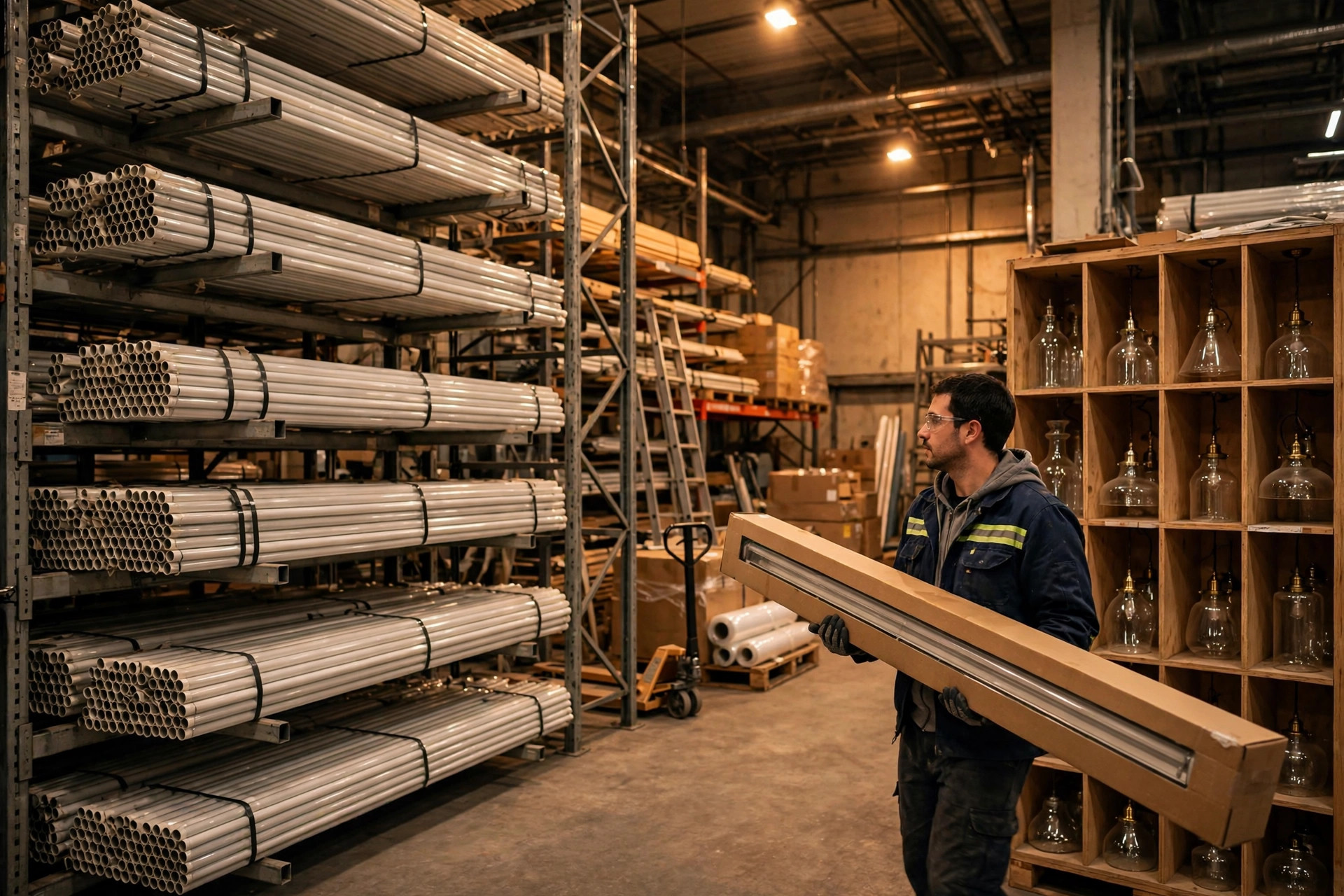
Most warehouses get the lighting fixtures warehouse storage bill wrong on the first line: they count rent and labor and leave out breakage. Tubes, glass shades, and chandeliers do not break by accident. The way they are stored writes the damage in advance, and whatever the racking saved gets paid back later as returns, reshipments, and lost distributors. This is an engineer's cut through the problem: how to store long tubes, how to separate glass, how to hang chandeliers, and at what volume dedicated equipment actually earns its keep.
Long-tube storage: the enemy is bending, not weight
A long tube fails by bending. Lay a 1.2-meter tube flat with its ends unsupported and it sags in the middle over time; stand it against a wall and the whole load sits on one bottom edge, so one fall takes out a row. Think of it as a bamboo drying pole: flat with both ends in the air, it bends; upright against a wall, it topples. The only posture that behaves is one with support points spread along its length. You can think of tube storage as a support-point problem, not a packaging problem.
In November 2024, a lighting manufacturer's own warehouse in Zhongshan, Guangdong, learned this the expensive way. Its 1.2-meter tubes were floor-stacked flat, up to seven layers high. The bottom cartons came out dented, and pulling one tube from the middle of a stack dragged the rest with it. That month the warehouse logged 63 broken tubes, spent more than 4,700 yuan on reshipment freight alone, and lost two distributor orders over the delays. The fix was unglamorous: flat pallet storage, no more than three layers per pallet, rigid dividers between layers, and side rails so nothing slides. Breakage the next month fell to 9 tubes. That is one warehouse's own record, not an industry benchmark, but it makes the point: most of the damage happened during the last pick inside the warehouse, not on the truck.
The selection boundary can be stated plainly:
| Method | Fits when | Upfront feel | Breakage risk | Pick speed |
|---|---|---|---|---|
| Floor stacking, flat | Under 300 long tubes shipped per month, fewer than 10 tube variants | Near zero | High: bottom layers bear the load, pulls drag the stack | Slow, lots of digging |
| Pallet storage, layered flat | 300 to 2,000 tubes per month | Small: dividers and side rails per pallet | Medium: stable once layer height is capped | Moderate, pick by layer |
| Cantilever long-goods rack | Over 2,000 tubes per month, or tubes longer than 1.5 meters make up half the volume | One rack runs into the thousands of yuan but lasts for years | Low: every tube picked independently | Fast, no unstacking |
Do not judge by floor area. Judge by two numbers: monthly tube throughput and how many layers a picker must disturb to pull one tube. If pulling one tube means moving three layers, the cantilever rack has earned its money. If volume is small and the rack sits half empty, that is money spent on a problem you do not have. One piece of pseudo-demand deserves a blunt word: thicker packaging for every tube. Thick packaging guards against knocks. It does nothing against bending, so the money goes into the box while the tube keeps bending inside it.
Glass shade storage: dividers beat thicker boxes
Glass shades break on a different logic. They do not fear weight; they fear point contact. Two shade rims tapping together can leave a hairline crack that is invisible in the warehouse and only opens up once the customer switches the light on and the glass warms. The return then reads as a quality defect, and the warehouse has no way to prove otherwise. In September 2023, a distributor warehouse in Hangzhou, Zhejiang, saw exactly this: one batch of ceiling shades passed inspection in the warehouse, then 14 came back within a week of reaching customers, every one with rim impact marks. The cause was inside the warehouse: shades stood upright in cartons with only newspaper between them, and one shake in handling was enough for them to knock together.
The fix put the money into dividers, not thicker cartons. Each shade gets its own cell, separated by corrugated or foam dividers, rim facing up, never stacked upside down. One layer per carton, with fragile and this-side-up marks on the outside. After the change, that warehouse went three straight months without a repeat return of this kind. Here is the counterintuitive part: the extra packaging cost is usually an order of magnitude smaller than the breakage cost it prevents. People treat dividers as waste; what a divider actually saves is one reshipment plus one customer's trust, and the second of those has no price tag.
Soft shades carry a second, quieter failure: deformation. Fabric shades do not crack, they crease. Stack more than four high and the rim takes a fold that will not spring back to round. Store them by diameter in divided cells, leave a finger's width between shades, and take from the top down, never pulled from the middle. Write the maximum stack height on the side of the carton where a picker can see it, not only in a procedure document nobody opens. Most lighting fixtures warehouse storage guides stop at carton thickness; the divider is where the money actually goes.
Chandelier storage and pick verification: hang the odd shapes
Chandeliers are the hardest category in the building: irregular shape, off-center weight, and crystal drops everywhere. Forcing one onto a standard rack is an open invitation to damage. Give them their own hanging zone. Pick hooks by rated load for the chandelier's weight, hang the fixture from its main frame with straps, and never hang it from an arm or a decorative piece. Take the crystal drops off, bag them separately, and ship them in the same carton as the fixture rather than letting them swing on the frame. Lay soft matting under the hanging zone so a slip still has a cushion. Hanging has a bonus that rarely gets budgeted: counting during stocktake becomes a glance, where flat-stacked odd shapes are where count errors hide.
Pick verification is the last gate, and for lighting fixtures the classic error is not the wrong model but the wrong variant: same fixture, different color temperature, size, or shade color, all looking alike at a glance. Verification needs two disciplines. Scan the item and variant code, and never ship from memory when a code will not scan. Then check the pick list item by item: fixture, shade, and hardware kit. One missing screw means the customer cannot install the light, and the return is the whole fixture. That check costs about 30 seconds and saves a full return shipment.
Then there is the maintenance trap, which is where most warehouses stop paying attention once the racks are in. Cantilever arms sag with use, dividers soften with damp, and worn hooks lose rated load. Check all three once a month: arm level, divider stiffness, hook wear. That routine is what keeps lighting fixtures warehouse storage holding up instead of quietly degrading. Replace any failed part on the spot instead of waiting for something to fall. The racking itself is cheap; one dropped chandelier pays for several racks.
Whether the money was worth it comes down to one number: take three months of lighting breakage reshipment and return freight, divide it by lighting units shipped in the same period, and you have breakage cost per unit. If that number is higher than what a divider or a hook costs per unit shipped, dedicated storage pays. If it is lower, the current setup is the right call.
By Da Liu, Automation Engineer