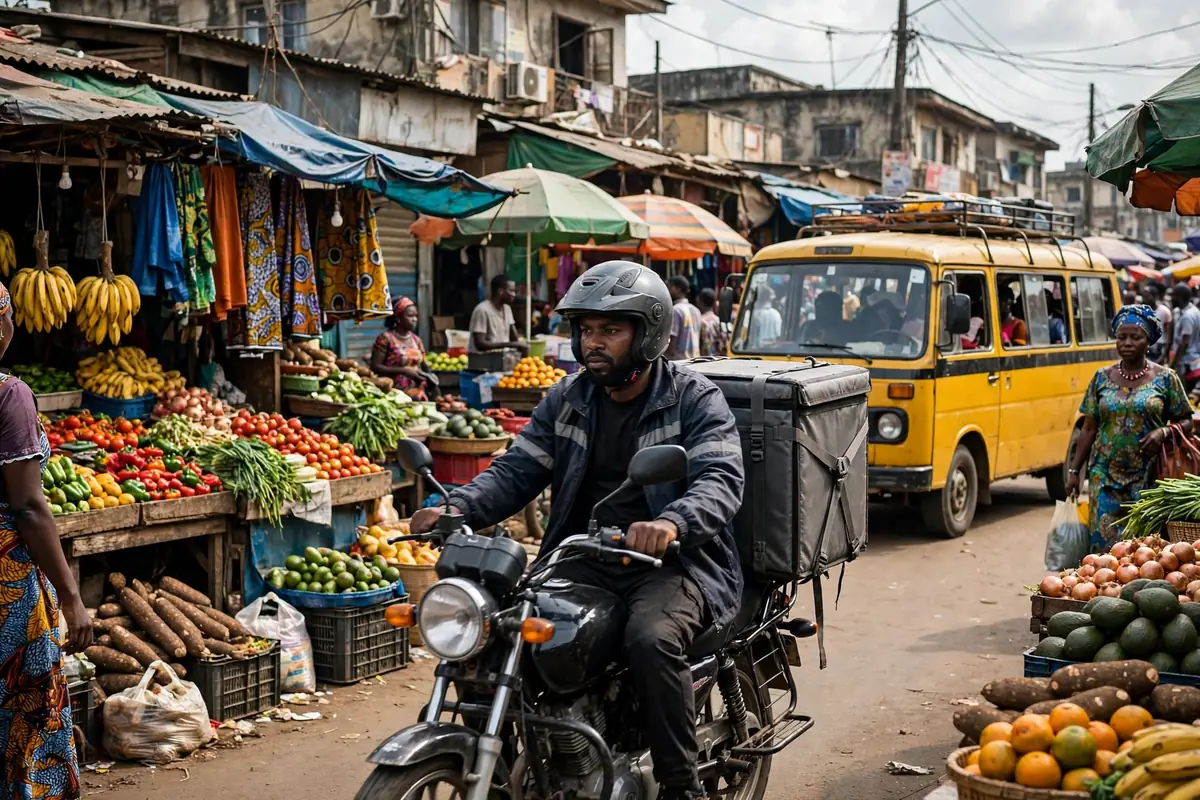
Let me be blunt: Lagos Nigeria last mile delivery is the most expensive link in my Nigeria business. The goods sit perfectly fine in the warehouse. The moment they leave the dock, it's a maze — the customer is in Lagos, the warehouse is in Lagos, and somehow half a city apart turns into two or three days. Nothing is wrong with your product. The last mile in this city is just built that way.
Look at the size of the prize. The Lagos metro area holds an estimated 17 to 21 million people as of 2025, making it Nigeria's largest city and one of the most populous urban areas in Africa. Nigeria as a whole has about 220 million people, and e-commerce transactions are expected to pass $33 billion in 2026 — more than double the $15 billion recorded in 2023. The cake is real. But the bigger the cake, the deeper the last-mile hole. Whoever can reliably put goods in customers' hands eats. Everyone else just pays for the attempts.
Where Lagos Last-Mile Delivery Actually Breaks
The first wall is traffic. Lagos is famously congested. A dispatch rider who should complete eight to ten runs a day may complete four. The fuel burned and the wear on the bike all end up in your delivery cost. And on the customer side? They saw "estimated delivery in two days" at checkout, then the rider spends a day and a half in traffic, the phone goes unanswered, and the order dies.
The second wall is the address. Street names and house numbers mostly exist in central Lagos, but they get patchy fast as you move outward, and landmarks substitute for street numbers — the yellow house opposite the church, the third compound past the filling station. How is a rider supposed to find that? The customer is right there, the rider is right there, and the two of them still can't meet. That's why plenty of platforms stopped fighting it and switched to pickup stations: the customer comes to a fixed, known location, and the whole "can't find the person" problem disappears.
The third wall is cash on delivery. Plenty of Nigerian buyers won't pay online for a first order, so cash on delivery is a must-have. But a cash-on-delivery order is slower to process — extra confirmation steps, plus cash collection and reconciliation. When a customer changes their mind and refuses the parcel, it rides all the way back, the delivery fee is burned, and the warehouse has to process a return on top of it.
Here's the part most people miss: a failed delivery is not just one extra trip. When the rider fails the first attempt, the parcel either waits at a sorting point for a second attempt or goes back to the warehouse, where someone has to log an exception. The second attempt needs a fresh route, and when the weekend and payday rush hits, the backlog snowballs. I learned this the hard way — two straight weeks of a failure rate I couldn't push down, and on the surface it just looked like deliveries running a few days late. In reality the warehouse was piling up with parcels that had already made the trip twice. Since then I watch exactly one number: first-attempt success rate. If that number doesn't move, every other metric is decoration.
The counterintuitive bit: the most expensive part of Lagos last-mile delivery isn't the delivery fee, it's the customer you can't find. One parcel making the trip twice doubles the transport cost and eats warehouse labor on the way back. Sellers haggle over the per-order fee and never add up what failed orders actually burn.
Warehouse Location Sets Your Lagos Last-Mile Cost
Sellers always ask me about delivery fees first. I ask one question back: where is your warehouse? Lagos splits into the Island and the Mainland, and so do your customers. A warehouse in Ikeja serves the Mainland side smoothly. But if your customers cluster in Lekki and Victoria Island while your warehouse sits on the other side of the Mainland, your riders lose half the day just crossing the bridge.
A friend of mine sells phone accessories out of a warehouse in Ikeja, while most of his customers live in Lekki and Victoria Island. His orders normally took two to five days from dispatch to the customer's hands — and that is already the normal window for big cities like Lagos and Abuja. Then he changed the play: main warehouse untouched, a small forward stockroom on the Island holding only the bestsellers. Island orders go out the same day on an on-demand rider and arrive within 3 hours. Mainland orders keep the old route. Inter-state orders go to a large courier that covers all 36 states. Within a month, the on-time rate for the Island batch had visibly improved.
Pickup stations are the other underrated lane. Africa's largest e-commerce marketplace runs more than 350 pickup stations across Nigeria, and in the first quarter of 2025, 58% of its orders came from rural and upcountry regions, served through that pickup network. The logic is simple: door-to-door has too many variables, and a pickup station removes the least controllable one — finding the person. For a seller, there's a bonus: refusal rates drop, because a customer who travels to collect a parcel actually wants it.
The Math: What Failed Deliveries Burn
The numbers below are an illustrative example — I made them up to show the math, but the direction of the conclusion is real:
| Situation | Monthly orders | Failed-delivery rate | Failed orders | Re-delivery cost per order | Burned per month |
|---|---|---|---|---|---|
| As things stand | 3,000 | 8% | 240 | 2,000 naira | 480,000 naira |
| Failure rate pushed down | 3,000 | 3% | 90 | 2,000 naira | 180,000 naira |
The math is simple: 3,000 orders times 8% is 240 failed orders, times 2,000 naira is 480,000 naira a month. Push the failure rate to 3% and it's 90 failed orders, 180,000 naira. That's 300,000 naira saved every month — 3.6 million a year. That money rents you a small forward stockroom on the Island. So stop haggling over the delivery fee alone. Push the failure rate down first; it saves more.
Pickup Points, Cash on Delivery, and Riders: How to Mix Them
My mix uses all three lanes and bets on none of them alone. Urgent orders on the Island and in the city center go to the fastest on-demand riders — if it can arrive within 3 hours, don't let it slide to tomorrow. Inter-state and long-haul orders go to a large national courier: slower, but the network holds. And customers with a vague address or a phone that never picks up get switched to a pickup station — let them come and get it.
For cash-on-delivery orders, make one confirmation call before the parcel leaves the warehouse. Don't skip it because it feels like extra work; that call blocks most of the "ordered on impulse, refused on arrival" cases. While you're on the phone, confirm the address too — have the customer describe the landmark in their own words. That works better than reading the address from your system back to them.
Peak season gets its own plan. When order volume surges, the warehouse and the delivery network jam at the same time, and delays cluster exactly then — worst during the Black Friday and marketplace anniversary weeks. My move is to push bestsellers into the forward stockroom a week before the sale starts, so Island and city-center orders ship straight from there without waiting on the main warehouse sort. During a big sale, don't expect any courier to bail you out. Your own warehouse has to hold the line first.
Returns belong in the last-mile math too. A return trip is as hard as the outbound one: the rider shows up, the customer isn't home, wasted trip; the goods come back to the warehouse, and quality checks and re-shelving are another round of work. My rule is that returns run on their own lane and never compete with outbound riders for capacity — pickup runs are batched on two fixed days a week, riders sweep several stops on the way, and the cost drops fast. One more thing: don't rely on phone calls alone. Plenty of people in Lagos prefer messaging apps — send the address, the landmark, and a photo of the parcel on arrival, and the rider finds the place far faster than three missed calls ever would.
This playbook I've tested myself, and it works: move about a third of your orders to pickup stations, confirm every cash-on-delivery order by phone before dispatch, and pre-position bestsellers in a forward stockroom. Don't try to perfect Lagos last-mile delivery in one go. Push the failed orders down first — the money you save is profit.
By Ah K, E-commerce Seller (5 yrs)