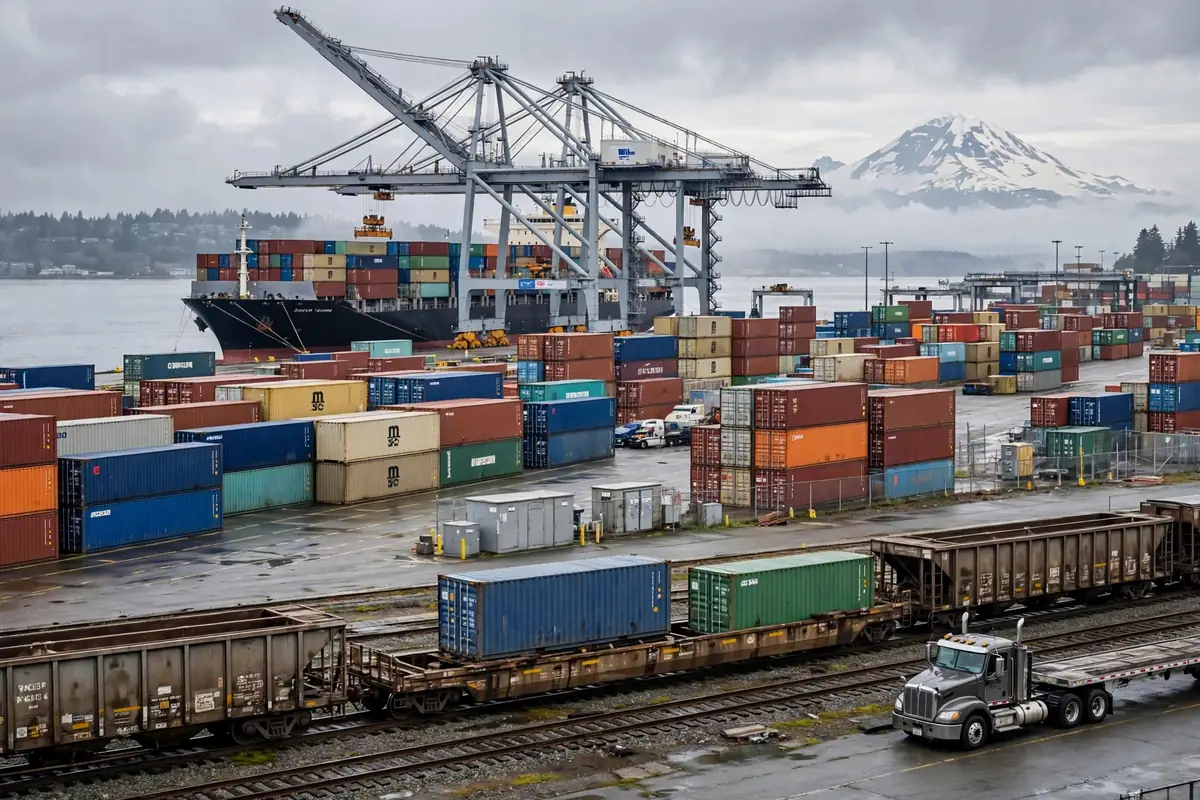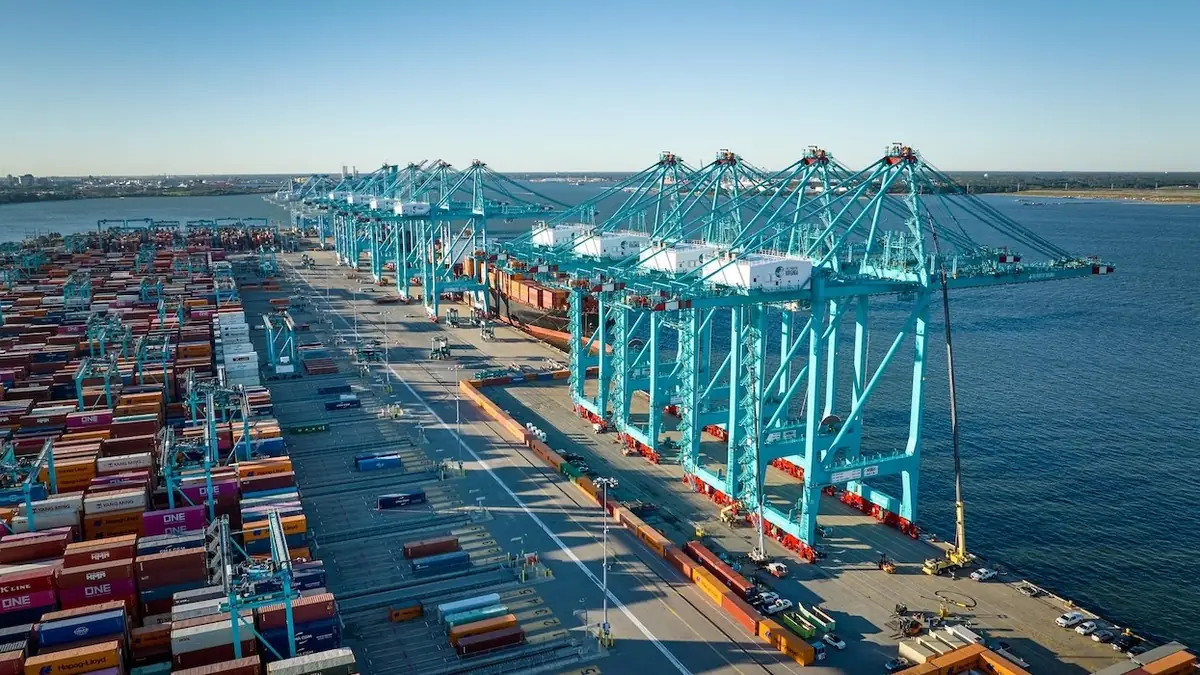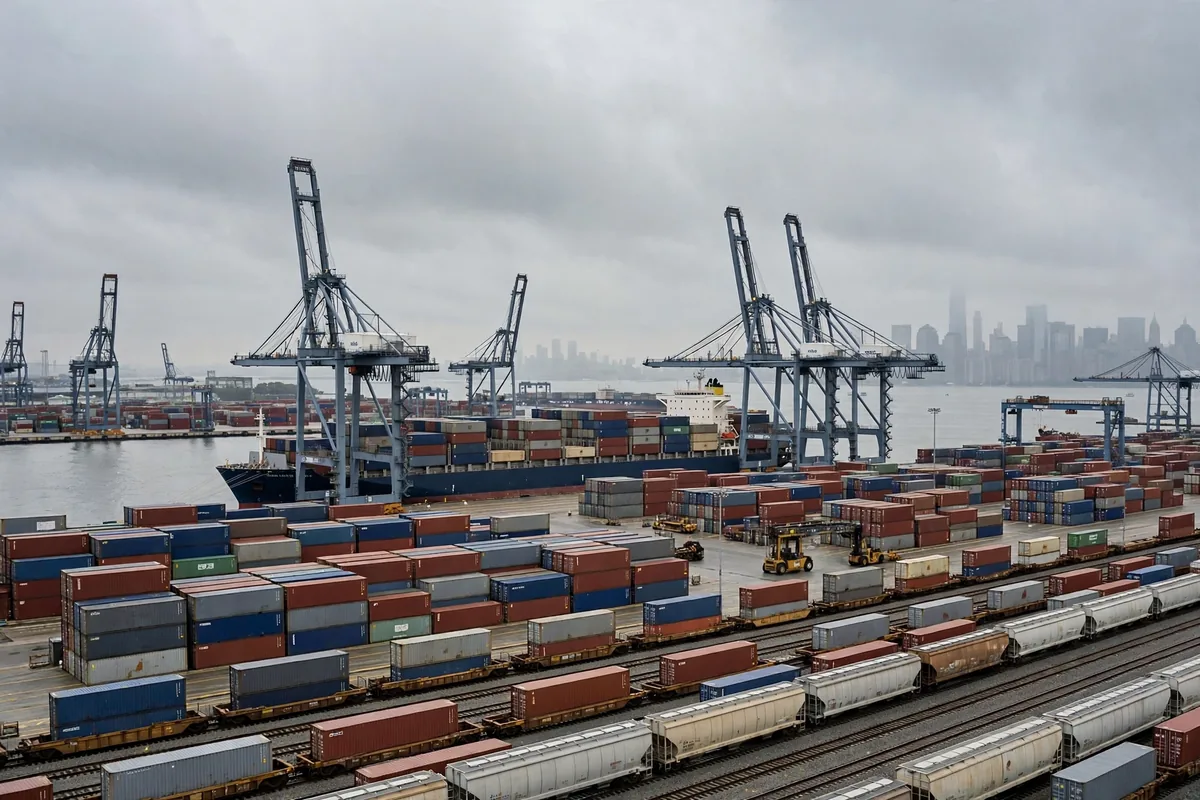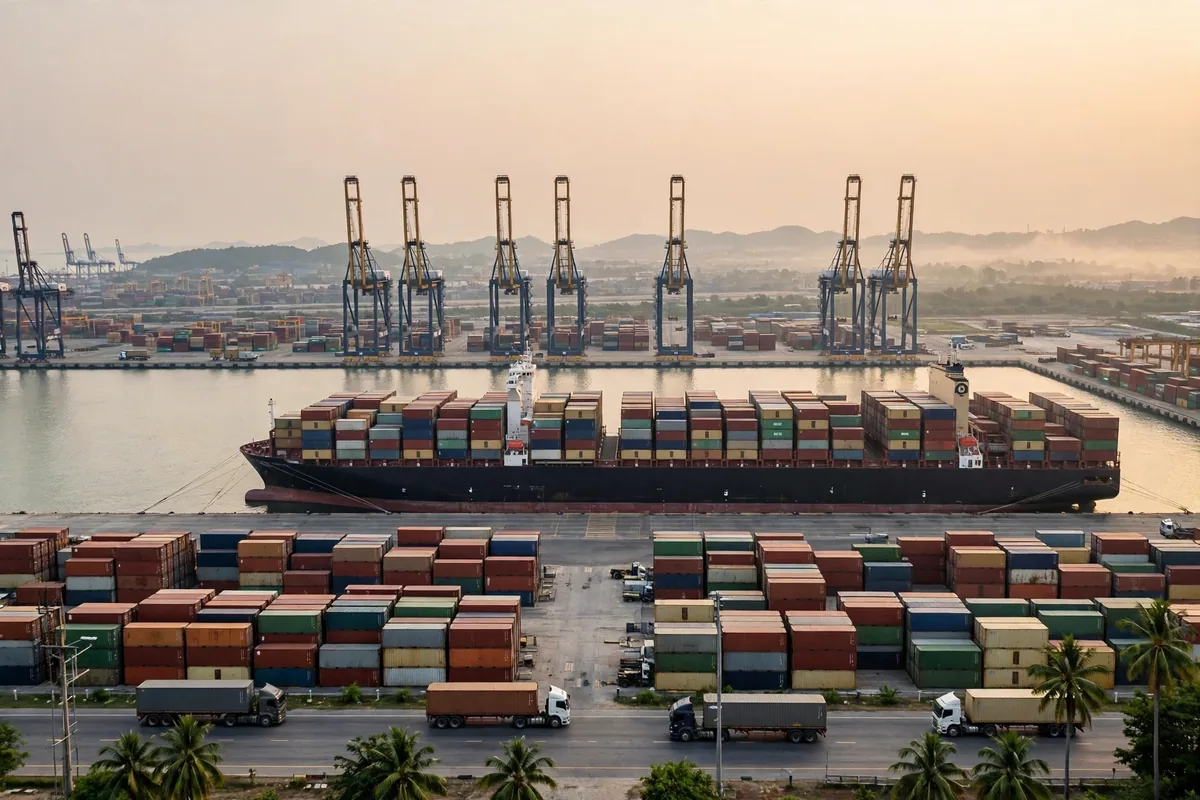
Laem Chabang port warehouse logistics Thailand looks, at first glance, like a story about a single impressive number. According to Lloyd's List, the port handled about 9.6 million TEU in 2024, up 7.7% year on year, ranked 20th in the world, and accounting for roughly 80% of Thailand's container throughput. One port taking four-fifths of a country's boxes is itself the starting point for any serious judgement: the warehousing problem at Laem Chabang is not the efficiency problem of any single warehouse. It is a capacity-allocation problem for Thailand's entire export gateway.
The growth behind that number was not evenly spread, and the unevenness matters. Read against total port capacity of about 13.4 million TEU, throughput of about 9.6 million TEU leaves headroom on the water side. The tightening has happened outside the gate. Once cargo leaves the vessel it has to enter a warehouse, be devanned, be sorted, be distributed, and get on the road. If any one of those steps falls behind the pace of the quayside, the better the berth numbers look, the longer the queue outside the port becomes. That mismatch is the first key to understanding warehousing and congestion at Laem Chabang.
Where Laem Chabang warehouse logistics volume comes from
The demand side has a specific shape, and the shape explains the volatility. Laem Chabang sits about 130 kilometres southeast of Bangkok, close to the Eastern Economic Corridor, and that geography fixes its cargo mix: manufactured exports, automotive parts and vehicles, electronics, and the imported raw materials and intermediate goods that feed those production lines. Behind the figure of about 9.6 million TEU sits a cargo pool built on manufacturing exports rather than on transhipment. The distinction matters, because manufacturing cargo moves in pulses that follow orders and production schedules. What the warehousing system feels is not a smooth flow but a sequence of surges.
A second data point deserves to be read on its own terms. According to public reporting, COSCO Shipping Ports paid about USD 110 million in 2025 to acquire stakes in two Laem Chabang terminals — 12.5% of TLT and 30% of HLT. The transaction says two things at once. First, outside capital is willing to bet at terminal level on the port's long-term volume. Second, consolidation at the terminal level is still under way, and competition is shifting from counting berths to coordinating terminals, yards, warehousing, and landside connections as one system. Read as port news, it is a share deal. Read inside a warehousing framework, it is a vote on where future cargo will flow.
The ranking itself carries a signal that is easy to miss. Ranked 20th in the world and handling roughly 80% of Thailand's container throughput, Laem Chabang has almost no substitute inside the country. When shippers have no second gateway, the cost of congestion cannot be avoided by switching ports. It has to be absorbed inside and around the port: longer waits, higher warehousing and trucking costs, or earlier ordering and thicker inventory. This is the counterintuitive part of the Laem Chabang story. The more successful the port becomes, the less bargaining room the warehousing side has, because the cargo has nowhere else to go.
Is it the warehouse or the road that runs out first
Discussions of congestion at Laem Chabang often blur two different constraints, and they need to be separated. The warehouse question is whether modern warehouse space around the port is keeping pace with cargo growth. The road question is whether the corridor running about 130 kilometres southeast from Bangkok can carry the landside volume that the quayside generates. Total capacity of about 13.4 million TEU means the terminals still have room to grow, but warehouse and road capacity do not expand automatically at the same speed as the berths.
From a research standpoint, a port's warehousing bottleneck rarely sits in a single link. It sits at the joints. Vessels arrive in clusters, yards need to turn over quickly, cargo needs devanning and sorting, warehouses need free space, labour, and systems to receive it, and trucks need to enter and leave the port area on schedule. A delay at any joint propagates upstream and eventually shows up as queues outside the terminal and stock piling up in warehouses. Growth of 7.7% in 2024 is not extreme on its own. What tests the system is that growth landing on top of a cargo structure that is already highly concentrated.
The following worked example is purely illustrative, with assumed figures used only to show cost structure; it does not represent any real quotation. Suppose a shipment needs temporary storage and distribution near Laem Chabang. Total warehousing and distribution cost can be split into four parts: port-related charges, warehousing rent and handling, trucking and landside transport, and the cost of waiting — demurrage and inventory holding. In this framework the last part is the easiest to underestimate and the hardest to lock in advance. When vessel schedules slip and cargo sits longer around the port, warehousing and trucking plans are disrupted, and the cost of fixing the disruption often exceeds the cost of having paid for warehouse space earlier. In other words, budgeting for Laem Chabang port warehouse logistics Thailand is less about finding the lowest unit price than about pricing volatility itself.
| Cost item | Behaviour when schedules slip | Response | | Port-related charges | Relatively fixed, moves with box volume | Model by TEU, keep elasticity in the plan | | Warehousing and handling | Rises when vessel calls cluster | Lock warehouse space early, stagger inbound flow | | Trucking and landside transport | Amplified during congested windows | Shift pickups off-peak, hold reserve capacity | | Waiting and inventory holding | Hardest to predict, easiest to lose control of | Hedge with safety stock, not last-minute premium space |
The judgement this table is meant to carry is that the centre of gravity in warehousing decisions should move from price comparison to scheduling. Whoever lines up warehouse space, labour, and trucks before the vessel arrives can hold volatility costs down. Whoever chases only the cheapest warehouse and the cheapest trucking fleet will pay a higher total cost when vessel calls cluster. That logic holds at any port. At Laem Chabang, where cargo is highly concentrated, it holds with particular force.
What sitting next to the Eastern Economic Corridor means for Laem Chabang warehouse logistics
Laem Chabang's proximity to the Eastern Economic Corridor appears in many introductions as a single line about location. It deserves a fuller reading. The corridor's industrial layout directly shapes the future structure of the port's cargo. If manufacturing keeps clustering inside the corridor, export volume will keep concentrating at Laem Chabang. If the corridor's industries move up the value chain, the unit value of cargo will rise, and the requirements on warehousing, distribution, and compliance will rise with it. Throughput of about 9.6 million TEU is only a total. What determines warehousing difficulty is the industrial structure behind the total.
The COSCO Shipping Ports acquisition of about USD 110 million in 2025 can be read inside the same framework. A terminal operator willing to invest is signalling an expectation that Laem Chabang's volume still has room to grow, but terminal investment pays back over a long horizon, and the decision rests on a multi-year view of cargo rather than on any single year's growth of 7.7%. When researchers look at a deal like this, they pay more attention to the long-term signal than to the headline amount. About USD 110 million, 12.5% of TLT, and 30% of HLT, taken together, point to deep participation at terminal level rather than a tentative financial probe.
Stepping back, the trend judgement for Laem Chabang port warehouse logistics Thailand can be narrowed to three threads. First, concentration is already high — roughly 80% of Thailand's container throughput moves through one port — and that structure will not change in the short term, so warehousing decisions have to be built around it. Second, the gap between total capacity of about 13.4 million TEU and 2024 throughput of about 9.6 million TEU suggests that water-side capacity is not the binding constraint today; the constraint is more likely to sit where port warehousing meets landside transport. Third, the Eastern Economic Corridor and the movement at terminal-equity level both suggest that the parties involved are preparing for longer-term volume growth, and the pace at which the warehousing system expands will become the next thing to watch.
These judgements remain open. What happens next at Laem Chabang depends on how fast industry lands inside the Eastern Economic Corridor, on whether warehouse and road capacity around the port keeps pace with terminal throughput, and on how global liner networks reallocate cargo across Southeast Asia. The throughput figures have already answered the question of what happened last year. Whether the warehousing system can absorb next year's growth will be decided on the few kilometres of road outside the gate, and in the rows of warehouses beyond it.
By Dr. Chen, Supply Chain Researcher