Kribi Cameroon port warehouse logistics deserves a closer look than it usually gets, because the gap between what this port can do and what it actually handles is the story. In 2025, Kribi handled 555,398 TEU, about 37.5 percent of Cameroon's national container volume, and total cargo of 12.7 million tonnes, up 19 percent. Those are respectable numbers for a port that only began operating its first phase in March 2018. Yet the second phase, completed in 2025, lifts annual capacity beyond 1 million TEU on the port authority's measure. The distance between roughly 555,000 TEU handled and more than 1 million TEU of capacity is not a rounding error. It is the central question for anyone planning warehouse space around Kribi: is this a gateway still filling up, or a gateway built ahead of its demand?
Kribi Cameroon Port Warehouse Logistics: What the 2025 Numbers Actually Say
According to the figures reported for 2025, the pattern is one of fast growth from a small base. Container volume of 555,398 TEU, a 37.5 percent national share, and total cargo up 19 percent to 12.7 million tonnes all point in the same direction. But the capacity figure deserves care, because sources differ: some cite around 700,000 TEU for the second phase, while the port authority's measure puts total capacity beyond 1 million TEU after phase two. This guide uses the port authority's figure — beyond 1 million TEU after phase two — and notes the difference openly, because a warehouse decision built on the wrong capacity assumption is a decision built on sand.
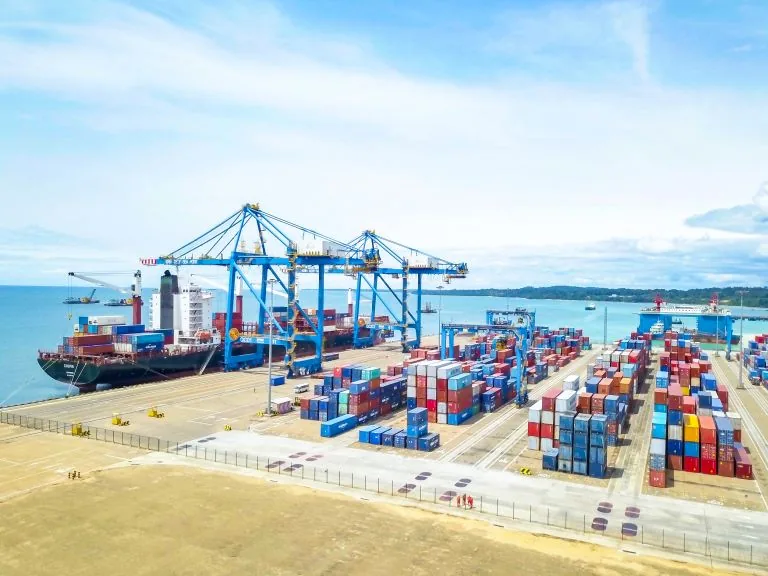
The physical facts are less ambiguous. The terminal has 715 metres of quay and a water depth of 16 metres. It can receive vessels of 8,000 TEU, and after the second phase it can receive vessels of 11,000 TEU. The call of the MSC Türkiye, a 24,346 TEU vessel, shows the port can host ships far larger than its routine traffic. The concession runs for 25 years, held by CMA CGM, Bolloré, and China Harbour. Taken together, these facts describe a deep-water terminal with long-horizon operators and room to grow, rather than a shallow-water port improvising its way forward.
Why Kribi Exists: Douala, Distance, and the Landlocked Hinterland
Kribi sits about 120 kilometres from Douala, Cameroon's established commercial port, and that distance is the key to understanding its role. Kribi was not built to duplicate Douala. It was built to do what Douala cannot easily do: receive large deep-water vessels and serve as a transshipment and transit gateway for landlocked neighbours — Chad, the Central African Republic, the Republic of Congo, and Gabon among them. That hinterland role is where the warehouse logic changes completely.
Consider two illustrative flows, described here as scenario sketches rather than reported cases. In the first, a consignment of goods bound for Chad arrives at Kribi in containers, is held in a warehouse near the port while transit documents are completed, and then moves inland by road. The warehouse is not a storage shed; it is the buffer that absorbs the difference between a vessel's schedule and a border crossing's timetable. In the second sketch, cargo bound for the Republic of Congo is transshipped at Kribi, with the port acting as a relay rather than a final destination. In both sketches, the same lesson applies: the value of a Kribi warehouse is measured in days of buffer and reliability of onward movement, not in square metres alone.
The counterintuitive judgement follows from this. A deep-water port does not automatically become a busy port, and a large capacity figure does not automatically create demand. Kribi's 16-metre depth and 11,000 TEU capability remove a physical constraint. They do not remove the commercial constraint: shippers, shipping lines, and inland transport operators must all choose Kribi, repeatedly, for the volumes to follow. Depth is a necessary condition. It is not a sufficient one.
Kribi Cameroon Port Warehouse Logistics: A Decision Framework for Three Shipper Profiles
The practical question is who should put warehouse space at Kribi, and on what terms. The table below is a decision framework, built only on the verified facts above; rents, rates, and tariffs are not stated here and should be checked against the latest official policy.
| Shipper profile | What Kribi offers | Warehouse play |
|---|---|---|
| Transit cargo to Chad / Central African Republic | Deep-water arrival, onward road corridor | Buffer warehouse near the port; plan around transit documents, not vessel arrival alone |
| Transshipment via Kribi | 715 m quay, 16 m depth, large-vessel calls | Short-stay, high-turnover space; flexibility matters more than size |
| Cameroon domestic import / export | 37.5% national container share, growing volumes | Medium-term space tied to actual throughput, reviewed as volumes grow |
For a rough sense of scale, consider a clearly labelled hypothetical example. Suppose a transit shipper moves a steady monthly flow of containers through Kribi to a landlocked destination. The illustrative arithmetic compares three costs: the cost of buffer warehouse days at Kribi, the cost of a missed onward departure, and the cost of holding the same buffer further inland. In this hypothetical example, buffer days at the port are the cheapest of the three when a border delay is likely, because the cargo is already consolidated and the port warehouse is the one place where waiting does not require re-handling. The numbers in the example are illustrative only. The logic — buy buffer where waiting is cheapest — is the durable part.
Attribution matters here. The growth in 2025, up 19 percent in total cargo, is consistent with a gateway in its expansion phase, and the 25-year concession gives operators a horizon long enough to invest in warehousing. But the honest reading of the data is that Kribi is still early in its story. A port that handles about 555,000 TEU against capacity beyond 1 million TEU is a port with headroom. Headroom is an opportunity for a warehouse planner and a warning at the same time: space may be available, but demand has not yet filled it, so commitments should be staged rather than signed in one large block.
Trend Judgement: Capacity First, Demand Second — and What to Watch
According to the sequence of events, Kribi's development has followed a deliberate order: first phase in March 2018, second phase completed in 2025, capacity lifted, vessel size lifted, and the concession structure set for 25 years. The trend judgement that follows is that the port's next phase will be decided less by construction and more by commercial adoption — whether shipping lines schedule larger vessels regularly, whether transit cargo for Chad and the Central African Republic shifts volume from competing routes, and whether warehouse and inland transport capacity keep pace with the port itself.
There is a trade-off that planners should name explicitly. Building warehouse space early at Kribi buys position and possibly better terms, but it carries the risk of underused space if demand grows more slowly than capacity. Waiting buys certainty about volumes, but it risks arriving after the best-positioned space near the port is taken. Neither choice is wrong in the abstract. The right choice depends on the shipper's cargo: transit cargo with volatile border timings justifies early buffer space, while domestic cargo tied to steady volumes justifies a staged commitment that grows with throughput.
The open question, and the one this guide leaves deliberately unresolved, is how quickly Kribi's transshipment and transit volumes will converge on its capacity. If the 2025 growth rate is sustained, the gap between roughly 555,000 TEU and more than 1 million TEU closes within a few years, and warehouse space near the port becomes a scarce resource. If growth slows, the port remains a deep-water gateway with room to spare, and warehouse commitments can stay flexible. Both outcomes are consistent with the data available today. The evidence to watch is not another construction announcement but the next two years of TEU figures, the frequency of large-vessel calls, and the share of transit cargo in total throughput. Those three series will tell us whether Kribi Cameroon port warehouse logistics is a story of a gateway filling up — or still waiting.
By Dr. Chen, Supply Chain Researcher