Today, October 6, Amazon's Prime Big Deal Days just kicked off — 48 hours of deals. Every year around this time, my phone lights up with the same call: the California warehouse is bursting at the seams, picking is backed up three days, and the seller wants to know if they should rush a truckload over from their Phoenix facility. Before you say yes, do the math.
One truckload, 26 pallets, Chino to Phoenix, roughly 350 miles. In September 2026, DAT's national dry van spot rate averaged $2.96 per mile all-in — so the linehaul alone runs a little over $1,000. On arrival, the receiving warehouse charges inbound handling, typically $25–45 per pallet across the industry, which adds another $650–1,170 for 26 pallets. Total hard cost for one transfer: roughly $1,700–2,200, or about $65–85 per pallet.
Sounds steep. But the other side of the ledger is scarier: a stockout. If your hero SKU goes dark for three days during promo week, you don't just lose three days of sales — you lose the search ranking that SKU spent all year building. Marketplace algorithms are merciless. The slot you vacate gets taken by a competitor the next morning, and winning it back costs multiples in ad spend. Once you run both numbers, the verdict is usually clear: transfers are expensive, but stockouts are worse.
Move It, or Split It?
First, separate two situations that people constantly mix up — and pay for the confusion.
Situation one: both warehouses have inventory, but the main building is out of picking labor and can't ship fast enough. You don't need a transfer here. Route a share of new orders to the backup warehouse and ship direct. Split-shipping solves a capacity problem; the freight doesn't move, the order routing does.
Situation two: the main warehouse is running dry on certain SKUs while the backup site sits on surplus. That's a transfer scenario — an inventory geography problem that only physical movement fixes.
I watched a home-appliance seller get this backwards in 2024. Their main warehouse overflowed, so they spent over two thousand dollars moving a truckload from Texas — only to discover both buildings had the SKUs in stock. What they were short on was pickers. The money was gone, and both warehouses ended up overstocked. The rule: check inventory first, capacity second. Never the reverse.
There's also the classic dilemma: not enough freight for a full truck — transfer or not? My rule of thumb is eight pallets. Above that, just book the full truckload. LTL is priced per pallet, and in peak season it routinely climbs past the cost of a dedicated truck; eight pallets of LTL money often covers a whole trailer. Below eight pallets, get an honest LTL quote and weigh it against the cost of the stockout. Whichever number is bigger wins.
And one more case where you should not transfer: when the selling window is only a week out. Transit plus receiving eats 7–10 days, and by the time the freight lands, the promotion is over — your transferred stock just sits there waiting for the next wave. In that spot, either air-freight a small emergency batch or take the hit and shift your ad budget to SKUs that won't stock out. Transfers are a game of lead time. Without lead time, money can't buy you a single day.
The Second-Touch Tax
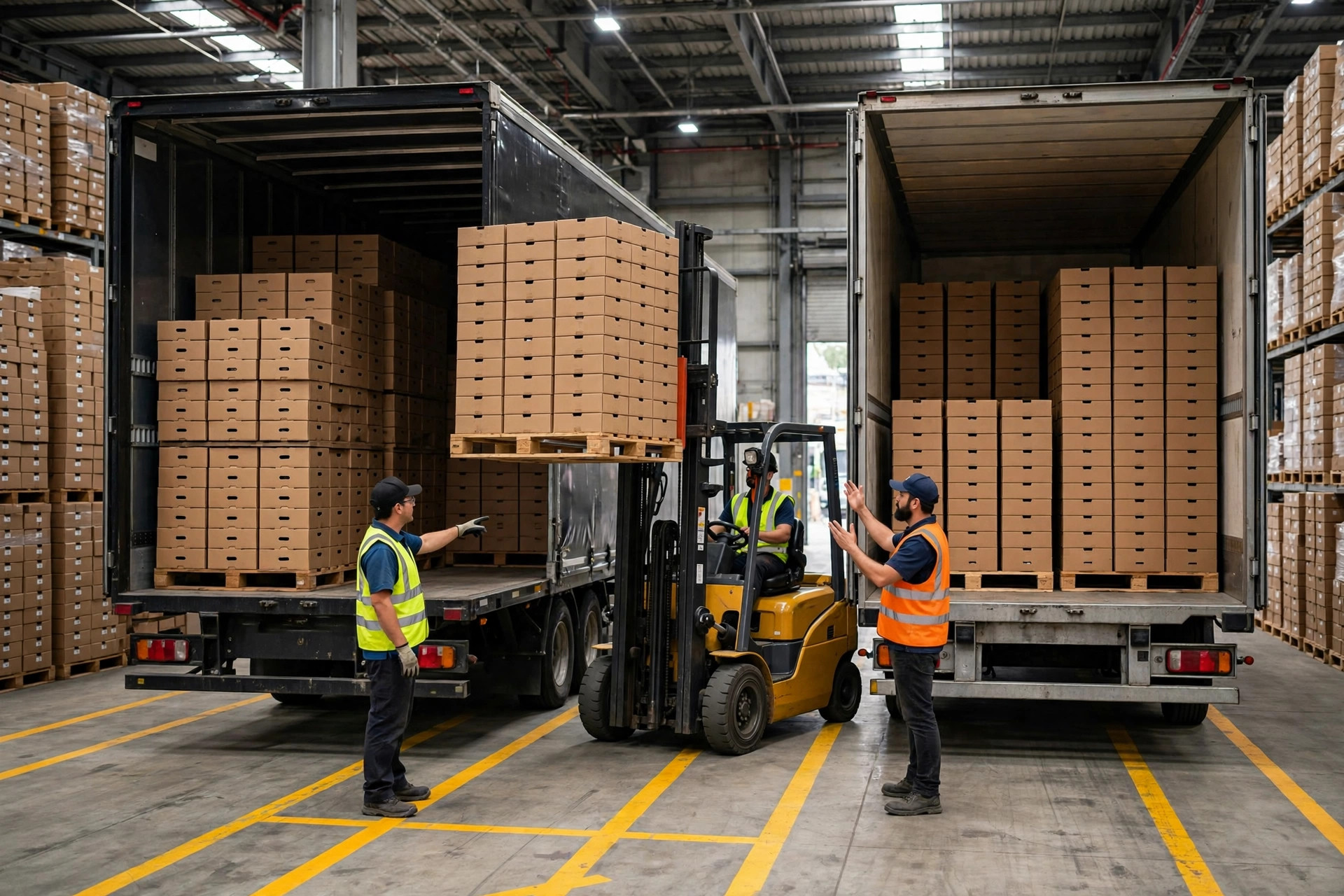
The most underestimated line item in any transfer is the receiving warehouse's "second touch." Receiving isn't just unloading. It's a chain: dock appointment, count-and-verify against the packing list, damage handling, system check-in, putaway. During peak season, a two-to-three-day queue for a receiving slot is normal. Book late and your truck sits outside their dock burning driver detention — billed by the hour.
The real trap is rework. Mixed pallets, sloppy labels, unscannable barcodes — the receiving warehouse bills those at $35–75 per labor hour. In 2024 I helped a client move a truckload to Texas; four of the 26 pallets were mixed, and the receiving site charged six hours of rework — nearly $400 extra on the invoice. The lesson: straighten your own pallets, fix your labels, and write clear carton markings before the truck rolls. Don't ship your problems along with your freight. Photograph every pallet before departure, too — that's your evidence if there's a dispute at arrival.
Don't forget the cost on the shipping side, either. In peak season your own warehouse is slammed, and pulling people off the pick line to build pallets and load a trailer has a real opportunity cost. Confirm the load time with your warehouse manager before the truck arrives. Making a driver wait three hours at your dock burns detention fees of tens of dollars an hour — pure margin, gone.
Book the Calendar Like It's Already Late
In peak season, the scarcest resource in a transfer isn't money — it's time. From decision to sellable inventory, the full chain runs: issue the transfer order, book the truck, load, 1–2 days in transit, receiving appointment at the other end, unload and putaway 1–2 days. Seven to ten days is a normal cycle. In peak season it only gets longer, never shorter.
So two weeks before a major promotion is your last window. If the idea of transferring first occurs to you during promo week, the freight will still be rolling down the highway when the promotion ends. My standing rule: freeze the transfer plan 14 days before the big event, and hold back roughly ten percent of capacity for emergency top-ups only. Emergency top-ups are no time to be cheap — small LTL or even air freight is fine. Keeping the SKU alive is the victory.
Three Lines on the Wall
Inventory visibility doesn't need to be fancy. Every morning, look at one table: available inventory per hero SKU per warehouse, divided by the last seven days' average daily sales, converted into days of cover. The table needs six columns: SKU, warehouse, on-hand, 7-day average daily sales, days of cover, status. Ten minutes a day to update it. The rows highlighted red are your to-do list. No multi-warehouse view in your WMS? A spreadsheet works. Get the habit running before you talk about automation — what matters is that someone looks at it daily.
Then draw three lines. Green at 21 days of cover, yellow at 14, red at 10. The moment a SKU drops below 14 days, the transfer order goes out that same day. Why 14? Because the full transfer cycle takes 7–10 days, and you want a few days of buffer left over. In peak season, tighten the lines further — sales can run two to three times normal, and 14 days of cover can burn through in five. I learned that one the hard way before Black Friday 2025: twelve days of cover calculated on normal velocity, half of it gone in three promo days, and the emergency transfer cost double in expedited freight.
Rhythm beats heroics. Three lines, checked every morning by someone with the authority to act. The most dangerous setup is a beautiful dashboard nobody reads — by the time the system alarm fires, it's already too late.
Here's your assignment for tonight: export available inventory for every hero SKU at every warehouse, divide by the last seven days' average daily sales, and compute each SKU's stockout date. Anything with a stockout date before the end of October gets a transfer order first thing tomorrow morning — no waiting. Run that table every morning through December. You'll thank me when peak season ends.