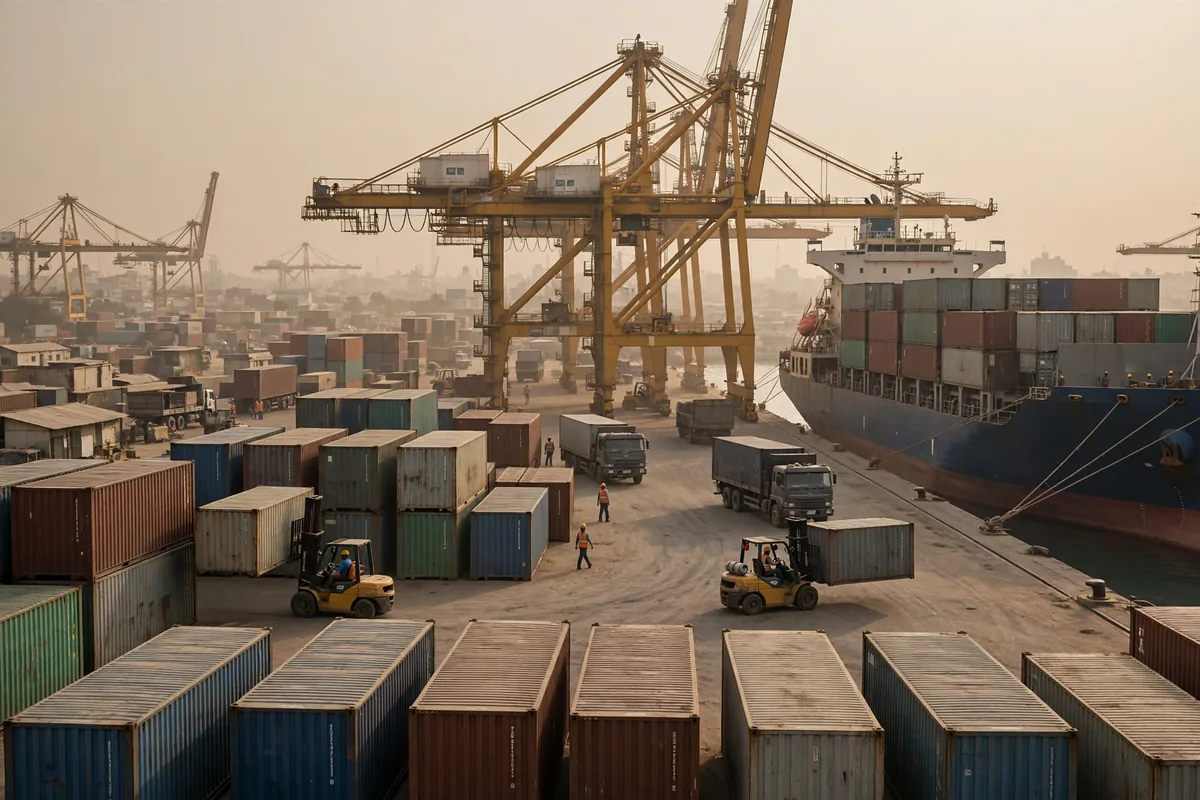
It is 4:30 in the morning and the road outside Karachi port is already lined with trucks. Drivers doze in their cabs, the guard at the warehouse gate calls out names while checking them in, the night shift is heading home and the day shift is walking in. Let me put it plainly, folks: the warehousing business at Karachi port is not won by whoever has the biggest warehouse. It is won by whoever runs the tightest shift roster. Get the roster wrong and the cargo does not move, no matter how much freight you have; the warehouse just becomes an expensive parking lot.
Karachi is Pakistan's largest and busiest seaport, handling the majority of the country's seaborne trade. In fiscal year 2024-25 it handled 2.65 million TEUs, an all-time record and up 16.4% from 2.277 million TEUs the year before. Total cargo hit 54.685 million tonnes, also a record, with 1.362 million import TEUs against 1.289 million export TEUs, 41.68 million tonnes of dry cargo and 12.28 million tonnes of liquid bulk. Good numbers. But behind the numbers is the other side of the story: the more cargo there is, the tighter the berths, yards, trucks and warehouse rosters get, and the smaller the margin for error on the ground becomes.
This is how our warehouse runs it today: the sailing schedule is pinned on the wall, and the shift roster is pinned right underneath it. Which cargo arrives when, which bay takes it, which crew handles it — all fixed a day ahead. Anything not fixed by then gets argued about at the gate at 4:30 in the morning, and those arguments never end well.
At Karachi port, the warehouse game is the roster first
The hardest part of warehousing at Karachi port is not floor space, it is rhythm. The yard inside the port has to shuffle boxes, the warehouse outside the port has to receive them, and between them sit the gate procedures and a congested stretch of road. Cargo arrives and the warehouse is not ready, so trucks queue at the gate. The warehouse is ready and the cargo has not cleared, so people stand idle in the aisles. Neither side can afford to wait. The roster exists to stop that happening.
Before Ramadan last year, a rice exporter was chasing a sailing. His cargo had to enter the warehouse in three batches and be loaded within two days, with the ship leaving early on the third morning. On the first night it rained hard, the road outside the port flooded, and the trucks arrived two hours late. The night-shift supervisor changed the plan on the spot: load what was already in the warehouse first, push the late batch to the first day-shift slot, and reshuffle the inspection and loading crews. The sailing was made, but nobody in the warehouse went home early that night. Afterwards the client said something honest: your warehouse is worth the money because there is someone here who can make a call on the spot. (Case details are illustrative; times and cost figures are a hypothetical scenario.)
That is what I want to say with this case. At an old port like Karachi, the edge is not new equipment. It is having people on the floor who can decide. Veterans train newcomers, and that is where the value sits: a newcomer reads the procedure sheet, a veteran looks at the queue at the gate and the clouds overhead and knows whether the roster needs changing today.
Draft and congestion are the other reality. Karachi is an old port. Berth and channel conditions are what they are; a large vessel coming in fully loaded has to watch the tide and the draft, and in peak season, when ships pile up, waiting time for a berth climbs. The ship waits outside, the cargo waits in the warehouse, and the free storage period does not wait for anyone. So when we plan for Karachi cargo, we build in half a day to a day of buffer by default. With the buffer there, a ship one day late is no panic. Without it, half a day late costs extra money.
What Port Qasim takes away — and what it does not
You cannot talk about Karachi port without talking about Port Qasim. Qasim was built in the early 1980s to take pressure off Karachi, positioned as an industrial cargo port. In the first nine months of fiscal year 2024-25, Qasim handled 33.769 million tonnes against Karachi's 40.378 million tonnes over the same period. The two ports share the same hinterland and the same road and rail system, so the split between them has been part of the Karachi business since the day Qasim was built.
Diversion takes cargo away, but it does not take the choice away. For the same shipment, here is the comparison we use in our warehouse. The figures are a hypothetical scenario; the logic is the point.
| Route | Rough cost | Rough time | Best for |
|---|---|---|---|
| Direct out of Karachi port | Medium | Fastest | General cargo, consolidations, most sailings |
| Out of Port Qasim | Low to medium | Half a day to a day longer | Industrial and bulk cargo near Qasim |
| Store at Karachi first, then switch ports | Highest | Slowest | Last-minute port change, re-stowed consolidations |
(Figures are a hypothetical scenario; confirm current rates with carriers and the ports.)
My experience is simple: industrial and bulk cargo close to Qasim is cheaper through Qasim; general cargo with many consolidations and a need for sailing choices still belongs to Karachi. The worst option is the third one — cargo already in a Karachi warehouse, then a last-minute decision to switch to Qasim. Re-handling, amended documents, rebooked trucks: every step costs money. Make the port decision before the cargo enters the warehouse. Change it after, and you have added a whole process to your own job.
Bonded and transit cargo deserve a mention too. Karachi handles transit cargo bound for Afghanistan, and its documentation and supervision are different from ordinary imports and exports — segregated storage and separate ledgers. Before taking transit cargo, get the supervision requirements clear. Do not find out after the cargo is in the warehouse that the bay and the books both need redoing.
The Cargo from Punjab: Do Not Stare Only at Karachi Port
Here is the counterintuitive part: the real bottleneck in Karachi port warehousing is often not the port at all. It is the road from the hinterland. Pakistan's industrial belt sits in Punjab — textile mills and processors around Lahore and Faisalabad — and their cargo travels hundreds of kilometres overland to reach Karachi. The port can run perfectly and a blocked road still misses the ship.
A textile exporter in Faisalabad normally needs two days on the road. Once, in the rainy season, a stretch of road gave way, the convoy detoured and lost most of a day. By the time the cargo reached the port, only one day of free storage was left, and the warehouse crew worked through the night sorting and loading to make the sailing. After that, the client changed his rule: in the rainy season, dispatch a day early. Better to let the cargo sit one extra day in the warehouse than to gamble on the road. One extra day of rent is far cheaper than missing a sailing. (Case details are illustrative; times and cost figures are a hypothetical scenario.)
So do not just look at the 2.65 million TEU record when you look at Karachi port. The record belongs to the port. The bill belongs to the cargo owner. My approach is old-fashioned, but it works. First, fix the sailing schedule and the roster a day ahead, and once fixed, do not change them lightly. Second, in peak periods like the rainy season and the run-up to Ramadan, budget one extra day of time. Third, make any port-change decision before the cargo enters the warehouse. Fourth, for transit and bonded cargo, get the paperwork clear before you accept the job. Folks, the port business looks like ships and boxes, but it is really people and time. Get the roster right, and cargo does move smoothly through Karachi.
By Chen Feng, Warehouse Operations Manager