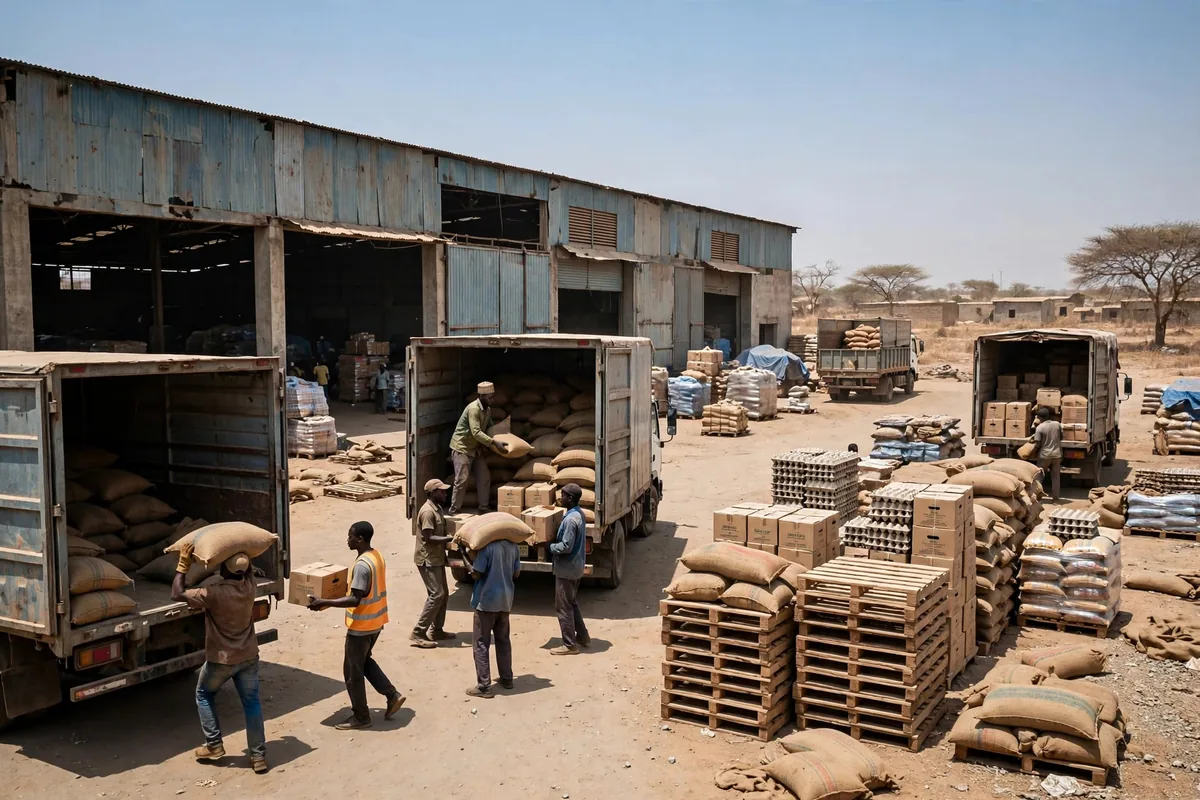
Let me start with the conclusion, because the rest of this piece only makes sense if you accept it first: whether a Kano distribution point is worth building has little to do with the distance from Lagos port. It has everything to do with what happens after the goods arrive in the north — whether you can split them cleanly and get them into customers' hands. If you cannot, forward stock is just inventory sitting in a northern warehouse, looking good on paper and terrible for cash flow. This question has two sides. On one side, forward positioning genuinely shortens the wait for northern customers. On the other, it moves the risk forward too — inventory, damage, and security all have to be carried on site, in the north.
I Have Seen Too Many Shipments Stall After the Long Haul
To put it bluntly, most people plan inland African distribution with a map in their heads: discharge at the port, truck north, receive at the warehouse, split to customers. It sounds smooth. In practice, every step adds friction. I have seen too many shipments burn time at the port stage — clearance, pickup, loading, each capable of slipping — then lose more days on the road for reasons nobody planned for, arriving in Kano days later than scheduled. And then, once the goods finally reach the warehouse, the split itself stalls: customer details incomplete, pickup times mismatched, order quantities changed at the last minute. The goods sit and wait, sometimes for a week or two.
A shipment from a few years ago still sticks with me. Several hundred cartons of everyday consumer goods moved north from Lagos, with a plan to split everything within three days of arriving in Kano. The truck arrived and the warehouse space was ready, but the split list had several customers with addresses and phone numbers that did not match up. The goods could not be released, and they sat in the warehouse for nearly an extra week — storage charges, watchmen's hours, and a string of impatient calls from customers, all of it cost. Nothing was wrong with the goods themselves. One misaligned link in the distribution chain slowed the entire batch down. I bring this case up every time I talk about inland distribution, because distribution is not the tail end of transport. It is a process in its own right, and it needs people, a list, and a rhythm.
Kano Inland Distribution: Settle Four Accounts Before Talking About a Warehouse
The first account is the trunk haul. Lagos to Kano is a long haul, and both its cost and its timing swing widely. My method is to stop treating the trunk leg as a fixed cost and instead plan in three bands: normal, delayed, and badly delayed. The normal band follows past experience, the delayed band carries several days of buffer, and the badly delayed band forces you to decide in advance how customers will be told and how orders will be split. Here is the counterintuitive part: many shippers wait for a full truckload to save on the per-trip rate, and the waiting time ends up costing more than the freight saved. For a distribution warehouse, arriving on time matters more than arriving cheap, because the split schedule is built around arrival, and a truck three days late means the whole split plan gets rebuilt.
The second account is the node's role. You must decide what the Kano warehouse actually is before you build it: a pure cross-dock split point, or a safety-stock location as well? A pure split point can be small, but its turnover must be fast, measured in days. A safety-stock location needs to be bigger, with proper stock counts and supervision. Mixing the two is the most dangerous option: a site called a split point that quietly becomes a stockpile, with goods accumulating and turnover slowing month by month. I have watched warehouses slide exactly that way, from distribution point to dead stock. Before deciding, ask one question: are northern orders stable and predictable, or scattered and sudden? Stable demand justifies forward stock. Scattered demand argues for thin stock and fast splitting on arrival.
The third account is loss and security. Inland distribution losses are not just breakage; they include moisture damage, mispicks, and stock records that do not match the shelves. My approach is three gates: count pieces before anything is put away, and hold the evidence on the spot if the count is off; check every outbound load against the customer list, never from memory; and count key products at least monthly, stopping to find the cause whenever the gap passes a small threshold. On security I will not go into operational detail here, but the principle is non-negotiable: night watch, locked zones, valuables stored separately. These are not upgrades to add when convenient; they are the baseline before the warehouse opens. On Africa topics I am deliberately careful with numbers: specific rates and transit times should be checked against the carrier's and the authorities' latest published terms, and a number I cannot verify is better left out.
The fourth account is forward stock quantity. How much should actually sit in Kano? My framework uses three inputs: northern customers' average demand over a recent period, the normal replenishment cycle for one trip, and the longest stockout you can tolerate. Forward quantity is roughly average demand multiplied by the replenishment cycle, plus a small safety margin. Do not get greedy with the safety margin. One stockout, fixed with an emergency replenishment, is cheaper than safety stock that quietly turns into dead stock. And there is a paradox worth stating plainly: the less reliable the replenishment cycle, the more conservative the safety margin should be — because when uncertainty is high, cash is worth more than inventory.
| Model | Fits what situation | Where the risk sits | My judgment |
|---|---|---|---|
| Kano as pure split point | Scattered, sudden northern orders | Arrival swings hit the split rhythm directly | Fast turnover, light stock, best for starting out |
| Kano with safety stock | Stable, predictable northern demand | Slides from split point to stockpile | Only when demand is genuinely steady, clear slow movers regularly |
| No Kano point, ship direct from Lagos | Small northern volume, dispersed customers | Long waits and slow replenishment for northern buyers | Do not rush to build before volume justifies it |
On the Ground, Rhythm Matters More Than Warehouse Size
Once a Kano operation actually runs smoothly, I have found that success depends less on how big the warehouse is and more on whether the on-site rhythm holds. My rule is this: three days before arrival, the split list must already be aligned — customer, quantity, pickup method, contact person, all four, no gaps. On arrival day, the warehouse does exactly one thing: count and receive, no splitting. Splitting starts the next day, sequenced by customers' ability to collect: self-collectors first, deliveries batched by direction so one vehicle does not crisscross the city. Every split is signed for on the spot, and the signed list is the only proof that matters if a dispute comes up later.
There is one more trade-off worth naming, because it decides whether the whole Kano idea pays. Forward stock shortens the northern customer's wait, but it also ties up your money hundreds of kilometers from the port, where your control is weakest. That is the real price of inland distribution, and it is paid in working capital, not in freight. If northern volume is thin and erratic, the honest answer may be to keep shipping direct from Lagos and accept longer waits, rather than building a northern stockpile to serve a handful of orders. A distribution point should be built when the split rhythm already exists in your orders — when you can point to regular northern demand and say, this volume needs a local split. Build it before that, and you are paying northern rent to store a hope.
So the question is not how fast a truck can reach Kano. The question is whether, the day after it arrives, you can split the load, collect the signatures, and clear the floor for the next truck. Get that rhythm right, and Kano earns its place in the network. Get it wrong, and no warehouse, however large, will save the operation.
By Lao Mi, Supply Chain Veteran (20 yrs)