Here is the conclusion up front: in japan sake export warehouse storage, the first job is not negotiating freight. It is separating nama sake from pasteurized sake. Nama, the unpasteurized kind, starts going downhill the moment it leaves the cold chain. Pasteurized sake holds up better, but it still hates heat, light, and rough handling. Run both kinds through the same warehouse routine and you hand your most delicate product to your bluntest process. I have watched this mistake three times, and every time the bill arrived at the overseas warehouse: returns, replacements, extra freight, all costing far more than the storage savings that caused the problem.
Let me start with a project. In the autumn of 2023, a small regional brewery was shipping a mixed load to California. The shipment held both nama and pasteurized ginjo. The brewery packed by variety, and the warehouse put stock away in arrival order, so nama and pasteurized bottles ended up in the same ambient zone. The load then sat for several days at a transfer warehouse during summer routing. By the time it reached the overseas warehouse in Los Angeles, inspection showed the nama had clearly turned. Nama made up less than half the shipment, but it made up most of the loss. The carrier was not at fault, and customs was not at fault. The warehouse had failed on day one by not separating the two kinds. In this business, the ledger starts at receiving, not at the moment something goes wrong.
Nama and Pasteurized Apart: The First Rule of Japan Sake Export Warehouse Storage
The difference matters on the warehouse floor, not just on a tasting sheet. Nama is unpasteurized, lively in flavor, and fragile in heat. Pasteurized sake is more stable, with a bit more tolerance for temperature swings, but long exposure to heat still damages it. Mixed storage creates two problems at once. Pickers cannot tell the kinds apart by looking at a shelf, and the system cannot tell them apart if they share a location group. One wrong pick, and the temperature record for the whole order stops matching reality.
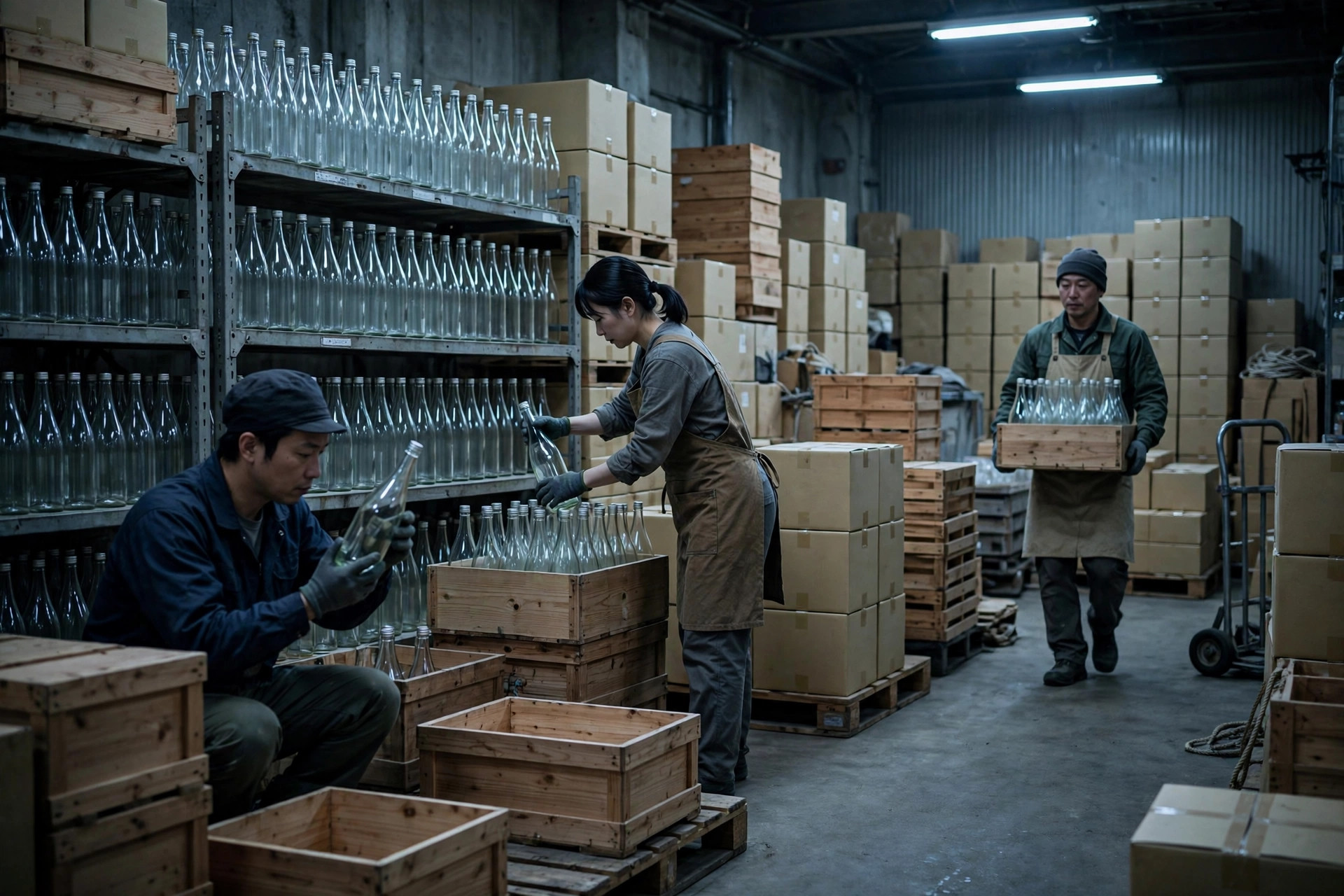
My rule is blunt. At receiving, check the shipping papers and the bottle labels, then book nama into its own zone and pasteurized sake into its own zone. The zones must be separate in the building and separate in the system, using different location groups, with no cross-picking between them. The nama zone runs under refrigeration, with stable temperature, doors kept shut, and minimal handling. The pasteurized zone can sit in a cool, stable area, but it still needs darkness, upright storage, and distance from heat sources. Upright storage deserves emphasis: bottles left on their sides for long periods keep liquid against the closure, and flavor drifts. Darkness is not fussiness either. A sunny bay, no matter how empty, is never a sake location.
One more split belongs in the same rule. Genshu, the undiluted original sake, and aged sake each need their own ledger. They are not the same goods as everyday pasteurized sake. Mix them in, and cycle counts stop reconciling while pickers grab the wrong bottles. The warehouse ledger has to run at the level of product kind. A coarse ledger cannot manage sake.
Summer Transit and Overseas Warehouse Dwell Time Are the Real Test
Brewery warehouses are usually decent. The real test comes in two later stages: summer transit, and dwell time at the overseas warehouse. Temperatures inside a container swing hard in summer, and every extra day at a port or transfer warehouse adds another break in the cold chain. Nama suffers most from repeated warming and cooling, not from a single hot afternoon.
A second project shows the pattern. In the summer of 2024, a ginjo shipment bound for North America spent an extra week in transfer. The outer cartons arrived in perfect shape, yet inspection found several cases in poor condition. The cause traced back to the transfer warehouse, where nama and pasteurized stock shared one holding area and the refrigeration doors opened constantly, so temperature never stabilized. The owner sold the nama at a discount and sold the pasteurized stock normally. Same shipment, two outcomes, and the dividing line was whether anyone had separated the kinds at receiving.
That is why my checklist carries a hard rule: cold-chain responsibility from brewery dispatch to overseas warehouse putaway must be written into the handover sheet. Name who holds refrigeration, name who confirms temperature at handover, and name who answers when the chain breaks. Verbal promises do not count. At the overseas warehouse, nama gets inspected first, put away first, and temperature-checked first, while pasteurized stock follows the normal flow. Nama that has dwelled past the agreed limit gets inspected separately and never blends straight into sellable stock.
The Night-Before-Go-Live Checklist for Japan Sake Export Warehouse Storage
I run a night-before-go-live checklist on every project, and sake projects are no exception. This list can go straight onto the warehouse floor.
Receiving inspection: match the shipping papers, bottle labels, and quantities three ways, then book nama and pasteurized sake separately, with no shared location group. Nama goes to refrigeration, pasteurized goes to the cool zone, and genshu and aged sake get their own ledgers. Record receiving time, location, and temperature zone for every case, so the history is traceable later.
In-stock control: check the refrigeration zone daily and keep the temperature record unbroken. Upright storage, darkness, and distance from heat sources get verified on every floor walk. Count nama separately from pasteurized sake. When the count disagrees with the books, stop shipping first and find the cause, never ship first and fix the books later.
Outbound review: mark every outbound order as nama or pasteurized, and pick strictly by location group, with no cross-zone substitution. In summer, route nama on the most temperature-stable lane available, and put the responsible name for temperature control on the handover sheet. After the overseas warehouse receives the load, send the nama inspection result back. Failed cases go into isolated quarantine, not into sellable stock.
Costing: most teams count only storage fees and freight, and they miss three lines. The first is temperature-control cost: power, equipment wear, and inspection labor for the refrigerated zone. The second is shrinkage cost: nama that turns, gets discounted, or gets returned, spread across each nama batch. The third is rework cost: labor for re-sorting, re-boxing, and re-labeling after mixed storage. Add those three lines, and a dedicated refrigerated zone for nama prices itself honestly. It looks expensive in plain sight, and it saves money by preventing the failures that cost far more.
Three Failure Points, All in Small Places
Failure point one: sorting by variety instead of pasteurization status. The same ginjo label can cover both nama and pasteurized bottles, and their storage rules are entirely different. A warehouse zoned by variety but not by pasteurization status has not actually zoned anything.
Failure point two: separating the floor but not the system. Physical zones mean little if the system still shows one big area, because pickers follow system prompts and grab the wrong case anyway. A split only counts when it exists in both the physical locations and the system location groups, matching each other exactly.
Failure point three: treating the overseas warehouse as the finish line. Goods arrive, nobody owns temperature control during dwell time, and nama quietly degrades on the shelf. The overseas warehouse is not the finish line. It is the last link in the chain, and its receiving, inspection, and quarantine routines need the same rigor as the shipping warehouse.
Here is the counterintuitive judgment: in this trade, the most expensive item is not refrigeration equipment. It is the cost of cleaning up after mixed storage. A refrigerated zone costs money you can see. One mixed-storage incident costs discounts, returns, and customer trust that never show up cleanly on a ledger, and the total runs higher. Separating the kinds looks like extra process on the surface. In practice, it kills the biggest risk on receiving day.
If you are moving into sake export, hold the freight negotiation for a day. Walk the warehouse floor first and check three things: are nama and pasteurized sake truly stored apart, are the system location groups truly split, and does the summer handover sheet truly name the person responsible for temperature control. When those three checks pass, the rest of the ledger is easy to settle.
By Lin Xiao, WMS Implementation Consultant