Look, I will be honest up front. I sell stuff online. My daily math is conversion rates, ad spend, and how many days of stock I can afford to hold. Phosphate rock shipped by the vessel-load sounds like another planet.
Then I spent time around bulk storage yards, and the math turned out to be the same. Whether you sell one dress or one shipload of mineral, warehousing comes down to three things: do not let the goods go bad, do not lose count, and do not miss the loading window. With phosphate, the killer is moisture and caking. People think a roof solves it. It does not. I have watched too many operators learn that lesson the expensive way, on loading day, when it is already too late to fix cheaply.
The Real Bill Is Not the Rent
Most people price bulk storage wrong. They look at the per-ton, per-day rate and stop there. That number is the smallest part of the story.
Once bulk material cakes, every number after it changes. A loader jams, workers spend half a shift breaking up hard crust with air picks, the vessel window slips, and demurrage starts running. Worse, caked lumps mixed into good product can jam discharge equipment at the destination port, and the buyer deducts for it. Whatever you saved on rent, you hand back — with interest.
The honest formula for phosphate storage cost is this: rent plus moisture-control spend plus handling loss plus rework and demurrage risk. Anyone quoting only the first item is selling you a fantasy.
Scenario One: Forty Days in an Open Yard, Where Rain Bills by the Hour
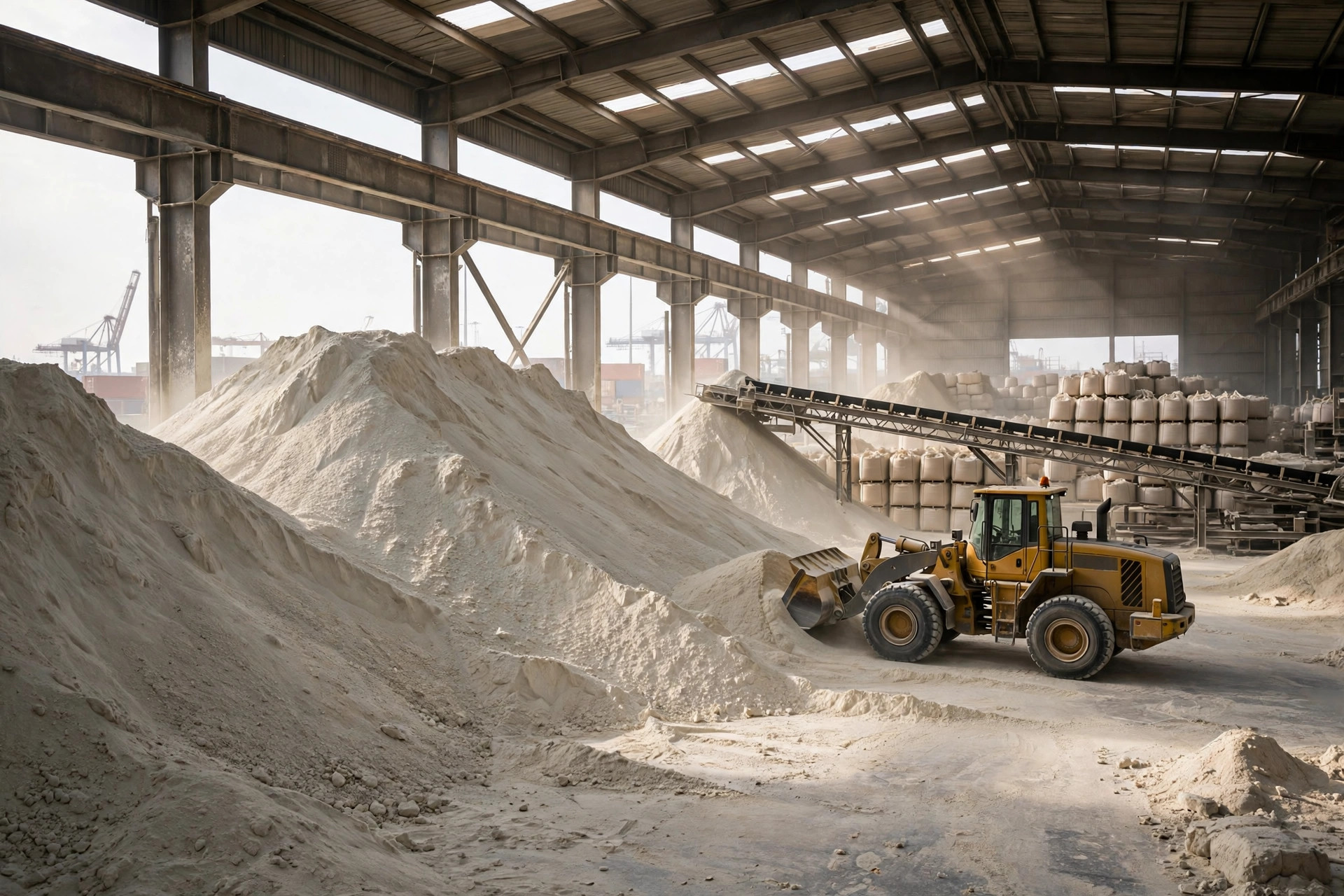
Picture a parcel of bulk material sitting in a hard-standing yard near a port, waiting 40 days for its vessel. Tarps are on, seams are taped, sandbags hold the edges down. From the gate, it looks professional.
The failure starts where nobody looks: the tarp seams. A small leak lets rain track inward along the sheet. The surface feels dry to the hand. Underneath, the bottom layer is already starting to set. Inspectors check the surface, write down "normal," and walk on. On loading day, the grab digs in and hits a hard shell that has to be broken up before it can go on the belt.
The lesson I took from that scene is blunt: surface checks are theater. Moisture has to be sampled in layers — top, middle, and bottom, at fixed points, every time. My rule would be two inspections a day, fixed sampling points, numbers written down, no vague "normal" allowed. An inspection without numbers is not an inspection.
Then do the loading math on day one. A 5,000-ton parcel at 300 tons per hour needs nearly 17 hours before any interruption. If caking adds four hours, a tight vessel window collapses, and every vessel queued behind it shifts too.
Scenario Two: The Driest-Looking Shed Caked the Worst
The second scene is the counterintuitive one, and it is the reason I wanted to write this piece. The same material, split between two sheds. One shed had ordinary ventilation. The other was sealed up tight — doors shut, windows closed, the "dry shed" everyone pointed to with pride.
The sealed shed caked worse.
Here is why, and it surprises most people the first time they hear it: a shed with no airflow traps its own moisture. The sun heats it by day, it cools at night, and water vapor condenses right on the surface of the pile. The pile itself breathes moisture out, and with nowhere to go, that moisture sits there and works its way in. The shed looked dry. In practice, it was steaming the product.
So here is my contrarian take: the driest-looking shed is not necessarily the safest one. A shed where air cannot move is dangerous no matter how dry it looks. Rain protection is only step one. Ventilation is step two, and it is the step most people skip because it is invisible when it works.
When I walk a warehouse now, I look for vents, cross-drafts, and clearance between pile and walls. A pile flat against a wall fails on the wall side first. Leaving 50 centimeters or more is not wasted space — it is a path for air and inspectors.
The Stage-by-Stage Math: Where Moisture Money Pays Best
Do not treat "moisture control" as one big vague job. Break it by stage, and it becomes obvious where a dollar does the most work.
| Stage | Key action | Cost of skipping it | My call |
|---|---|---|---|
| Inbound acceptance | Layered moisture sampling, batch records, check the ground is dry first | Wet lots mixed into dry lots drag the whole pile down | Best money in the whole chain — ten minutes saved here costs ten hours later |
| Storage period | Fixed-point inspections, ventilation, weekly tarp-seam checks | Dry surface, caked base, discovered on loading day | Ventilation and inspection are daily costs; you cannot pause them |
| Bagging | Seal bag mouths properly, stack with air channels, replace torn bags immediately | One torn bag dampens its neighbors | Bagging looks like extra work; it is really insurance on each unit |
| Outbound loading | Test once more before loading, break up caked material before it hits the belt | Jammed belts, slipped vessel windows, deductions at destination | The pre-loading test is non-negotiable |
The logic underneath this table is simple, and it is the same logic I use for stocking decisions: the later a problem surfaces, the more it costs to fix. Catch a wet truck at inbound and you reject one truck. Catch caking at loading and the whole vessel is affected. In my own business, half a day of extra inbound quality control saves a week of after-sales firefighting.
Bagging deserves a note. Operators often treat it as an unnecessary extra, but bagged product resists moisture, mixing, and spillage. If your cargo faces multiple transfers or a rough destination port, the bagging premium often pays for itself in lower loss and fewer disputes. Price it against your vessel schedule, transfer count, and destination conditions before deciding.
Pitfalls I Would Flag Before You Start
First, do not confuse "under a roof" with "protected from moisture." A roof stops rain. It does not stop ground damp rising through the floor, and it does not stop condensation from trapped air. You need a damp-proof floor layer, raised stacking, and real cross-ventilation. Miss any one of the three and the roof is decoration.
Second, do not substitute "looks dry" for testing. Hands and eyes only see the surface. Sampling has to be layered, recorded, and traceable by batch. Without records, when something goes wrong you cannot even say which lot failed first, and you have no evidence for a claim.
Third, build slack into the loading plan. That 5,000-ton parcel at 300 tons per hour needs 17 hours in a perfect world. If your vessel window has zero slack, any small failure makes you late. My habit is to hold at least 20 percent buffer time in the plan. It looks like waste. It is insurance.
Fourth, keep batches clean. Which lot arrived when, what its moisture reading was, and which pile it sits in must line up one-to-one. Mix batches and a quality problem becomes nobody's responsibility.
On rules, one honest caveat: export inspection and port rules vary by country and port, and they change. For any compliance detail, check the latest official source. Operations can run on experience; compliance must run on the current official wording.
How I Would Run It: A Checklist Worth Stealing
If someone handed me a phosphate export parcel to store from scratch, here is the playbook I would run, no fluff attached:
Test at inbound with layered sampling, stack wet lots separately, and never mix batches. Keep clearance around every pile, keep vents open, inspect twice daily with numbers on record. Check tarp seams weekly, twice as often in rainy season. Replace torn bags on the spot. Test once more before loading, clear caked material before it reaches the belt. Hold 20 percent buffer in the vessel plan, and keep documents matched to batches one-to-one.
None of this is high-tech. It is basic discipline, written down as non-negotiable rules. Five years of selling online taught me: getting the basics right beats chasing the newest tool.
What actually worked, in my experience, is not cleverness — it is turning every place where people like to cut corners into a written rule that gets checked. Bulk storage does not usually fail in a storm. It fails a little bit every day, quietly, and then hands you the whole bill on loading day.
By Ah K, E-commerce Seller (5 yrs)