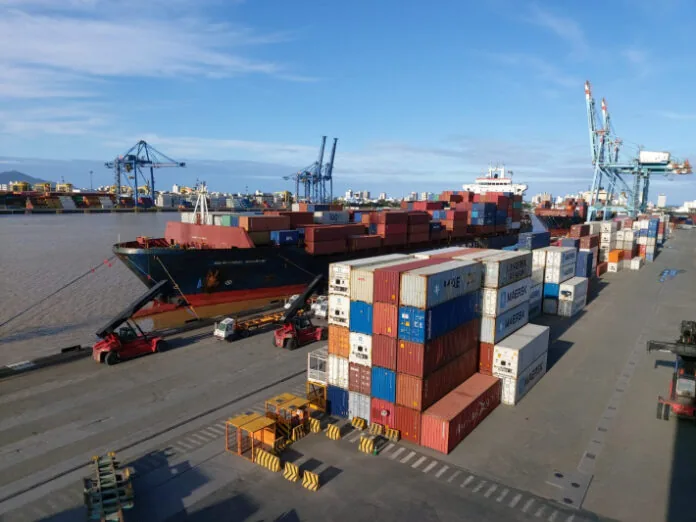
Here is my verdict up front: Itajaí port warehouse logistics is worth doing, but do not treat it as a cheaper Santos. It is a front door into southern Brazil, not a back door. Get the chain right and the container and reefer business both work. Get it wrong and your cargo sits outside the terminal while rent keeps running and the vessel sails anyway.
Put plainly, this story has two sides. One side is momentum. The other side is the bottleneck. You need both in view before you commit.
JBS Terminais took over the Itajaí container terminal in October 2024, and in two years it has handled more than 800,000 TEU. From January to September 2026 the terminal moved nearly 500,000 TEU, about 73 percent higher than the same period in 2022. That is not a gentle recovery. It is a port that was switched back on. On a 2020 measure, the Itajaí port complex is Brazil's second-largest container complex, behind only Santos. The name carries weight, and so does the momentum.
But I have seen too many people buy the momentum and ignore the bottleneck. Annual capacity tops out at about 600,000 TEU, and the terminal had already moved nearly 500,000 TEU in the first nine months of 2026. Keep that pace going and the full-year volume presses against, or past, the capacity line. The terminal covers about 180,000 square metres, with 1,030 metres of quay, four berths, 14 metres of water depth and 1,750 reefer plugs. Read together, those numbers say something simple: the place is not large, ships can berth, reefers can plug in, but the slack is thin. When peak season squeezes, the queue starts at the terminal and ends at the warehouse gate.
The Reefer Trade in Itajaí Port Warehouse Logistics Is the Real Business, and the Real Trap
Santa Catarina, the state around Itajaí, lives on meat and farm exports, so cold chain is not a side line here. It is the main course. The terminal's 1,750 reefer plugs are a serious number for southern Brazil. Plenty of plugs, though, does not mean a plug whenever you arrive. When vessels bunch together, plugs, trucks and cold-store slots become one rope: one snag and the whole line tightens.
I have seen this scene too many times. A frozen load arrives, the vessel discharges, and then the reefer boxes wait for plugs, the trucks wait outside for boxes, and the cold store waits for cargo. No single link looks broken. Together they add up to warming cargo, a sailing schedule moving on, and a customer on the phone. Reefer business is not won by whoever owns the newest cold store. It is won by whoever plans the port, warehouse and truck handoffs most tightly.
That is why, in Itajaí, where the warehouse sits matters more than how big it is. A warehouse close to the terminal saves a truck leg and a waiting round for every reefer box, and that is risk taken straight off the job. The building needs its own backup power and temperature monitoring; a power cut or a system fault cannot be left to luck. More important still, the contract should spell out reefer-plug assurance, priority pickup and who pays when time runs over. Priority promised verbally disappears the moment peak season arrives.
Here is a labelled hypothetical to feel the size of it. Suppose one reefer shipment needs 100 plugs, and suppose each day of delay carries a material cost at a scale you set from your own rates. Three days of waiting against same-day pickup can swallow several months of rent saved by choosing a slightly cheaper warehouse further away. The figures are hypothetical. The logic is not: in cold chain, the money is saved in the days you do not wait, not in the rent.
Itajaí Port Warehouse Logistics: Pick the Terminal First, Then the Warehouse
Across the water in Navegantes sits Portonave, which handled 638,476 TEU in the first half of 2024. That is a serious volume too. So the Itajaí complex gives a shipper a real choice: JBS on one side, Portonave on the other, facing each other across the water. Pick the wrong terminal and the warehouse location, the trucking route and the pickup rhythm all have to change with it. That choice is the most interesting part of working this port.
The first table below uses only verified figures, nothing else.
| Item | JBS Itajaí terminal | Portonave, Navegantes |
|---|---|---|
| Volume since October 2024 | More than 800,000 TEU in two years | Not in the verified figures for this piece |
| January to September 2026 | Nearly 500,000 TEU, about 73% above the same period in 2022 | Not in the verified figures for this piece |
| First half of 2024 | Not in the verified figures for this piece | 638,476 TEU |
| Annual capacity | Up to about 600,000 TEU | Check the official source for current policy |
| Physical plant | About 180,000 sqm, 1,030 m quay, 4 berths, 14 m depth, 1,750 reefer plugs | Check the official source for current policy |
The second table is the decision frame I would use when choosing a warehouse.
| Decision | Look at first | Pitfall to avoid |
|---|---|---|
| Terminal choice | Sailing density and reefer-plug headroom | Judging by freight rate alone, ignoring pickup queues |
| Warehouse location | Truck time to the terminal and a backup route | Judging by rent alone, ignoring peak-season congestion |
| Cold-chain cover | Backup power, temperature monitoring, overtime liability | Leaving cover as a verbal promise |
| Capacity headroom | The gap between annual capacity and the current pace | Booking big peak-season volume at the edge of saturation |
Nearly 250 million reais invested over two years tells you the operator means to grow this port. Investment is good news and also a signal: equipment will improve and processes will speed up, but capacity will not catch up with cargo overnight, and a bottleneck does not vanish just because money was spent. Here is the counterintuitive part: a port getting better fast is, in the short run, the easiest place to lose money, because everyone arrives chasing the same momentum, and plugs, berths, trucks and warehouse space all tighten at once.
So the two sides again. On the good side, Itajaí has cargo, vessels and a cold-chain base, and more than 800,000 TEU in two years under JBS is a record, not a story. On the hard side, the terminal is not large, the capacity line is fixed, and nearly 500,000 TEU in nine months of 2026 is already running close to it. In this trade the winner is not whoever arrives first. It is whoever plans the port, warehouse and truck as one chain and leaves nothing to luck.
If you are serious about Itajaí, do not sign a long lease first. Spend a few days by the terminal. Watch how vessels berth, how reefer boxes queue, and what time the trucks start jamming in peak season. Then take the sailing schedule and the plug headroom to the warehouse owner and put priority pickup and overtime liability in the contract. It is a good port. Make sure the warehouse deserves it. And ask yourself one question before you sign: can your cargo afford to wait?
By Lao Mi, Supply Chain Veteran (20 yrs)