Two weeks before last peak season, an e-commerce fulfillment warehouse in Carson called me. Their incline conveyor was, in their words, "possessed." Cartons slid backward halfway up — light ones, heavy ones, all of them. An operator stood at the top poking boxes uphill with a stick. I drove over, ran my hand across the belt, and it was polished like a mirror. Not possessed. Just three variables, all wrong.
Nine times out of ten, incline slippage gets "fixed" by cranking the tension. People tighten the belt like a guitar string, burn out the bearings early, and the boxes keep sliding. Because the root cause isn't tension — it's friction. Friction comes down to three variables: incline angle, belt surface tread, and tension. And the order matters: check the angle first, then the tread, and touch the tension last.
Start with the angle: past 20 degrees, forget smooth belts
A carton riding a belt is a static-friction problem between the box bottom and the belt surface. A smooth PVC belt on cardboard gives you a friction coefficient around 0.3, which means slippage risk kicks in past roughly 17 degrees. I build in a safety margin, so my rule is simple: smooth belt, keep the incline under 15 degrees.
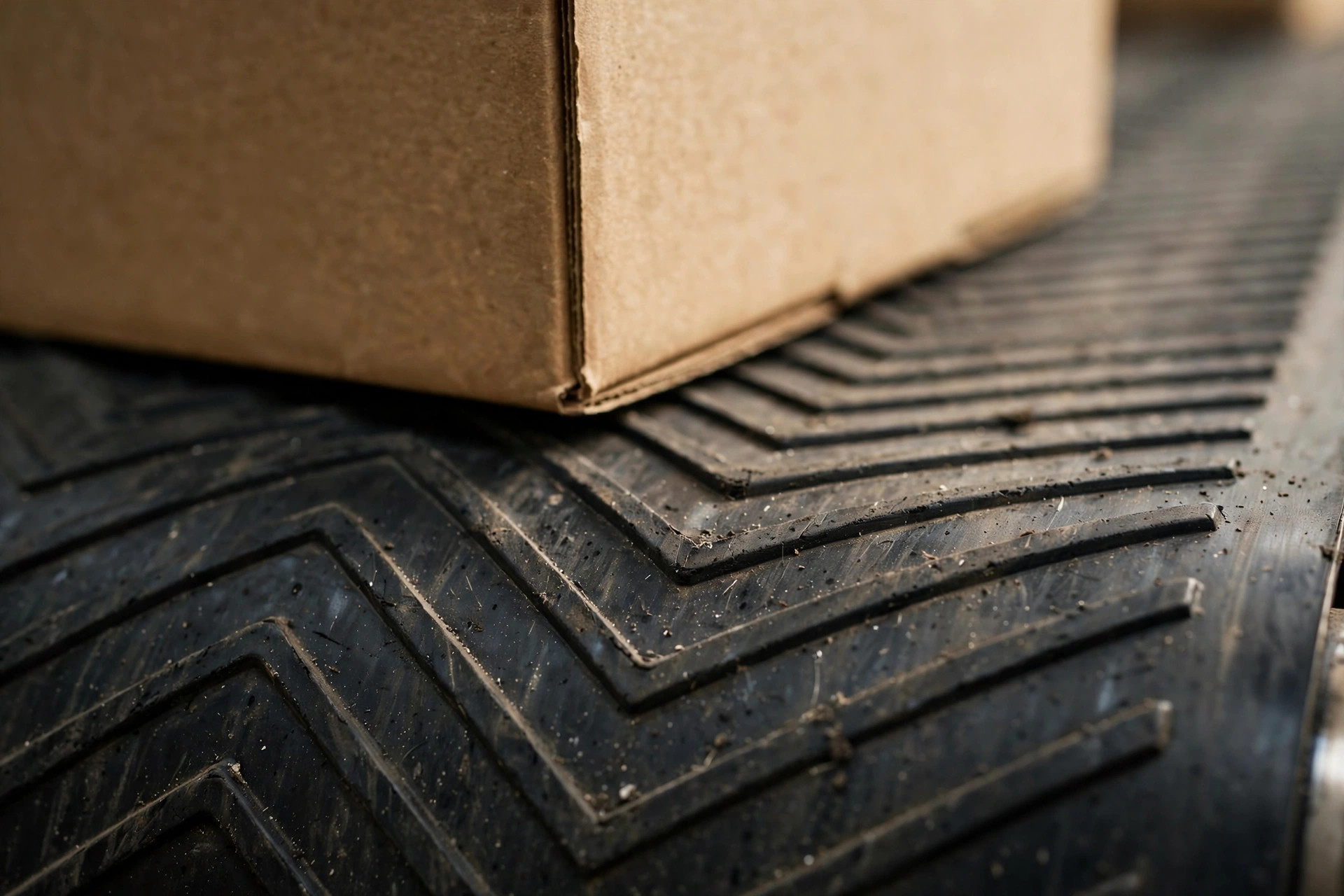
Over that? Two options. Lower the angle by lengthening the incline — but that takes floor space most older buildings don't have. Or change the belt: swap smooth for profiled. Chevron, rough-top, or diamond tread pushes the coefficient above 0.5 and holds steady up to about 25 degrees. The worst retrofit I ever saw: a 30-degree incline with a smooth belt, "solved" by a worker manually boosting boxes at the top — 8,000 boxes a day in peak season. No wonder their turnover was through the roof.
Tread selection has its own subtleties. Corrugated boxes do well on rough-top or chevron; plastic totes want small stud profiles that grip without chewing the base. Don't just buy the most aggressive tread available — deep profiles can scuff lightweight carton bottoms and fray the sealing tape.
Then the tread: a worn-out profiled belt is a smooth belt
That Carson warehouse failed on this one. Their belt was chevron — on paper. After four years of service, the tread was worn down to a shadow, and the friction coefficient was no better than a smooth belt. The ops manager insisted "but it's a profiled belt." I told him to feel it. The word "profiled" no longer applied.
The field test is simple: press your fingernail into the tread. If you feel clear ridges, it's still working. If it feels nearly flat, replace it. Don't wait for it to go fully bald — friction decays gradually, and slippage starts as "one box slides occasionally." By the time it's "boxes slide all the time," you've already bled a lot of throughput.
The tread's silent killer: caked-on dust and adhesive
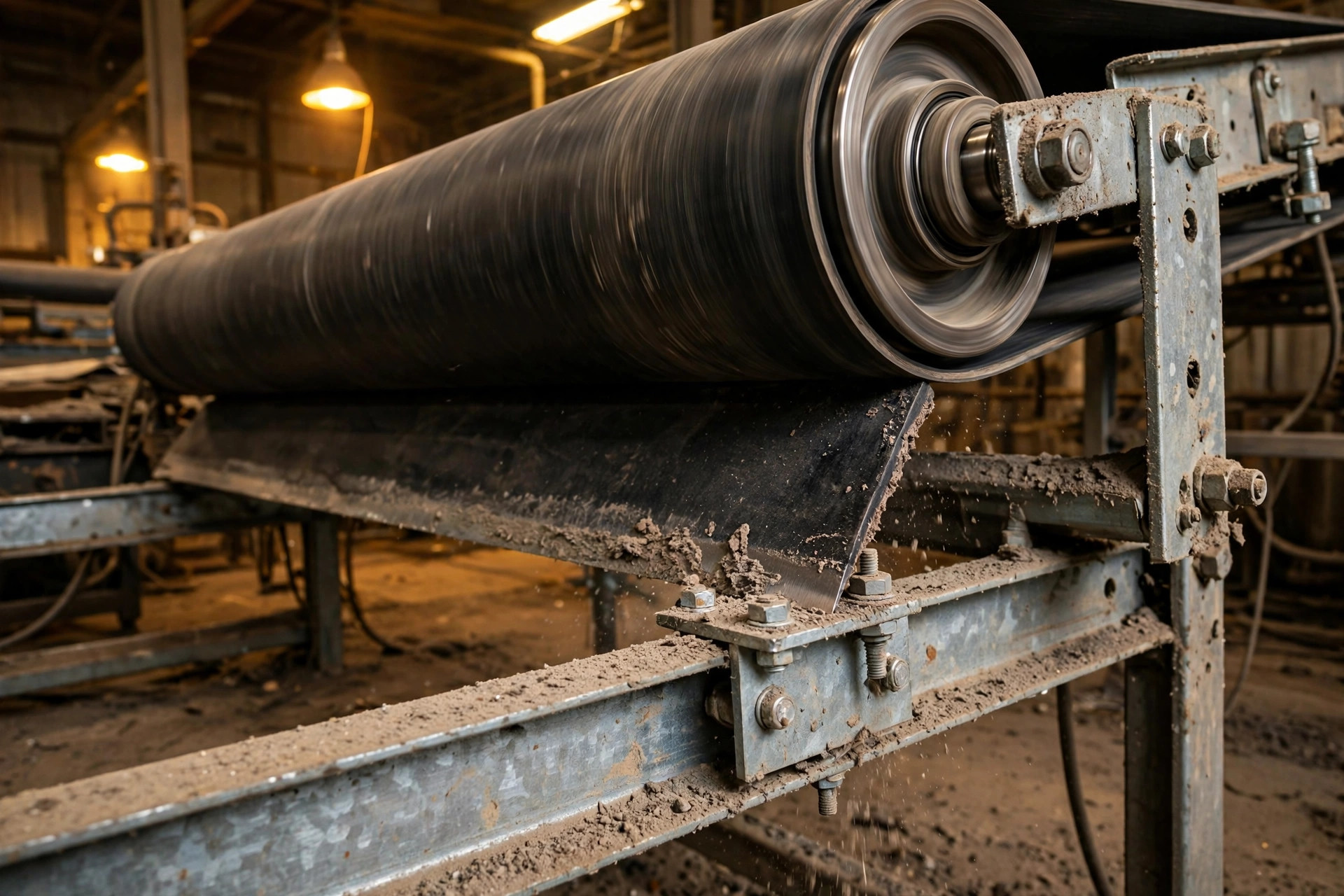
Paper dust, tape adhesive, and general grime fill in the tread and flatten it — same effect as wearing it smooth. I require a deep belt cleaning at least monthly: neutral cleaner, never aggressive solvents. Solvents accelerate PVC aging and cracking; a belt that should last three years goes brittle in eighteen months.
Tension last: too loose slips, too tight kills bearings
Tension is the final variable, and the most abused. Too loose, and the drive pulley slips against the belt — the pulley spins while the belt crawls. Too tight, and yes, friction improves, but bearing load and motor current climb, and bearings and gearboxes die young.
The right way to set tension: slacken off first, verify the belt tracks straight (never adjust tension on a mistracking belt — it only gets worse), then turn both take-up screws in sync, half a turn at a time, with a 10-minute trial run between adjustments. The acceptance criteria: full-load incline with no slippage, reasonable sag on the return side when empty, and motor current under 85% of rated.
Remember the sequence: angle, then tread, then tension. Angle is a design problem — get it wrong and you need a different solution. Tread is a consumable problem — worn out means replace. Tension is an adjustment problem, and it goes last, for fine-tuning. Follow that order and incline slippage gets fixed in one pass, not three rounds of guessing.