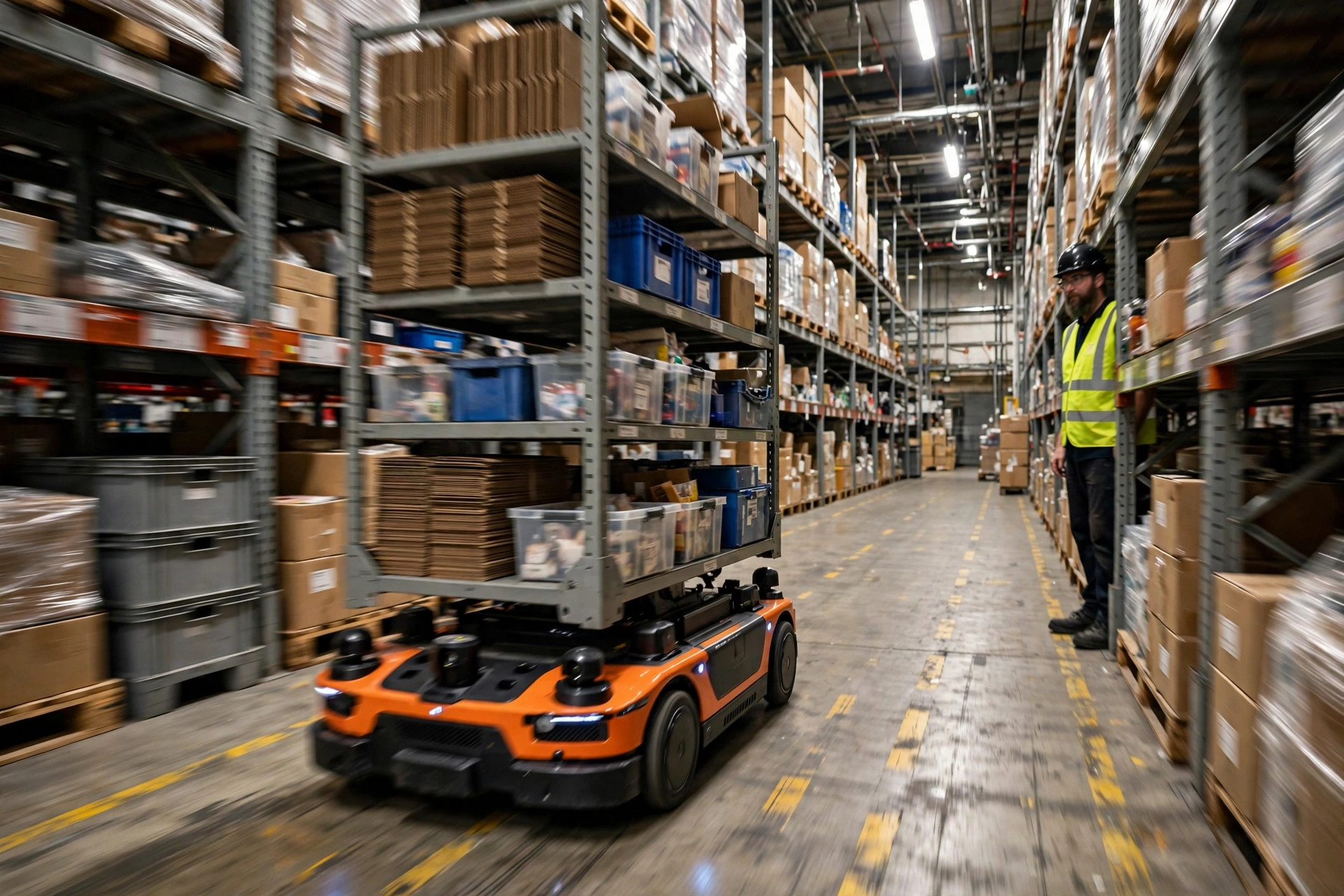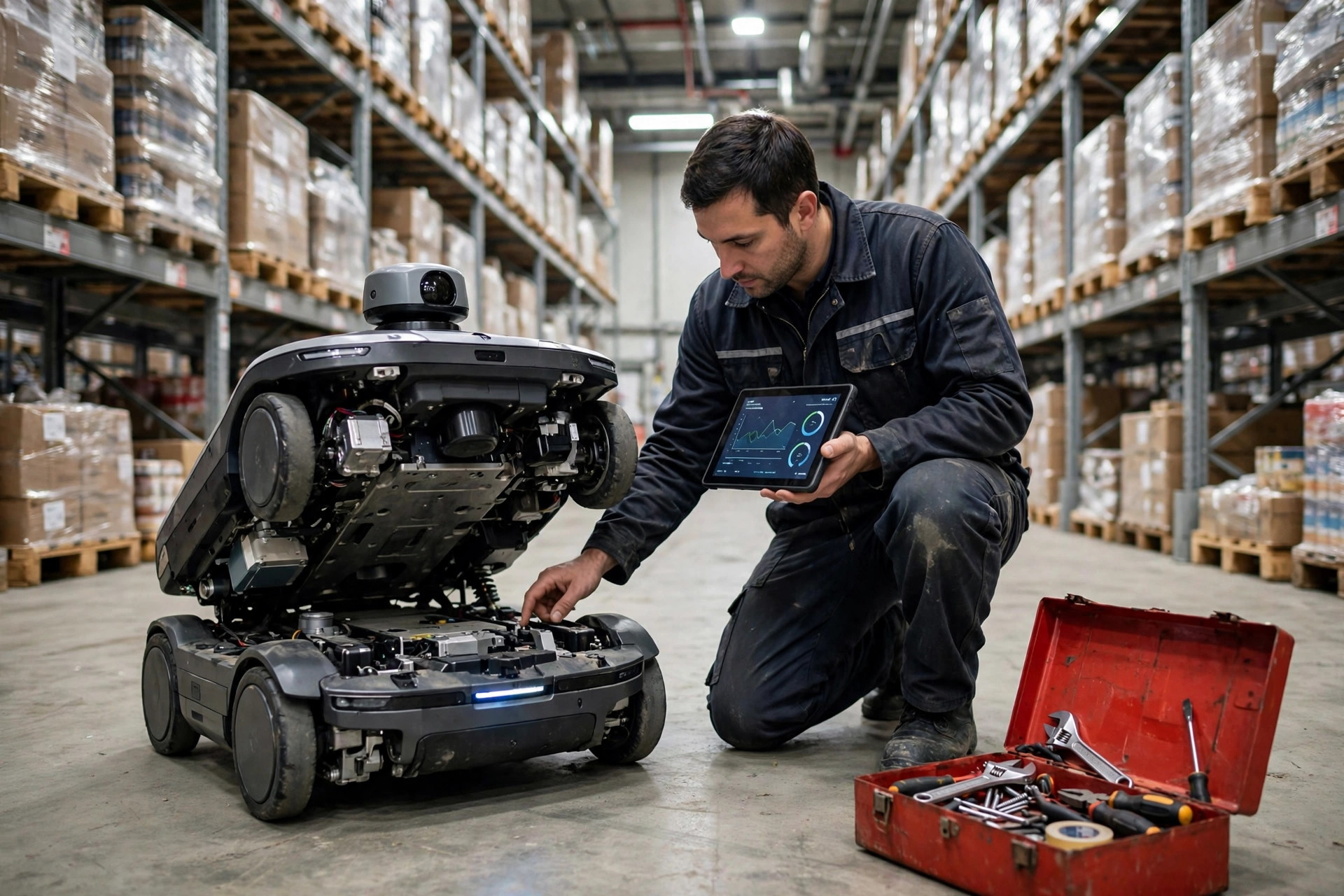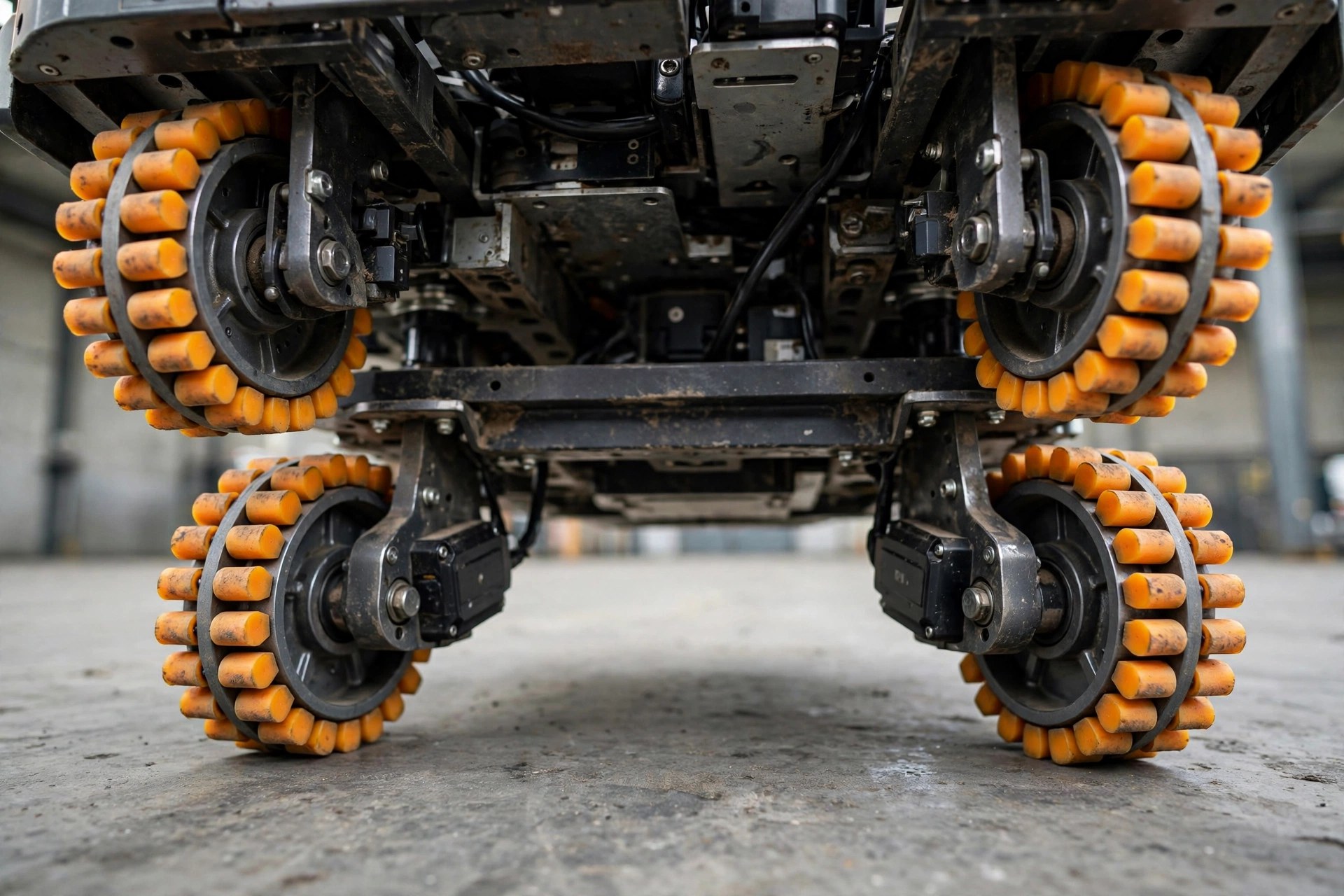
At the AMR negotiation table, wheels almost never make the agenda. Buyers talk payload, navigation, fleet software, and WMS interfaces; maintenance gets a passing "two-year full warranty." Yet a friend at an integrator with a few hundred AMR deployments behind them told me that "wheels" is one of the most frequent words in their after-sales tickets — not because wheels break, but because they quietly wear out, bringing a trail of small mysteries with them: dock alignment success rates slipping, straight lines turning into gentle arcs, lateral moves growing shakier by the month.
This article tries to put a number on mecanum wheel wear: how often these wheels need replacing, what a full set costs, and how wear gradually eats away at localization accuracy. Wherever possible I cite vendor and integrator figures and name the source; where no public source exists, I will say so and mark it as industry experience.
How Often Mecanum Wheels Need Replacing: What Vendors Actually Say
Vendors rarely promise a neat cycle count the way battery makers do, because wheel life depends heavily on duty cycle: floor material, payload, daily operating hours, and the share of lateral moves. Change any one of those and life can easily double or halve. Still, several public data points exist.
One medical-AGV wheel supplier's FAQ recommends preventive replacement at 12,000 operating hours (supplier-published figure, climate-controlled medical setting). Drive-unit maker HSOAR lists a rated life of 8,000–20,000 hours for its integrated mecanum wheel-plus-cycloidal-reducer unit (vendor product page). And Accio's mecanum wheel market guide notes that polyurethane-coated rollers last roughly 2.5x longer than rubber ones. Put together: at a typical two-shift warehouse pace of about 5,000 operating hours a year, a set of mecanum wheels lands in a replacement window of roughly 1.6 to 2.4 years.
Pricing is similarly tiered. Public list prices for an 8-inch industrial mecanum wheel set (600 kg-class per wheel), four wheels, run $393–$572 (Oz Robotics public retail). A 6-inch/300 kg-class set lists around $350 for four (Mecalun volume pricing). A 10-inch/1,500 kg-class set is about $1,000 (Mecalun). Heavy-duty custom wheels (500 kg+ per wheel) are far pricier — $2,500–$2,800 per wheel (Wisdom Wheel ZL-B205 range via Accio). So a full set of four for a mainstream latent AMR costs roughly $400–$700 in materials for mid-duty use, and several thousand dollars for heavy duty — before labor and downtime.
One caveat: these are bare-wheel public prices. What an integrator quotes an end customer usually adds on-site service and re-calibration. The honest answer to "what does a set cost" is always your integrator's quote; the numbers above just give you an anchor at the negotiating table.
How Mecanum Wheel Wear Eats Localization Accuracy
Wear degrades localization through two channels — one gradual, one sudden.
The gradual one is effective-diameter drift. Wheel odometry math is simple: distance per revolution equals π times wheel diameter. Shave 1–2 mm off the roller coating and the encoders count the same revolutions while the vehicle actually travels less — odometry starts systematically overestimating distance. The literature agrees: an MDPI study of a mecanum platform notes these platforms are inherently slip-prone and wheel odometry alone is unreliable over long traverses, requiring fusion with IMU and LiDAR (MDPI, "Eight-Wheel Mecanum Omnidirectional Autonomous Mobile Robot," 2026); a PMC paper on odometry calibration adds that tire wear and load changes alter the effective wheel diameter, which static factory calibration cannot cover — parameters must be re-learned in the field (PMC, "Calibration and Improvement of an Odometry Model," 2021).
The sudden channel is roller slip. Each mecanum roller spins independently; once the coating goes smooth or cracks, friction drops and individual rollers start spinning freely during lateral moves. Laser SLAM can normally correct odometry error, but frequent slip makes pose estimates jitter — and in centimeter-precision docking against conveyors or racks, one slip can mean a failed dock and a retry.
The genuinely counterintuitive part is the third: four wheels wearing unevenly is worse than four wheels wearing together. Holonomic kinematics rests on a hidden assumption — four symmetric wheels with identical parameters. In practice, the wheel on the inside of turns and the wheels taking lateral loads wear at completely different rates. Once wear goes asymmetric, calibration silently breaks: the vehicle thinks it is driving straight while actually tracing an arc. Worse, replacing only the worst one or two wheels — mixing new and old — widens the parameter gap and makes the bias bigger. That is why a kinematic re-calibration after every wheel change is mandatory; skip it and the new wheels buy you nothing.
Mecanum vs. Conventional Drive Wheels: Where the Hidden Costs Differ
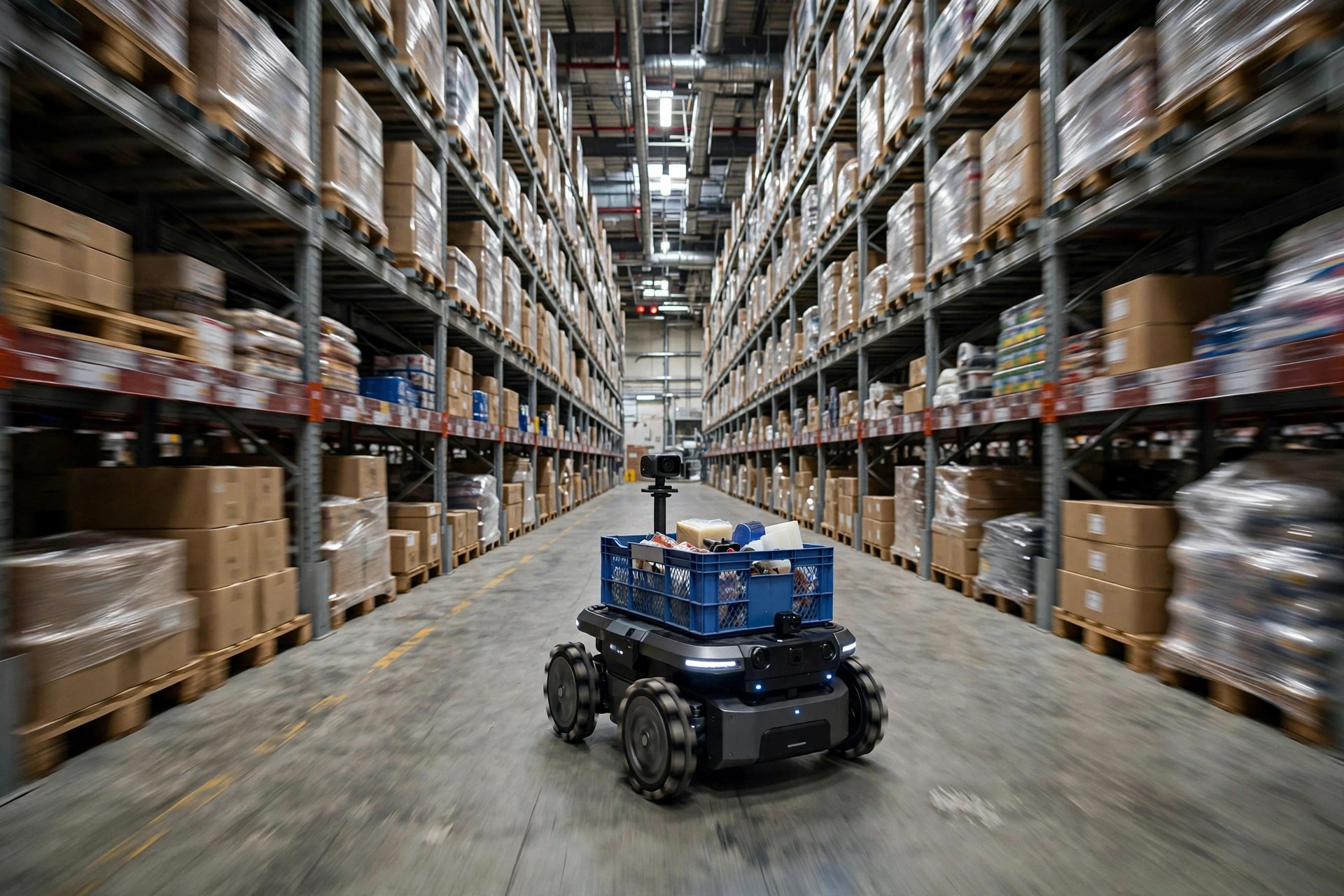
Differential-drive and tricycle-steer AMRs mostly use ordinary polyurethane drive wheels. MiR's official blog puts it bluntly: mecanum wheels concentrate stress across many small rollers, accelerating wear and raising replacement frequency under heavy payloads and high cycle counts — the outcome is higher downtime and service cost (mobile-industrial-robots.com). MiR's own pallet-handling AMR uses a tricycle drive instead: one powered steerable wheel plus two passive load wheels.
Side by side:
| Cost item | Mecanum-wheel AMRs | Conventional drive wheels (differential / tricycle) |
|---|---|---|
| Wheel materials | Set of four; mid-duty ~$400–$700 per vehicle (public vendor prices); heavy duty several thousand | Typically two drive wheels; pricing varies widely by brand — use vendor quotes; generally a fraction of a mecanum set |
| Replacement frequency | Higher — many small rollers, concentrated stress (MiR's assessment) | Lower; individual tires usually last longer |
| Wear impact on localization | All three degrees of freedom drift together: straight, lateral, and rotational calibration | Mostly straight-line yaw; no lateral kinematic coupling |
| Post-replacement work | Full holonomic kinematic re-calibration is mandatory | Usually a simple calibration suffices |
| Energy | Coordinating multiple wheels for holonomic motion draws more power, charges more often (MiR) | Lower |
The point of this table is not "mecanum wheels are bad" — in narrow aisles where spot-turns and lateral shifts are the job, omnidirectional motion is irreplaceable. The point is: choose mecanum, and you should budget higher wheel spend plus periodic re-calibration labor into the TCO model, instead of discovering it through after-sales tickets.
Harder Than "Replace on Schedule": Replace on Wear
Two field cases from integrator follow-ups, anonymized, figures per integrator records.
The first: a 2024 e-commerce 3PL returns warehouse in East China, 14 latent AMRs on mecanum chassis, epoxy floor, two shifts a day. In month 15, the fleet dashboard showed first-attempt conveyor docking success sliding from 99.4% to 96.8%, mostly on night shifts. After ruling out network and map issues, the culprit turned out to be uneven roller-coating wear: lateral creep error was being systematically underestimated by odometry. A fresh set of wheels plus kinematic re-calibration brought success back to 99.5%. The lesson: the early signal of wheel wear is not on the wheel — it is in the docking-success curve on the fleet dashboard.
The second: a 2023 auto-parts plant in North China, two AMRs from the same batch — one running long straight hauls, the other constantly spot-turning to dock racks. By month 10 their wear patterns looked nothing alike: the first had uniformly thinned rollers, the second had visible steps worn into roller edges. The site's original policy — "replace all wheels every 18 months" — turned out to be wrong: replacing by the calendar wastes money on the lightly worn and risks docking failures on the heavily worn. They switched to per-vehicle wear inspections with three checks: cracked roller coating, visible shudder in lateral moves, and two consecutive weeks of declining first-attempt docking success.
Both cases point to the same conclusion: mecanum wheel replacement should follow wear, not the calendar. And "follow wear" only works if wheel-wear metrics make it into routine inspections — as naturally as checking tire tread on a car.
Which leaves an open question: the tire industry has a standardized wear marker (1.6 mm tread, mandatory replacement); the AMR industry has no vendor publishing a standardized mecanum wear threshold. Dataintelo projects the global mecanum wheel market growing from about $1.8 billion in 2025 to $4.6 billion by 2034, roughly 11% CAGR. The bigger the market, the more conspicuous this "small money" becomes inside TCO. Perhaps within a few years, a "wheel replacement SLA" will sit in AMR purchase contracts next to battery warranties — and articles like this one will not have to work so hard.
By Dr. Chen, Supply Chain Researcher